Get an honest snapshot of where you are now, so your next decision is grounded in facts, not guesswork. Coach-tested for life transitions.
Free, print-ready PDF.
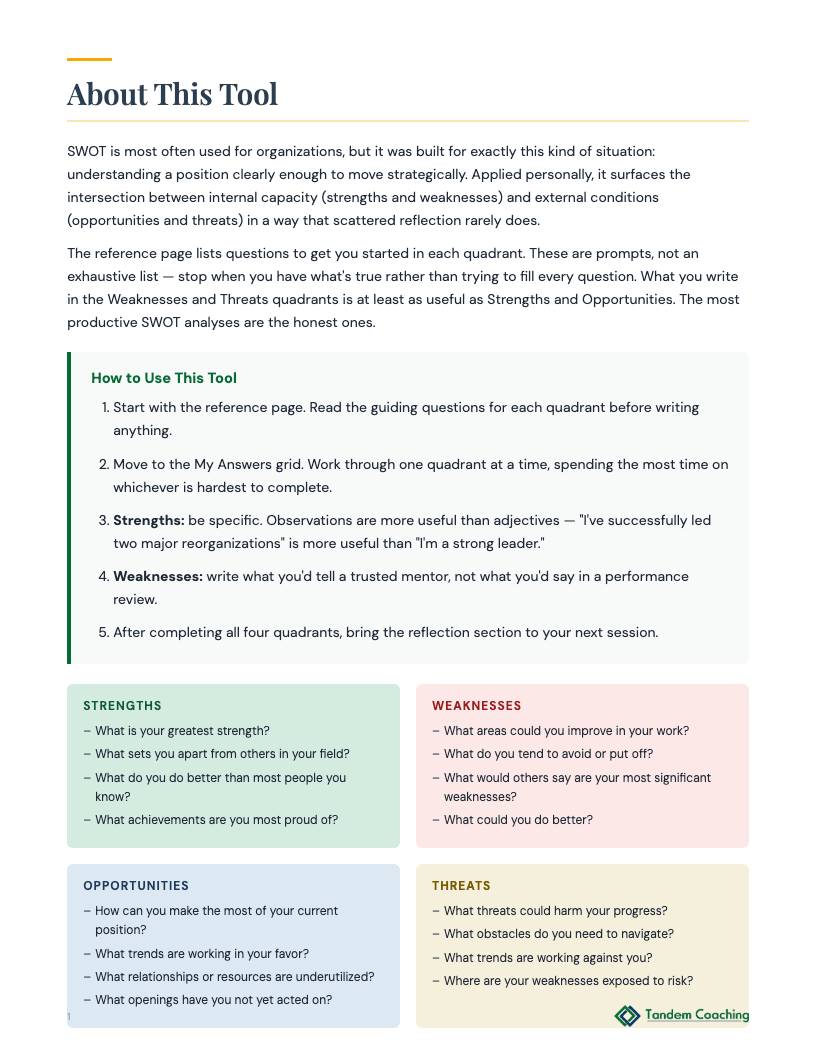
The most useful SWOTs are the honest ones — particularly the Weaknesses and Threats quadrants. Write what you'd tell a trusted mentor, not what you'd put in a performance review.
A technical manager just promoted to director of engineering at a 200-person startup. Managing managers for the first time, feeling overwhelmed by strategic responsibilities they weren't prepared for. Thinks they need better time management and delegation skills.
Frame this as a position audit before building new capabilities. 'Before we work on delegation techniques, let's map what you're working with and against.' Most new directors resist the Weaknesses quadrant because admitting gaps feels like confirming imposter syndrome. Address directly: 'Knowing your gaps isn't about being unqualified - it's about being strategic with your development time.'
Strengths filled with technical skills rather than leadership capabilities signals they're still thinking like an individual contributor. Opportunities section focused on internal improvements rather than external market/org conditions means they haven't made the strategic thinking shift yet. Threats quadrant completed in under two minutes indicates they're not seeing the political landscape.
Start with the Opportunities quadrant - what they wrote reveals whether they're thinking at director level or still in manager mode. Then ask: 'Looking at your Strengths and the Opportunities you listed, where's the mismatch?' This surfaces the capability gaps without starting in deficit. The question that opens development planning: 'Which weakness, if addressed, would unlock the most opportunities?'
If Threats quadrant is empty or contains only technical risks, the client may not understand the political dimensions of their new role. Severity: moderate. This isn't a coaching issue but a business literacy gap that could derail their success. Response: continue coaching but assess whether they need mentoring or political guidance from someone who knows their organization.
A marketing VP known for exceptional results but struggling with a new CMO who questions their methods. Client describes themselves as 'strategic' and 'collaborative' but can't articulate what makes their approach effective. Wants to better communicate their value to leadership.
Position this as evidence gathering for value communication. 'Your CMO needs to understand what drives your results. Generic strengths won't convince them - specific capabilities will.' Expect resistance to getting concrete because many high performers operate on intuition they've never examined. Frame specificity as strategic necessity, not self-analysis: 'What would someone need to know to replicate your success?'
Strengths quadrant filled with adjectives rather than capabilities or track record indicates the client doesn't know what they do well - they just know they get results. Weaknesses section with only minor flaws or learning opportunities suggests they're performing confidence rather than genuine self-assessment. Watch completion time: under 15 minutes total means they're working from existing self-concept, not examining it.
Start with the most specific item in their Strengths quadrant and ask for the story behind it. This reveals whether they can connect their capabilities to outcomes. Then move to Weaknesses: 'Read me the one that would be hardest to admit to your CMO.' The gap between public and private self-assessment is where the development work lives. Key question: 'What would change if your CMO understood these strengths the way you do?'
If client cannot provide specific examples when pressed on any strength, or if all weaknesses are variations of 'works too hard' or 'cares too much,' they may have significant blind spots about their actual performance. Severity: moderate. Response: continue coaching but focus on gathering external feedback before proceeding with development planning.
An independent consultant specializing in organizational change is considering a VP role at a former client company. Successful practice but tired of business development and attracted to the stability and resources of employment. Thinks this is a straightforward career decision but hasn't worked for anyone else in a decade.
Frame as a transition feasibility assessment, not a pros-and-cons list. 'This isn't about whether the opportunity is good - it's about whether you're equipped for the transition and what it would cost you.' Independent consultants often resist examining Weaknesses around collaboration and organizational politics because they've avoided those challenges. Name it: 'You've been your own boss for ten years. That's created strengths and blind spots we need to see clearly.'
Strengths heavily weighted toward independence, self-direction, and client-facing skills with little mention of collaboration or organizational navigation. Threats section that focuses on external market conditions rather than internal adaptation challenges suggests they're not anticipating the personal adjustment required. Opportunities filled with company benefits rather than professional growth indicates they may be running from consulting challenges rather than toward employee benefits.
Start with what's missing: 'What strengths would an employee version of you need that aren't on this list?' This surfaces the capability gaps the transition requires. Then examine Threats and Opportunities together: 'You listed market volatility as a threat and steady income as an opportunity. What else are you trading?' The key question: 'Looking at your Weaknesses, which ones would be magnified in an employee role?'
If Weaknesses section avoids organizational skills (politics, consensus-building, managing up) or if Threats doesn't include personal adaptation challenges, client may be idealizing employment and underestimating transition difficulty. Severity: moderate. Response: continue coaching but ensure they gather intelligence about the organizational culture and role expectations before deciding.
A operations director whose previously high-performing team has missed three consecutive quarterly targets. Blames external factors - budget cuts, market conditions, competing priorities from leadership. Resistant to examining their own role in the decline, focused on what they can't control.
Position as a diagnostic tool, not self-evaluation. 'Before we address the team issues, we need to understand what's changed in your position - what you're working with and what's working against you.' Expect deflection toward external factors because examining personal contribution feels like accepting blame for team failure. Reframe: 'This isn't about fault - it's about finding leverage points you can actually influence.'
Threats quadrant significantly longer than other sections indicates external attribution bias. Weaknesses section focused on resource constraints rather than leadership capabilities suggests they're avoiding personal accountability. If Opportunities section is sparse or focused on external changes, they may be stuck in victim mindset rather than looking for influence points.
Start with the Strengths quadrant but focus on what's changed: 'These strengths helped you succeed before. What's different now that's making them less effective?' This opens examination of personal factors without starting with blame. Then move to the intersection: 'Looking at your Strengths and the Threats you listed, where could your capabilities address these challenges?' Key question: 'What would your team say belongs in your Weaknesses quadrant that you didn't write?'
If client cannot identify any personal weaknesses that might contribute to team performance decline, or if all threats are external with no acknowledgment of leadership factors, they may not be ready for coaching focused on behavior change. Severity: high. Response: pause and explore whether they're seeking coaching or just validation. Consider whether performance coaching or management consulting might be more appropriate.
Client is approaching a new challenge but discounts their own record of follow-through
LifeA client who's spinning on a problem they can't solve and needs to separate what's in their control from what isn't
LifeA client doubts themselves in ways that are holding them back from what they want