ADHD Work Pattern Reflection
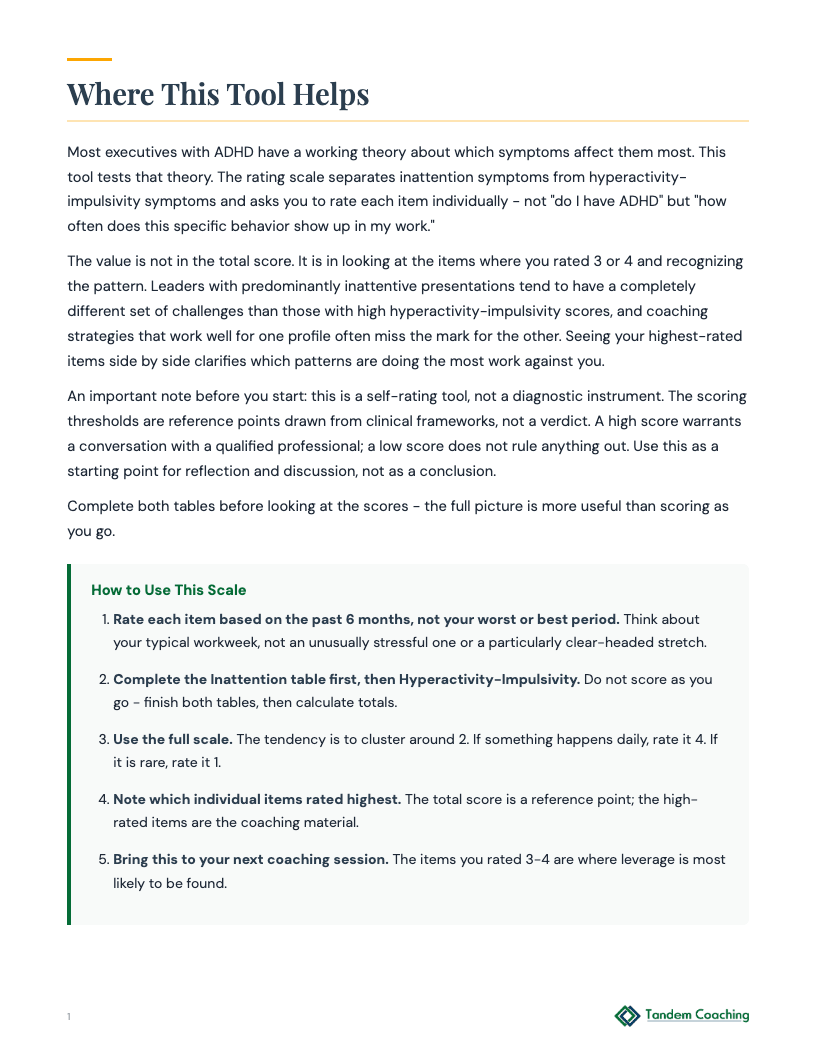
Identify which ADHD symptoms are most disruptive right now using a standardized, clinically used rating scale for adults with a diagnosis.
Get This Tool
Free, print-ready PDF.
When to Use This Tool
A diagnosed ADHD client wants to notice specific attention and follow-through patterns at work without generating a clinical score
A client wants concrete examples to discuss separately with a coach and a licensed clinician
A client wants to track context around individual work patterns without inferring an ADHD presentation
How to Introduce This Tool Plus
Which individual attention, activity, or follow-through patterns are affecting your work, and what examples can you describe without totaling or diagnosing them?
Coaching Tool Disclaimer
This tool is designed for coaching contexts, not clinical use. If you or your client is in crisis, contact the 988 Suicide and Crisis Lifeline (call or text 988) or Crisis Text Line (text HOME to 741741).
Browse All Pages
Tool Classification
Domain
ADHD
Type
Assessment
Phase
Discovery
Details
15 min
Opener
Monthly
Topics
Executive Function
Self-Care
Mindset
For the Coaching Practitioner
Plus
Coaching Scenarios
Plus
1 Resolving the Inattentive vs. Combined Profile Confusion ▶
Context
A client with ADHD who is a VP of operations was diagnosed in adulthood and has always understood his ADHD as an attention problem. He has been surprised in coaching by feedback that he interrupts people in meetings and generates too many ideas for his team to execute. His self-image does not include hyperactivity-impulsivity, and he is skeptical when the coach raises it. The rating scale lets the client produce his own data rather than accepting the coach's observation, which reduces defensiveness and opens the conversation about which presentation is actually driving his leadership challenges.
How to Introduce
Frame the scale as a profile clarification tool, not a severity measurement: 'The reason I want you to complete both tables is that there are actually two distinct symptom clusters, and they respond to different strategies. Coaching has been focused on attention and organization, which is Part 1. But what you've described in meetings may be more Part 2. Rate both, finish both tables before looking at the totals, and bring it in. We'll look at the numbers together.' Assign it between sessions rather than in session so the ratings come from a full-week reflection rather than the filtered memory of a coaching conversation.
What to Watch For
Watch for the client rating all hyperactivity-impulsivity items low despite meeting reports of constant interruptions and idea flooding. The hyperactivity-impulsivity presentation in adults rarely looks like physical restlessness - it looks like rapid speech, idea generation, interrupting, and impatience. Ask about specific items: 'Item 7 - completing others' sentences before they finish. Think about your last three executive team meetings. What would your colleagues rate that?' The peer-view calibration question often surfaces ratings the client underestimates. Also watch for the client dismissing high scores as 'that's just leadership, not ADHD.'
Debrief
Start with the gap between the two subtotals: 'Your inattention total is 22 and your hyperactivity-impulsivity total is 26. What do you make of that?' The client's own surprise or recognition is the entry point. Then drill into the highest-rated individual items: 'You rated item 7 and item 9 both as 4. In what contexts does that show up most?' Moving from total score to specific item to specific context gives the coaching conversation concrete behavioral targets rather than abstract symptom labels.
Flags
- Moderate
Client's scores are extremely high across both subscales (inattention >= 35, hyperactivity-impulsivity >= 30) and he reports that symptoms are significantly worse than they were six months ago despite having a long-standing ADHD diagnosis and stable medication regimen
Response: A significant worsening of rated symptoms in a previously stable presentation - especially when medication and diagnosis are already established - is a clinical signal rather than a coaching one. Name it directly: 'Your scores are noticeably higher than I would expect given that you've had a diagnosis and treatment for years. That kind of change is worth a conversation with your prescribing physician - it can reflect medication tolerance, life changes, or something else worth evaluating. Continue the coaching work and also have that conversation.'
2 EF-Interaction: Using Monthly Ratings to Track Intervention Effectiveness ▶
Context
A client with ADHD who is a product director has been working with her coach for four months on time management and task prioritization systems. She reports feeling better but cannot tell whether the improvement reflects real behavioral change or just better mood. Her ADHD medication was also adjusted two months ago. She wants to know whether the coaching strategies or the medication change or both are responsible for the improvement, which matters to her because she wants to know what to protect. Monthly ratings give both client and coach a measurement point.
How to Introduce
Frame the repeat rating as a measurement tool, not a re-diagnosis: 'We're going to use this scale the same way you might track a KPI - not because we're uncertain about your ADHD, but because it gives us a number to compare across time. You complete it now, and we'll have a baseline. In four weeks you'll complete it again. The difference between the two - which specific items moved and which didn't - tells us something about what's actually shifting.' Have her complete the initial rating in session so the baseline is captured accurately rather than from memory.
What to Watch For
Watch for the client interpreting a lower score as 'getting better' at ADHD rather than as evidence that specific interventions are working. The distinction matters: ADHD is not something that improves with coaching, but the functional impact of specific symptoms can be reduced with specific strategies. If item 5 (organizing tasks and priorities) moved from 4 to 2, ask what changed in her workflow. The behavioral change behind the score movement is the coaching artifact to preserve and build on. Also watch for higher scores in the second rating triggering discouragement - a higher score in a stressful month reflects context, not regression.
Debrief
When comparing baseline to follow-up: start with the items that moved downward and identify what changed in the corresponding behavior. Then look at items that did not move - those are the next coaching targets. The comparison map gives the coaching plan a data foundation rather than depending on subjective sense of progress. Ask: 'Looking at these two ratings side by side, what surprises you most?' The items the client expects to improve but didn't are often more informative than the ones that did.
Flags
- Moderate
Scores increase significantly in the month following a medication change, and the client reports the medication adjustment was made without her full understanding of what was changed or why
Response: Worsening symptom ratings following a medication change the client does not fully understand is a signal to encourage re-engagement with her prescriber rather than a coaching concern to solve: 'The timing here - scores going up right after the medication change - is worth mentioning specifically to your physician. You described not being sure what was changed. Going back and asking exactly what changed and what the intended effect was would give you and your doctor a clearer picture than coaching can provide.'
3 First Rating as Coaching Contract Foundation ▶
Context
A client with ADHD who is a senior financial analyst is four sessions into a new coaching engagement. He has a diagnosis from seven years ago and has worked with two previous coaches. Both coaching relationships ended without meaningful change. He is skeptical that coaching addresses ADHD specifically, having experienced what he describes as generic productivity advice that ignored the neurological dimension. He has never completed a structured symptom rating. Using the scale at the outset of a new engagement establishes a shared, precise language for which symptoms matter most and creates the specificity that his previous coaching lacked.
How to Introduce
Connect the rating directly to the coaching contract: 'Before we build any structure, I want to know which specific symptoms are doing the most work against you right now - not a general picture, but a ranked list. This rating gives us that. We are not going to try to address 19 items. We're going to identify the two or three items you rated highest and build the coaching specifically around those. The sessions that didn't help you before may have been working on the wrong things.' That frame positions the scale as the foundation of a more targeted engagement, not a routine assessment.
What to Watch For
Watch for the client rating everything at a moderate level (2s and 3s across both tables) - a sign of cautious self-assessment or uncertainty about what 'often' means in relation to his own baseline. Before he completes the rating, clarify the frame: 'Think about your current workweek, not your best week or your worst. If something happens more than twice a week, that's 'often.' If it happens most days, that's 'very often.'' Calibrating the scale descriptors to his specific work context before he rates tends to produce more differentiated and useful data. Also watch for him dismissing high hyperactivity-impulsivity scores as 'that's just how I am,' which blocks the item-specific coaching conversation.
Debrief
After reviewing both subtotals: 'If you were to pick the three items across both tables that are costing you the most professionally - not theoretically, but in terms of actual missed opportunities or damaged relationships this year - which three would they be?' The coaching contract is built from the client's answer to that question, not from the highest numerical scores. The scale provides the map; the client's selection of the highest-cost items determines the destination.
Flags
- Low
Client completes the rating and scores are low (inattention < 10, hyperactivity-impulsivity < 8) despite a formal ADHD diagnosis, and he reports that things have been significantly harder for him than these numbers suggest
Response: A significant gap between low self-ratings and the client's reported functional difficulty may indicate that the scale's reference period (past 6 months) doesn't capture the current challenge, or that the client is normalizing symptoms as personality rather than ADHD. Explore the gap directly: 'Your scores are relatively low, but you described significant difficulty in the areas we've been discussing. Walk me through the last week - specifically any moments where something went wrong at work.' The behavioral interview often reveals what the abstract rating misses, and the gap itself becomes useful coaching material about self-awareness and symptom recognition.
Tool Flow
Plus
Requires
- None - standalone tool
→
Produces
- individual work-pattern observations
- context and example notes
- separate coaching and clinician questions
Related Articles


Adaptive ADHD Leadership: 7 Strategies That Work
Read article →
ADHD Mentorship: Support Networks That Work
Read article →
Leading With ADHD: Executive Leadership Strategies That Work
Read article →
ADHD Productivity: 9 Work Strategies That Stick
Read article →