Connects saving to your real-life “why” so it’s easier to start and stick with, using ADHD-informed coaching prompts built for adult brains.
Free, print-ready PDF.
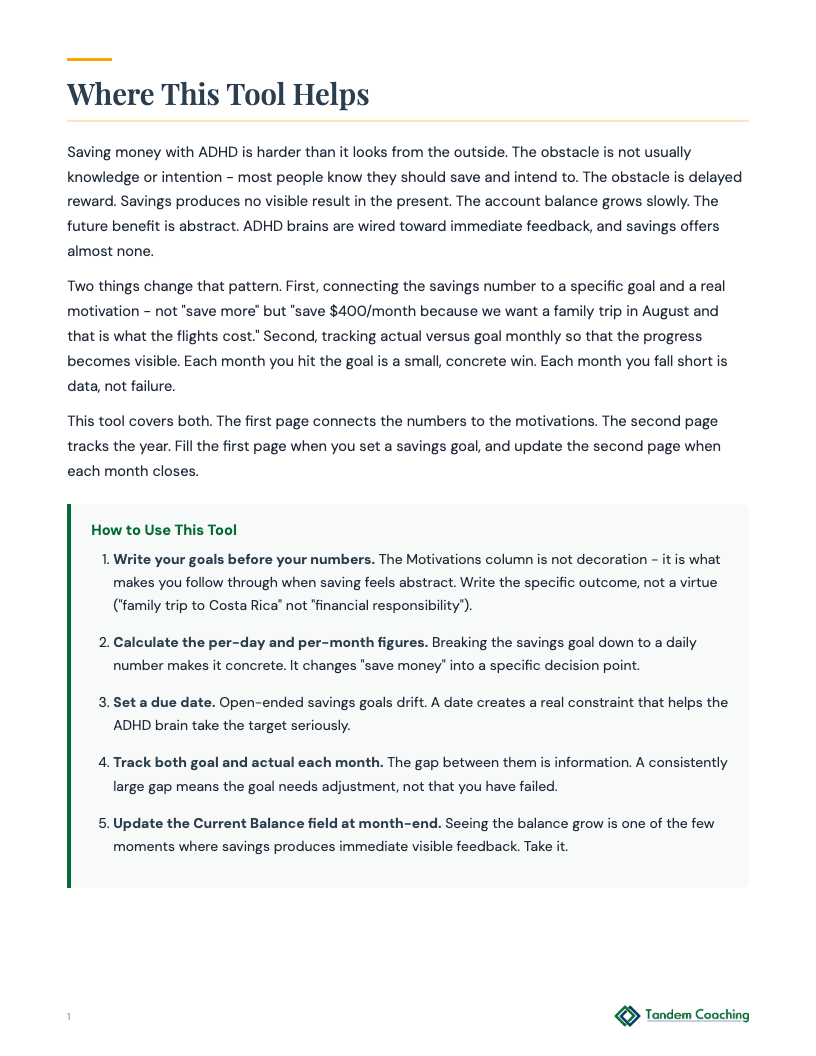
Savings goals that aren't tied to something specific tend to get raided. This planner asks for the goal, the motivation behind it, and then tracks actual versus planned progress each month.
Marketing director at a tech startup, diagnosed ADHD, recently survived layoffs that eliminated half her team. Says she needs an emergency fund but keeps spending her intended savings on immediate purchases. Believes the problem is lack of willpower.
Frame this as making the invisible visible, not willpower building. 'Emergency fund' stays abstract for ADHD brains. Ask her to name three specific scenarios where she'd need the money - job loss, medical emergency, car repair. Then calculate backwards from those real costs. The Motivations column isn't about virtue; it's about making future consequences feel present.
If she writes vague motivations like 'financial security' or 'peace of mind,' the tool won't work. ADHD brains need concrete scenarios. Watch whether she calculates realistic monthly amounts or aspirational ones. If the per-day number feels impossible to her, she'll abandon the plan within weeks.
Start with the per-day calculation. 'You wrote $12 per day. What does that look like in your actual spending?' Then move to the scenarios in Motivations. Ask: 'Which of these three emergencies feels most likely to you right now?' The one that creates the strongest emotional response is the motivation that will sustain the behavior.
If she can't name specific emergency scenarios or insists 'anything could happen,' the avoidance may be protecting her from anxiety about job security that goes beyond savings. Severity: moderate. Continue coaching but explore whether the financial anxiety connects to deeper concerns about career stability.
Operations manager at a manufacturing company, wants to save for a house down payment but partner thinks they should wait until debt is paid off. Client believes saving and debt payment can happen simultaneously but hasn't proven it with numbers.
Position this as a negotiation tool, not a personal planning exercise. 'Before you can convince your partner, you need to show the math works.' Have her calculate the down payment goal, then work backwards to monthly savings. The tool will reveal whether her timeline is realistic given current expenses.
Watch whether she inflates the Required Amount to impress her partner or deflates it to make the monthly target achievable. Either direction indicates she's managing the relationship dynamic rather than planning realistically. Also note if she avoids filling in the Due Date - that suggests she knows the timeline is unrealistic.
Start with the monthly amount versus her current discretionary income. 'You wrote $800 per month. Walk me through where that comes from in your budget.' Then address the partner dynamic: 'What would your partner need to see in these numbers to feel comfortable with this plan?' This moves from wishful thinking to relationship negotiation.
If she repeatedly mentions partner 'not understanding' or 'being controlling' about money, the savings goal may be secondary to relationship conflict about financial decision-making. Severity: low. Continue with the tool but note whether financial planning becomes a proxy for relationship power dynamics.
Sales representative with variable commission income, has started and abandoned three different savings plans in the past year. Each time starts with high motivation and aggressive targets, then stops tracking after missing goals two months in a row.
Frame this as designing for variable income, not fixing motivation. 'Your income changes month to month, but your previous plans assumed it was steady.' Use the tool to calculate a baseline monthly amount she can save even in low-commission months, with a separate plan for windfall months.
She'll want to base the monthly target on her best commission months, not her average or worst ones. If the Per Month number is more than 15% of her base salary, she's setting up another failure cycle. Watch whether she fills in optimistic numbers or realistic floor amounts.
Start with income variability. 'Your commission ranges from $X to $Y per month. What's the lowest amount you could save even in a terrible sales month?' Then work up from there. Ask: 'What would you do with windfall commission months?' This separates consistent savings from bonus savings.
If she insists on using peak commission months for planning despite repeated failures, or if she describes the previous abandoned plans as 'not trying hard enough,' she may be using perfectionist thinking that sets up failure cycles. Severity: low. Continue coaching but address the all-or-nothing pattern directly.
Senior project manager at a consulting firm, wants to take a six-month sabbatical in two years but recently started contributing to parents' care costs. Feels guilty about saving for personal goals while parents need financial help.
Frame this as resource allocation, not competing priorities. 'You're managing multiple financial responsibilities. This tool helps you see if the sabbatical goal is realistic given your other commitments, or if the timeline needs adjustment.' Include parent support costs in the baseline before calculating sabbatical savings.
If she puts parent support in the Motivations column alongside sabbatical goals, she's conflating obligations with choices. Watch whether she calculates sabbatical costs realistically or minimizes them to make the goal seem more achievable. Also note if she avoids setting a firm Due Date.
Start with the total financial picture. 'You're saving for sabbatical and supporting your parents. Walk me through how much discretionary income that leaves.' Then address the guilt directly: 'What makes the sabbatical feel selfish when you're also helping your parents?' This separates financial planning from family obligation guilt.
If she describes the sabbatical as 'probably impossible' or 'selfish' while being specific about parent costs but vague about sabbatical costs, she may be using financial planning to avoid making a difficult choice about competing priorities. Severity: moderate. Continue coaching but explore the underlying values conflict.
Client has broad intentions but hasn't translated them into concrete, named commitments
ADHDADHD adult who wants to build fitness habits but keeps starting over without structure
WellnessClient has a vague sense of needing to take better care of themselves but hasn't defined what that means across different dimensions