
ADHD Medication Tracker
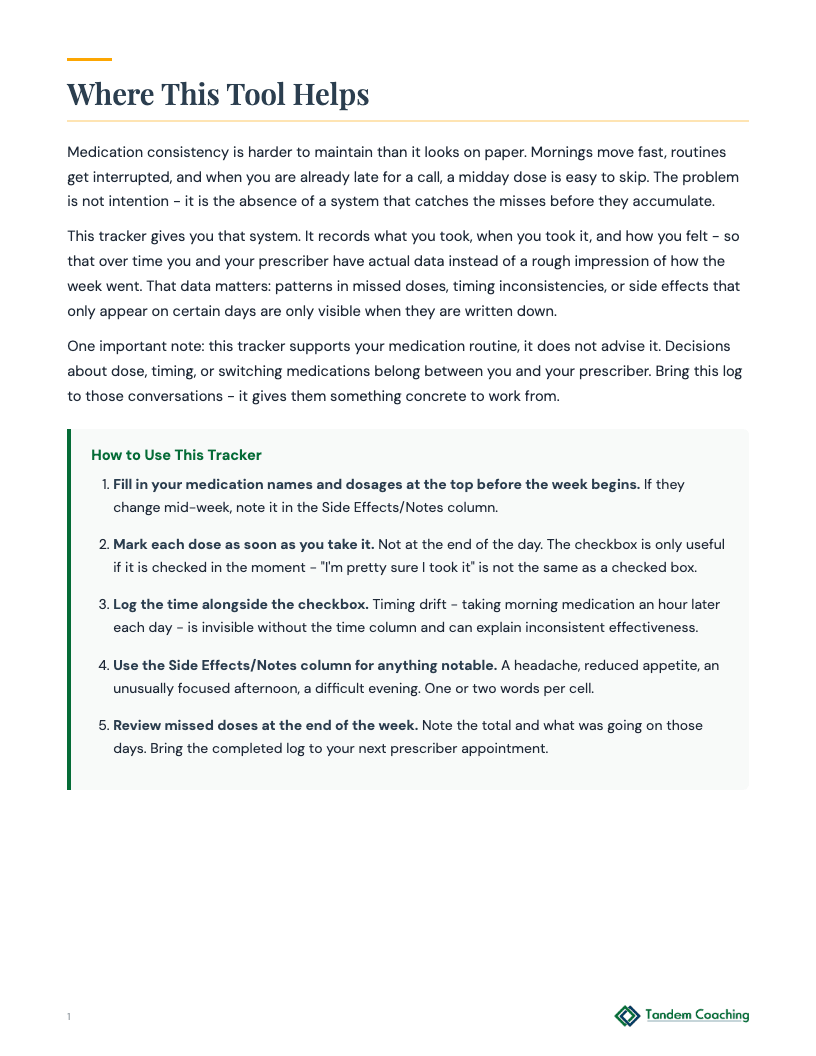
Track ADHD medication adherence and see how dose timing affects focus, mood, and sleep, using structured daily logs designed for adult ADHD care.
Get This Tool
Free, print-ready PDF.
When to Use This Tool
ADHD adult who is taking medication and wants to track adherence and observe how timing affects their daily functioning
A client who is gathering data on medication patterns to inform conversations with their prescriber
Person who knows their medication helps but can't articulate clearly enough to describe the effect when asked
How to Introduce This Tool Plus
This tracker is a coaching support tool, not medical advice. Bring the data to both your coaching sessions and your prescriber conversations.
Coaching Tool Disclaimer
This tool is designed for coaching contexts, not clinical use. If you or your client is in crisis, contact the 988 Suicide and Crisis Lifeline (call or text 988) or Crisis Text Line (text HOME to 741741).
Browse All Pages
Tool Classification
Domain
ADHD
Type
Tracker
Phase
Action
Review
Details
5 min
Between sessions
Weekly
Topics
Executive Function
Accountability
Self-Care
For the Coaching Practitioner
Plus
Coaching Scenarios
Plus
1 Inconsistent Tracking Undermines Titration ▶
Context
A client with recently diagnosed ADHD is in a titration period with their psychiatrist. The psychiatrist has asked for a symptom log to guide dosing decisions, but the client has been providing incomplete, retrospective reports from memory. The client has been in coaching for two months, working on executive function, and wants to finally generate reliable data for their next appointment.
How to Introduce
Frame this as a communication tool, not a self-monitoring task. 'Your psychiatrist is making dosage decisions with incomplete information right now. This sheet gives them what they need to make a better call.' The resistance here is not about effort - it is about the client not believing their daily experience is worth recording. Some clients with ADHD have a long history of being told their self-reports are unreliable or exaggerated. Name that directly: 'You're not diagnosing yourself. You're documenting what you notice so a professional can interpret it.'
What to Watch For
Watch for the client filling in entire weeks from memory at session time rather than tracking daily. The data will be uniformly rated - all 3s, or all 5s - with no variance across days or times. Ask directly: 'Did you actually fill this in each day, or did you reconstruct it?' The answer changes how you use the data. Also watch for the client omitting the 'Challenges' column entirely while completing 'Medication Taken' and 'Dose' accurately - this is the column with the most coaching relevance.
Debrief
Start with variance, not averages. If the tracker shows high-functioning days and low-functioning days, ask what differed between them - sleep, stress load, time of dose. If there is no variance, the tracker was not filled in honestly or daily enough to be useful. Move to the Challenges column: 'Walk me through your worst day here. What was happening?' The goal is to link observable patterns to environmental conditions the client can adjust. End by asking what the client plans to tell their psychiatrist and whether the log changes that conversation.
Flags
- Moderate
Client reports skipping doses regularly without telling their prescriber because they 'don't think it's working' or they dislike side effects
Response: This is a medication compliance issue that sits outside coaching scope. Reflect back what you heard without interpreting it medically: 'It sounds like you've been managing this on your own without your prescriber knowing.' Encourage the client to have that conversation at their next appointment. Do not advise on whether to take or skip medication.
- Moderate
Tracker shows extreme mood or functioning ratings (9-10 highs followed by 1-2 lows) with rapid cycling across the week
Response: Note the pattern and reflect it to the client without interpretation. Encourage them to share the full tracker with their psychiatrist, not just a summary. This pattern is medical information, not coaching information.
2 Post-Diagnosis Skepticism About Medication ▶
Context
A client was diagnosed with ADHD at age 38 after years of being told they were 'scattered' or 'unmotivated.' They started medication three months ago but are ambivalent - some weeks they take it, some weeks they don't. They cannot tell whether the medication is actually helping because their experience is too inconsistent to compare. Coaching focus is on building sustainable work habits.
How to Introduce
Do not position this as a way to evaluate medication effectiveness - that is a medical question. Position it as data collection about their own patterns: 'Right now you're comparing some medicated days to some unmedicated days, but you don't have it written down, so you're relying on impressions. This gives you actual data to work with - whatever conclusion you draw.' Some clients in this position have strong feelings about the medication decision itself. Do not enter that conversation. Stay with the data.
What to Watch For
Watch for the client using the tracker selectively - only logging on days they took medication, or only on 'good' days. This produces a skewed comparison. If you notice the pattern, name it: 'I'm seeing mostly medicated days in the log. Did you log the days you didn't take it?' The incomplete data is itself a finding - it may indicate the client is avoiding the comparison rather than making it. Also watch for high functioning scores paired with 'challenges: none' - this can signal the client is not engaging with the tool honestly.
Debrief
Start with the medicated vs. unmedicated days as a simple comparison, without evaluating the medication: 'Looking at this, what do you notice about how these days feel different?' Then move to the variable that the client can actually control in coaching - routine, sleep before medicated days, what work they chose to tackle. The coaching conversation is about the conditions around medication use, not the medication itself. End with the question: 'What's one thing you could do consistently that you noticed made a difference regardless of which days you were tracking?'
Flags
- High
Client discloses they are combining medication with alcohol or other substances and this appears in the tracker notes
Response: This is outside coaching scope. Do not engage with the substance use as a coaching topic. Reflect what was shared and name that this is something to discuss with their prescriber or physician. Consider whether a referral to a clinical provider is appropriate.
3 Executive Function Tracking After Dose Change ▶
Context
A client working as a senior product manager has been stable on ADHD medication for two years but recently had a dose adjustment. Their psychiatrist wants to know whether the change is improving their functioning at work. The client struggles to articulate the difference in follow-up appointments because they cannot separate medication effects from work volume, stress, and sleep variability.
How to Introduce
Frame this as isolating variables: 'You're trying to give your psychiatrist a signal, but right now there's too much noise. This tracker helps you separate the medication pattern from the day-to-day noise.' The 7-day format should be introduced as a full work week plus weekend - the contrast between work days and non-work days often reveals something. Some clients at this career level resist the tracker because it feels elementary. Name that: 'This is diagnostic, not remedial. Your psychiatrist needs clean data, and right now they're getting impressions.'
What to Watch For
Watch for the 'Challenges' column being dominated by meeting load, team issues, or project complexity rather than cognitive symptoms. This client is at risk of attributing functioning problems to workload rather than medication effects, and vice versa. If every low-functioning day also had a high meeting load, explore that intersection rather than assuming the medication change is the variable. Also watch for the client conflating energy levels with medication effectiveness - fatigue from overwork looks identical on the tracker to medication under-performance.
Debrief
Start with the day of the week pattern: 'Are the low-functioning days clustered at any particular point in the week?' This reveals whether the pattern is medication-related (consistent) or workload-related (variable). Then move to the dose timing column: 'Does when you took the medication correlate with when you felt most functional?' End by asking what the client plans to say to their psychiatrist and whether the tracker changes that. If the client wants to use the tracker to advocate for a different dose, acknowledge the goal but keep the coaching conversation on what they can observe and report, not on what the medical outcome should be.
Flags
- Moderate
Tracker reveals the client has not slept more than 5 hours on any tracked day
Response: Raise sleep as a variable that may be confounding everything else in the tracker. This is a coaching conversation about sleep hygiene, not medication. Before attributing functioning patterns to the dose change, the sleep issue needs to be addressed. Name what you see: 'I notice every entry shows 5 hours or less of sleep. That makes it very hard to read anything else in this tracker.'
Tool Flow
Plus
Requires
- current medication names and prescribed dosing schedule
→
Produces
- weekly dose adherence log with timing and side effect notes
- missed dose pattern summary for prescriber appointment
Pairs Well With
ADHD
Attention Context Log
Use this tracker to notice patterns in executive function and habits over time before drawing conclusions.
Why it pairsOnce your client has dose timing data, layer in symptom intensity logs to show whether adherence gaps correlate with hyperactivity spikes across specific situations.
LifeOptional Multi-Area Goal Notes
Use this worksheet to explore values and identity and turn the client’s observations into one optional next step.
Why it pairsUse adherence patterns gathered over weeks to ground monthly intention-setting in what medication consistency actually makes possible across life domains.
ADHDSelf-Care Energy Map
ADHD adult who feels chronically drained but can't identify what's taking their energy
Why it pairsAfter logging dose timing effects, map which activities drain or restore energy to separate medication variables from lifestyle contributors to fatigue.
Related Articles


Remote vs In-Person ADHD Coaching: The Research
Read article →
Executive Function Strategies for ADHD Leaders: Working Memory, Impulse Control & Flexibility
Read article →
Organize Your Success – ADHD Coaching to Master Organizational Skills
Read article →
ADHD and People-Pleasing: Why I Say Yes When I Should Say No
Read article →