A step-by-step checklist to declutter your home when ADHD clutter fuels overwhelm, built on ADHD-friendly coaching strategies.
Free, print-ready PDF.
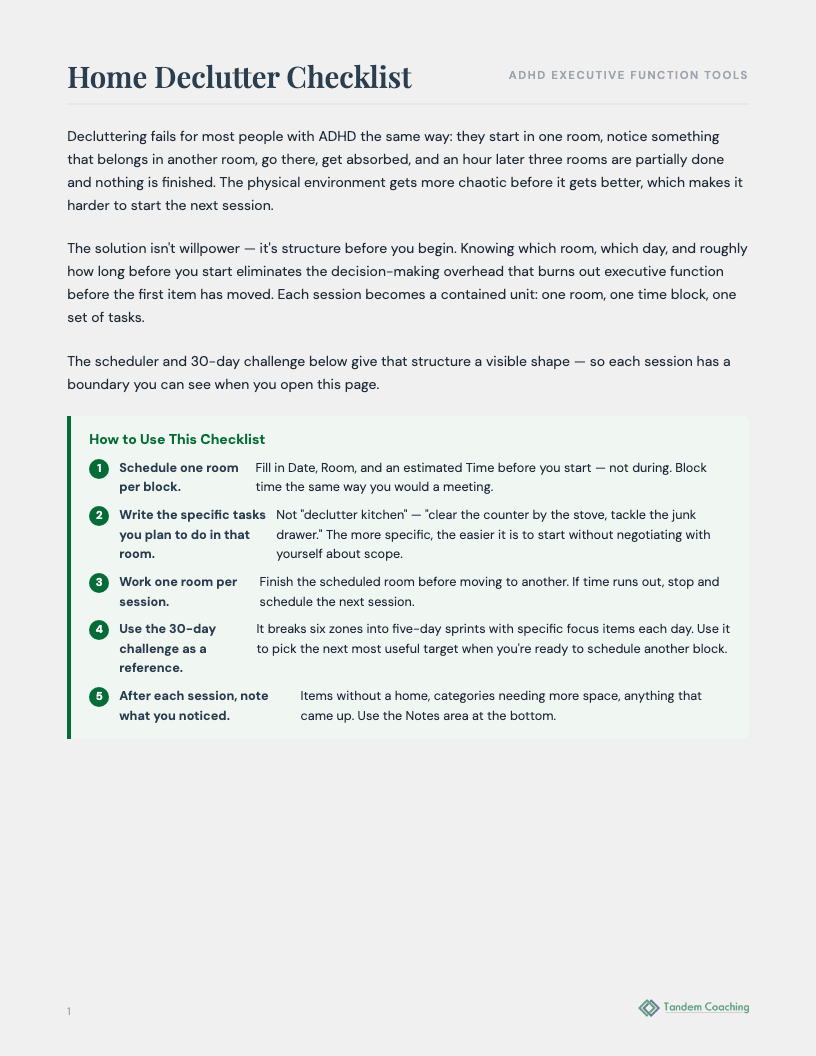
You've mentioned your space feels chaotic. This planner breaks decluttering into rooms with a schedule, plus a 30-day challenge to make it sustainable rather than a one-time effort.
VP of Operations working from home since 2020. Direct reports have started commenting on background clutter during video calls. Client says they need better time management but keeps mentioning how distracted they feel at home.
Frame this as workspace optimization, not personal organization. 'Your environment is part of your executive presence now. Let's map out which spaces need attention first.' ADHD executives often resist home organization because it feels domestic rather than professional. Connect decluttering directly to work performance and leadership presence.
Client schedules only office-adjacent spaces (home office, entryway) and avoids personal areas (bedroom, bathroom). This suggests shame about private spaces affecting professional identity. Also watch completion time - if they schedule all six blocks for the same week, they're underestimating executive function demands.
Start with the room they scheduled first - this reveals their priority hierarchy. Ask: 'What would change about your workday if this space worked the way you want it to?' Then examine any rooms they avoided scheduling. The gap between professional and personal space organization often mirrors work-life boundary issues.
Client schedules only work-visible areas and refuses to address private spaces. Moderate severity. This pattern suggests identity fusion where personal environment feels irrelevant to professional success. Continue coaching but explore whether the client's self-worth depends entirely on work performance.
Marketing Director who has rescheduled three decluttering attempts. Says their home environment is affecting their ability to think clearly but keeps pushing sessions to next week. Recently promoted and managing a larger team.
Don't present this as another scheduling tool - they already know how to schedule. Instead: 'This isn't about finding time, it's about finding the minimum effective dose. What's the smallest room that would give you the biggest mental relief?' Focus on reducing scope, not increasing commitment.
Client fills in ambitious tasks like 'reorganize entire kitchen' or schedules 3-hour blocks. This indicates they're still thinking in perfectionist terms. Also watch for scheduling all blocks on weekends - suggests they view decluttering as separate from daily life rather than integrated maintenance.
Ignore the scheduled tasks and focus on what they didn't schedule. Ask: 'What room did you think about including but decided against?' This reveals where the real overwhelm lives. Then: 'What would need to be true for you to spend 20 minutes in that space?' The resistance pattern often points to deeper capacity issues.
Client consistently schedules but never executes, or schedules unrealistic scope (whole house in one weekend). High severity if pattern extends beyond decluttering to other commitments. This suggests executive function breakdown under new role demands. Consider whether coaching should address role transition before environment management.
Senior Operations Manager whose spouse manages all home systems. Client feels incompetent about domestic tasks despite running complex projects at work. Wants to contribute more at home but doesn't know where to start without disrupting existing systems.
Frame as project management, not domestic help. 'You coordinate multiple workstreams daily. This applies the same skills to a different domain.' Address the competence gap directly: 'Your partner has systems you don't see. This tool helps you contribute without disrupting what already works.'
Client defers to partner's preferences in every room choice or asks to involve partner in the planning. This suggests they've abdicated household agency entirely. Also watch for over-scheduling - trying to prove competence by taking on too much too fast, which will create conflict with existing systems.
Start with the rooms they chose independently, without partner input. Ask: 'What made you confident about tackling this space?' Then explore the spaces they avoided: 'What would you need to know about this room to feel capable of organizing it?' The goal is rebuilding domestic agency, not just decluttering.
Client cannot identify any household area they feel competent to address independently, or wants to completely reorganize spaces their partner has already organized. Moderate severity. This suggests learned helplessness in domestic contexts despite professional competence. Explore whether the dynamic extends to other life areas.
Senior Project Manager who approaches decluttering like a multi-phase construction project. Has created detailed spreadsheets and floor plans but hasn't moved a single item. Says they need the 'right system' before starting.
Acknowledge their planning strength, then redirect it. 'You're excellent at project design. The challenge here is that decluttering is more like daily maintenance than project delivery - it needs to be simple enough to repeat.' Position this tool as rapid prototyping, not final architecture.
Client writes elaborate task descriptions that sound like project specifications ('Assess kitchen workflow patterns and optimize storage allocation'). They're applying the wrong mental model. Also watch for scheduling dependencies between rooms - treating decluttering like a critical path project rather than independent modules.
Focus on the gap between their planning detail and actual task simplicity. Read their most complex task description back to them, then ask: 'What would this look like if you had to explain it to a 10-year-old?' The goal is helping them access their intuitive organizing ability rather than their project management training.
Client cannot engage with any organizing task without extensive planning phase, or creates dependencies that prevent starting anywhere. Low severity - this is a strength overused rather than a deficit. Continue coaching but help them recognize when project management skills become obstacles to simple action.
Person with ADHD who does all their cleaning in one exhausting weekend burst
ADHDADHD adult who wants a pre-filled weekly cleaning structure they can follow without planning
ADHDADHD adult who wants to design their own weekly cleaning schedule rather than follow a preset one