ADHD Annual Budget
See your full year of income and expenses in one ADHD-friendly view, built on proven budgeting and coaching methods for real-life follow-through.
Get This Tool
Free, print-ready PDF.
When to Use This Tool
ADHD adult who wants a year-at-a-glance view of income and expenses
A client who is trying to identify seasonal spending patterns across the full year
Person who needs an annual financial tracking system that shows monthly totals side by side
How to Introduce This Tool Plus
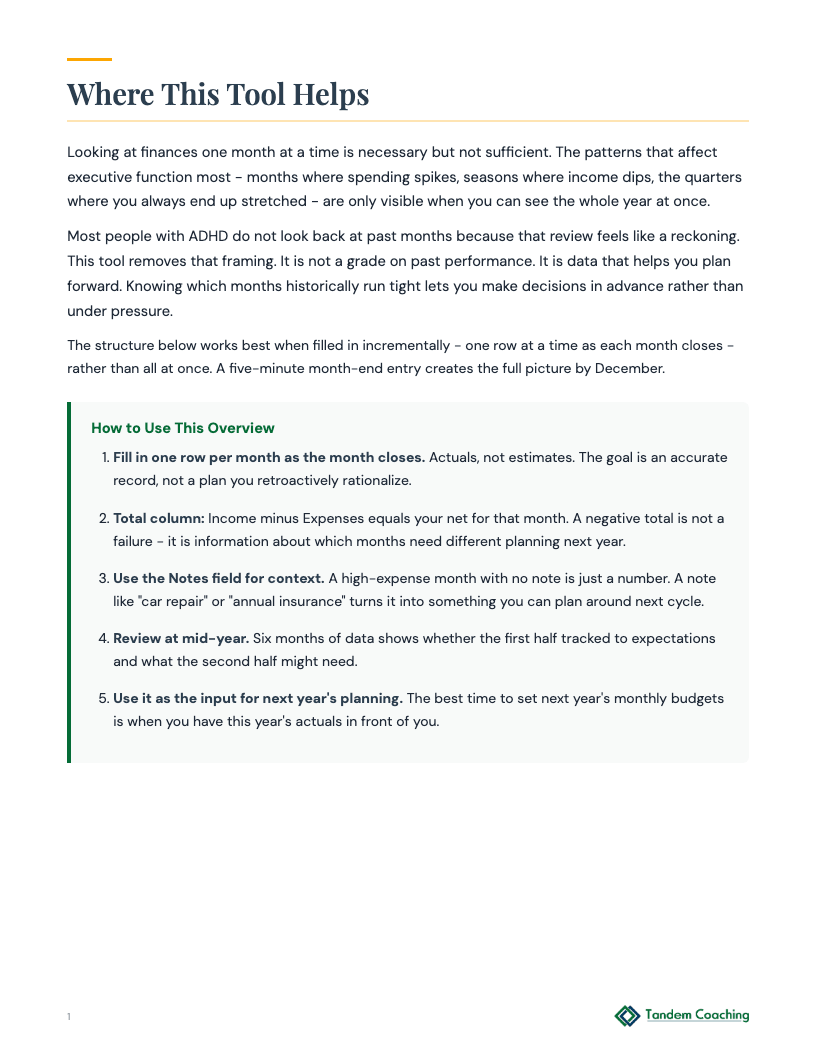
Monthly budgets tell you what happened this month. An annual view lets you see patterns across the year - which months are tight, which are healthy, and whether the trend is moving the right direction.
Browse All Pages
Tool Classification
Domain
ADHD
Type
Planner
Phase
Goal Setting
Review
Details
30 min
Between sessions
Monthly
Topics
Finances
Accountability
Habits
For the Coaching Practitioner
Plus
Coaching Scenarios
Plus
1 Freelance consultant who chronically underprices projects in summer months ▶
Context
Independent marketing consultant, ADHD diagnosis at 34, came to coaching after third consecutive summer of financial stress. Client attributes the pattern to 'summer slowdown' but suspects there's more to it. Has detailed monthly expense tracking but has never looked at the year as a whole.
How to Introduce
Frame this as pattern detection, not budgeting. 'You track expenses well month to month. This puts 12 months side by side so we can see what your brain does with seasonal changes.' Most ADHD clients resist annual planning because it feels overwhelming. Position this as data collection that happens five minutes at a time, one month as it closes.
What to Watch For
Speed of completion for different months reveals memory patterns. If summer months take significantly longer to fill in, the client may be avoiding or minimizing those periods. Watch for round numbers in high-stress months - a sign of approximation rather than actual data review.
Debrief
Start with the Total column. Ask: 'Which negative months surprised you and which ones didn't?' The unsurprising ones are patterns the client already knows but hasn't planned around. Then: 'What would need to change in March and April for July to look different?' This moves from pattern recognition to advance planning.
Flags
If the client cannot recall expenses for more than 3 months or provides obviously fabricated round numbers across multiple months, this may indicate executive function challenges beyond normal ADHD patterns. Severity: moderate. Consider whether memory or organizational systems need attention before financial planning.
2 Mid-level manager avoiding financial planning after recent divorce ▶
Context
Operations manager at a logistics company, 18 months post-divorce, ADHD managed with medication. Came to coaching for 'getting organized' but deflects any conversation about money. Has been living month-to-month since the divorce settlement, claims not to know where money goes.
How to Introduce
Present as a data-gathering exercise, not financial planning. 'This isn't about creating a budget - it's about seeing what's actually happening across 12 months.' Expect resistance framed as 'I don't have time for this' or 'my situation is too chaotic.' Counter with: 'Chaos is exactly why we need the overview. You can't plan around patterns you can't see.'
What to Watch For
Client may fill in only recent months or leave large gaps, claiming 'I don't remember.' This is often avoidance, not memory issues. Watch for emotional reactions to specific months - divorce-related expenses, holiday spending, or months when child support started. The Notes column may stay completely empty as another avoidance strategy.
Debrief
Start with completed months only. Don't push on gaps initially. Ask: 'What do these numbers tell you about which months feel manageable and which don't?' If client minimizes patterns, try: 'If your best friend showed you this chart, what would you notice?' This creates distance from the emotional charge.
Flags
If client becomes visibly distressed when looking at specific months or refuses to engage with the tool entirely, the financial avoidance may be trauma-related rather than executive function. Severity: moderate. Continue coaching but consider whether financial therapy or debt counseling resources would be appropriate.
3 Small business owner whose ADHD hyperfocus creates feast-or-famine income cycles ▶
Context
Runs a web design studio, ADHD diagnosis in college, came to coaching because 'I can't smooth out my income.' Alternates between months of intense client work and months of almost no revenue. Attributes this to market conditions but suspects their work patterns are the real driver.
How to Introduce
Frame as a business intelligence tool. 'You're tracking project income, but this shows the rhythm of your business across seasons.' ADHD entrepreneurs often resist looking at annual patterns because hyperfocus makes each project feel like the most important thing ever. Position this as: 'We're not changing how you work - we're seeing what your work style produces over time.'
What to Watch For
Income column will likely show extreme variations - some months 3-4x others. Client may rationalize every low month with external factors in the Notes column. Watch for months where expenses stayed flat while income dropped to zero - indicates the client didn't adjust spending to match the feast-famine cycle.
Debrief
Start with the pattern, not individual months. 'Your income swings from $X to $Y. What drives those peaks?' Then: 'What happens to your client outreach in the high-income months?' Most hyperfocus entrepreneurs stop marketing when they're busy, creating the famine. The question that opens this: 'What would change if you treated marketing like a fixed expense?'
Flags
If income variations exceed 5:1 ratio between highest and lowest months, or if the client shows no awareness that their behavior drives the cycle, this may indicate hyperfocus patterns that need clinical attention alongside coaching. Severity: low to moderate. Continue coaching but monitor whether the client can implement systems that interrupt hyperfocus cycles.
4 Corporate director who overspends during high-stress project periods ▶
Context
IT director at a healthcare system, ADHD managed since childhood, sought coaching after realizing they spend significantly more during major system implementations. Calls it 'stress spending' but wants to understand the pattern better. Has good baseline financial habits but loses control during work crises.
How to Introduce
Position as a stress-pattern diagnostic. 'You know you spend more during big projects. This tool shows exactly when and how much, so we can plan for it instead of being surprised.' Frame the Notes column as crucial: 'Mark which months had major projects. The correlation between work stress and spending might be tighter than you think.'
What to Watch For
Look for expense spikes that correlate with work events noted in the Notes column. Client may underestimate the spending increases or rationalize them as 'necessary' during stressful periods. Watch whether the client can identify the spending categories that increase - food delivery, convenience purchases, or larger stress-relief purchases.
Debrief
Start with the correlation: 'Show me the months with project launches and the months with highest expenses.' Then dig into mechanism: 'What specifically do you buy more of when work gets intense?' The breakthrough question: 'What would you need to have in place before the next big project to spend $X less during it?' This moves from pattern recognition to intervention planning.
Flags
If stress spending exceeds 40% above baseline for multiple months, or if the client cannot identify what they're purchasing during stress periods, this may indicate impulse control challenges that need clinical attention. Severity: low. Continue coaching but consider whether ADHD medication management or therapy for stress responses would be beneficial.
Tool Flow
Plus
Requires
- monthly actual income and expense figures
→
Produces
- 12-month income and expense record with notes
- seasonal spending pattern visible across full year
- year-end net totals for forward planning
Pairs Well With
Career
Debt Context and Payment Notes
Use this tracker to notice patterns in finances and accountability over time before drawing conclusions.
Why it pairsOnce the annual budget shows which months carry income surplus, this tracker helps clients route that money toward specific debts deliberately.
ADHDRecurring Payment Context Log
Use this tracker to notice patterns in finances and accountability over time before drawing conclusions.
Why it pairsAfter the annual budget surfaces your client's recurring expense totals, this tracker adds a monthly checkoff grid to prevent missed payments.
CareerPersonal Money Context Snapshot
Use this tracker to notice patterns in finances and career transition over time before drawing conclusions.
Why it pairsUse this after the annual budget shows which months consistently overspent - clients need a purchase gate before those months repeat next year.
Related Articles


ADHD Coaching Certification: Which Path Actually Counts
Read article →
Group vs Individual ADHD Coaching: Which Works?
Read article →
Adaptive ADHD Leadership: 7 Strategies That Work
Read article →
ADHD Executive Coaching: What It Is and How It Works
Read article →