A quick, science-informed checklist to pause impulsive spending and reduce buyer’s remorse, designed for ADHD adults with real-life triggers in mind.
Free, print-ready PDF.
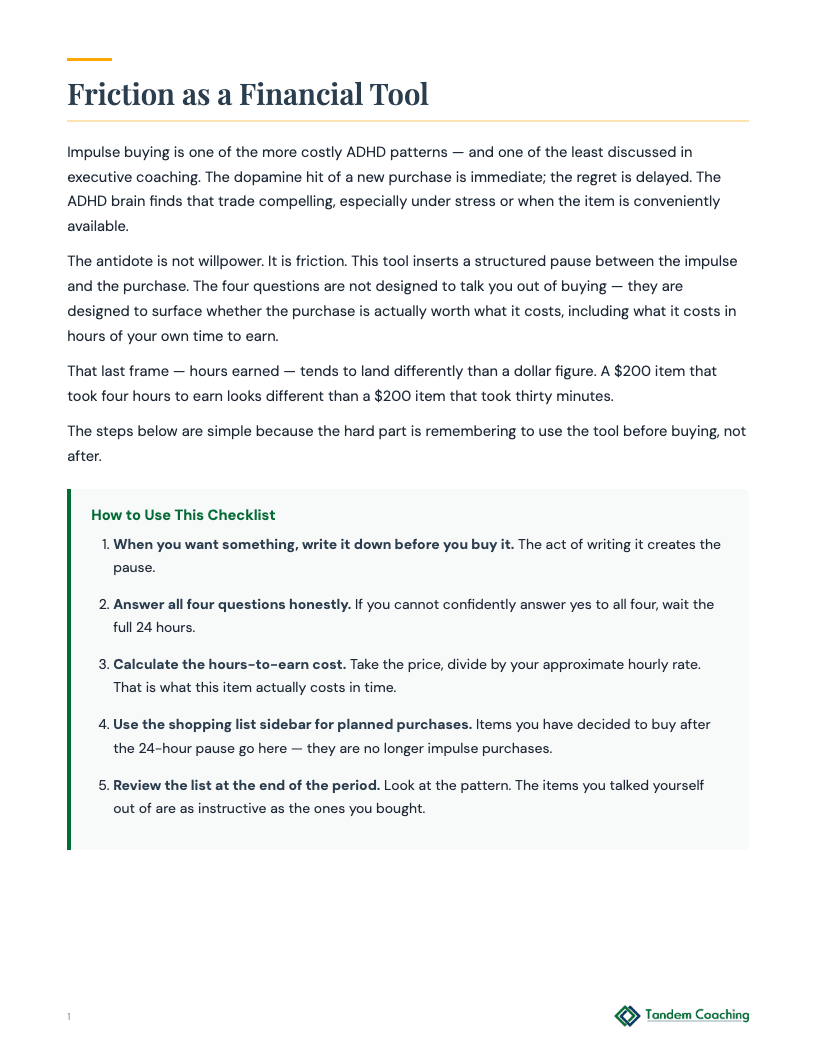
Impulse spending is one of the more concrete ways ADHD impulsivity shows up in daily life. This four-question checklist creates a 24-hour pause before the decision - not a veto, just a gap.
Mid-level software engineer at a startup experiencing crunch time before a major product launch. Client reports spending $800 last month on productivity apps, ergonomic accessories, and coding tools that promised to solve workflow problems. Most purchases happened during late-night coding sessions when feeling overwhelmed.
Frame this as debugging your purchase patterns, not restricting spending. 'You're solving real problems - better ergonomics, workflow efficiency. Let's see if the timing of purchases matches the timing of stress.' ADHD brains seek external solutions when internal systems feel chaotic. The tool isn't about saying no to useful tools; it's about buying them intentionally rather than as emotional regulation.
Time stamps matter more than dollar amounts. If most purchases happen after 9pm or during documented stressful periods, the buying is serving an emotional function. Watch whether the client can articulate specific problems each purchase was meant to solve, or if descriptions are vague ('better productivity'). Multiple apps solving the same problem signals buying-as-soothing rather than problem-solving.
Start with the hours-to-earn calculation on their biggest recent purchase. 'That monitor cost you twelve hours of coding time. Was the productivity gain worth twelve hours?' Then look at timing patterns: 'Three of these happened the same week as the database migration crisis. What was driving the purchases in those moments?' The question that opens it up: 'When you're stressed at work, what does buying something give you that taking a break doesn't?'
If the client bought multiple solutions for the same problem within a short timeframe, or if total monthly spending on tools exceeds 10% of income, the pattern may indicate emotional dysregulation beyond normal ADHD impulsivity. Severity: moderate. Response: explore whether work stress is manageable through other means before addressing spending patterns.
Marketing director at a mid-size agency who came to coaching for time management issues. During intake, mentioned credit card debt but dismissed it as 'business investments' - courses, software subscriptions, networking events. Resistant to examining spending patterns, insists everything purchased has professional value.
Don't challenge the business investment frame directly. Instead, position this as ROI tracking: 'If these are investments, let's measure returns like any other business decision.' The resistance often comes from shame about purchases that didn't deliver promised value. Frame the 24-hour pause as due diligence, not restriction: 'You wouldn't approve a $300 software purchase for your team without evaluation. Same standard for your own professional development.'
Compliance looks like filling out the form but justifying every purchase as necessary. Genuine engagement means the client starts questioning whether a course will actually get used or if they already own similar resources. Watch for the phrase 'I might need this later' - it signals buying for imaginary future scenarios rather than current problems. Multiple courses in the same skill area within months indicates learning-as-avoidance.
Start with completed courses or tools from previous months: 'You bought three project management courses in Q1. Which one are you actually using?' Then move to the pattern: 'What's the gap between what you buy to learn and what you implement?' The question that creates movement: 'If you could only buy one professional development item this quarter, what problem would it solve that you can't solve with what you already own?'
If the client cannot name specific outcomes from recent professional development purchases, or if they're buying multiple solutions for skills they already possess, the spending may be avoiding deeper performance issues. Severity: moderate. Response: explore whether the learning purchases are masking confidence gaps or role misalignment that coaching should address directly.
Executive assistant to a demanding C-suite executive at a Fortune 500 company. Came to coaching to improve boundary-setting with her boss. During the first month using this tool, she notices most impulse purchases happen within 24 hours of tense interactions with her executive - clothing, home decor, small electronics.
Present this as data collection, not behavior modification: 'Let's see if there are patterns in when you want to buy things.' Don't mention the connection to work stress initially - let the client discover it. The ADHD brain often uses purchasing as immediate mood regulation after rejection sensitivity episodes. The tool will surface the timing correlation without you having to interpret it.
The breakthrough moment is when the client connects purchase timing to workplace interactions without prompting. Watch for the shift from 'I just wanted it' to 'I was feeling...' when describing the impulse. If the client starts noting what happened at work before each purchase urge, they're making the connection. Resistance looks like insisting the timing is coincidental.
Start with the timeline: 'Look at the dates when you wanted to buy something. What was happening at work those days?' Don't interpret - let the client see the pattern. Then explore the function: 'When your boss dismisses your input in the morning meeting, what does buying something give you that afternoon?' The question that opens it up: 'What would you need in those moments that doesn't cost money?'
If purchases consistently follow workplace conflicts and the client reports feeling 'invisible' or 'dismissed' at work, the spending may be compensating for chronic invalidation. Severity: low to moderate. Response: continue coaching but address the workplace dynamic directly - the spending is a symptom, not the core issue.
Independent management consultant who left corporate three months ago. Income is irregular but higher than previous salary when projects come in. Using coaching to build sustainable business practices. The tool reveals a pattern of buying premium versions of items (laptop, software, office furniture) immediately after landing new clients.
Frame this as business expense analysis: 'Let's track what you're buying for the business versus what the business actually needs.' The pattern often emerges around identity - buying the trappings of success to feel like a successful consultant. Don't pathologize this; it's normal transition behavior. The tool helps distinguish between purchases that serve the business and purchases that serve the consultant's confidence.
Look for premium versions of items the client already owns that function adequately. The tell is upgrading working equipment immediately after good news rather than when the current version fails. Watch whether the client can articulate functional differences between what they have and what they're buying, or if justifications focus on image ('looks more professional'). Multiple upgrades in the same category signal identity-driven purchasing.
Start with the timing: 'Three of these purchases happened right after you landed clients. What's the connection?' Then examine necessity: 'Your current laptop works fine. What would the new one do that this one doesn't?' The question that creates movement: 'When you imagine meeting with clients, what do you worry they'll think about your current setup?' This surfaces the confidence issue underneath the spending.
If the client is buying expensive items to project success while struggling with irregular income, or if they express anxiety about 'looking legitimate' to clients, the spending may indicate imposter syndrome that's creating financial risk. Severity: moderate. Response: address the identity transition from employee to consultant directly - the purchases are external validation-seeking that coaching can help internalize.
ADHD adult who has multiple debts and no visibility into their payoff progress
ADHDADHD adult who misses bill due dates or forgets which bills have been paid
ADHDADHD adult who has no clear picture of where their money goes each month