Turn a clear goal into a step-by-step plan with milestones, priorities, and next actions, using a proven coaching framework to stay on track.
Free, print-ready PDF.
You've named what you want — what's the first concrete step, and what needs to be true for that step to actually happen?
A manager has set a professional development goal across multiple coaching sessions and generated conversation about it. When asked what they'll do this week, the answer is always a direction rather than an action: 'work on stakeholder relationships,' 'improve my communication,' 'build my visibility.' The goal isn't the problem - the translation from goal to concrete step hasn't happened, and the recurring vagueness means weeks pass without movement.
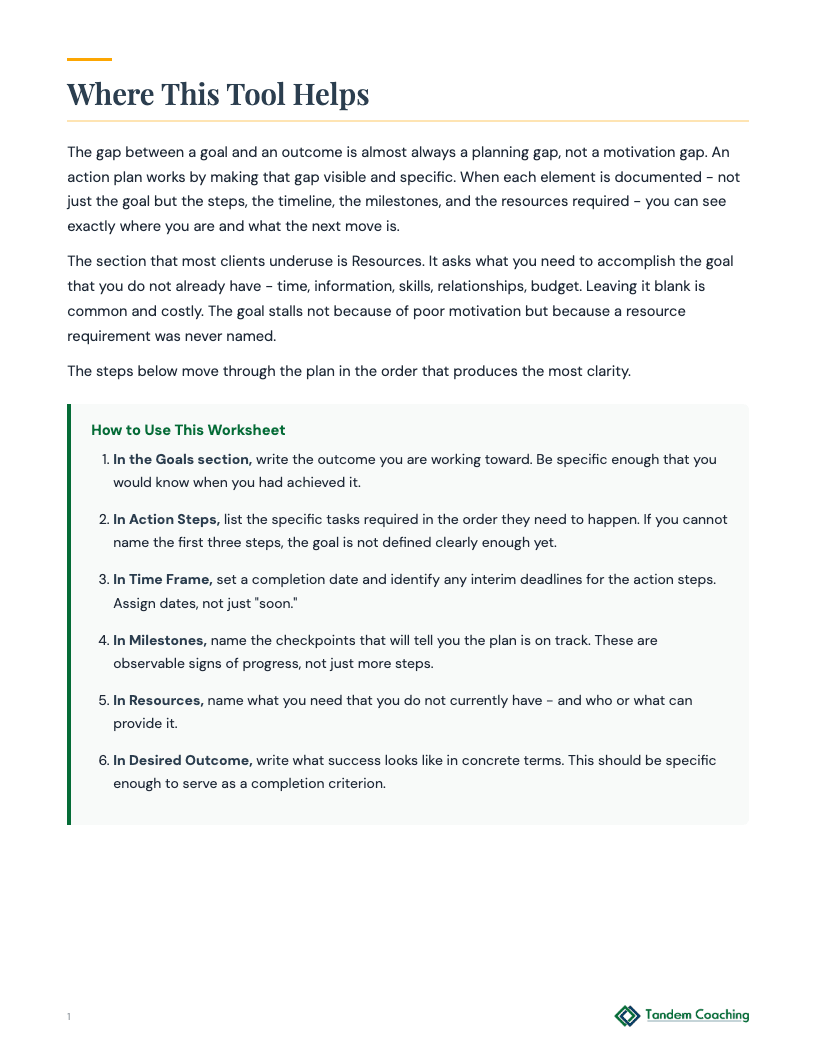
Position this as a translation exercise, not a goal-setting one. 'The goal is set. What we're doing here is converting it into specific steps someone could observe - not 'improve stakeholder relationships' but 'schedule a thirty-minute conversation with the finance director before Friday.' The action steps section requires that specificity. If a step can't be scheduled, it isn't a step yet.' Walk through the six sections: goal, action steps (with specificity requirement), time frame, milestones, resources, desired outcome. Some clients resist the specificity because vague action feels more flexible. Name it: 'Vague steps are how goals stay intentions. Specific steps are how they become results.'
Watch the action steps column for directions masquerading as actions. 'Reach out to stakeholders' is a direction. 'Email Marcus and Priya this week to schedule thirty-minute conversations before March 31st' is an action. If the column contains directions, ask: 'What specifically would you do - with whom, by when?' Also watch the time frame and milestones columns together. If the time frame is long (six months) and the milestones are vague, the action plan has no intermediate accountability. Push for milestones that are observable at 30-day intervals.
Start with the action steps and ask the client to read the first one and answer: 'If I watched you this week, what would I see you doing that's on this list?' If the answer requires interpretation - if the step needs to be translated before it's observable - the step isn't specific enough yet. Then ask about the milestones: 'How will you know, at the 30-day mark, whether you're on track?' Close by identifying the first action step by date: 'What specifically are you doing before we meet again, and when specifically will you do it?'
If the client's action steps are consistently vague across multiple sessions despite prompting for specificity, the vagueness may be serving a function - it preserves the appearance of progress while avoiding commitment to outcomes that can be assessed. Severity: low. Note the pattern and explore whether there's ambivalence about the goal itself, rather than difficulty with planning. A client who doesn't fully want the goal will generate vague plans as a structural protection against accountability.
A professional has made significant progress toward a goal twice in the past eighteen months, only to have the progress collapse and restart from a lower point each time. The goal itself is unchanged; the approach has been the same each time. They haven't examined whether the action plan structure is a factor in the collapses - specifically, whether the milestones and time frames they've set up have contributed to a cycle of overcommitment and restart.
Position this as a design review, not a motivation conversation. 'You've made substantial progress twice. The progress collapsed both times at roughly the same point. That's not a motivation problem - it's a structural signal. This worksheet is designed to help us look at the plan itself: whether the milestones are spaced appropriately, whether the resources section accounts for what you actually need, and whether the desired outcome has been stated in a way that's achievable given your current conditions.' Some clients experience plan redesign as admitting failure. Name it: 'Redesigning a plan that's failed twice isn't giving up. It's using the two prior runs as data.'
Watch the milestones column for signs of the overcommitment pattern - milestones that assume the client will sustain peak output for the duration of the plan without accounting for competing demands. If the milestones are equally spaced regardless of what's happening in the client's work calendar, the plan is designed for ideal conditions rather than actual ones. Also watch the resources column. If it's sparse or empty, the client may be planning on capability or willpower rather than on actual supports. 'What do you need in place for this step to be executable - not just motivation but actual resources?'
Start with the milestones and ask: 'Where in the previous two attempts did progress stop? Was there a milestone you missed and then didn't recover from?' The answer often identifies a structural vulnerability - a single milestone whose failure cascaded into abandonment. Then ask: 'What would you add to the resources section that wasn't there in the previous attempts?' That question surfaces what was missing from the prior design. Close by asking: 'What's the minimum viable version of this plan that would still count as meaningful progress if everything else went wrong?' That question builds a floor into the plan rather than assuming ceiling conditions.
If the collapse point in prior attempts coincides with predictable external demands - a quarterly crunch, a family obligation, an annual high-stakes period - the plan may need to account for those periods explicitly rather than treating them as obstacles. Severity: low. A plan that doesn't account for known recurring demands will fail at those demands reliably. Note what was happening in the client's life at the collapse points and build the milestones around those realities rather than around a clear calendar.
A director is actively pursuing three professional development goals simultaneously. Each is reasonable individually; together, they're competing for the same limited time and attention. Progress on all three is slow. They haven't examined whether the goals have a natural sequence (one enables the others), whether they're genuinely parallel, or whether pursuing all three at once is producing progress on none of them.
Use the worksheet to complete an action plan for each goal separately before addressing the sequencing question. 'We're going to fill this out for each goal independently, as though it's the only one. Once we have three complete plans, we'll look at whether they can actually run simultaneously or whether they need a sequence.' This approach prevents the sequencing decision from contaminating the planning: clients who know they'll have to sequence often write less ambitious plans for the goals they expect to defer. Some clients resist doing three separate plans. Name it: 'We're not committing to all three. We're understanding what each one actually requires before we decide how to order them.'
Watch the time frame and resources columns across all three plans for conflicts. If all three require substantial time in the same period and draw on the same resources (cognitive bandwidth, relationship capital, unscheduled hours), the plans are structurally in conflict regardless of how well-intentioned the sequencing is. Also watch the desired outcome column - if all three outcomes have roughly equal priority for the client, the sequencing conversation will be harder. If they have different stakes, the sequence may emerge from that difference.
After completing all three plans, lay them side by side and ask: 'Looking at the time frames and resources across all three, which ones are in direct conflict?' That question makes the competition visible in concrete terms rather than abstract ones. Then ask: 'If you could only make progress on one of these for the next sixty days, which one would have the most downstream value for the other two?' That question surfaces the natural sequence - the goal that, if addressed first, makes the others more achievable. Close by asking for a sequencing decision: one primary goal for the next sixty days, with the others on hold rather than running at reduced capacity.
If the client's three goals are themselves in conflict - building a skill that serves one direction while positioning for a role that requires a different direction - the sequencing question may be a proxy for a direction question that hasn't been made explicit. Severity: low. Note whether the simultaneous pursuit of multiple goals reflects genuine parallel opportunity or unresolved clarity about direction. If the latter, the planning work may need to follow, not precede, a conversation about direction.
My client keeps going back and forth on a decision and can't move forward
LifeI know what I need to do but I keep dropping things by end of day
LifeI start the year strong but lose momentum by March