Declutter one small area a day with ADHD-friendly prompts that prevent overwhelm, designed by coaches who understand executive dysfunction.
Free, print-ready PDF.
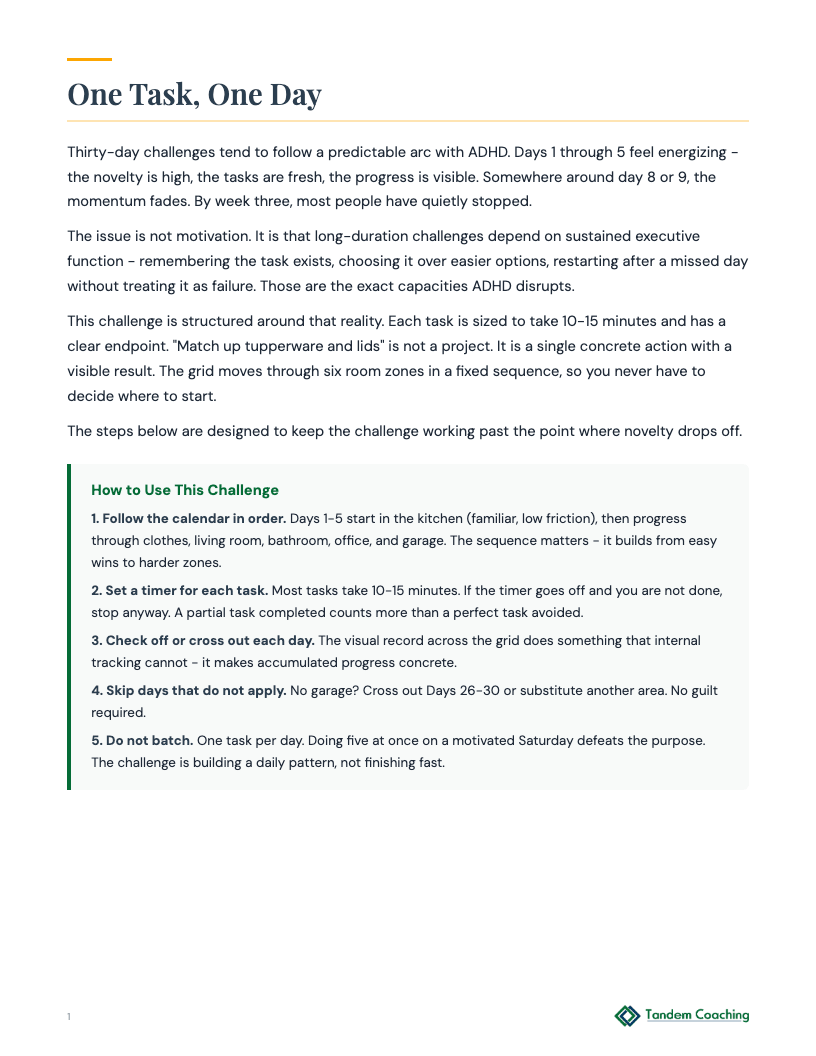
Decluttering works best when the tasks are small enough that starting them is easy. This thirty-day calendar gives you one specific action per day so there's no decision about what to tackle.
Marketing director at a SaaS company, fully remote for two years. Client reports feeling 'unprofessional' on video calls because their background is cluttered and they can't find documents during meetings. Started coaching to improve executive presence but keeps circling back to physical environment.
Frame this as professional infrastructure, not home organization. 'Your environment is part of your leadership toolkit. This challenge starts with spaces that show up on camera, then works outward.' Expect resistance to the daily structure - high achievers want to batch tasks. Name it: 'The point isn't efficiency, it's building a sustainable system.'
Client skips weekend days or tries to do multiple days at once during motivated periods. Office tasks (Days 21-25) get more attention than other zones. If they photograph 'before and after' shots, they're performing productivity rather than addressing the underlying pattern of accumulation.
Start with Days 21-25 (office zone) since that was their entry point. Ask: 'Which of these five tasks changed how you feel during video calls?' Then move to the pattern: 'Look at where you stalled. What was happening at work during those days?' Connect the missed days to work intensity cycles.
Client completes all tasks perfectly but reports no change in how the space feels. This suggests they're managing the tool rather than engaging with the underlying relationship to their environment. Severity: low. Continue coaching but explore what 'professional' means to them beyond visual presentation.
Operations manager at a manufacturing company, diagnosed with ADHD at 35. Has attempted whole-house organization three times in the past year, each time starting with elaborate systems and abandoning them within two weeks. Coaching focus is on completing initiatives at work and home.
Position this as the opposite of their previous attempts. 'This isn't about creating systems - it's about completing small loops. One task, one day, done.' The ADHD brain will want to optimize the sequence or add tasks. Redirect: 'The calendar is fixed. Your job is to follow it, not improve it.'
Client adds extra tasks to days or tries to reorganize the sequence 'for efficiency.' Around day 12-15, they may skip a day and then want to quit entirely. The all-or-nothing pattern will show up as either perfect compliance or complete abandonment - no middle ground.
Focus on the restart pattern, not the completion rate. 'Show me where you stopped and where you restarted.' If they restarted after missed days, that's the breakthrough - ADHD brains typically treat a missed day as total failure. Ask: 'What made it possible to continue after Day [X]?'
Client reports feeling 'behind' or 'failing' after missing 2-3 days, even if they completed 20+ tasks. This perfectionism pattern can trigger shame spirals that extend beyond the challenge. Severity: moderate. Address the all-or-nothing thinking directly before it generalizes to work projects.
Recently promoted from director to VP of customer success at a tech company. Moved to a larger house six months ago to 'match the new role' but reports feeling disorganized both at home and work. Boxes still unpacked, can't find things, feels like the space is controlling them instead of supporting them.
Connect this to their leadership transition. 'You're managing more complexity at work and more space at home simultaneously. This challenge creates order in one domain so you have bandwidth for the other.' Expect them to want to delegate or hire help. Redirect: 'The value is in you making the decisions about what stays.'
Client treats this as a project management exercise, creating spreadsheets or assigning tasks to family members. They may rush through decisions without considering what they actually use. Watch for 'executive' language - 'optimizing the space' instead of 'figuring out where things go.'
Start with the clothes section (Days 6-10) - most revealing for someone adjusting to a new professional identity. Ask: 'What did you discover about what you actually wear versus what you think you should wear?' Then connect to the promotion: 'How does this mirror what's happening with your new role?'
Client delegates most tasks to family members or housekeeper, then reports the challenge as 'complete.' They're avoiding the decision-making that creates ownership of the space. Severity: low. This pattern may show up in their management style - delegating decisions they need to make themselves.
Independent management consultant who works from home office, client sites, and co-working spaces. Reports that every location becomes cluttered within weeks and they waste time looking for materials. Coaching initially focused on time management but keeps returning to physical organization across multiple environments.
Frame this as a pilot for one location before scaling. 'Pick your home base - the place where you prep for everything else. We'll use this challenge to create a template you can adapt.' They'll want to modify tasks for portability. Resist: 'First establish what works in one place, then we'll translate it.'
Client tries to do the challenge simultaneously in multiple locations or skips tasks that don't apply to their 'mobile' lifestyle. They may focus heavily on office tasks (Days 21-25) and rush through personal spaces. Look for language about 'systems' versus actual decision-making about objects.
Focus on which tasks created the most relief. 'You work in chaos in multiple places. Which of these 30 tasks made the biggest difference in how you feel in this space?' Then explore portability: 'What would the traveling version of this task look like?' Connect to their consulting work - how does environmental control affect client presence?
Client reports that the challenge 'doesn't apply' to their lifestyle and modifies most tasks beyond recognition. This may indicate avoidance of creating any stable base, which could signal deeper issues with commitment or boundaries. Severity: moderate. Explore what 'home base' means to them professionally and personally.
ADHD adult who wants a structured end-of-week review to capture wins and struggles
ADHDADHD adult who avoids starting tasks because they won't be able to do them perfectly
ADHDADHD adult who feels overwhelmed by competing demands and can't prioritize what to work on first