Core Coaching Techniques: A Reference Guide for Professional Coaches
Key Takeaways
- Every coaching technique maps to a specific ICF Core Competency - knowing the competency tells you what the technique is actually doing at the professional standard, not just what it looks like.
- The "when NOT to use" condition is as important as the "when to use" - the right technique at the wrong moment produces technically correct coaching that still misses the coachee.
- Techniques chain: the first move in a sequence changes what the coachee can hear and what the coach can usefully offer next. Sequence determines outcome more than any individual technique.
- The ACC-to-PCC progression is not about learning more techniques - it is about developing the judgment to deliberately withhold one.
Techniques vs. Models vs. Skills
A coaching technique is a specific action a coach takes in a session moment - a question, a pause, a reframe. A coaching model (like GROW) is the architecture the session runs inside. A coaching skill is consistent, reliable access to the right technique at the right moment. Most guides conflate these three categories. This one does not.
This article covers 10 core coaching techniques, each mapped to the ICF competency it expresses. Every technique gets a definition, a session condition for when to use it, a one-line example of what it sounds like, and - the part no other guide covers - when not to use it. These are the building blocks of the coaching skills these techniques express.
Use this as a reference, not a reading list. Find the technique you need, check the session condition, and move on.
The 10 Core Coaching Techniques
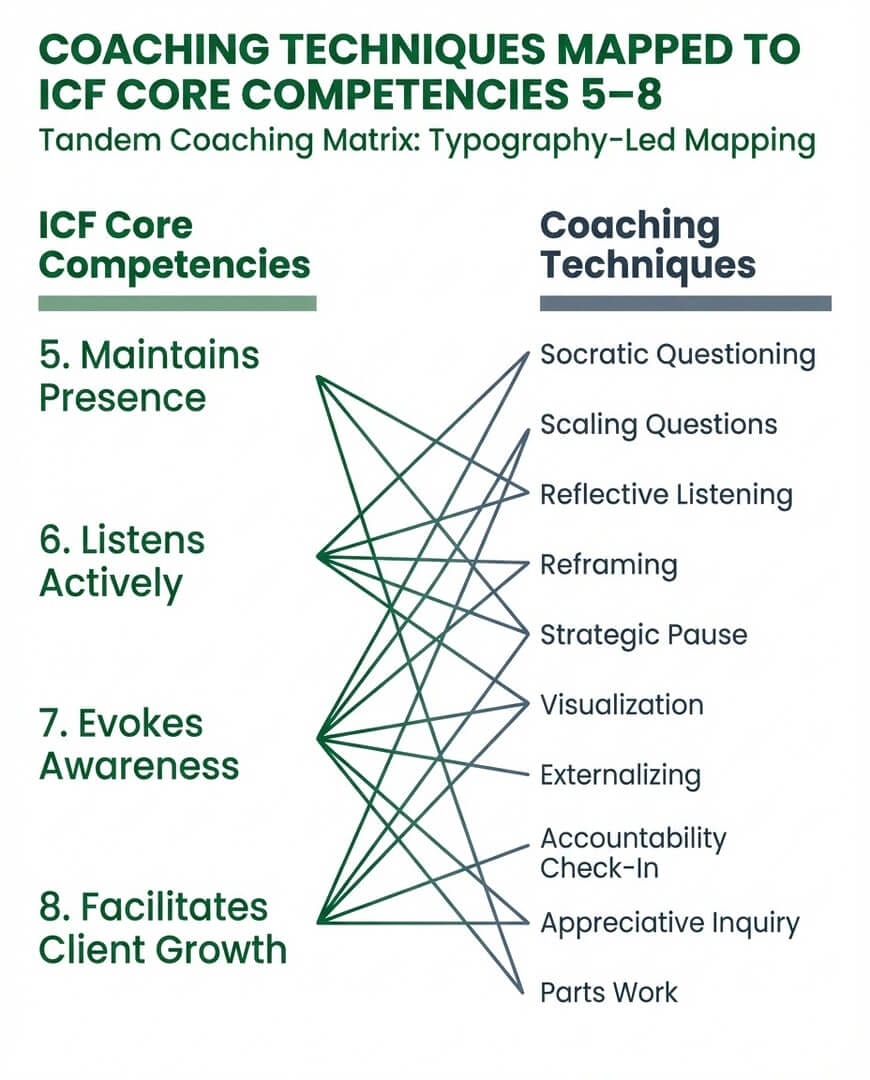
Each technique below maps to one of four ICF Core Competencies: Maintains Presence (5), Listens Actively (6), Evokes Awareness (7), or Facilitates Client Growth (8). The competency connection tells you what the technique is actually doing at the professional standard level - not just what it looks like.
1. Socratic Questioning
ICF Competency 7 - Evokes Awareness. Socratic questioning uses a chain of open questions to guide the coachee toward their own insight rather than delivering the coach's conclusion. The coach knows (or suspects) where the thinking needs to go but resists the shortcut of saying it directly.
The distinction from general powerful questioning matters: Socratic questioning is sequential - each question builds on the previous answer. It requires you to listen to the answer and construct the next question from it in real time.
When to use: The coachee holds a belief or assumption they haven't examined and needs to discover the gap themselves.
What it sounds like: "What evidence supports that conclusion?"
When NOT to use: When the coachee is emotionally activated. Socratic questioning in the middle of frustration or grief reads as interrogation.
2. Scaling Questions
ICF Competency 7 - Evokes Awareness. Scaling questions ask the coachee to rate something on a numerical scale (typically 1-10), then explore what that number means. The number itself is irrelevant. The conversation about why it is a 6 and not a 4 - that is where the awareness lives.
When to use: The coachee is stuck in vague language - "things are bad" or "I'm not confident." The scale forces specificity.
What it sounds like: "On a scale of 1 to 10, where is your confidence in this decision right now?"
When NOT to use: When the coachee has already been specific. Asking someone who just said "I'm terrified I'll lose my job" to rate their confidence on a scale is reductive.
3. Reflective Listening
ICF Competency 6 - Listens Actively. Reflective listening mirrors the coachee's language back to them - not as a parrot, but as a signal that you heard both the substance and the feeling behind it. The technique gives the coachee a chance to hear their own words from outside their head.
When to use: After a coachee shares something significant. Especially when they are processing an experience for the first time aloud. Reflective listening slows the session down and creates the space for depth.
What it sounds like: "You were expecting that promotion, and it went to someone else."
When NOT to use: When the coachee is in action mode. If they are generating options or planning next steps, reflecting back their momentum can stall it.
4. Reframing
ICF Competency 7 - Evokes Awareness. Reframing offers the coachee a different lens on the same situation - not a correction, but a shift in perspective that opens new options. The technique works by changing the meaning assigned to an event without changing the facts of it.
This is the technique ACC coaches struggle with most. A reframe offered before the coachee feels fully heard lands as dismissal. The skill is timing - typically after reflective listening has done its work.
When to use: The coachee is locked in a single interpretation of events and that interpretation is limiting their options. They have been heard. They are ready to consider alternatives.
What it sounds like: "What if the pushback from your team is not resistance but a signal about pace?"
When NOT to use: When the coachee is still processing the original experience. A premature reframe says "I understand your situation better than you do." It erodes trust.
5. Strategic Pause / Silence
ICF Competency 5 - Maintains Presence. Strategic silence is the deliberate choice not to speak when the coachee is processing. The pause is the technique. It communicates that the coach trusts the coachee's thinking and is not rushing to fill the space with another question or observation.
This is the most underused coaching technique in the set and the one that creates the most discomfort in training. ACC coaches report that after about 3 seconds of silence, their nervous system reads the gap as failure. The pull to fill the space with a question, a reframe, or an encouraging word is physical - and giving in to it interrupts the coachee's internal processing at the exact moment it needs room.
When to use: After the coachee finishes a thought - especially when their voice trails off, they look away, or they say "I don't know." Protect that space.
What it sounds like: Nothing. That is the point.
When NOT to use: When silence becomes avoidance. If the coach pauses because they do not know what to say next, the coachee will feel the difference.
When practicing these coaching techniques, work with one per session block - not all ten simultaneously. A coach who deliberately practices strategic silence for two weeks learns more about silence than one who rotates through all ten techniques in a single afternoon.
6. Visualization
ICF Competency 8 - Facilitates Client Growth. Visualization asks the coachee to mentally construct a future scenario - what it looks like, feels like, and specifically what they are doing in it. The technique moves the coachee from abstract goals to concrete, sensory-level detail about the outcome they want.
When to use: The coachee can articulate what they want to move away from but struggles to describe what they want to move toward.
What it sounds like: "Six months from now this has worked. What does your Tuesday morning look like?"
When NOT to use: When the coachee is dealing with an immediate crisis. Asking someone facing a layoff next week to visualize their ideal Tuesday is tone-deaf.
7. Externalizing the Problem
ICF Competency 7 - Evokes Awareness. Externalizing separates the person from the problem. Instead of "I am bad at delegation," the coachee examines "this pattern of holding work too long." The technique creates distance between identity and behavior, which makes the behavior available for change.
When to use: The coachee is fused with the problem - talking about it as a personal flaw rather than a pattern they can observe and modify. Self-criticism has become circular.
What it sounds like: "If this avoidance pattern had a name, what would you call it?"
When NOT to use: When the coachee needs to take ownership. Externalizing a genuine accountability gap ("my team keeps missing deadlines because I won't set them") would let them off the hook.
8. Accountability Check-In
ICF Competency 8 - Facilitates Client Growth. The accountability check-in revisits commitments the coachee made in previous sessions. The technique is not enforcement - it is a structured space to examine what happened between intention and action. Did they follow through? If not, what got in the way?
When to use: At the start of a session when the coachee has existing commitments. The check-in establishes that commitments matter.
What it sounds like: "Last session you committed to having the conversation with your CFO. What happened?"
When NOT to use: When the coachee arrives with something more urgent. Insisting on the check-in when the coachee needs to process a new development prioritizes the coach's agenda over the coachee's needs.
9. Appreciative Inquiry Questions
ICF Competency 7 - Evokes Awareness. Appreciative inquiry questions direct attention to what is already working rather than what is broken. The technique is not positive thinking - it is a diagnostic move that reveals strengths and successful patterns the coachee may be overlooking.
When to use: The coachee is focused entirely on gaps and failures and cannot see their existing resources.
What it sounds like: "When has this worked before, and what was different about that time?"
When NOT to use: When the coachee is describing a real failure that needs honest examination. "What is working well?" asked after a botched product launch sounds dismissive. Acknowledge the failure first, then look for patterns of success in adjacent areas.
10. Parts Work / Empty Chair
ICF Competency 7 - Evokes Awareness. Parts work invites the coachee to give voice to competing internal perspectives - "the part of you that wants the promotion" versus "the part of you that values stability." The technique makes internal conflict external and examinable, which is often enough to resolve it. It draws from Gestalt therapy and has connections to NLP techniques and the belief framework behind NLP-informed techniques.
When to use: The coachee is stuck in ambivalence - they want two contradictory things and are unable to choose. Parts work gives each side a voice instead of letting them cancel each other out.
What it sounds like: "What would the part of you that wants to stay say to the part that wants to leave?"
When NOT to use: When the coachee is not psychologically safe enough for the exercise, or when the internal conflict touches clinical territory. Parts work requires trust and emotional readiness.
Parts work is also the technique where coach bias is most visible. Notice if you default to it when the coachee needs clearer feedback rather than deeper exploration.
The table below summarizes all 10 techniques for quick reference.
| Technique | ICF Competency | When to Use | When Not to Use |
|---|---|---|---|
| Socratic Questioning | 7 - Evokes Awareness | Unexamined belief or assumption | Coachee emotionally activated |
| Scaling Questions | 7 - Evokes Awareness | Vague language, need for specificity | Coachee already specific |
| Reflective Listening | 6 - Listens Actively | After significant disclosure | Coachee in action mode |
| Reframing | 7 - Evokes Awareness | Locked in single interpretation | Before coachee feels heard |
| Strategic Pause | 5 - Maintains Presence | After thought completion, "I don't know" | Coach avoiding, not choosing |
| Visualization | 8 - Facilitates Growth | Abstract goals, unclear desired state | Immediate crisis or deadline |
| Externalizing | 7 - Evokes Awareness | Fused with problem, circular self-criticism | Genuine accountability gap |
| Accountability Check-In | 8 - Facilitates Growth | Existing commitments from prior session | More urgent issue has emerged |
| Appreciative Inquiry | 7 - Evokes Awareness | Focused only on gaps and failures | After a real failure needing examination |
| Parts Work | 7 - Evokes Awareness | Internal conflict, ambivalence | Low trust, clinical territory |
When Techniques Work Together
Coaching techniques rarely land in isolation. Experienced coaches chain two or three techniques in a single session moment, and the sequence determines the outcome more than any individual technique does. The first technique in the chain sets the session conditions - it changes what the coachee can hear and what the coach can usefully offer next.
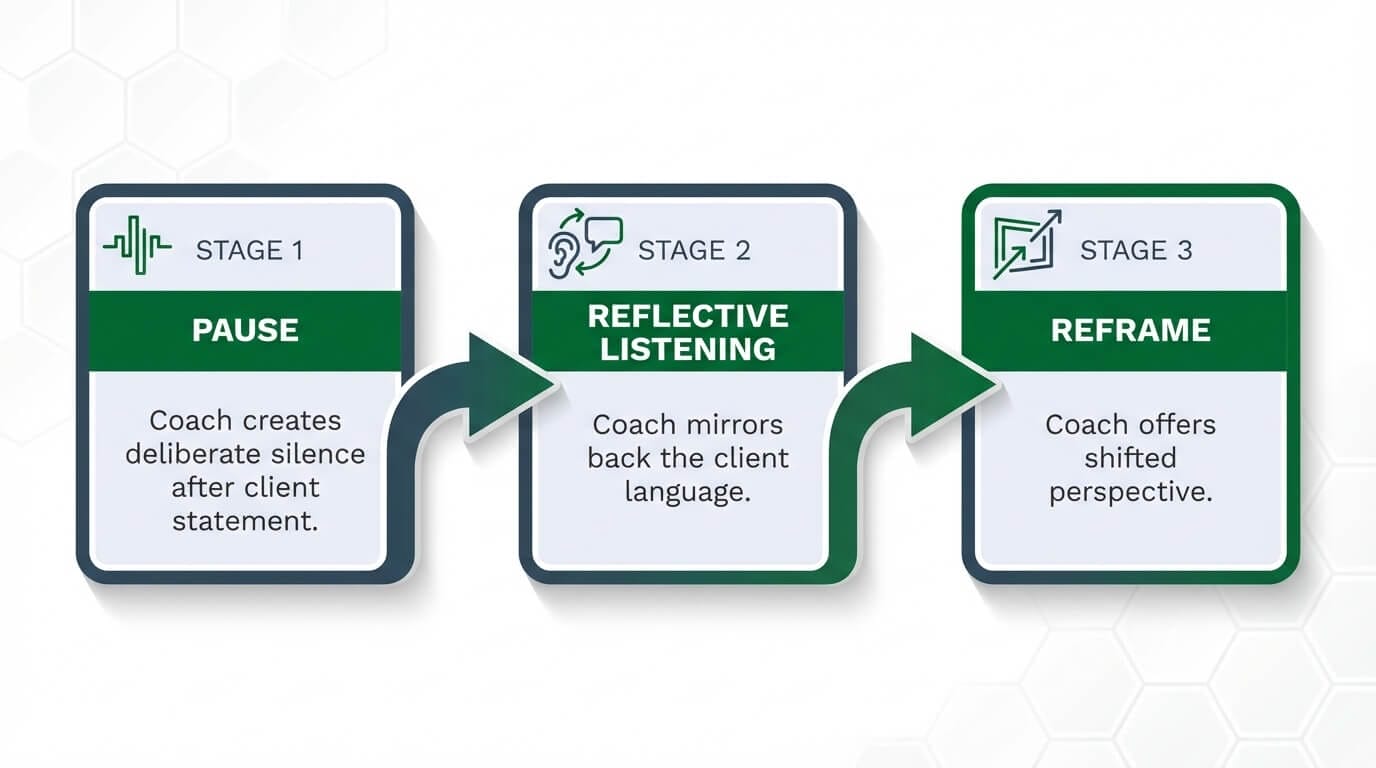
Consider a session where a coachee discloses she was passed over for a promotion she expected. The natural instinct is to move to problem-solving - what happened, what will you do differently. Instead, the coach holds a strategic pause and lets the disclosure land. Then reflective listening: "You were expecting that role and it went to someone else." A second pause. Only after the coachee says "yes, and I think I know why" does the coach move to a Socratic question.
If questioning had followed the disclosure directly, the coachee would have answered from a defensive posture - justifying, explaining, rationalizing. The pause-listen-pause sequence moved her from reaction to reflection on her own terms.
Each technique changes the session conditions for whatever follows. A pause creates the conditions for reflective listening to land. Reflective listening creates the conditions for Socratic questioning to reach the coachee's own thinking rather than their defenses.
The reframe was never needed because the coachee reframed herself once she had the space. That is what good technique selection actually looks like.
Techniques and Coaching Models
Techniques operate inside coaching models, but the relationship is not a fixed assignment. A model like GROW provides the session architecture - Goal, Reality, Options, Will - and techniques are the moves that make each phase productive. The GROW model maps usefully to specific techniques, but the model phase does not dictate the technique choice.
In GROW's Reality phase, reflective listening and scaling questions do most of the work - helping the coachee articulate where they actually are rather than where they think they should be. The Options phase relies on Socratic questioning and appreciative inquiry to surface possibilities the coachee has not considered. Will and Way Forward use accountability check-in language and visualization to move from intention to commitment.
But the mapping is not rigid. A reframe can appear in any GROW phase. Strategic silence works everywhere. The model tells you what the session needs to accomplish in a given moment; the technique is how you accomplish it. Coaches who treat model phases as technique prescriptions ("Reality phase means scaling questions") lose the flexibility to respond to what the coachee is actually doing in the room.
How Technique Use Changes: ACC to PCC
ACC-level coaches learn techniques individually and practice correct execution. PCC-level coaches deploy techniques with session-level awareness - reading the conditions and choosing the right tool for the moment, not the model phase. The progression from ACC to PCC is not about learning more techniques. It is about knowing when not to use one.
The most visible difference between ACC and PCC technique use is negative space. An ACC coach uses techniques when the model tells them to - they are executing a sequence. A PCC coach uses techniques when the session tells them to - they are reading conditions. The same scaling question deployed at the right moment lands differently than one deployed because the GROW model says you are in the Reality phase.
At PCC level, you see coaches deliberately choosing NOT to use a technique. An ACC coach might feel obligated to ask a scaling question because that is what they learned for this type of moment. A PCC coach recognizes that the coachee is already in motion and a scaling question would interrupt rather than clarify. The absence of a technique becomes as intentional as its presence.
Developing this kind of technique selection criteria requires supervised practice - peer coaching, mentor coaching, recorded sessions with feedback. Our ICF ACC program builds this progression deliberately: techniques first, then session-moment awareness, then the judgment to hold back.
An ACC coach deploys a technique because the model says to. A PCC coach deploys it because the coachee is ready. One is following a script; the other is reading the room.
Common Misapplications
The most common technique error is not choosing the wrong technique - it is applying the right technique at the wrong time. Mechanical application without reading session conditions produces technically correct coaching that misses the coachee. The coach hits their marks while the coachee disengages because none of it responds to what they actually brought into the room.
Over-reliance on a single technique is the second pattern. The coach who scales everything reduces every coachee experience to a number. The coach who only asks questions never offers the reflective listening that makes questions land. Technique diversity matters - not to show range, but because different session moments require different tools.
Filling silence too quickly is the third. Most coaches abandon a strategic pause after 3 seconds. The coachee was about to arrive at something - and the coach's next question pulled them back to the surface.
Reading this guide and memorizing all 10 techniques will not make you able to deploy them reliably in a live coaching session. Technique knowledge and technique access are different things. Access comes from repetition under conditions that approximate real sessions - mentor coaching, peer practice, recorded review. This guide gives you the map. Supervised practice gives you the territory.
Frequently Asked Questions
What is the most useful coaching technique?
Strategic silence. It requires no words, creates space for the coachee to think, and improves the effectiveness of every other technique that follows it. It is also the technique most coaches underuse because the discomfort of silence feels like failure. If you practice one technique, practice the pause.
How many coaching techniques should a coach know?
A working repertoire of 8-12 core techniques covers the vast majority of coaching session moments. The goal is not to accumulate techniques but to develop reliable access to the ones you know. A coach who can deploy 6 techniques with precise timing will outperform a coach who knows 20 but applies them mechanically.
Can coaching techniques be used in management?
Several coaching techniques for managers translate directly: reflective listening, scaling questions, and accountability check-ins work well in one-on-ones and performance conversations. The constraint is role clarity - a manager using Socratic questioning needs to be transparent about whether they are coaching or directing. Mixing the two without signaling the shift erodes trust.
ACC Certification — $3,999
60+ training hours, mentor coaching, and supervision included. Everything ICF requires for your Associate Certified Coach credential.
See the ACC Program →