How to Structure a Coaching Conversation That Actually Moves
Key Takeaways
- Session structure is not a model to follow - it is a meta-skill that operates underneath whatever model you use, and it develops through practice, not study.
- The pivot point between exploration and commitment is the moment most coaches either force too early or miss entirely. Recognizing it changes how every session closes.
- Five self-assessment questions, one per session phase, give you a supervision-ready tool that connects directly to ICF Competencies 4, 6, 7, and 8.
- Structure without presence produces sessions that look correct on a recording and feel hollow in the room - both develop with practice, and neither substitutes for the other.
- The client's version of the session is the one that matters. When the coach's summary replaces the client's synthesis, ownership of the insight transfers to the wrong person.
The Gap Between Skills and Sessions
Halfway through a coaching session, a coach realizes they have been asking questions designed to move the conversation forward rather than questions designed to open it up. The client is answering each one. The session is progressing. But nothing is actually changing.
That gap - between a productive-seeming conversation and a coaching conversation - is what most practitioners bump into after they learn the competencies. You can know what active listening is. You can understand what powerful questions do. You can describe GROW from memory. And you can still sit down for a 45-minute session and not know how to put it all together.
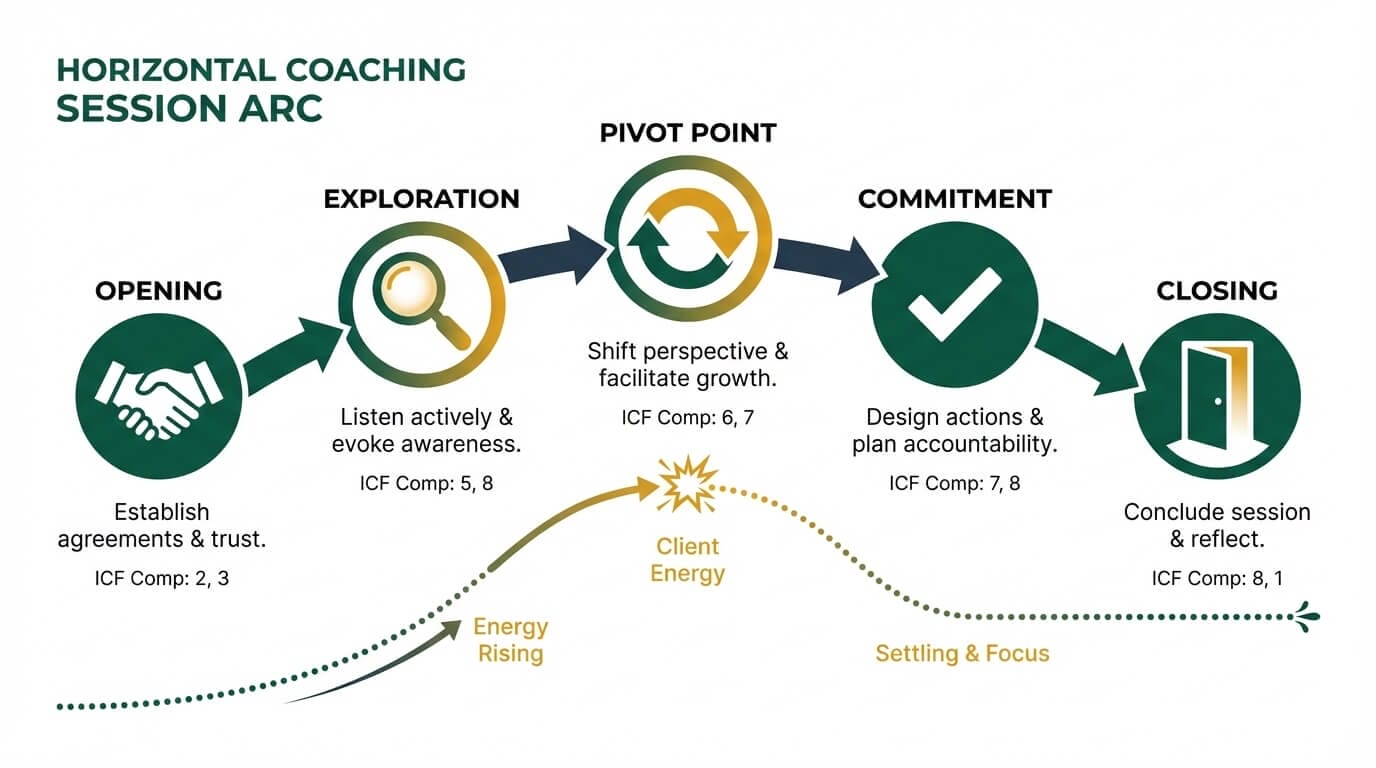
Session structure is the meta-skill that addresses this. It is not a model - GROW, CLEAR, and OSCAR are models. Structure is the architecture inside which the skills that each conversation phase activates actually operate. This article covers how a coaching session flows from opening to closing, what the coach is doing at each phase, and how to use this framework for honest self-assessment.
Opening the Session
The first five to ten minutes do three things: establish how the client is arriving, surface what they want from this session, and create enough safety for the real work to begin. Most coaches get at least one of these wrong in a way that shapes the rest of the session.
The check-in is not small talk. It is an active read of the client's current state - their energy, whether they are still carrying something from the meeting they just left. A coach who skips this and opens with "so what are we working on today?" is asking the client to perform readiness they may not feel.
Contracting follows the check-in. At its core, contracting is contracting as the trust-setting opening - a brief negotiation about what the client wants to leave with today. At ACC level, this often sounds scripted: "What would make this session successful for you?" At PCC level, the language responds to what the check-in revealed: "it sounds like the team situation is weighing on you - is that where you want to focus, or is there something underneath it?"
Two opening errors show up repeatedly. The first is rushing to the topic before the client has arrived - hearing a presenting issue in the first sentence and coaching it before the client has oriented. The second is over-contracting: spending fifteen minutes refining the goal before any coaching happens, turning the opening into a planning session.
GROW as one common structural approach maps a useful framework for goal-setting in the opening. But the opening is not only about the goal. It is about coach and client settling into the session, which is different from establishing a topic.
The Exploration Phase
The exploration phase is the heart of the session - typically fifteen to twenty minutes of following the client's thread without directing it. The coach stays with the client's thinking as it develops, using questions at the moments the client's current frame is running out, noticing energy shifts and following them.
What the session is doing during exploration is moving from the client's surface account toward the thing underneath it. The client arrived with a narrative. The exploration phase tests that narrative - not by challenging it directly, but by creating space for the client to hear themselves think about it differently.
Three signals tell you the exploration phase is working, as opposed to a session that is stuck in the opening:
- The client is saying things they had not thought before entering the session. New language is appearing, not rehearsed descriptions.
- The client's language is shifting from descriptive to analytical. They move from telling the story to examining it.
- Your internal experience as the coach is one of genuine curiosity, not planning. If you are calculating your next question while the client speaks, the exploration has stalled.
ICF Competency 6 (Listens Actively) and Competency 7 (Evokes Awareness) are most active here. What the competencies measure is whether the coach is listening across the session arc - tracking what the client is saying, what they are not saying, and what is shifting in how they talk about it. The coach who can do this produces sessions where the client arrives at their own insight.
How questioning works within session flow matters most during exploration. The difference between a question that opens something and a question that confirms what the coach already thinks becomes audible in this phase.
The Pivot Point
Every coaching session has a natural inflection where the client has gone far enough into exploration that they are ready to look forward. Recognizing this pivot is one of the least-discussed and most consequential session skills a coach develops.
The pivot sounds like the client shifting from adding new information to processing what they have already said. They stop elaborating and start asking themselves "so what does this mean?" or "what am I going to do about this?" Sometimes it is even simpler: a long exhale, a pause, a change in posture. The client has found something and is sitting with it.
Two coaching errors live at the pivot point. The first is forcing it. The clock-watching coach who feels time pressure and asks "so what are you going to do?" before the client has reached their own readiness produces a compliant action plan with no energy behind it. The second error is never pivoting at all. The coach who stays in exploration indefinitely produces sessions that are rich with insight but leave the client without forward motion. After forty-five minutes of deep conversation, the client walks out saying "that was a good session" and then does nothing differently.
The pivot question that works is more like "what's becoming clear for you?" than "so what are you going to do?" The first meets the client where they are. The second imposes a direction the client may not be ready for. One word separates a coach who facilitates insight from a coach who assigns homework.
A compliant action plan and a genuine commitment sound almost identical in the session. The difference shows up three days later when one gets done and the other doesn't.
Building Toward Commitment
After the pivot, the session moves toward commitment - helping the client identify what they want to do with what they have explored. This phase is explicitly about the client's agency. ICF Competency 8 (Facilitates Client Growth) measures whether the commitment comes from the client or from the coach's sense of what should happen next.
The questions here are different from exploration questions. They are forward-facing and specific: "What is one thing you could do before our next session?" or "What does this open up for you?" or "What are you taking away from today?" Each one invites the client to name their own action rather than accept one.
When a weak commitment appears - the client says "I guess I should probably talk to my manager" without conviction - the coach's role is not to accept it. It is to explore what would feel more real. "You said 'I guess I should.' What would you actually want to do?" That question separates commitment from compliance. A coachee who leaves with genuine energy behind a commitment will follow through. One who leaves with an obligation agreed to under session pressure will not.
The commitment phase typically runs ten to fifteen minutes. The balance is one clear commitment the client can articulate in their own words, specific enough that both coach and client will recognize whether it happened.
Closing the Session
The last five minutes of a session do two things: synthesize what happened and acknowledge the client's work. Both are harder than they sound, and most coaches default to one while neglecting the other.
Synthesis is brief and client-led. The coach asks "what are you taking away from today?" rather than delivering a summary. When the coach over-summarizes - recapping every insight and every topic - the close turns into a lecture. The client's experience of the session gets replaced by the coach's interpretation of it. A good synthesis is three sentences from the client, not three paragraphs from the coach.
You do not learn session structure by studying it. You learn it by running sixty sessions badly, noticing what went wrong, and running sixty more.
Acknowledgment is the part new coaches skip. It is specific, behavioral, and about the client's work: "I noticed you said something today that I do not think you had words for when we started" or "the way you reconsidered your initial reaction took real honesty." This is not praise. It is the coach naming what was present in the conversation.
Two closing errors appear consistently. First, no synthesis - the session ends at the commitment and the coach says "see you next week," leaving the client with no frame for what happened. Second, the coach summarizes instead of the client. The coach's version of the session is always different from the client's. When the coach's version wins, the client loses ownership of their own insight.
Presence Through the Whole Session
Session structure is not what the coach is managing. It is what the coach is working inside. Underneath the five phases, the coach is attending to four things simultaneously: the client's energy, the time, the session arc, and their own reactivity. Maintaining presence through the whole session is what keeps structure from becoming mechanical.
A session that is structurally sound but presence-empty feels like filling out a form. The check-in feels perfunctory. The questions are well-timed but impersonal. The commitment gets recorded but not held. Structure without presence produces sessions that look correct on a recording and feel hollow in the room.
The coach who can tell you what phase the session is in while staying fully present with the client has internalized structure. The coach who has to think about it is still performing it.
What presence through the whole session actually looks like: the coach notices that thirty-five minutes have passed and the pivot has not happened yet, and makes a move without forcing it. The coach registers their own impulse to offer a reframe and chooses to hold it for ten more seconds. The coach senses that the client's energy dropped when they named their commitment and pauses to ask about it instead of writing it down.
This is the specific skill that separates a coach who follows a structure from a coach who inhabits one. The structure provides the architecture. Presence is the quality of attention the coach brings to each room in that architecture. Both develop with practice. Neither substitutes for the other.
Session Self-Assessment Checklist
These five questions are designed for your next mentor coaching or peer supervision session. Each one maps to a session phase and its corresponding ICF competency. Rate your most recent session honestly - not your best session, your most recent one.
Get Structured Feedback on Your Sessions
Self-assessment reveals the questions. Mentor coaching reveals the answers. Our ACC program includes dedicated mentor coaching hours where experienced MCCs observe your sessions and give you the feedback these five questions point toward.
- Opening (ICF Competency 4): Did the check-in and contracting establish what the client actually wanted from today - or did I start coaching before they had fully arrived?
- Exploration (ICF Competency 6): Did the exploration reach something beneath the client's initial account - or did I stay at the level of the presenting issue?
- Exploration (ICF Competency 7): Did the client say something during exploration that surprised them - or were they confirming what they already knew?
- Pivot and Commitment (ICF Competency 8): Did the commitment come from the client's energy - or from a sense of obligation to leave the session with an action item?
- Closing: Did the close leave the client with an integrated experience of the session - or did it end with a task list?
If you are working toward your ACC or preparing for a performance evaluation, these questions connect directly to the competency areas assessors observe. An ICF ACC program will give you structured feedback on these skills through mentor coaching hours - but the self-assessment starts with the questions you bring.
How do you structure a coaching session?
A coaching session moves through five phases: opening (check-in and contracting), exploration (deep listening and questioning), pivot (the shift from exploration to forward motion), commitment (client-owned action), and closing (synthesis and acknowledgment). The structure is not rigid - it responds to the client's pace and what emerges in the session. Most sessions run 45-60 minutes, with the exploration phase taking the largest share of time.
How long should a coaching conversation be?
Most coaching sessions run 45-60 minutes. Shorter sessions (30 minutes) work for focused check-ins but compress the exploration phase. Longer sessions (90 minutes) are common in team coaching or at the start of an engagement. The time matters less than the coach's ability to manage all five phases within whatever duration is available.
What should happen at the beginning of a coaching session?
The beginning of a coaching session includes a check-in (how the client is arriving, not small talk), establishing the session topic, and light contracting - asking what the client wants to leave with today. This typically takes 5-10 minutes. The most common opening error is rushing past the check-in to start coaching before the client has fully settled into the session.
How do you close a coaching conversation?
Close with two elements: synthesis (the client articulates what they are taking away, not the coach summarizing) and acknowledgment (the coach names something specific about the client's work). Check the commitment one final time and bridge to the next session. The close takes about five minutes. The client's version of the session is the one that matters.
After your next session, ask yourself two questions before you do anything else: What did the client say during exploration that they could not have said in the opening five minutes? And did the commitment they left with have energy behind it, or did it feel obligatory? Those two questions will tell you more about how the session was structured than any framework will.
From Skills to Sessions
Knowing the competencies is the starting point. Our ACC program teaches you how to put them together across a full session - from opening through pivot to close - with mentor coaching that gives you honest feedback on the parts you cannot see yourself.
Learn About the ACC Program →