Change Management: The Complete Guide for Leaders
Seventy percent of organizational change initiatives fail to meet their stated goals. McKinsey’s research across large-scale transformations established that number, and it has been cited so many times that most leaders gloss over it. The statistic has become wallpaper.
What receives far less attention is the pattern underneath it. The transformations that succeeded were not the ones with better frameworks, more detailed communication plans, or bigger budgets for training. They were the ones where senior leaders reported higher levels of personal engagement with their own development during the initiative. Not learning more about change management methodology. Learning more about themselves as leaders of change. Developing the self-awareness, the emotional resilience, and the stakeholder navigation skills that no project plan accounts for.
That distinction matters because it reframes the entire discipline. Change management is not one problem with one solution. It requires both structured methodology and leader capability development. Most organizations invest heavily in the first. Frameworks get purchased, consultants get hired, timelines get built. The people accountable for making the change real receive almost no developmental support. And then everyone wonders why 70% of initiatives stall.
The pattern holds across industries, organization sizes, and types of change. Mergers, restructurings, digital transformations, cultural shifts. The organizations that produce sustainable outcomes are not the ones with the most sophisticated change management apparatus. They are the ones where leaders developed through previous change rather than being depleted by it. Change capability is a leadership development outcome, not a project management deliverable.
What follows covers both dimensions of the discipline. The what: the models, the process, the skills, the metrics that give change management its structure. And the who: the leaders who carry the work, their development needs, and the coaching approach that makes methodology produce lasting results instead of temporary compliance. If you are leading change right now, sponsoring it, or supporting the people who carry it, both dimensions matter. Neither is optional.
Key Takeaways
- Change management requires both structured methodology and leader capability development — most organizations invest in frameworks but underinvest in developing the people who carry the change.
- The 70% failure rate is not a methodology problem. It correlates with insufficient developmental support for the leaders responsible for sustaining the initiative.
- No single model (Kotter, Lewin, ADKAR, Bridges) is universally superior — each offers a different diagnostic lens. Match the model to the complexity.
- Coaching develops leader capacity that frameworks assume already exists: emotional resilience, stakeholder navigation, and comfort with ambiguity under pressure.
- Measure leader growth alongside process metrics. If the people who carried the change are depleted rather than developed, the next initiative starts from a deficit.
What Change Management Actually Requires
Change management is the discipline of preparing, supporting, and developing people to adopt new ways of working so that an organization achieves its intended business outcomes. It combines structured processes for planning and executing change with intentional development of the leaders and teams responsible for sustaining it.
The roots of the discipline trace back to Kurt Lewin’s work on planned change in the 1940s. As Burnes (2004) documented in the Journal of Management Studies, Lewin understood that changing human behavior within organizations required more than new instructions. It required shifting the forces that held existing behavior in place. That insight, nearly eighty years old, still gets overlooked in practice.
Not all change work is the same. There are meaningful differences between process installation, adoption, and genuine transformation. Process installation is mechanical: new system goes in, people learn to use it, existing workflows adjust. Adoption goes deeper: people change how they think about their work, beyond what tools they use. Transformation reaches the organizational identity itself, altering culture, values, and shared assumptions about how things get done. Each level requires a different scope of investment, a different timeline, and a different kind of support for the people leading it.
Most organizations say “transformation” when they mean “installation.” The mismatch creates problems that surface months later. Leaders plan a twelve-week rollout for something that actually requires eighteen months of developmental work. The timeline looks reasonable on paper. The human reality is different. Understanding the types of organizational change and which one you are actually facing is the first decision that shapes everything downstream.
Prosci’s benchmarking data across thousands of change initiatives found that organizations with effective change management are six times more likely to meet their project objectives. The word “effective” carries weight in that sentence. The most frequently cited barrier to effective change management in the same research is not budget, technology, or timeline. It is ineffective sponsorship from senior leaders. The methodology exists. The capability to execute it is what separates the benefits of structured change management from unfulfilled promises.
Why Change Initiatives Fail
The common explanations for failed change are familiar: poor communication, insufficient sponsorship, inadequate resources, resistance from employees. These explanations are accurate and incomplete. They describe symptoms. The root cause runs deeper.
When the Plan Is Fine—But the Change Isn’t
Get an outside lens on the real blockers: leader depletion, weak sponsorship, and adoption gaps that dashboards won’t show.
Across organizations of different sizes, industries, and levels of change management sophistication, a pattern repeats: underdeveloped leaders executing well-designed plans. The strategy is sound. The stakeholder map is thorough. The timeline is realistic. The leader tasked with making it real has never been developed for the demands the initiative places on them. Nobody builds a change plan that includes developing the person accountable for its success.
Three failure patterns show up consistently.
Process before people. The plan runs on schedule. Milestones get checked. Training sessions fill up. Meanwhile, the leaders running the initiative are burning out, losing credibility, or quietly disengaging from the work they are supposed to be championing. The process is proceeding. The people executing it are deteriorating. Gallup’s workplace research consistently shows that employee engagement drops sharply during poorly managed organizational change, and the first place it drops is among the leaders and managers carrying the heaviest load.
Compliance masquerading as adoption. Behavior changes without mindset changes. People attend the training, update their dashboards, use the new terminology in meetings. Remove the oversight and they revert. What looked like adoption was compliance with a shelf life. The difference only becomes visible six months after the project is officially complete, when the metrics start sliding backward and nobody can explain why.
The middle manager crush. Caught between leadership pushing the change and teams resisting it, with no development support and no safe space to process their own doubts about the initiative. Middle managers are the load-bearing structures of organizational change. When they stop believing, adoption stalls regardless of what the dashboards show. And they are the most likely to leave, taking institutional knowledge and team trust with them.
Consider a Director-level leader tasked with integrating two teams after a merger. She has the integration playbook, the communication timeline, the executive sponsor’s endorsement. Six months in, the initiative is on track on paper but dead in practice. The VP sponsor has stopped attending check-ins. Middle managers comply publicly and revert privately. She knows something is wrong, but the framework does not have a step for what to do when the plan is working and the change is not.
The gap between plan and reality is where coaching accelerates change outcomes. And the earlier organizations start assessing change risks that include leader readiness alongside operational readiness, the better the odds become.
The gap between knowing what a difficult conversation requires and actually having that conversation in front of a skeptical team is the gap coaching closes.
Models and Frameworks Worth Knowing
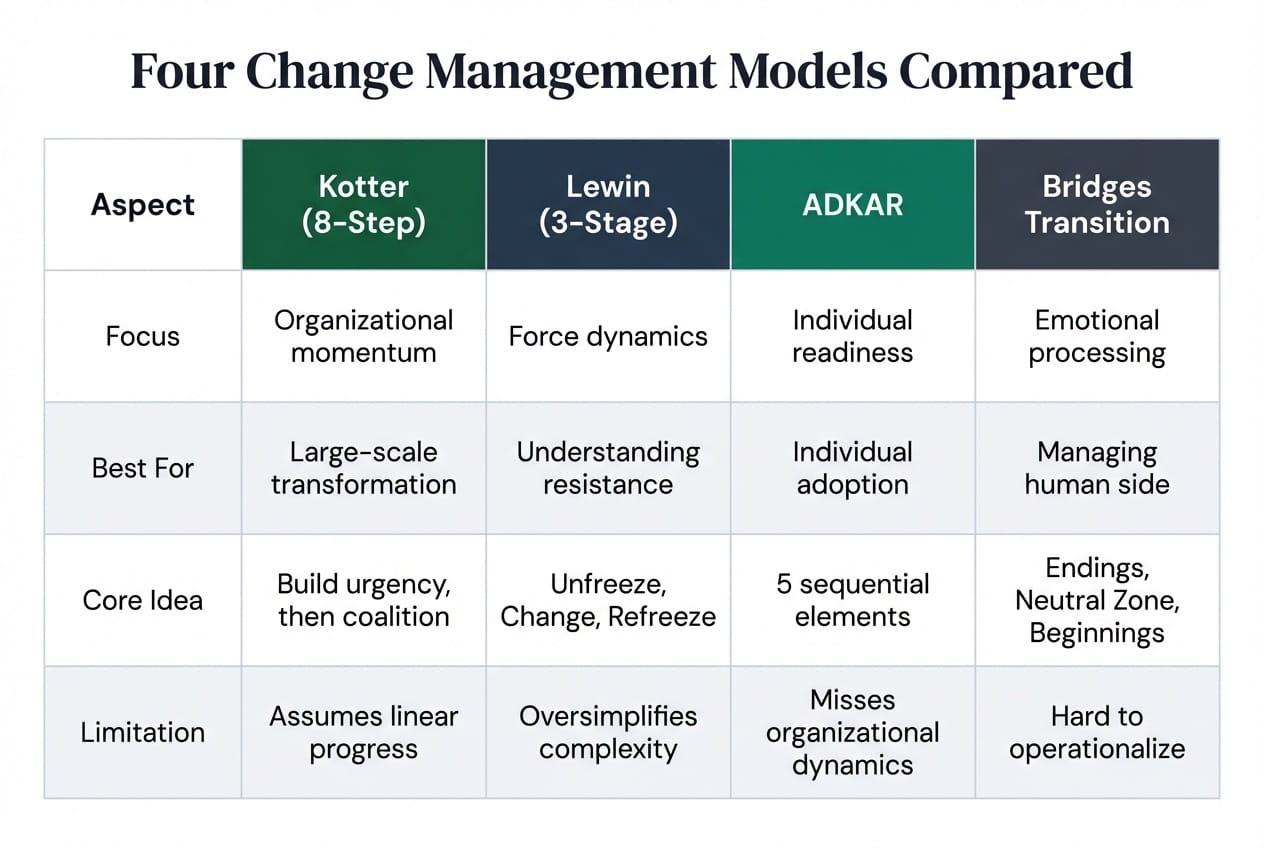
Several established models give structure to organizational change. Each was built from a different set of assumptions about how change works. None is universally correct. The decision is not which framework is best but which one fits the situation, the organizational culture, and the leader’s own developmental stage. You can compare change management frameworks in depth, but here is the practitioner perspective on each.
Kotter’s 8-Step Process
The most frequently cited change model, and directionally right. Kotter’s eight steps describe what needs to happen during a major transformation: establish urgency, build a coalition, form a vision, communicate it, remove obstacles, create short-term wins, consolidate gains, anchor in culture. What the model does not describe is what leaders experience between the steps. “Create urgency” is a coaching conversation, not a slide deck. “Build a guiding coalition” requires political navigation skills that no framework teaches. In organizations where everything is perpetually urgent, Step 1 is not creating more urgency. It is rebuilding credibility by finishing something before starting something new.
Lewin’s Unfreeze-Change-Refreeze
The simplest and most enduring change model. Its power is in the “unfreeze” concept: people cannot move toward new behavior until the forces holding old behavior in place are loosened. Lewin’s force field analysis, often overlooked in favor of the three stages, provides a practical diagnostic for identifying what sustains the status quo. The limitation practitioners discover: “refreezing” assumes a stable end state. In organizations running multiple changes simultaneously, nothing refreezes. The model still works as a diagnostic lens. It is less useful as a project plan.
ADKAR (Prosci)
ADKAR operates at the individual level: Awareness, Desire, Knowledge, Ability, Reinforcement. This makes it the most directly applicable model for coaching conversations, because each element maps to a question about where a specific person is stuck. What ADKAR does not show: these stages rarely unfold sequentially. People form opinions about a change the moment they hear about it. Awareness and Desire often collapse into a single reaction. The diagnostic value is real. The neat progression in the diagram overstates the linearity.
Bridges Transition Model
William Bridges distinguished between change (external, situational) and transition (internal, psychological). Change is what happens to people. Transition is what happens inside them. The model names three phases: ending, neutral zone, new beginning. The practical insight many change leaders miss: people cannot begin something new until they have processed the ending of what came before. Skipping the grief accelerates the timeline on paper and slows actual adoption.
| Model | Primary Lens | Practitioner Insight |
|---|---|---|
| Kotter 8-Step | Leadership-driven, sequential | Works when executive commitment is genuine, struggles when urgency is manufactured |
| Lewin | Psychological forces | Strongest as a diagnostic; weakest as a project timeline |
| ADKAR | Individual adoption | Maps directly to coaching conversations; overstates linear progression |
| Bridges Transition | Internal psychological experience | Explains why technically complete changes still feel unfinished |
The Change Management Process
Change management unfolds across four broad phases: assessment, planning, implementation, and reinforcement. This is not a prescriptive step-by-step. How an organization moves through each phase depends on the type of change, the organizational context, and the capacity of the leaders involved. What matters more than the sequence is what gets included at each stage, and what usually gets left out.
Assessment typically covers organizational readiness: stakeholder analysis, impact assessment, current-state documentation. Standard practice. What is almost always missing: an honest assessment of the leaders who will carry the initiative. Are they developed for this work? Have they led change before? Do they have the self-awareness and emotional resilience the situation will require? Organizational readiness without leader readiness produces a plan that looks complete and collapses under pressure.
Planning produces the communication strategy, the training schedule, the stakeholder engagement plan. Solid work, and necessary. The missing dimension is a development plan for the leaders themselves. What will they need to learn, practice, and develop during the initiative? Who supports them when the plan meets reality and the two do not match? Effective planning includes development milestones for the people driving the change management process, alongside communication schedules for the people receiving it.
Implementation is where the gap between plan and reality becomes visible. The standard activities proceed: communications go out, training happens, new processes launch. The human-development dimension that standard content omits: real-time support for the leaders executing the plan. When the first major setback hits, when a key stakeholder withdraws support, when the middle management layer starts showing signs of fatigue, what happens? In most organizations, nothing structured. The leader improvises. If you are building a change management plan, the implementation section is where coaching support earns its return.
Reinforcement measures what stuck. Standard metrics track adoption rates, timeline adherence, satisfaction scores. Useful data. Insufficient data. The reinforcement phase should also measure whether the leaders who carried the initiative are more capable now than when they started. If the answer is no, the organization consumed human capital to produce the change rather than building it. The next initiative starts from a deficit. Reinforcement that includes leader growth alongside process metrics is what separates one-time change from sustained change management activities and exercises that build organizational capability over time.
The Coaching Approach to Change
Every framework described above answers the same question: what should happen during organizational change? None answers a different question: how does a leader develop the capacity to make it happen under pressure, ambiguity, and active resistance?
That question is not a gap in the frameworks. It is simply outside their scope. Frameworks describe the process. Coaching develops the person responsible for the process. The two are complementary. Organizations that invest in both produce successful change that persists after the engagement ends.
Three dimensions distinguish coaching-led change from process-only change.
Developing leader capacity, not just leader knowledge. Most leaders tasked with organizational change do not lack information. They have read the books, attended the workshops, possibly earned a certification. What they lack is the ability to act on what they know when the situation is ambiguous, when stakeholders push back, when their own confidence wavers. Coaching does not give leaders more content. It develops their capacity to perform under the conditions that real change creates. The difference between knowing what a difficult conversation requires and actually having that conversation in front of a skeptical team is the difference coaching closes.
Sustainable change versus temporary compliance. When a consultant or external expert becomes the force holding changes in place, the change lasts exactly as long as the external presence does. The moment the consultant leaves, the organization rolls back to what is familiar. The consultant was the forcing mechanism. Coaching takes a fundamentally different approach. Instead of installing the change and hoping it holds, coaching develops the internal leaders so they can sustain the change independently. The test of a coaching engagement is not whether things improved while the coach was present. It is whether improvements continued after the coach left.
Commitment, not compliance. There is a meaningful difference between people who follow a new process because they are being watched and people who follow it because they understand why it matters. Installing compliance is fast. Developing genuine commitment takes longer. And commitment is what survives the moment organizational attention moves to the next priority. The invitational approach to organizational change, described in Enterprise Agile Coaching, starts with a fundamentally different assumption: the people inside the organization are competent, creative, resourceful, and capable of leading the change themselves. Coaching does not bring the answers. It develops the leaders’ capacity to find and implement their own.
An honest limitation belongs here. Coaching cannot fix a fundamentally flawed strategy. If the merger should not happen, the restructuring is solving the wrong problem, or the transformation exists because someone needs to justify their role, coaching does not make it right. What coaching does is help leaders see more clearly. Sometimes that means the coaching engagement surfaces the need to stop the change, not accelerate it.
Consider an organization that ran a transformation using a directive approach. Initial metrics looked strong: new processes adopted, training completed, KPIs met. Twelve months later, the most capable people had left. The remaining teams were doing the minimum to avoid attention. A second engagement started not with a new process but with developing leaders who understood why the change mattered, not just what to do. The change that followed was slower to start. It did not roll back.
The ICF Global Coaching Study found that organizations investing in coaching reported improvements in productivity, team effectiveness, and employee engagement. Those returns increase during periods of change because the developmental work is addressing the exact capability gap that causes change initiatives to fail. For a deeper treatment of how coaching operates within the coaching approach to change management, see the supporting article.
Skills That Make Change Leaders
The capabilities that distinguish leaders who sustain change from those who simply survive it are not innate traits. They are developmental capacities, which means they can be built. That distinction matters because it shifts the conversation from “do I have what it takes?” to “what do I need to develop?”
Emotional intelligence under operational pressure. Not emotional intelligence as a concept on a leadership assessment. Emotional intelligence as a practiced capability when the team is anxious, the timeline is slipping, and the executive sponsor is losing patience. Most leaders understand emotional intelligence intellectually. Far fewer can access it when it matters.
Stakeholder navigation. The ability to hold multiple perspectives simultaneously without losing your own position. Change affects different groups differently. What looks like progress to one team looks like loss to another. Leaders who sustain change learn to move between those perspectives without pretending the tensions do not exist.
Adaptive communication. Saying the same thing differently depending on who needs to hear it and what they need to hear first. The executive sponsor needs strategic alignment. The middle manager needs operational clarity. The front-line team needs honest acknowledgment that the change is hard. One message does not serve all three audiences, and the leader who tries to use one message for all of them loses credibility with everyone.
Comfort with ambiguity. Organizational change is not a linear process, and the leaders who need certainty before they act will wait too long. Comfort with ambiguity is the capacity to make decisions with incomplete information, communicate confidence without false certainty, and adjust course when new information arrives without treating every adjustment as evidence of failure.
Self-awareness under pressure. The most consequential change leadership skill, and the one least likely to appear on a competency framework. Knowing how you respond when things go wrong. Knowing your patterns of avoidance, your triggers, your tendency to control when you feel uncertain. Without self-awareness, every other skill becomes performative. People see through performative leadership faster than leaders expect.
Each of these is coachable. Each develops through practice, reflection, and honest feedback rather than through reading or training alone. That is why the essential change management skills are developmental outcomes, not checkboxes. And it is why leading through organizational change requires a different kind of preparation than leading in stable conditions.
Measuring What Matters
Standard change management metrics track the process: adoption rates, milestone completion, training attendance, timeline adherence, satisfaction surveys. These are necessary and insufficient. They measure whether the plan ran. They do not measure whether people changed.
The most common measurement failure in change management is tracking activities rather than outcomes. A 95% training completion rate tells you people sat in the room. It tells you nothing about whether they understood the material, agreed with the direction, or changed how they work afterward. An adoption dashboard showing new system usage rates tells you people logged in. It does not tell you whether they trust the new process or are doing the minimum to avoid escalation.
A 95% training completion rate tells you people sat in the room. It tells you nothing about whether they changed how they work.
Alongside operational KPIs, consider coaching-informed metrics that measure the human dimension of change:
Leader capability growth. Are the leaders carrying this initiative more capable now than when they started? Can they articulate what they have learned about themselves, their teams, and the organization through this experience? If not, the organization consumed leadership capital to produce the change rather than building it.
Relationship quality. Not stakeholder satisfaction scores but actual relationship quality between the change leaders and the people affected by the change. Trust, credibility, and willingness to have honest conversations are leading indicators of whether adoption will hold.
Decision quality under ambiguity. How well are leaders making calls when the information is incomplete and the stakes are high? This is observable and trackable, though it requires more effort than pulling a number from a dashboard.
Team resilience. After the initiative, is the team more capable of absorbing the next change or less? If the answer is less, the organization spent human capital to produce this change. The next initiative starts from a deficit. Organizations that measure resilience alongside adoption learn something about their own sustainability that pure process metrics cannot reveal.
Data creates visibility. Visibility creates the conditions for honest conversation about what is actually happening versus what the dashboards say is happening. That conversation is where measurement becomes useful rather than performative. For a complete framework on measuring change management success, see the supporting guide.
Change at the Organizational Level
Organizational change is not individual change at scale. An organization is a system with culture, power dynamics, structural interdependencies, and institutional memory that no individual-level framework fully addresses. Changing a process inside that system produces different results depending on where the organization sits on the complexity spectrum.
Simple process changes (new expense reporting software, updated safety protocols) need clear communication, adequate training, and consistent reinforcement. Complex cultural transformations (post-merger identity integration, shifting from command-and-control to collaborative leadership) need something different entirely. Matching the intervention to the complexity of the situation is a practitioner skill that methodology alone does not teach. Organizations that apply a simple-domain playbook to a complex-domain challenge get the 70% failure rate they deserve.
The executive sponsor role is where managing change at the organizational level succeeds or stalls. An engaged sponsor who understands the change, communicates the rationale, and visibly supports the people doing the work creates conditions where adoption can develop. A disengaged sponsor who approved the initiative, delegated its execution, and disappeared creates conditions where compliance is the ceiling.
Strategic alignment connects the daily experience of change to the organizational direction. When people understand why a change matters to the strategy — beyond what is changing — their relationship to the change shifts. They stop being objects of the change and start being participants in it. That shift from object to participant is what separates strategic change management from project management with a change label.
In complex environments, agile approaches to change that treat the initiative as a series of experiments rather than a fixed plan produce better results. Not because agile methodology is inherently superior, but because iterative approaches create feedback loops that rigid plans do not. The organization learns as it changes, which means the change itself becomes smarter over time. Real-world change examples consistently show that the organizations producing sustainable outcomes are the ones that built learning into the change process rather than bolting it on afterward.
Professional Development in Change Management
Professional development in change management offers two complementary paths that most practitioners treat as separate: methodology certification and coaching capability.
On the methodology side, Prosci certification, the Certified Change Management Professional (CCMP) designation, and APMG qualifications teach structured approaches to planning and executing organizational change. These programs develop important technical competence. They teach frameworks, tools, assessment methods, and implementation planning. For practitioners who need a structured foundation, change management certification paths provide it.
On the coaching side, ICF credentials (ACC, PCC, MCC) develop the ability to work with individuals and teams through developmental conversations that build capacity rather than install compliance. Coaching training develops listening, powerful questioning, presence, and the ability to hold space for someone working through uncertainty without rushing to a solution. These are not soft skills. They are the capabilities that determine whether a well-designed change plan produces lasting results or temporary compliance.
The bridge between these paths is where the strongest change practitioners operate. Kalina Terzieva, who holds both PROSCI certification and ICF coaching credentials, demonstrates that the two are complementary rather than competing. Methodology teaches the what and when of change management. Coaching develops the who: the leader’s capacity to implement the methodology under real organizational conditions. Both matter. Neither is sufficient alone.
For practitioners whose change management work lives inside larger initiatives, understanding how to integrate CM into project management ensures that the people dimension receives the same rigor as the technical and operational dimensions.
The patterns here connect across levels and functions: benefits of executive coaching, building resilience chance power coaching, scaling coaching through systems thinking, scrum has a messaging problem, and what expect coaching session.
Where This Leads
Every model in this guide describes what happens during change. None describes what happens to the person leading it.
That is not a criticism of the models. Kotter’s steps are sound. Lewin’s psychological foundations remain relevant. ADKAR maps usefully to coaching conversations. Bridges gives language to the internal experience of transition. These frameworks do important work. They organize complexity. They create shared vocabulary. They provide structure when the goals are clear but the path to achieving them feels chaotic.
What they cannot do is develop the leader sitting across the table from a skeptical team on a Tuesday afternoon when the plan is not working and the sponsor is losing interest. No framework substitutes for the developmental work that makes a leader capable of holding the complexity these models assume someone can hold.
Organizations don’t change. People inside them do.
The most change-ready organizations do not have change management departments. They have leaders who developed through previous change rather than being depleted by it. Their capacity grew because someone invested in their development alongside the change process.
If the pattern described in this guide matches something you are experiencing, the question is not whether your framework is right. The framework is probably fine. The question is whether the people accountable for making it real have the developmental support they need to grow through the experience rather than just survive it.
That is a question worth sitting with before the next steering committee meeting, the next town hall, the next difficult conversation with a team that is not sure this change is worth the cost. The answer will tell you more about where your initiative actually stands than any dashboard or status report.
Leading Change While Everyone Pulls You Apart?
Let’s map what’s happening beneath the plan—middle manager crush, compliance, and stakeholder drag—and choose a practical path forward.
Book a Free Consultation →