C-Suite AI Appointments: What the Org Chart Won’t Tell You
Three companies, one week, the same announcement. Sage recruited a Chief Product Officer and a Chief Strategy Officer to drive its AI work. Nokia named a new president for its mobile infrastructure division as it leans hard into an AI pivot. A Valencia startup closed a 2.6 million euro round to build an AI copilot for managers. Read the press releases side by side and they all say the same thing: we are serious about AI, and here is the org-chart move that proves it.
The move is real. Whether it proves anything is a separate question.
Here is the pattern worth watching. A new box appears on the org chart. A title gets minted. Everyone exhales, because the problem finally has an owner. Then, more often than not, nothing changes about how the company actually makes decisions. Anyone who has sat inside enterprise technology leadership has watched this happen with cloud, with agile, with digital. AI is the latest topic to get the treatment.
So the question for any leader watching their own organization reshuffle around AI is not who got the title. It is whether the system around that title is built to use it.
Key Takeaways
- A wave of C-suite AI appointments at Sage, Nokia, and others signals intent. Intent and capability are not the same purchase.
- A new title creates a reporting line. The organization still has to build the capability that title is supposed to deliver.
- The hardest AI question inside a company is not technical. It is who holds decision authority, and who is allowed to disagree.
- Organizational coaching works the seams between functions, where AI strategy actually succeeds or quietly stalls.
- When your own org reshuffles, name the decision rights before you celebrate the appointment.
What Actually Happened
Strip the announcements down to facts and a clear shape appears.
Sage, the FTSE-listed financial software company, brought in two senior executives to expand its position in the small and medium business market. Krish Vitaldevara joins as Chief Product Officer, Anand Swaminathan as Chief Strategy Officer, both based in San Jose. CEO Steve Hare framed the hires as continued investment in innovation and growth. The work itself centers on embedding AI across the company’s financial workflow platform.
Nokia’s move came wrapped in a stock story. The shares have climbed 112 percent since January on the strength of an AI infrastructure pivot, touching a new annual high before profit-taking pulled them back. To accelerate the shift, Nokia appointed Emma Falck as president of its mobile infrastructure division, effective September 2026. One detail in that announcement matters more than the rest: Falck replaces Tommi Uitto, whose departure was tied to strategic disagreements over the company’s direction.
Fresh People, the Valencia company, raised its round to scale Booster, described as a proactive copilot for managers. The pitch is that managing people has become an administrative burden, and the tool exists to remove that friction so managers can spend their attention on the team rather than the paperwork.
Different companies, different scales, one common instinct. Each treated AI as something you address structurally. You hire for it, you reorganize around it, or you buy a tool to carry it. That instinct is not wrong. It is just incomplete, and the gap is exactly where organizational coaching does its work.
The Org Chart Is Not the Organization
An org chart is a map of reporting lines. It tells you who answers to whom. It does not tell you how work actually moves, where decisions really get made, or which conversations happen in the hallway after the meeting ends. The chart is the official story. The organization is the real one, and the two are rarely identical.
This matters for AI appointments because a new title only edits the chart. Sage now has a Chief Product Officer and a Chief Strategy Officer. Both are, by all accounts, capable people. But the appointment itself does one concrete thing: it creates a reporting line. Building the capability that title is supposed to deliver is separate work, and that work happens in the parts of the organization the chart cannot show.
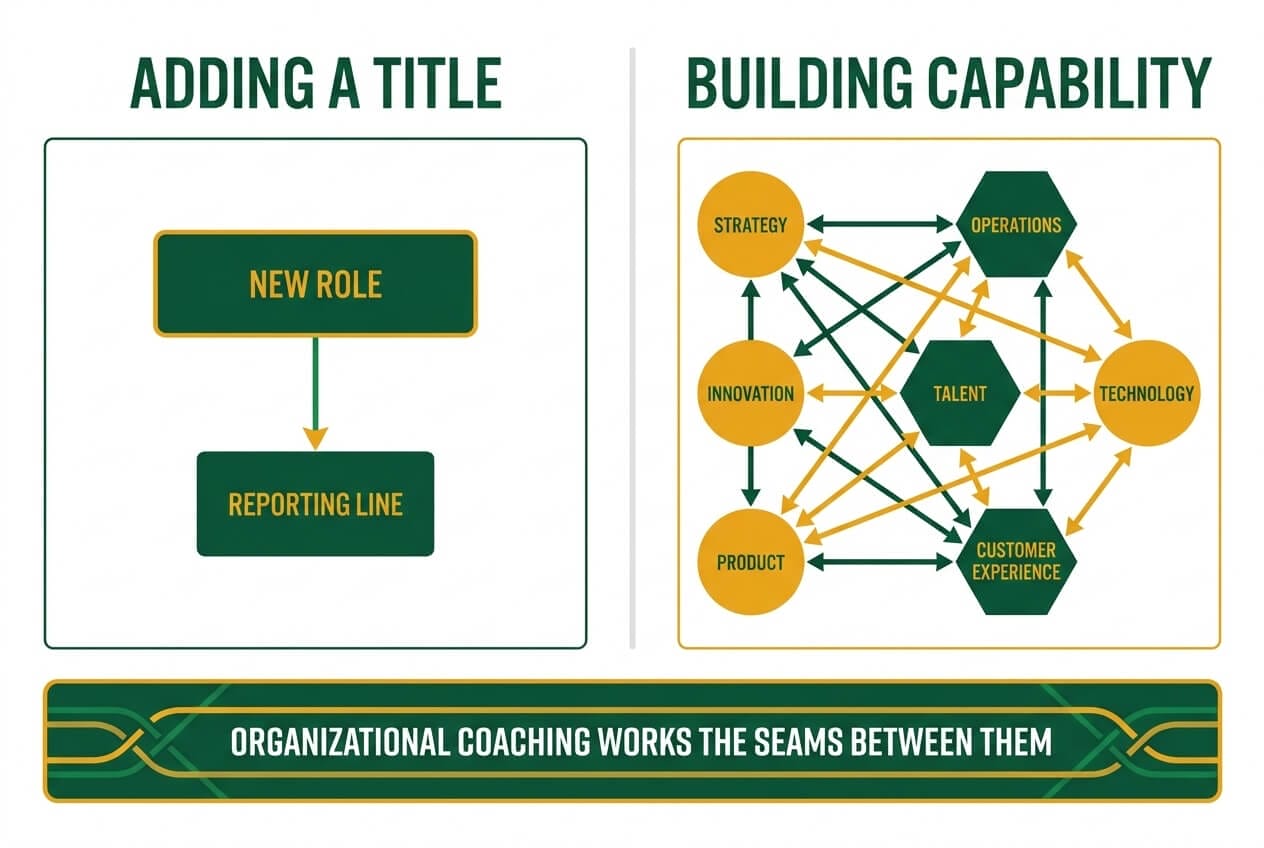
Think about what an AI initiative actually requires. Product has to decide what to build. Engineering has to decide what is feasible. Legal has to decide what is allowed. Finance has to decide what gets funded. Sales has to decide what gets promised to customers. Every one of those functions has its own incentives, its own risk tolerance, its own read on what AI means for its world.
A Chief AI Officer, or a Chief Product Officer with an AI mandate, sits on top of all that. The title gives them a seat. It does not give them agreement. If the functions underneath disagree about what AI is for, the new executive inherits the disagreement on day one. The org chart will look settled. The organization will not be.
This is the same trap that swallowed a decade of transformation work. Compliance is easy to install. You can announce a structure and have everyone nod. Capability is harder, because it lives in how people actually coordinate when no one is watching the chart.
Where Does AI Authority Actually Live?
Look again at the Sage announcement. The company hired a Chief Product Officer and a Chief Strategy Officer in the same breath. Product strategy and corporate strategy are close cousins, and AI sits right in the overlap. Who decides whether a given AI bet is a product call or a strategy call? The press release does not say, because press releases never say. The two executives will have to work that out between themselves, in real time, with real money on the line.
Stop Letting AI Authority Go Underground
When strategy disputes get solved by departures, you’re paying for ambiguity. Let’s clarify who decides what—and how dissent stays in the room.
That negotiation is the actual job. The titles are the easy part.
Nokia gave us the cautionary version. The executive being replaced, Tommi Uitto, departed over strategic disagreements about the company’s direction. That phrase is doing a lot of quiet work. It tells you that authority over the AI pivot was contested, that a senior leader did not agree with where things were heading, and that the disagreement was resolved by one person leaving rather than by the system absorbing the tension. Sometimes that is the right outcome. Often it is just the expensive one.
Here is the question that actually matters when a company restructures around AI. Not who has the title. Who decides, and who is allowed to disagree with the decision and stay?
Authority that is announced but never negotiated does not disappear. It goes underground, and it surfaces later as the resignation nobody saw coming.
An organization that can hold disagreement in the open has a real shot at using AI well, because the hard tradeoffs get argued where everyone can see them. An organization that drives disagreement underground gets the Nokia outcome on repeat: a clean org chart, a string of departures, and a strategy that lurches whenever the loudest voice changes. The chart never shows the difference. The behavior always does.
The Copilot Question
Fresh People’s Booster raises a different version of the same problem, one rung down the org chart. The product promises to be a proactive copilot for managers, removing the administrative friction of managing people so the manager can focus on the team.
Take the promise seriously, because the friction is real. Managers do drown in administrative load, and a tool that clears the paperwork gives them their attention back. That is a genuine win. But notice the limit. A copilot can hand a manager more time and better information. It cannot hand them judgment.
A tool amplifies whatever the manager already brings. Give it to a manager who knows how to have a hard conversation, read a struggling team member, and tell the difference between a performance problem and a burnout problem, and the tool clears their runway so they do more of that well. Give the same tool to a manager who avoids hard conversations, and it clears their runway to avoid them faster, with better dashboards.
An AI copilot scales a manager’s existing capability in both directions. It makes a strong manager faster and a confused manager faster. The tool is not the variable that decides which.
This is the part the funding announcements skip. The market for AI leadership tooling assumes the bottleneck is friction. Sometimes it is. Often the bottleneck is judgment, and no copilot has ever produced that. Judgment gets built the slow way, through reflection, feedback, and the experience of getting it wrong and noticing. That is coaching territory, and it is not for sale in a software license.
Coaching the System, Not the Hire
When a company appoints a new AI executive, the instinct is to coach the executive. Get them an onboarding plan, a stakeholder map, maybe an executive coach to smooth the transition. All useful. All aimed at the wrong unit.
Coach the System Behind the AI Mandate
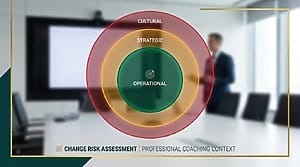
Organizational coaching helps leadership teams negotiate handoffs, expose assumptions, and build coordination that an AI Center of Excellence can’t create alone.
The new executive is one person. The thing that determines whether their mandate succeeds is the system they are joining, and that system has not agreed on what AI means. Engineering thinks it means automation. Sales thinks it means a feature to sell. Legal thinks it means exposure. Finance thinks it means a cost line that had better produce returns. The new executive walks into that room carrying a title and a set of assumptions, and the assumptions collide with four other sets on the first day.
Organizational coaching works on the system, not the individual. The unit of attention is the leadership team and the handoffs between functions, because that is where AI strategy actually lives or dies. The coach’s job is to surface the disagreements early, while they are still cheap, and help the team build a shared enough picture that the new executive is stepping into alignment rather than refereeing a fight.
That work has a particular texture. It looks like getting the CPO and the CSO in a room to name out loud which decisions belong to which of them, before a live deal forces the question. It looks like helping a leadership team say the quiet part: that Legal is genuinely worried, that Engineering thinks the timeline is fantasy, that Finance has stopped believing the ROI slides. None of that shows up on the org chart. All of it determines the outcome.
There is a fashionable structural answer to this, the AI Center of Excellence, a dedicated group meant to coordinate AI work across the company. As a structure it can help. But a Center of Excellence is another box, and the same question applies. Does it have real authority, or only a mandate to advise? Do the functions route decisions through it, or around it? A structure without coordination is a more elaborate version of the original problem. The coordination is the part that has to be built, and it gets built between people, not on a chart.
What to Do When Your Own Org Reshuffles
Say your company is about to make one of these moves. A new AI title is coming, or a function is being reorganized around it. You are a leader watching it happen, and you want it to mean something. A few things are worth doing before the announcement goes out.
Name the decision rights before you name the person. Write down, in plain language, which AI decisions belong to the new role and which stay where they are. Vague authority is the seed of the Nokia outcome. If the new executive and the existing leaders cannot say who decides what, the title is decoration.
Surface the disagreements while they are still cheap. Before the new hire arrives, get the leadership team to say where they actually disagree about AI. The goal is not consensus. The goal is a map of the fault lines, so the new executive inherits a known problem instead of a hidden one.
Coach the team, not just the newcomer. Onboarding the individual is necessary and not sufficient. The leadership team is the unit that has to absorb the change, and it usually needs help doing that. An outside coach who can hold the team’s tensions without being inside its politics earns their fee in the first month.
Picture the alternative. A company appoints a Chief AI Officer, runs a tidy announcement, and three months later the org chart looks modern while nothing about how decisions get made has shifted. The functions still disagree. The new executive is busy refereeing. The strategy still lurches. Everyone can see the new box. Nobody can find the change. That is the default outcome, and it is the one the structural instinct produces when it stops at structure.
The appointment is the start of the work. It is worth treating it that way.
Frequently Asked Questions
Why do companies appoint C-suite leaders specifically to drive AI strategy?
A senior appointment gives an AI initiative a clear owner, a budget line, and a seat at the leadership table. It signals intent to the market, to employees, and often to investors. The appointment creates accountability on paper. Whether it creates capability depends on whether the rest of the organization is built to coordinate around that role, which is a separate question the announcement rarely addresses.
What does organizational coaching do that an executive hire does not?
An executive hire adds a person and a title. Organizational coaching works on the system that person joins: the leadership team, the handoffs between functions, and the unspoken disagreements about what AI is for. Coaching surfaces those tensions early and helps the team build a shared picture, so a new AI executive steps into alignment rather than refereeing a fight nobody named.
Can AI tools replace the judgment leaders and managers bring?
No. AI copilots can remove administrative friction and surface better information, which gives a manager more time and clearer inputs. They cannot supply judgment. A tool amplifies whatever capability the manager already has. Judgment is built through reflection, feedback, and experience, and that development work is what coaching addresses rather than software.
Name Decision Rights Before the Next AI Reshuffle
In a free consult, we’ll map where authority is contested, surface the hidden disagreements, and identify the seams where AI work quietly stalls.
Book a Free Consultation →