Team Coaching and Workshop Design: What Makes Leadership Development Stick
Two pieces ran in the coaching trade press inside the same window. Coaching at Work covered what they called the moment of contact in team coaching - the opening minutes where a session either becomes useful or becomes a meeting. The Coaching Tools Company published Jennifer Britton on the 4A model for designing leadership workshops and webinars that stick.
Different topics. Same diagnosis. Most leadership development is engineered for the day it runs and abandoned the moment people walk out of the room. The audience evaluates the experience well. The business measures no change.
If you run an L&D function, commission leadership development, or sit one rung above the people who do, this is your problem. Not because the vendors are bad. Because most programs are designed to optimize for engagement instead of transfer, and almost no one in the buying chain is asking the question that would change that.
Key Takeaways
- Most leadership development is built for the day it runs, not for the months after. Engagement is easy to measure; transfer is the work.
- The first five minutes of a team coaching session are the whole session in miniature. Watch the contracting move - or its absence.
- The 4A model (Anchor, Action, Application, After) is a design discipline, not a content topic. Most programs do the first two and skip the second two.
- Team coaching is not a workshop with better snacks. Workshops teach. Team coaching works the live group on live work. Buying one and expecting the other is the most common L&D mistake.
- The L&D function is a transfer engine, not a content procurement function. Build the design discipline, not the topic library.
The Engagement-Transfer Gap
The pattern shows up in any organization that takes leadership development seriously. The cohort runs. The evaluations come back at 4.6 out of 5. The participants tell their managers it was the best program they have been through. Six months later, when someone tries to point at the behavior change in the role, no one can find any.
What Should Engagement Actually Change?
If your metrics stop at satisfaction, we can define the Tuesday-morning behavior, reinforcement, and measurement before you buy another program.
This is the engagement-transfer gap, and it is the operational problem behind both pieces in the trade press. Coaching at Work is asking what makes the opening of a team coaching session land instead of dissolve into polite agenda-shuffling. Britton is asking what makes a workshop produce behavior change instead of a sugar high. Different formats, same buyer-side question: what is this engagement actually supposed to change in the business, and how will I know whether it did?
The fix is not a new framework. The fix is a buyer who knows that engagement is the entry ticket, not the product. Once the function understands that, the vendor conversation changes, the design changes, and the kind of team coaching and workshop work that actually moves the business becomes findable.
The First Five Minutes Are the Whole Session
The Coaching at Work piece on the moment of contact in team coaching is making a structural claim. The opening of a team coaching session is not a warm-up. It is the session in miniature. What happens in those first five minutes determines what is possible for the rest of the time the group is in the room.
The competent move at the start is contracting. The coach names what the group is working on, what the coach will and will not do, what the group has to bring, and how the group will know whether the session was useful. None of this is hard to articulate. Most facilitators skip it because the room is uncomfortable and contracting makes the discomfort visible. A pre-meeting opener about logistics is easier than a question about what the group actually wants to leave with.
The competence signal for an L&D leader observing a team coaching session is the contracting move. If the coach steps into the silence, names what the group is working on with concrete language, and gets explicit agreement on what useful looks like, the next ninety minutes have a chance. If the coach opens with logistics, social warmth, and a vague invitation to share, the session has already drifted.
The same pattern shows up at the engagement level. The team coaches who produce results contract hard at the start of the engagement - what changes, who decides whether it changed, what the coach is and is not for. Skip that conversation, and the engagement becomes whatever the first crisis turns it into.
Why Most Leadership Workshops Don’t Stick
The default failure mode in workshop design is content drift. The designer starts with a topic. The topic generates modules. The modules generate slides. The slides generate exercises. By the end, the workshop has a tight narrative arc, fits cleanly inside the day, and produces strong evaluations. None of which is the same as producing behavior change in the role.
What “stick” actually means in leadership development is narrow. It means a participant does something different in their job - measurably different, observably different - in the weeks and months after the program. Not that they remember the framework. Not that they liked the facilitator. Not that they would recommend the workshop to a peer. Behavior change in the role, where the role is.
A workshop that lights up the room and dies in the parking lot is engagement, not transfer. The first is a deliverable. The second is the actual product. Most L&D functions buy the first and report on it as if it were the second.
The buyer pattern that creates this is structural. L&D budgets are defended on participation, completion, and satisfaction. Behavior change in role is harder to instrument and slower to surface, so it gets quoted in glossy case studies and ignored in operational reviews. The vendor base optimizes for what the buyer measures. This is not bad faith on either side. It is what happens when no one in the chain is responsible for the gap.
The 4A Model as a Design Discipline
The Britton 4A model - Anchor, Action, Application, After - is useful precisely because it forces the design conversation past the content. It is not a topic framework. It is a pipeline.
Build the Missing “Application” + “After”
Coaching can turn your 4A design into an operating system—manager involvement, peer practice, and accountability that survives the parking lot.
Anchor is the pre-work and the pre-frame. Why is each participant in the room. What does each participant need to leave able to do. The pre-frame answers the question the workshop is for, in the language of the participant’s actual job. Most programs treat pre-work as logistics. Anchor treats it as the contracting move that makes the room workable on day one.
Action is what happens in the room - and the test for action is deliberate practice, not content delivery. The participants try the new behavior, in low-stakes conditions, with feedback. Lecture is not action. A case study discussion is not action. Action is the thing the participant must be able to do back in the role, performed under conditions where it can be coached and corrected.
Application is the structured plan for using the new behavior in the actual role. Not a generic action item written on a sticky note, but a specific commitment with a specific trigger, in the participant’s real work, with a specific person who knows about it. Application is where the program leaves the room without leaving the participant.
After is the part nearly every workshop omits. Reinforcement, practice, observation, peer accountability, manager engagement - the operating system that turns a one-day or two-day event into something that compounds. Skip the After, and the curve flattens fast. Most program metrics quietly assume the After exists. Most programs have not built it.
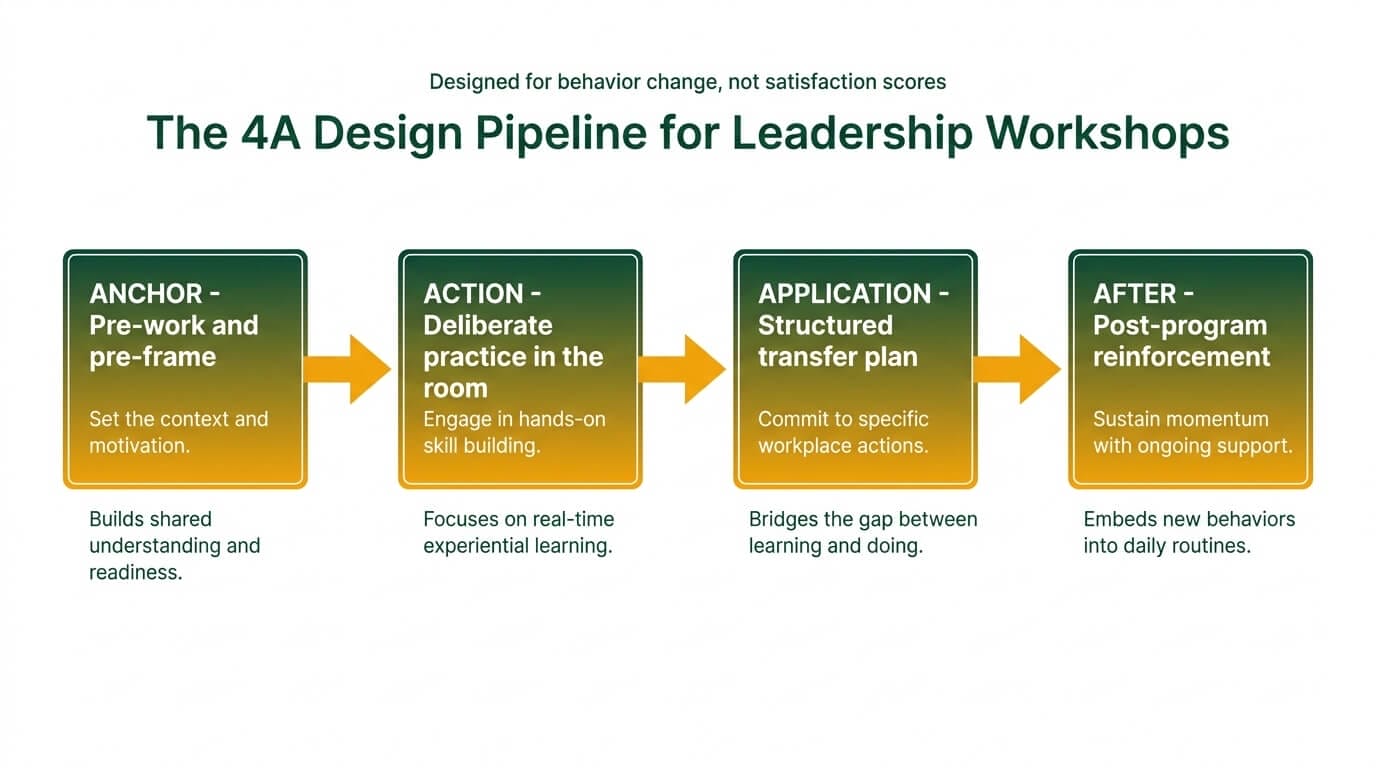
For an L&D buyer, each A becomes a vendor question. What is your Anchor. What is the Action design - show me an exercise where the participant has to do the new behavior under feedback. What is the Application step. What is your After, and how do you measure whether it happened.
Team Coaching Is Not a Workshop With Better Snacks
The most common buying mistake in leadership development is conflating workshops with team coaching. The labels overlap in vendor decks. The structures do not.
A workshop teaches. The facilitator presents frameworks and exercises so participants can practice a new behavior in a low-stakes environment. The participants then return to their real teams and try to apply what they learned. The teaching unit is the individual.
Team coaching works the live group on the live work. The unit is the team itself, with its real composition, real challenges, and real dynamics. The coach is not delivering content. The coach is helping the team become better at being a team while doing the work the team is already doing. Leadership team coaching works at the level of how this specific team thinks together, decides together, and recovers from conflict together. A workshop cannot do that, because the workshop room is not where the team lives.
| Format | What It Does Well | Buy It When |
|---|---|---|
| Leadership workshop | Teaches frameworks; builds individual skill in low-stakes practice; common language across a cohort | You need a population of leaders to develop a specific capability and you can support transfer in the role |
| Team coaching | Improves how a specific team operates as a team while doing real work; addresses dynamics no individual can fix alone | The team itself is the unit of change; the dysfunction or potential lives in the system, not in any one member |
| Manager-led practice | Embeds new behaviors through reps in real work, with the manager as coach | You have a trained manager line and a clear behavior to reinforce post-program |
| 1:1 executive coaching | Develops a single leader against specific outcomes the leader and the org agreed to | The change you need lives inside one person’s judgment, behavior, or relationships |
The trap is buying a workshop and expecting team coaching outcomes. The team attends a two-day program on collaboration. They love it. They go back to the same dynamics that made you call the vendor in the first place, because no one worked the live system. Mature buyers understand the difference, and the practitioner literature on team coaching vs facilitation draws the same boundary in slightly different language.
Designing for Transfer, Not for Theater
The transfer mindset is the discipline both Coaching at Work and Britton are pointing at from different angles. It can be reduced to three questions every L&D leader should be able to answer about any program before it runs.
What behavior changes. Not what topic gets covered. Not what learning outcome gets stated. What does a participant do differently in the role on Tuesday morning that they did not do the Tuesday before. If you cannot answer that in concrete language, the program will not transfer, because no one inside it knows what is supposed to be different.
What reinforces it. The new behavior has to survive contact with the real role. That means peer pods that meet for ninety days. Manager involvement that is more than an email. Structured observation by someone who can see the behavior happening or not happening. Action learning where the participant brings real work back into a coached environment. Without reinforcement, the curve trends down inside two weeks. The literature on team coaching failure patterns is mostly a catalog of programs that skipped reinforcement and watched the work dissipate.
What measures it. Not the satisfaction survey. Something that points at the behavior in the role. Manager observations on a defined frequency. 360s designed before the program runs, not after. Business metrics tied to the team or the cohort. Anything other than “participants reported a 4.6 average satisfaction score.” Pick the measurement before the program starts. If you cannot, the program is not yet ready to run.
What L&D Leaders Should Watch For When Buying
Most vendor proposals signal everything you need to know in the first two pages. The proposal that opens with content topics, modules, and a day-by-day schedule is selling delivery. The proposal that opens with the behaviors that will change, the way those behaviors will be practiced and reinforced, and how the change will be measured is selling transfer. Both proposals will produce a workshop. Only the second one will produce a result.
The vendor question that separates serious practitioners from polished pitches is direct. What is the After in your design, and how do you measure whether it happened. Mature vendors answer in concrete operational terms. Marketing decks answer with abstractions. If the design has no role for the manager and no role for the participant’s real work, the program is closed-loop entertainment.
Reference checks are worth doing, but check against business results, not satisfaction scores. Ask the reference what they were trying to change, whether it changed, how they measured it, and what the program would have to do differently to produce a better result. Customers who can only answer the first question are reporting a relationship, not a result. The same logic applies to team coaching ROI metrics and any leadership development investment over a hundred thousand dollars.
Pilot before you scale. One team or one cohort. Defined outcome. Measurement designed before the program runs. If the pilot moves the outcome, broaden carefully. If it produces only motion, the vendor does not get a second cohort, regardless of how well the participants liked it.
Build the Discipline, Not the Library
The L&D function that produces results is not the function with the largest content library. It is the function that has built design discipline into how it buys, runs, and measures everything. Standard buyer questions for vendors. A default 4A pattern applied to every program. A default measurement plan that pairs satisfaction with at least one behavior-in-role indicator. A pilot-then-scale rule. A standing question - what is the After here - that gets asked in every design review.
This is what it looks like to treat L&D as a transfer engine instead of a content procurement function. The job stops being “find a vendor for this topic” and becomes “design the engagement so the change holds.” The same shift, at the organizational level, is the work behind embedding team coaching as an organizational capability instead of buying it as a one-off intervention.
So here is the question. Pick the next leadership workshop or team coaching engagement on your calendar. Open the design. Ask the four 4A questions, the three transfer questions, and the one buying question above. If the design holds up, run it. If it does not, the design is not yet ready and you have time to fix it. That work, done once at the function level, will outperform any new framework you bring in this quarter.
Common Questions About Team Coaching and Workshop Design
Five questions come up consistently when L&D leaders work through this material.
How is team coaching different from a leadership workshop?
A workshop teaches. Participants learn frameworks and practice in low-stakes conditions, then apply what they learned in their real role. Team coaching works the live group on the live work - the team itself is the unit of change, with its real composition, real challenges, and real dynamics. Buy a workshop when you need a population of leaders to develop a specific skill. Buy team coaching when the change you need lives in how a particular team operates as a team.
What is the 4A model in workshop design?
Anchor, Action, Application, After. Anchor is the pre-work and pre-frame that makes the room workable on day one. Action is deliberate practice of the new behavior under feedback - not content delivery. Application is the structured plan for using the behavior in the real role. After is the post-program reinforcement most workshops omit. Treated as a pipeline, the 4A model exposes where transfer fails and what to design instead.
Why do leadership workshops fail to produce behavior change?
Most workshops are designed to optimize for engagement instead of transfer. They produce strong evaluations and weak behavior change because the buying chain measures satisfaction, not behavior in role. The fix is to define the behavior that should change before designing the program, build reinforcement into the design, and measure the behavior - not the experience - on the back end.
What should L&D leaders look for when buying team coaching?
Watch the contracting move. A serious team coach will name what the team is working on, what the coach will and will not do, and how everyone will know whether the engagement worked - in concrete language, before the work starts. Vendors who lead with their methodology and skip the contracting conversation are signaling that they sell delivery, not change.
When does an organization need team coaching instead of a workshop?
When the dysfunction or the potential lives in the system rather than in any one team member. If a leadership team keeps making the same kind of decision badly, recovers from conflict slowly, or runs on a dynamic no one will name, no individual workshop will fix that. The team needs work done on the team while the team is doing real work. Team coaching is the format for that.
Design for Transfer—Not Theater
Bring a live program or vendor proposal. We’ll pressure-test the 4A pipeline, measurement plan, and “After” so results show up six months later.
Book a Free Consultation →