

Human Performance Under Pressure: What Organizational Coaching Addresses
What organizational coaching addresses about human performance under pressure?
Organizational coaching works on four systems-level capabilities: communication patterns under pressure, stress adaptation as organizational design, collective resilience, and decision quality under constraints. The target is the organizational environment that degrades performance, not the individual. Supplements treat symptoms. Coaching changes the system that produces degraded thinking in the first place.
Key Takeaways
- Performance under pressure is systemic and coachable - not a function of individual grit or personal toughness
- ISRO's astronaut crew research validates what organizational coaches address: communication, resilience, and decision-making as collective capabilities
- Organizations create their own extreme conditions through resource scarcity, restructuring, and sustained pressure - the parallel to high-altitude stress is structural, not poetic
- Supplementing degraded cognitive performance addresses symptoms; coaching addresses the system that degrades it
When Space Agencies Study Behavior, Not Rockets
ISRO's Mission MITRA sent a crew to Ladakh at 3,500 meters - not to test hardware but to study how humans perform when conditions degrade. The Indian Space Research Organisation identified crew behavior, not propulsion or life support, as the primary risk variable in spaceflight mission success.
Mission MITRA (Mapping of Interoperable Traits and Response Assessment), running April 2-9 in the thin air of Leh, is designed to simulate the stresses astronauts face in space. But the study has nothing to do with hardware. It has everything to do with how humans respond when conditions degrade.
The Indian Space Research Organisation (ISRO) and its Institute of Aerospace Medicine (IAM) are assessing participants on physiological adaptation, psychological resilience, and operational decision-making. "Crew safety and performance are the most critical elements of all human spaceflight missions," ISRO stated.
The most critical element isn't the propulsion system. It isn't the life support hardware. It's the crew's ability to function together under pressure. That priority tells you something about where risk actually concentrates in complex operations.
This isn't a soft finding from a coaching journal. This is the space agency that launched Chandrayaan telling the world that human behavior is the primary risk variable in mission success. When an organization that builds rockets starts investing in understanding people, the rest of us should probably pay attention.
The Thin Air Problem Every Organization Faces
High-altitude environments degrade cognitive function through oxygen deprivation, isolation, and sustained physical stress - the same mechanisms that play out in organizations facing resource scarcity, restructuring, and chronic pressure. ISRO chose Leh at 3,500 meters specifically because these conditions mirror what astronauts face in space operations.
At altitude, every breath delivers less oxygen than your body expects. Thinking slows. Judgment narrows. Simple decisions feel heavier than they should.
Your organization has its own version of thin air.
| Extreme Environment Stressor | Organizational Equivalent | Impact on Performance |
|---|---|---|
| Hypoxia (reduced oxygen) | Resource scarcity, budget cuts | Degraded decision quality, narrowed thinking |
| Isolation | Organizational silos, remote distribution | Reduced information flow, delayed response |
| Sustained cold and discomfort | Chronic pressure, unrealistic deadlines | Cognitive fatigue, diminished creativity |
| High-stakes operations | Market crises, regulatory changes | Risk aversion, paralysis, or reckless shortcuts |
The analogy isn't poetic - it's structural. When ISRO studies how altitude degrades crew performance, they're documenting the same mechanism that plays out in organizations every day. The environment shapes performance more than individual capability does.
A team of brilliant people in a resource-starved, high-pressure environment will produce mediocre work. Not because they lack skill, but because the conditions they're operating in have reduced their capacity to use it. Restructuring, rapid growth, budget cuts, leadership turnover - each one thins the organizational air a little more. Stack two or three together and you have conditions that reliably degrade the quality of every decision your leadership team makes.
The problem isn't that people aren't resilient enough. The problem is the altitude.
Resilience Is Not Individual - It Is Relational
Resilience in high-performing teams is a relational capability - it lives between people, not inside them. ISRO's MITRA research frames crew effectiveness as a function of mutual support, communication, and collective stress adaptation rather than individual toughness or personal coping capacity.
When ISRO describes what makes the difference between mission success and failure, they don't talk about individual toughness. They talk about the crew as a system:
"The ability of crew to communicate effectively, adapt to stress, maintain psychological resilience and support one another determines the success and safety of any mission."
ISRO - Mission MITRA Statement
Every word in that statement maps to what organizational coaches work on. Communication effectiveness. Stress adaptation. Psychological resilience. Mutual support. These aren't individual capabilities - they're relational ones. They live between people, not inside them.
This is the reframe that most organizations miss. They send individuals to resilience training, give them coping techniques, maybe an app with breathing exercises. Then they wonder why the team still collapses the moment real pressure arrives.
Individual resilience without relational resilience is a liability. The most individually resilient person on a team can become the biggest problem if their coping mechanism is to withdraw, power through alone, or stop communicating under stress. Their personal toughness actively damages the system's ability to function.
Organizational coaching works at the relational level because that's where team performance actually lives. You don't coach a crew member to be more resilient in isolation. You coach the crew to respond together in ways that sustain performance when conditions degrade. Different target, different methods, different outcomes.
Decision-Making at Altitude
Decision quality is the first cognitive capability to erode under sustained pressure. Mission MITRA measures this directly - not whether participants know the right answer, but whether they can reach it when hypoxia, fatigue, and isolation are compressing their cognitive bandwidth. Organizations face the same degradation pattern without the altitude.
This isn't controversial. It's physics applied to cognition. Reduce the available resources - oxygen, time, cognitive bandwidth - and the system makes fewer decisions, slower decisions, or worse decisions. Usually all three.
What organizations experience is the same pattern without the altitude. Stress compresses decision timelines. Information gets filtered through anxiety rather than analysis. Teams narrow their input sources. Leaders default to what worked before, regardless of whether "before" resembles "now."
A pattern worth noticing: under sustained pressure, teams don't make worse decisions in the way you'd expect. They make fewer decisions and call the remaining ones "strategy." The narrowing looks like focus. The rigidity looks like conviction. And the reduced input looks like efficiency.
Coaching addresses this by working with leaders and teams on how they make decisions, not what decisions to make. The gap between knowing the right approach and executing it under pressure is exactly where coaching operates. It's also exactly what MITRA is designed to measure - not whether participants know the right answer, but whether they can reach it when the conditions are working against them.
Cognitive performance under pressure is trainable. Not through knowledge transfer, but through building the capacity to access what you already know when the environment is trying to take it from you.
Cognitive Performance Is Not a Supplement
The cognitive optimization industry treats degraded thinking as an individual chemistry problem solvable through supplementation. Organizational coaching treats it as a systems problem - the bottleneck is rarely the individual brain but the organizational environment, communication structures, and relational patterns that surround and constrain it.
Cognitive optimization is now a market category. Companies are positioning focus, clarity, and decision-making as problems that can be solved at the individual level - with the right stack of ingredients. The framing is appealing: if pressure degrades your thinking, enhance your thinking to compensate.
The supplement industry is correct about one thing - cognitive performance matters. They're wrong about where the bottleneck is.
No supplement addresses the meeting structure that prevents your leadership team from hearing dissenting perspectives. No pill fixes the incentive system that rewards individual heroics over collaborative problem-solving. No stack of nootropics will repair the communication breakdown between engineering and product that's been compounding for eighteen months.
Organizational coaching addresses the conditions that degrade cognitive performance in the first place. Creating environments where people can think clearly - where the organizational air is breathable - is a different intervention than supplementing individual brains that can't think clearly because the environment won't let them.
One treats the symptom. The other changes the system.
What Organizational Coaches Actually Work On
Organizational coaching addresses four capability areas that map directly to what ISRO measures in astronaut crews: communication patterns under pressure, stress adaptation as organizational design, collective resilience building, and decision quality under constraints. Each one targets the system, not the individual.
Not Sure If Coaching Addresses Your Situation?
Every organization has its own version of thin air. A brief conversation can help determine whether the conditions your teams face are coachable - or whether they need structural redesign first.
When we talk about organizational coaching in the context of human performance under pressure, the work falls into these four areas.
Communication patterns under pressure. Not communication skills - patterns. The skill set doesn't change when pressure increases. What changes is which patterns get activated. Under stress, most teams default to information hoarding, status posturing, or premature convergence. Coaching identifies these default patterns and builds alternatives that the team can actually access when conditions degrade.
Stress adaptation as organizational design. This isn't about teaching individuals to manage stress. It's about designing organizational responses to predictable stressors. How does the team redistribute load when someone is overwhelmed? What decisions get escalated and which get delegated during a crisis? These are design questions, not training questions.
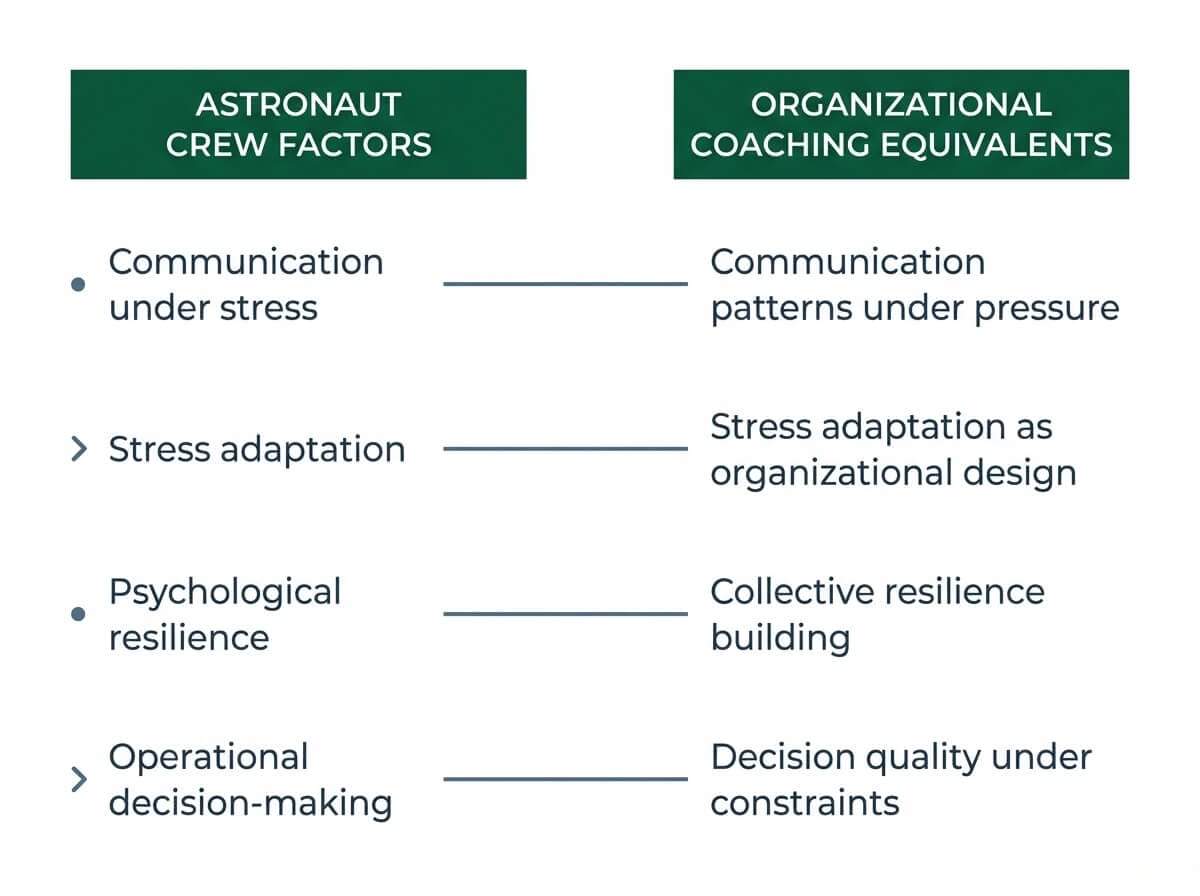
Collective resilience. The system's ability to absorb disruption and maintain function. This is built through practice - not theoretical practice, but actual rehearsal of response patterns under simulated pressure. Coaching creates the conditions for that practice.
Decision quality under constraints. Expanding the input sources, challenge mechanisms, and reflection practices that sustain decision quality when time and resources compress.
One important caveat: coaching doesn't override structural constraints. If the organization's operating conditions are genuinely unsustainable - chronic understaffing, impossible timelines, contradictory mandates from leadership - no amount of relational work will compensate. Coaching builds capacity within the system. It doesn't replace the need to fix the system itself. When the conditions are structurally broken, the honest answer is redesign, not resilience.
The Mission That Never Leaves the Ground
Unlike MITRA's week-long altitude study, organizational pressure is permanent - resource constraints, leadership transitions, and competitive urgency don't resolve on a timeline. Human performance under these sustained conditions is not fixed. It is coachable, buildable, and designable at the organizational level.
MITRA wraps up April 9. The crew comes down from altitude. The data gets analyzed. Your organization's mission doesn't end. The pressure conditions your teams operate under are permanent features of the landscape, not temporary challenges to endure.
The research is clear on this point. The same factors ISRO identified as mission-critical - communication, stress adaptation, psychological resilience, mutual support, operational decision-making - are exactly what organizational coaching addresses.
Most organizations treat team performance under pressure as an engineering problem - better tools, better processes, better dashboards. That framing misses what ISRO's research makes explicit: the variable is the crew, not the equipment. Treating the human side as a systems challenge rather than an individual weakness opens a different set of interventions entirely.
ISRO chose to study the human side. They did it because they already know the hardware works. The variable is the crew.
The Variable Is the Crew, Not the Equipment
If ISRO knows the human side is the primary risk variable in complex operations, your organization should too. Partner with coaches who work at the systems level.
Leadership Development Coaching →