
The Risk Your Boss Wants You to Take (That Your Training Says Don’t)
Should I take the risk my boss wants despite my training?
Your resistance is not timidity — it is formation. Your career installed a specific definition of responsible that earned every promotion. The risk your boss wants is not recklessness; it is the version of responsibility that operates at your current level, where the cost of inaction is often higher than the cost of a wrong call.
Your boss wants you to take a risk. Not a reckless one. A strategic bet — committing resources before the data is complete, backing a direction that could be wrong, putting your credibility behind something the numbers cannot fully justify. You know this. You have heard the feedback: be bolder, move faster, take a stand. And something in you resists. Not because you disagree. Because everything your career taught you about being good at your job says that moving without sufficient evidence is how people get hurt.
That resistance is not timidity. It is formation. Your function installed a specific relationship with risk and uncertainty — a trained instinct about when to act, what counts as sufficient evidence, and what “responsible” looks like. That instinct served you for years. It earned every promotion. And at this level, it is the thing standing between you and the contribution the room now expects.
Key Takeaways
- Every function installs a specific relationship with risk. What counts as “responsible” in finance is different from engineering, legal, marketing, or operations. Each is legitimate. Each creates a different ceiling.
- The senior leadership transition requires a fundamentally different relationship with uncertainty — not eliminating it, not modeling it, but acting within it.
- The resistance to taking strategic risks is not a courage problem. It is a formation problem. Your career defined “responsible” in a way that the new level is asking you to transcend.
- A coach who understands your formation’s relationship with risk does not push you to be bolder. They help you see what “responsible” means at the level you now occupy.
What Your Career Taught You About Risk
In finance, risk is quantified. You model it, assign probabilities, build scenarios. The responsible thing is to have the data before making the call. A decision without a model is, in the finance formation, a guess — and guesses are how organizations lose money.
In technology, risk is tested. You ship a small version, see what breaks, iterate. The responsible thing is to move fast but reversibly — build the experiment, contain the blast radius, learn from failure. A decision that cannot be rolled back is, in the engineering formation, architecturally unsound.
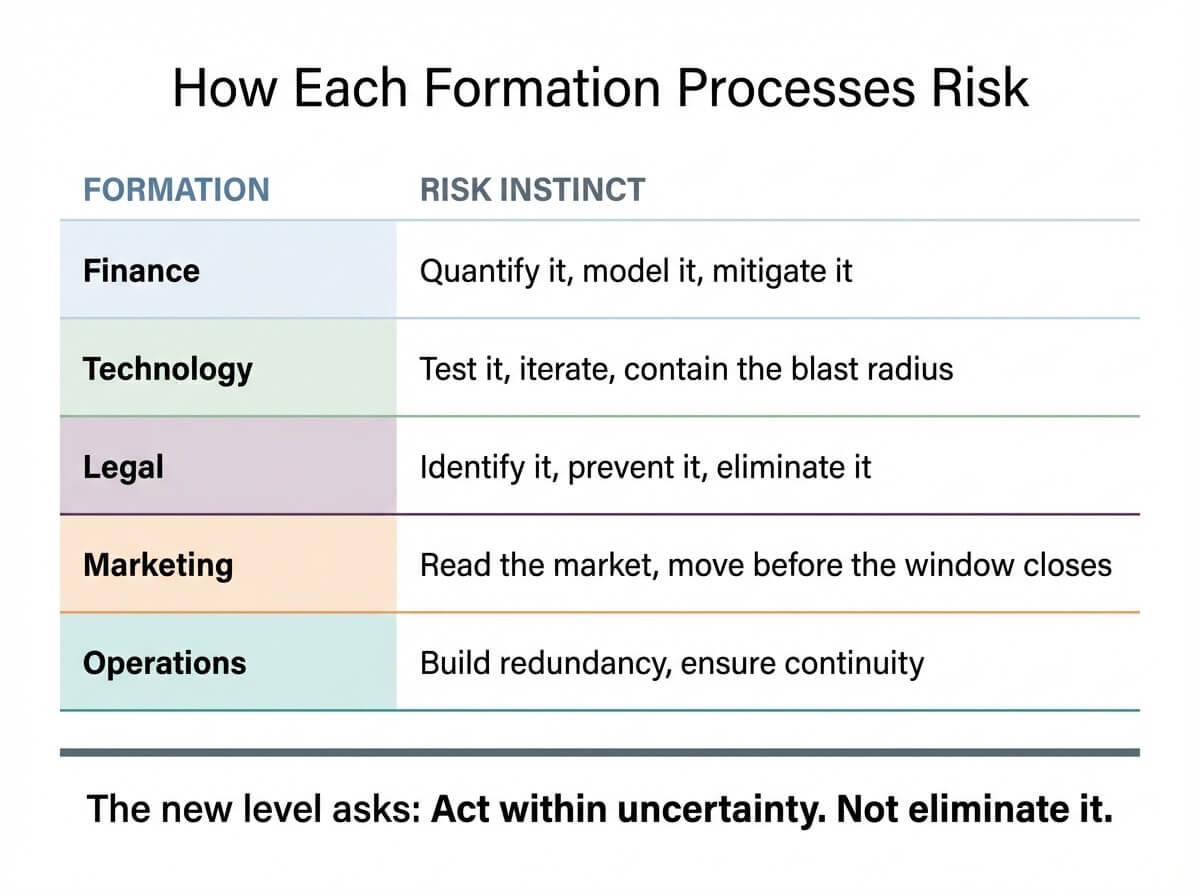
In legal, risk is prevented. You identify exposure, map liability, eliminate uncertainty before it materializes. The responsible thing is to ensure nothing goes wrong. A decision that accepts known risk is, in the legal formation, negligence.
In marketing, risk is embraced. You move on narrative conviction, competitive timing, audience instinct. The responsible thing is to act before the window closes. A decision delayed by excessive analysis is, in the marketing formation, a missed opportunity.
In operations, risk is contained. You build redundancy, create fallback systems, design processes that absorb disruption. The responsible thing is to ensure continuity. A decision that threatens operational stability is, in the operations formation, irresponsible.
Ask five leaders to define “responsible risk-taking” and you will get five different answers — each trained into them by a career that rewarded one version and punished the others.
None of these is wrong. Each is a legitimate formation response to uncertainty. The problem arrives when the organization asks you to operate with a version of risk your career never installed.
What the New Level Asks
At IC and manager level, risk lives within the function. The boundaries are clear: your domain, your team, your deliverables. The consequences of a wrong call are contained. The evidence you need to act is usually available or attainable.
At Director and VP level, the risk equation changes. You must now influence decisions that span functions, commit to directions with incomplete data, and put your credibility behind recommendations that could be wrong. The evidence you are accustomed to having is not available at the speed the organization needs decisions. The “strategic thinking” feedback is often code for: we need you to act with less certainty than your formation says is responsible.
The specific form of the challenge depends on the formation:
| Formation | What “Risk” Means at IC/Manager | What the New Level Demands | Where the Friction Lives |
|---|---|---|---|
| Finance | Model it, quantify it, mitigate it | Make the call before the model is complete | Conviction without complete data feels irresponsible |
| Technology | Test it, iterate, contain the blast radius | Commit to irreversible organizational bets | Irreversible decisions violate the engineering instinct |
| Legal | Identify it, mitigate it, prevent it | Accept some risks and help the org move through them | Accepting known risk feels like professional negligence |
| Marketing | Read the market, move before the window closes | Commit resources at enterprise scale, not campaign scale | Enterprise-scale bets require the rigor the formation resists |
| Operations | Build redundancy, ensure continuity | Disrupt existing systems to create new capability | Deliberate disruption violates the stability instinct |
Why Courage Is the Wrong Frame
The conventional advice for leaders who resist strategic risk-taking is: be braver. Step out of your comfort zone. Lean into the discomfort. That framing treats the resistance as a character trait — as if the leader simply needs more courage.
Recognize the Resistance?
If the tension between your instinct and the role’s demand is live for you, that tension is where coaching starts.
The resistance is not a character trait. It is a formation response. The professional identity that defines “good” and “responsible” was built by a career that rewarded caution, thoroughness, precision, or containment. Asking the leader to “be braver” without addressing the formation underneath is like asking someone to speak a language they were never taught. They might be able to mimic the words. They will not feel fluent. And under pressure, they will default to their mother tongue.
This is why the inflection point is so predictable. The leader gets the feedback. They try to act on it — to move faster, take bigger swings, operate with less certainty. It feels wrong. The results are mixed because the attempt is performative rather than grounded. And the leader concludes that they are simply not the kind of person who takes strategic risks. The formation has won. Not because the leader lacks capacity, but because the formation’s definition of “responsible” was never surfaced and examined.
The leader who says “I am just not a risk-taker” is usually not describing a personality trait. They are describing a formation that defined responsible leadership as the opposite of the thing the organization is now asking for. That is a recognition worth having — and it changes what the coaching conversation can do.
What a Coach Who Gets This Asks
Generic coaching hears “I know I need to take more risks but I keep holding back” and offers courage frameworks: exposure therapy for risk, incremental experiments, reframing failure as learning. A coach who understands the formation hears the same sentence and recognizes that the leader’s definition of “responsible” is in conflict with what the level demands.
The coaching question is not “What would it take to be braver?” The question is: “What does ‘responsible’ mean to you right now — and what would ‘responsible’ look like if you defined it from the level you are at rather than the level that trained you?”
That question does not push the leader to override their instinct. It invites them to update the instinct. To discover that responsibility at Director or VP level is not the absence of risk — it is the wisdom to know which risks the organization needs taken. The old definition of responsible was right. It was right for the old level. The new level has a different version, and the formation has not caught up.
These patterns connect to broader dynamics: how risk tolerance shifts when the time horizon lengthens and when caution was the promotion-worthy behavior.
Redefining Responsible
The risk your boss wants you to take is not recklessness. It is the version of responsibility that operates at the level you now occupy — where decisions are made with incomplete information, where the cost of inaction is often higher than the cost of a wrong call, and where the organization needs leaders who can hold uncertainty without freezing.
Your formation installed a definition of responsible that served you well. It still has value. It is no longer the whole picture. The expansion is not about becoming someone who ignores risk. It is about becoming someone who can hold what risk means to you alongside what risk means to the room — and act from both.
If the tension between your formation’s instinct and the role’s demand feels live for you, a coach who understands what your career installed can help you see the gap without asking you to be someone you are not. The goal is not to override the formation. The goal is to expand what “responsible” means.
Frequently Asked Questions
Why do senior leaders resist taking strategic risks even when they know the organization expects it?
The resistance is a formation response, not a courage problem. Every career function installs a specific definition of what 'responsible' looks like. Finance requires a complete model, legal requires eliminating exposure, operations requires protecting continuity. That definition becomes the default even when the new level demands something different. Telling someone to 'be braver' without surfacing the underlying formation rarely sticks.
How does risk tolerance need to shift when a leader moves into a Director or VP role?
At IC and manager level, risk is contained within a function with recoverable consequences and attainable evidence. At Director and VP level, the decisions span functions, the data is incomplete by the time a call is needed, and the credibility bet is real. The transition requires operating with less certainty than the formation says is responsible. The work is updating what 'sufficient evidence' means at this level, while keeping judgment intact.
What does a coach actually do differently when they understand a leader's functional formation?
Instead of offering courage frameworks or incremental exposure to discomfort, a formation-aware coach surfaces the definition of 'responsible' that the leader's career installed and examines whether it still fits the level they occupy. The shift from 'What would it take to be braver?' to 'What would responsible look like if you defined it from your current level?' is the difference between asking a leader to override their instinct and helping them update it.
A Conversation About What Responsible Means Now
A 30-minute call where your coach understands what your career installed about risk and where the role is asking for a different definition of responsible.
Book a Free Consultation →