Sylvia Hewlett’s Executive Presence Model: What It Gets Right, Where It Falls Short
What are the strengths and weaknesses of Sylvia Hewlett's executive presence model?
Hewlett's model gave the field a shared vocabulary — gravitas (67%), communication (28%), appearance (5%) — backed by data from 4,000 professionals, creating a business case for presence development where none existed. Its weakness: it describes what presence looks like from the outside without diagnosing why a specific leader lacks it or accounting for organizational context.
Sylvia Ann Hewlett’s research produced the most widely cited framework for executive presence in the corporate world. Her Center for Talent Innovation study surveyed 4,000 professionals and identified three pillars that senior leaders use to evaluate presence: gravitas, communication, and appearance. The data showed that 26% of what it takes to get promoted is executive presence, and that finding gave HR leaders and coaches a business case for investing in EP development. Hewlett called it “the missing link between merit and success.”
That contribution was real. She gave the field a shared vocabulary where none existed. For fifteen years, that vocabulary shaped how organizations evaluate leaders, how coaching firms design engagements, and how individual leaders think about their own development.
It was also the point where most EP thinking stopped. The Hewlett framework describes what presence looks like from the outside. It does not diagnose why a specific leader lacks it. And it does not account for the fact that the same behavior registers as strong presence in one organization and “lacking presence” in another. The field is still working with descriptive categories when what practitioners need is a diagnostic model.
Key Takeaways
- Hewlett’s three-pillar model (gravitas 67%, communication 28%, appearance 5%) remains the field’s shared vocabulary for executive presence, not its diagnostic instrument.
- Three limitations constrain the model’s usefulness for coaching: no organizational context variable, no assessment instrument integration, and no mechanism for the systemic dimension of presence.
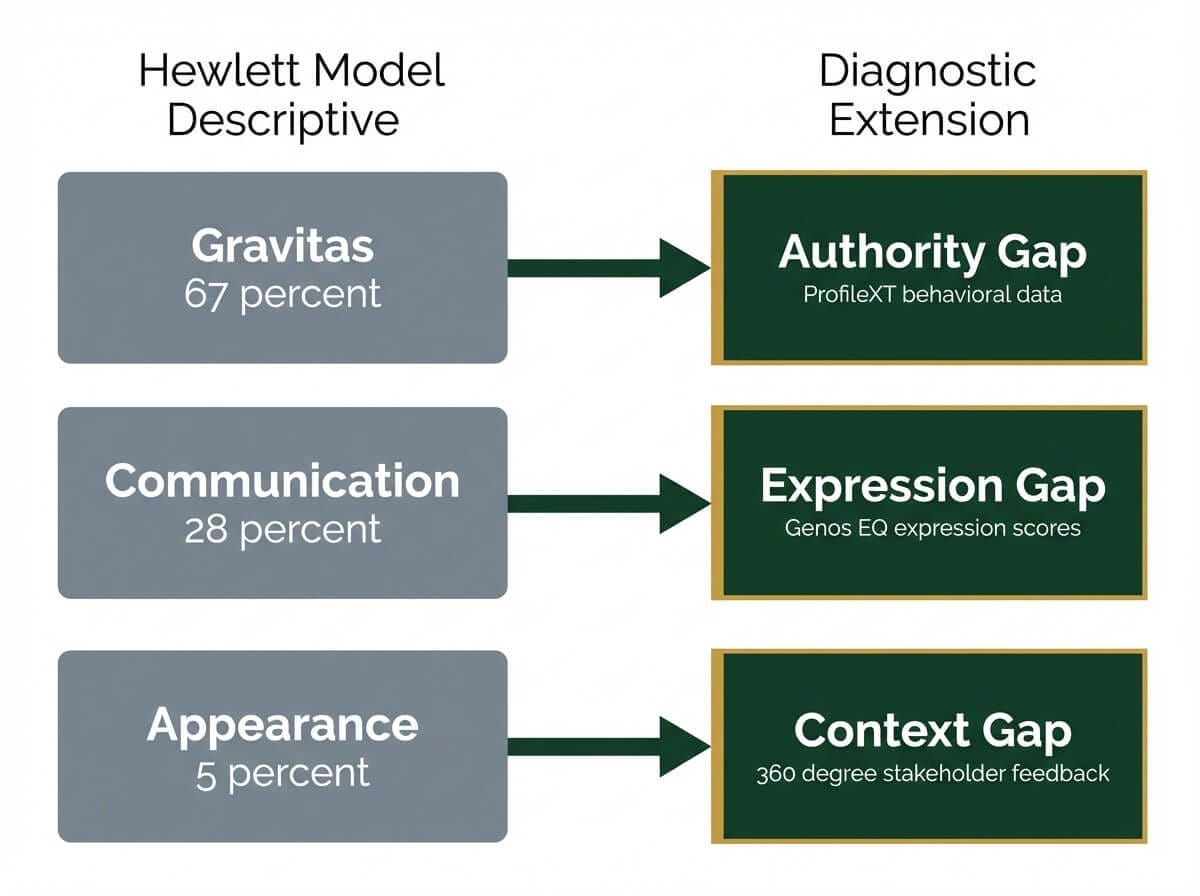
- Each Hewlett pillar maps to a diagnostic category: gravitas to the authority gap (ProfileXT), communication to the expression gap (Genos EQ), and appearance to the context gap (360-degree feedback).
- Most leaders flagged for presence gaps are not under-confident. They are under-expressed. The standard advice to “develop more gravitas” restates the problem as the solution.
What Hewlett Got Right: The Three Pillars
Hewlett’s research identified three components of executive presence, weighted by how frequently senior leaders cite each one as essential. Gravitas dominates. Communication is the vehicle. Appearance carries far less weight than most people assume.
| Pillar | Weight | Core Components |
|---|---|---|
| Gravitas | 67% | Confidence, decisiveness, integrity, emotional intelligence, reputation, vision |
| Communication | 28% | Speaking skills, assertiveness, ability to read an audience, ability to speak truth to power |
| Appearance | 5% | Grooming, physical fitness, polish, poise |
Gravitas outweighs communication and appearance combined in how senior leaders evaluate leadership material. In Hewlett’s data, gravitas is not merely confidence. It is the perception of intellectual heft: the ability to project decisiveness under pressure, build trust through consistency, and demonstrate that you can see around corners. When senior executives describe someone who “has it,” 67% of the time they are describing gravitas.
Communication functions as the vehicle through which gravitas becomes visible. A leader who processes deeply but communicates little may possess gravitas without anyone knowing it. Hewlett’s data captured this: 28% of presence evaluations hinge on how effectively a leader makes their thinking visible. Speaking skills, assertiveness, the ability to read an audience and adjust, the willingness to speak truth to power.
Appearance, at 5%, is the most controversial pillar. Hewlett’s original 2014 formulation included grooming, body language, and physical fitness. The weight is small relative to gravitas and communication, but the controversy it generated reshaped the entire conversation about what executive presence assessments should measure.
In practice, the Hewlett model shows up as a mental checklist in talent reviews: “Does she project gravitas? How’s his communication? Does he look the part?” The checklist is useful for pattern recognition. It names what presence looks like from the audience’s perspective. Its limitation becomes apparent when you need to move from recognition to intervention.
Where the Model Falls Short
The three pillars describe executive presence from the audience’s perspective. They answer the question: what does presence look like? A different question matters more for the leader receiving presence feedback: why don’t I have it, and what specifically do I do about it?
Executive Coaching for Senior Leaders
1:1 partnership with MCC-credentialed coaches—built for senior leaders navigating high-stakes decisions, transitions, and growth into the C-suite.
Three limitations emerge when practitioners try to use the Hewlett framework as a diagnostic tool.
The context gap. Hewlett’s model treats executive presence as an individual attribute. A leader either has it or needs to develop it. The model does not account for organizational context. What counts as gravitas at a Wall Street bank is different from a tech startup, which is different from a nonprofit. The same behavior that registers as “decisive leadership” in one culture reads as “bulldozing” in another.
Consider a leader effective in one organizational culture who receives “lacks presence” feedback after moving to a different one. Under the Hewlett framework, the recommendation would be “work on your gravitas.” But 360-degree feedback tells a different story. When ratings split along stakeholder group lines rather than showing consistent low scores across all raters, the variable is not the leader’s behavior. It is the audience’s cultural template for what “executive” looks like. The Hewlett model has no mechanism for diagnosing this.
The measurement problem. Gravitas, communication, and appearance are descriptive categories, not diagnostic instruments. Knowing that a leader “needs more gravitas” is like knowing that a patient “feels unwell.” It describes the symptom without identifying the mechanism. You cannot score a leader on “gravitas” with validated psychometric data. You can score them on emotional expression, behavioral tendency patterns, and stakeholder perception divergence. Those scores reveal which specific gap is producing the gravitas deficit.
The advice to “develop more gravitas” is circular. Gravitas is defined by its visible manifestation. The recommendation restates the problem as the solution. A diagnostic framework breaks this loop by identifying the mechanism underneath the symptom, using executive presence assessment tools that map to validated instruments.
Knowing that a leader “needs more gravitas” is like knowing that a patient “feels unwell.” It describes the symptom. It does not identify the mechanism.
The systemic dimension. The appearance pillar exposed this limitation most visibly. Research on gender and leadership shows that appearance-based presence assessments disproportionately penalize women and leaders from underrepresented groups. The standard for “looking the part” reflects the demographic composition of existing leadership, not a neutral definition. This creates presence challenges specific to women leaders that the Hewlett framework frames as individual development needs rather than organizational patterns.
The deeper issue extends beyond appearance. The entire framework treats presence as an individual responsibility without examining whether organizational culture systematically excludes certain leadership styles from the “executive” template. Executive presence coaching that diagnoses the system alongside the individual addresses what the descriptive model cannot.
Executive Presence 2.0: What Changed
Hewlett published Executive Presence 2.0 in 2024, updating the framework for a decade of cultural and organizational shifts. She adjusted the appearance pillar downward, acknowledging the bias embedded in appearance-based assessments. She added virtual and remote presence dynamics. She incorporated more data on emotional intelligence as a component of gravitas.
These updates were directionally correct. The 2.0 version is more nuanced, more inclusive, and more current than the original. For anyone evaluating EP frameworks, Hewlett’s revision demonstrates genuine intellectual honesty about where the original model drew criticism.
What remains unresolved: the framework is still descriptive, not diagnostic. The 2.0 version adds more categories but not more measurement precision. The organizational context variable is still absent; presence is still framed as an individual development challenge. And the updated model does not integrate with assessment instruments. It remains a checklist model, even if the checklist is more thoughtful. The question is not whether Hewlett improved the framework. She did. The question is whether a descriptive framework, however refined, can produce the diagnostic specificity that presence coaching requires.
From Description to Diagnosis
Each Hewlett pillar maps to a diagnostic category that extends it. The pillar describes what the audience sees. The diagnostic category identifies why the gap exists and which assessment instrument reveals it.
Gravitas → Authority gap. What Hewlett calls gravitas is, in assessment terms, the gap between the register that earned the promotion and the register the current role requires. Leaders operating in a proving register (adding to every conversation, being the expert, arguing positions) produce the gravitas deficit Hewlett describes. They are not lacking confidence. They are operating in a mode that served them at a previous level. ProfileXT behavioral tendency data reveals the mechanism: high analytical drive paired with a proving orientation that reads as “not yet executive.”
Communication → Expression gap. Hewlett described effective communication skills as assertiveness, audience reading, and speaking skills. The expression gap identifies a more specific disconnect: high internal processing with low external visibility. Leaders who think deeply but display little create a perception of detachment where they experience deep engagement. Genos EQ emotional expression scores quantify this gap. The leader who reads 360 feedback saying “she doesn’t listen” when she processes everything internally faces an expression gap, not a communication skills deficit.
Appearance → Context gap. Hewlett described what “looking the part” means. The context gap reframes appearance as a cultural variable. What counts as “looking the part” depends on which organization, which industry, and which stakeholder group defines “executive.” 360-degree stakeholder feedback reveals whether the gap is behavioral (the leader needs to adjust) or contextual (the organization’s definition is the barrier). That distinction changes the entire coaching conversation.
The leaders who score highest on emotional intelligence assessments are often the ones with the widest expression gaps. Awareness without display creates the largest perception disconnect.
Three additions make the diagnostic approach different from the descriptive one: assessment instruments that produce measurable data instead of subjective categories, an organizational context variable that distinguishes individual gaps from cultural definitions, and specific coaching interventions mapped to each gap type. For comprehensive coverage of how these diagnostic categories work in practice, see what we mean by executive presence and how assessment data informs the coaching process.
The diagnostic approach does not replace Hewlett’s framework. It extends it. The three pillars remain useful as orientation vocabulary. The diagnostic layer adds what the pillars lack: instruments, context, and gap-specific interventions.
What This Means for Leaders and Coaches
If you have been told to “develop more executive presence” and the advice centers on gravitas, communication, and appearance, you have descriptive categories. You do not yet have a diagnosis.
For leaders: Before investing in development, seek data. 360-degree feedback across multiple stakeholder groups reveals whether your gap is behavioral or contextual. Emotional expression assessment reveals whether high internal processing is paired with low external visibility. Behavioral tendency data reveals whether you are operating in the register that earned your last promotion rather than the one your current role requires. The data distinguishes between expression gaps (often fast to close through targeted behavioral practice), authority gaps (slower, involving role-identity work), and context gaps (an organizational variable that may not be yours to close). To learn how to develop executive presence through a diagnostic approach, start with the data, not the checklist.
For coaches and HR professionals: Hewlett’s framework is a useful orientation tool for initial conversations and talent reviews. Its limitation shows up in coaching engagement design. “Develop your gravitas” is not a coaching plan. A coaching plan starts with assessment data that identifies which specific gap produces the gravitas deficit, measures it with validated instruments, and maps to interventions that address the mechanism rather than the symptom. Presence coaching rarely involves confidence-building. Most leaders flagged for presence gaps are not under-confident. They are under-expressed. The influence a leader needs is already there; what is missing is the visibility.
FAQ: Sylvia Hewlett’s Executive Presence
What are Sylvia Hewlett’s three pillars of executive presence?
Hewlett identified gravitas (67% weight), communication (28%), and appearance (5%) as the three components of executive presence, based on her Center for Talent Innovation study of 4,000 professionals. Gravitas includes confidence, decisiveness, and the ability to project authority. Communication includes speaking skills, assertiveness, and audience awareness. Her 2024 update reduced the weight of appearance and added virtual presence considerations.
Is the Hewlett executive presence model still relevant?
The descriptive framework remains useful as a shared vocabulary for how organizations evaluate leaders. Its limitation is that it describes what presence looks like without diagnosing why a specific leader lacks it. Diagnostic approaches that use validated assessment instruments and account for organizational context extend where the Hewlett model stops.
What is the difference between descriptive and diagnostic presence frameworks?
Descriptive frameworks like Hewlett’s identify components of presence (gravitas, communication, appearance). Diagnostic frameworks identify specific gap types (authority, expression, context), map each to assessment instruments (ProfileXT, Genos EQ, 360-degree feedback), and produce different coaching plans for different gaps. The question shifts from “what does presence look like?” to “why does this leader lack it?”
Hewlett gave the field a vocabulary. That vocabulary shaped how organizations talk about executive presence for fifteen years. What it did not produce is diagnostic precision: the ability to identify which specific gap a specific leader faces, measure it with validated instruments, and design interventions that address the mechanism rather than the symptom.
The question is not “does this leader have gravitas?” It is “what is the gap between this leader’s intention and this audience’s experience, and where does that gap live?” That question produces different coaching plans, different timelines, and different outcomes. It is the question Hewlett’s framework makes possible to ask but not to answer.
Not Sure Where to Start?
Book a free consultation to discuss your goals and find the right path forward.
Book a Free Consultation →