High-Performance Coaching for Executives: What It Is and How It Works
What is high-performance coaching for executives?
High-performance coaching is a structured, one-on-one partnership between a credentialed coach and a senior leader that builds internal capacity for clarity under complexity. It targets decision-making, stakeholder influence, and sustainable impact without burnout. The goal is judgment that persists after the engagement ends, not skill checklists or externally owned deliverables.
What High-Performance Coaching Is
High-performance coaching — also called executive performance coaching — is a structured, one-on-one partnership between a credentialed coach and a senior leader focused on accelerating results at the executive level. Unlike life coaching (which addresses personal fulfillment) or performance management (which corrects deficits), high-performance coaching builds the internal capacity that allows leaders to operate with clarity under complexity: better decisions, stronger stakeholder influence, and sustainable impact without burnout.
Key Takeaways
- High-performance coaching builds executive judgment and decision-making capacity, not skill checklists: the goal is leaders who operate differently after the engagement ends.
- Structured engagements use validated assessments (360s, ProfileXT, Genos EQ) to establish baselines and measure behavioral change over 6–12 months.
- ICF credential level is the single most reliable quality signal: MCC coaches have logged 2,500+ supervised hours, while many “certified” coaches completed a weekend workshop.
- The strongest ROI comes at inflection points: C-suite transitions, performance plateaus, and team-level complexity where existing patterns no longer produce results.
- Coaching cannot fix structural organizational problems. A qualified coach names when the constraint is systemic rather than individual.
The distinction from consulting is fundamental. A consultant diagnoses problems and prescribes solutions. A coach facilitates the executive’s own capacity to see, decide, and act. The difference shows up in sustainability: consulting creates dependency on external expertise. Coaching builds judgment that persists long after the engagement ends.
At the ICF Master Certified Coach (MCC) level, the top 3% of credentialed coaches globally, this work moves beyond behavioral techniques into identity-level shifts. When a VP cannot get peers to align on strategy, the surface issue is communication. The coaching question is: what is this leader compensating for, and what does the organizational system reward or punish?
Five misconceptions surface repeatedly among executives entering coaching for the first time. They assume advice-giving or performance management is “coaching.” They expect the coach to do the work for them. They equate wanting to change with actually doing the change work. They underestimate the identity-level depth involved. And they confuse ICF professional coaching with the dozen other things called “coaching” in corporate settings. Understanding these misconceptions is the first step toward getting value from the engagement.
What Sets Performance Coaches for Executives Apart
Executives evaluating coaching encounter confusing overlaps between coaching, consulting, and mentoring. The differences are structural, not just stylistic.
| Dimension | High-Performance Coaching | Standard Coaching | Consulting |
|---|---|---|---|
| Focus | Executive capacity under complexity | Goal achievement and accountability | Problem diagnosis and solution delivery |
| Method | Questions, reflection, behavioral data (360s, assessments) | Goal-setting frameworks and check-ins | Analysis, recommendations, implementation plans |
| Ownership | Executive owns insights and actions | Shared between coach and client | Consultant owns deliverables |
| Depth | Identity, mindset, and leadership patterns | Skills and habits | Processes and systems |
| Duration | 6–12 months with defined engagement arc | 3–6 months, session by session | Project-scoped |

The credential gap matters here. ICF-credentialed coaches at the PCC or MCC level have logged 500–2,500+ hours of supervised coaching experience. Proprietary “certifications” from coaching brands often require a weekend workshop. The difference between an MCC and a self-certified “high-performance coach” is the difference between a board-certified surgeon and someone who completed an online anatomy course.

Consulting creates dependency on external expertise. Coaching builds judgment that persists long after the engagement ends.
How It Works in Practice: The Coaching Model
Most coaching providers keep the engagement process opaque. A transparent executive coaching engagement typically follows a predictable arc:
Intake and assessment (weeks 1–2): The coach administers validated instruments: 360-degree multi-rater feedback, behavioral assessments like the ProfileXT, and emotional intelligence measures like Genos EQ. These produce baseline data, not opinions. The executive sees patterns they have been compensating for, often for years.
Goal alignment (week 3): Coach and executive define 2–3 measurable development goals anchored to business outcomes, not abstract aspirations. “Improve stakeholder alignment on the Q3 product roadmap” is a coaching goal. “Become a better leader” is not.
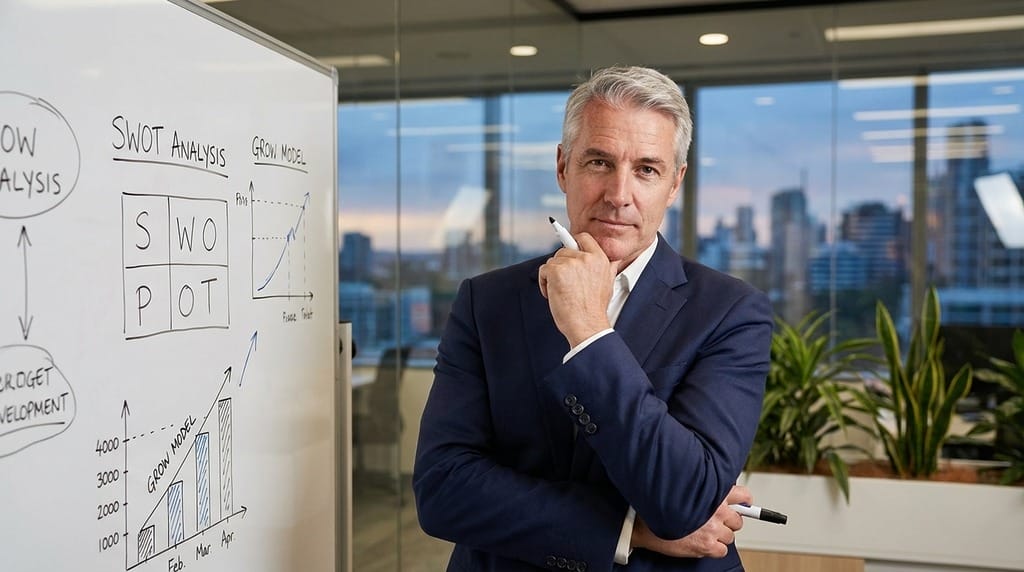
Session cadence (months 2–10): Biweekly 60-minute sessions with structured accountability between meetings. Each session follows a progression: review commitments, surface what emerged, work the current challenge, define next actions. Executive coaching tools like the GROW model (Goal, Reality, Options, Way Forward) provide session structure without constraining the work.
Measurement and closure (months 10–12): Re-administer baseline instruments. Compare pre/post behavioral data. Quantify progress on the original goals. Transfer ownership of the development process to the executive for sustained growth without ongoing coaching.

The arc matters. Coaching without a structured engagement process (no baseline data, no measurement checkpoints, no defined endpoint) is a conversation, not a professional intervention. The process is what separates credentialed coaching from well-intentioned advice.
Who Benefits Most: High Performers Facing New Complexity
High-performance coaching delivers the strongest ROI for leaders in specific inflection points:
Wondering If Coaching Is Right for You?
A 30-minute conversation can clarify whether coaching addresses your current leadership challenge. No commitment required.
- C-suite executives navigating complexity. CEO coaching addresses the isolation of top leadership. At this level, the coach is often the only relationship without an agenda.
- Rising VPs preparing for their next level. The skills that earned the promotion are rarely the skills required for the new role. Coaching bridges that gap before it becomes a performance issue.
- Executive teams in transition. Mergers, strategic pivots, and succession events require executive team coaching that addresses the system, not just individual players.
- Leaders hitting performance plateaus. When an experienced executive’s growth stalls, the constraint is usually mindset or identity, not skill. This is where coaching depth matters most.
- HR and L&D leaders building coaching culture. Organizations investing in leadership development often start with individual coaching engagements and expand to systematic programs anchored to leadership development goals.
The common thread: high-performance coaching works best when the executive is talented but facing a complexity level where their existing patterns no longer produce results. Coaching is not remediation. It is acceleration for leaders who are already high-performing but want to operate at a higher level of impact. Whether framed as coaching for high performance, executive performance coaching, or leadership development coaching, the mechanism is the same: building internal capacity rather than importing external solutions.
One pattern we see consistently: executives assume their challenge is a skill gap when it is actually a focus problem. Understanding how career formation shapes high-performance patterns reframes what the coaching engagement actually needs to address. They are spread across too many priorities, compensating for organizational dysfunction, or operating from a leadership identity that worked at the previous level but constrains them now. High-performance coaching surfaces these patterns through data, not opinion, and that is what makes the work actionable rather than theoretical.
Coaching is not remediation. It is acceleration for leaders who are already high-performing but operating below their actual capacity.
Outcomes You Can Measure
Coaching outcomes fall into three categories, each with different measurement timelines:
Behavioral indicators (visible within 3–6 months): Improved 360-degree feedback scores in communication, delegation, and stakeholder management. Reduced escalation frequency from direct reports. Faster decision-making velocity on cross-functional initiatives.
Organizational impact (visible within 6–12 months): Improved team alignment and engagement scores. Reduced executive turnover. Replacing a C-suite executive costs 2–4x their annual salary, making retention a direct financial outcome. Measurable shifts in leadership culture metrics tracked through pulse surveys.
Career trajectory (visible within 12–24 months): Accelerated promotion timelines. Expanded scope of influence. Successful navigation of leadership transitions that would have derailed without coaching support.
An honest limitation: attribution in executive coaching is always complex. Coaching exists within a system of concurrent interventions: organizational restructuring, market shifts, peer dynamics. Rigorous coaching engagements measure behavioral change and its downstream indicators rather than claiming singular ROI causation.
The widely cited “700% ROI” figure comes from a 2009 ICF study based on self-reported satisfaction, not controlled measurement. The MetrixGlobal study found a 529% ROI for executive coaching, but again with self-reported attribution. The real evidence is in the behavioral data: did this leader’s decision patterns, stakeholder relationships, and team outcomes measurably improve? That is what a structured coaching engagement measures, and that is what distinguishes evidence-based coaching from the confidence game of unmeasured interventions.
The real question is not “what is the ROI of coaching?” It is: did this leader’s decisions, relationships, and team outcomes measurably improve?
Coaching also cannot fix structural organizational problems. If the executive is in the wrong role, operating in a toxic culture, or reporting to a leader who undermines development, coaching alone will not produce lasting results. Part of a qualified coach’s work is naming when the constraint is systemic rather than individual, and recommending the right intervention, even when that intervention is not more coaching.
How to Choose a High Performance Coach
Six factors separate a qualified high-performance coach or executive performance coach from the thousands of practitioners using those titles without the depth to back them:
1. ICF credential level. ACC (Associate) = 100+ coaching hours. PCC (Professional) = 500+ hours. MCC (Master) = 2,500+ hours. For C-suite work, PCC is the minimum; MCC-level coaches have the range to work with identity-level complexity. Verify credentials directly on the ICF credentialing database.
2. Executive-specific experience. Coaching a mid-career manager differs fundamentally from coaching a CEO. Ask how many executives at your level the coach has worked with, and in what contexts (individual, team, organizational transition).
3. Assessment methodology. A qualified coach uses validated instruments (ProfileXT, Genos EQ, 360-degree feedback), not intuition alone. Ask what tools they use and how baseline data informs the engagement.
4. Structured engagement process. Look for a defined arc: intake, assessment, goal-setting, session cadence, measurement, and closure. Coaching that runs indefinitely without measurement checkpoints is a red flag.
5. Chemistry and trust. A 30-minute chemistry session should feel like a productive conversation, not a sales pitch. The coach should ask questions that make you think, not recite credentials.
6. Organizational understanding. For leaders operating within complex organizations, the coach needs to understand systems: how power structures, culture, and incentives shape individual behavior. Individual coaching that ignores the system produces individual growth that the organization absorbs without changing.

When you are ready to evaluate options, consider what it means to work with an executive coach who brings MCC-level depth and a structured assessment methodology to the engagement.
Become a Certified High Performance Coach - or Hire an Effective Coach?
One clarification, because this term attracts two different readers. If you are an entrepreneur or coach looking to become a certified high performance coach - to build coaching skills, help clients, and run a practice - that is a training decision, not a services one: start with our guide to becoming a certified life coach and the ICF-accredited certification program path. The rest of this page is for the other reader: the executive deciding whether to hire one. And no, an effective coach at this level does not sell high performance habits or promise to unlock a high achiever's hidden 10x - performance coaches work on decision quality under load, which is less romantic and more measurable.
What is the formula for super high performance in executives?
There is no secret formula for super high performance - and an executive coach who sells one is selling placebo. What reliably moves senior-leader performance: clear decision rights, a feedback loop that survives hierarchy, deliberate recovery, and a coach who confronts the leader's actual constraints rather than their calendar. Structured coaching turns those into practice, not slogans.
FAQ
Can high-performance coaching be done online?
Yes. Virtual coaching is equally effective for most executive engagements. The key factor is session quality, not physical proximity. Video sessions preserve the nonverbal cues that matter in coaching while eliminating travel logistics that often cause scheduling conflicts. Many executives prefer virtual sessions because they can schedule coaching from any location without blocking half a day.
Is high-performance coaching for teams or only individuals?
Both. Individual high-performance coaching focuses on one leader’s development. Team coaching addresses the executive team as a system: how members make decisions together, manage conflict, and align on strategy. Some situations call for individual coaching first (a new CEO finding their footing), while others require team-level intervention (a leadership team navigating a merger). The choice depends on where the performance constraint actually sits.
How long does a typical coaching engagement last?
Most executive coaching engagements run 6–12 months with biweekly sessions. The first 2–3 months focus on assessment and goal-setting. Months 4–10 are the active coaching phase. The final months address measurement and transition to self-directed development. Shorter engagements (3 months) work for targeted challenges. Open-ended coaching without a defined endpoint often signals a lack of structure.
What credentials should a high-performance coach have?
At minimum, an ICF PCC (Professional Certified Coach) with 500+ hours of coaching experience and documented training from an ICF-accredited program. For C-suite and senior executive work, ICF MCC (Master Certified Coach) with 2,500+ hours provides the depth to work with identity-level complexity. Be cautious of proprietary “certifications” that lack ICF alignment; they may reflect marketing investment rather than coaching competency. Verify any credential at executive coaching cost or directly through the ICF.
What is executive performance coaching, and how does it differ from high-performance coaching?
The terms are used interchangeably in most corporate contexts. Executive performance coaching typically frames the work around measurable business outcomes: decision speed, stakeholder alignment, team productivity. High-performance coaching emphasizes the internal capacity-building methodology - how a coach develops an executive's judgment rather than just their output metrics. In practice, a qualified executive performance coach working at the PCC or MCC credential level delivers both: structured behavioral assessment, identity-level development work, and measurable outcomes against defined business goals. The label matters less than the coach's credential level, methodology, and experience with leaders at your complexity tier.
What is high performance business coaching?
High performance business coaching focuses on a business's leadership performance constraints: decisions that slow down, team dynamics that undermine execution, or leaders whose development has stalled relative to the company's growth stage. It differs from general executive coaching in its explicit business outcome framing - engagements are scoped to specific business challenges (entering a new market, navigating a leadership transition, scaling from Series B to Series C) rather than long-arc developmental goals. When the performance constraint sits at the individual leader level, individual coaching applies. When it sits at the team or organizational level, team coaching or organizational coaching is the right intervention.
Find Out If High-Performance Coaching Fits
Book a free 30-minute consultation to discuss your leadership goals, assess fit, and understand what a structured coaching engagement looks like.
Book a Free Consultation →