Change Management Activities: Beyond Workshop Theater
What are the best change management activities?
The highest-leverage single activity is the sponsor skip-level: sponsor sits with front-line teams, no managers present, answers real questions. Beyond that, match the barrier. Resistance mapping for desire problems. Adoption shadow sessions for ability gaps. Bright spots interviews for reinforcement failures. Wrong diagnosis guarantees the right activity produces nothing.
Change management activities fill agendas across organizations going through transition. Workshops are scheduled, icebreakers are carefully chosen, and facilitation guides are printed. The activity catalog grows with each initiative. What rarely grows is the adoption rate that follows.
The problem isn’t the activities themselves. It’s how they’re selected, who facilitates them, and whether anyone acts on what they surface. Most change management activities are diagnostic tools being used as intervention tools — and the gap between the two explains why so many well-facilitated workshops produce so little lasting change.
Why Most Change Management Activities Fall Flat
Most change management activities fail because they address the wrong barrier, get facilitated by someone who can’t hold the space, or get treated as the change itself rather than a diagnostic step toward it. Three patterns account for the majority of wasted workshop time.
The workshop went well. Participants broke into groups, discussed the upcoming reorganization, filled out sticky notes, and left with action items. The facilitator reported high engagement. Three months later, adoption sat at 31%.
The gap between workshop energy and actual behavior change is where most change management activities live. They create the appearance of progress without creating movement. Three patterns explain why.
Activity theater. The exercise looks productive but doesn’t address the actual barrier to adoption. Icebreakers are popular because they feel safe. They rarely address why people are resisting the change. The activity provides a release valve without generating traction.
Diagnostic mismatch. The activity doesn’t match the problem. Force-field analysis helps when people don’t understand the forces for and against change. It does nothing when they understand perfectly well and simply don’t want to change. Wrong diagnosis leads to wrong activity.
Facilitation gap. The activity design is sound, but the person running it can’t hold the space. A fishbowl discussion facilitated by someone uncomfortable with conflict becomes a presentation with spectators. The design matters less than the capability of the facilitator.
Before selecting activities, diagnosis comes first. Identify the barrier you’re addressing. Then choose the activity that fits.
Key Takeaways
- Most change activities fail because they address the wrong barrier — diagnosis must come before activity selection.
- Resistance contains useful data; treating it as an obstacle to overcome guarantees you’ll miss what it’s telling you.
- Facilitation capability matters more than activity design — a strong exercise falls flat without someone who can hold the space.
- Activities are diagnostic instruments, not interventions — the real work begins with what you do after the workshop ends.
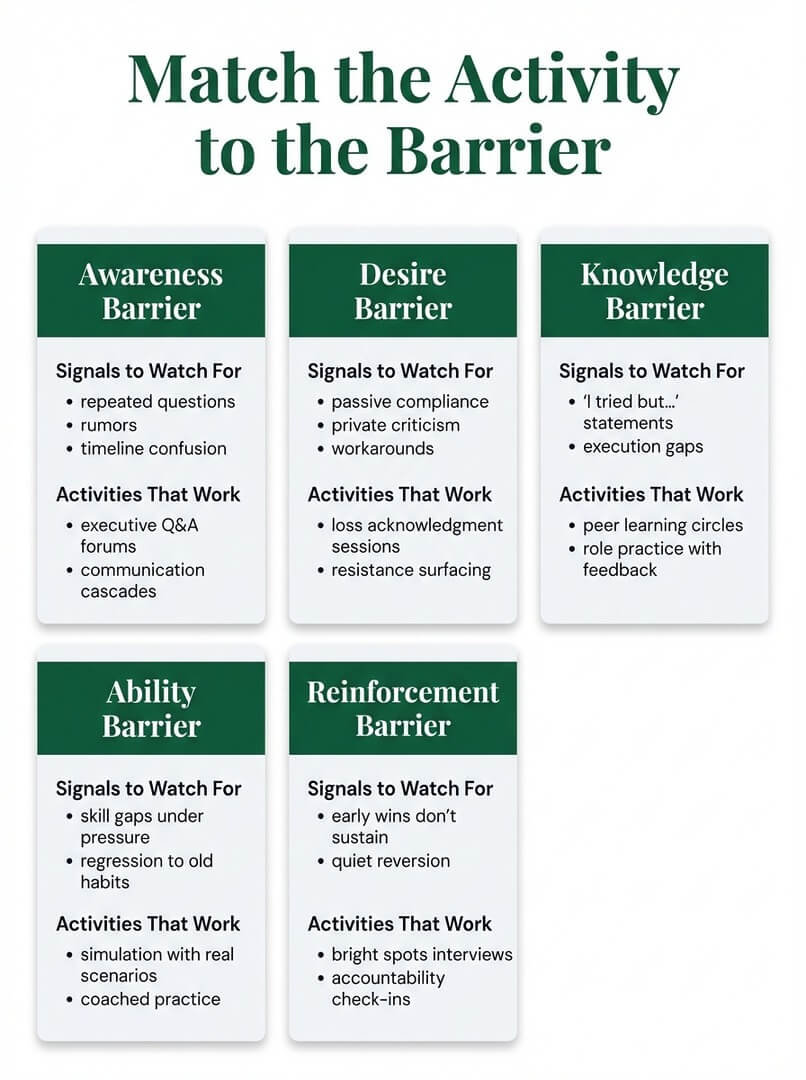
Match Activities to Barriers
Not Sure Which Barrier You’re Facing?
If you’re debating awareness vs. desire (or ability vs. reinforcement), a short consult can help you choose activities that fit—and skip the ones that won’t.
The right change management activity depends on the barrier your organization faces. People stuck at different points in the adoption curve need different interventions — awareness problems need different activities than desire problems, and ability gaps require something entirely different from reinforcement failures. Five barrier categories cover most situations and point directly to the activities that address them.
Awareness barrier — people don’t understand what’s changing or why. Signals: repeated basic questions, circulating rumors, confusion about timelines. Activities that work: executive Q&A forums, information sessions, transparent communication cascades. Activities that don’t: team-building exercises, icebreakers, anything that avoids the actual content of the change.
Desire barrier — people understand but don’t want to change. Signals: passive compliance, private criticism, workarounds that preserve old ways. Activities that work: loss acknowledgment sessions, resistance surfacing, “what’s in it for me” dialogues where the answer is honest. Activities that don’t: more communication about the vision.
Knowledge barrier — people want to change but don’t know how. Signals: good intentions with execution gaps, “I tried but...” statements. Activities that work: targeted training, peer learning circles, shadowing, role practice with feedback. Activities that don’t: motivational talks.
The first three barriers are cognitive — people need information, motivation, or instruction. The next two are behavioral and require sustained practice with support.
Ability barrier — people know what to do but can’t do it yet. Signals: competence frustration, skill gaps under pressure, regression to old habits. Activities that work: simulation with real scenarios, coaching conversations, protected practice time, graduated difficulty. Activities that don’t: additional classroom training.
Reinforcement barrier — initial adoption decays. Signals: early wins that don’t sustain, quiet reversion, “we tried that” fatigue. Activities that work: recognition structures, progress celebrations, accountability check-ins, bright spots interviews. Activities that don’t: one-time launch events.
This diagnostic aligns with ADKAR-aligned activities from Prosci’s framework, but the principle is simpler: match the activity to the actual barrier. Running awareness activities when the barrier is desire wastes everyone’s time. Getting the diagnosis right is the first step in any change management process.
Seven Activities That Drive Adoption
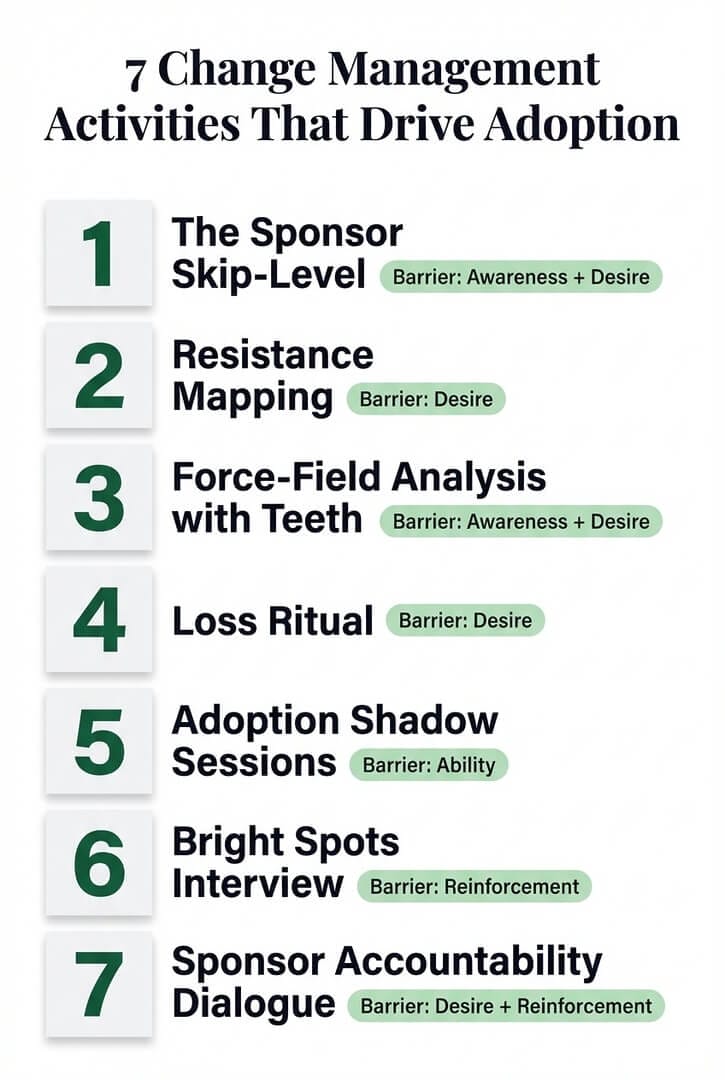
Seven change management activities consistently produce results when matched to the right barrier and facilitated with skill. Each one below includes the specific barrier it addresses, the failure mode that undermines it most often, and the coaching behavior that makes the difference between insight and theater.
1. The Sponsor Skip-Level
Barrier addressed: Awareness and desire.
When to use: Early in the change, when messages are mutating through management layers.
After supporting dozens of organizational changes, this is the single highest-leverage activity: the sponsor sitting with front-line teams, without their managers present, answering real questions. Not presenting slides. Listening and responding.
Failure mode: The sponsor arrives with talking points instead of genuine curiosity. Teams recognize the performance. The skip-level becomes evidence of insincerity rather than connection.
What makes it work: Coach the sponsor beforehand on questions they might hear and can’t answer honestly. Those are the questions that matter most. Deciding how to handle them before the session prevents the defensive responses that destroy trust.
2. Resistance Mapping
Barrier addressed: Desire.
When to use: When adoption is stalling and resistance feels diffuse.
Gather a cross-section of stakeholders — people at different levels, different functions, different attitudes toward the change. Ask three questions: What are you hearing people say about this change? What are they probably thinking but not saying? What would need to be true for skeptics to become supporters?
Failure mode: Using it as interrogation rather than inquiry. If people feel they’re being asked to name resisters, the conversation shuts down. The purpose is understanding resistance, not identifying who to “manage.”
What makes it work: The facilitator must genuinely believe that resistance contains useful information. If the facilitator sees resistance as an obstacle rather than data, participants sense the difference.
Resistance isn’t the enemy of change — it’s the most honest data your change effort will ever produce.
3. Force-Field Analysis with Teeth
Barrier addressed: Awareness and desire.
When to use: When driving forces are assumed rather than validated.
Standard force-field analysis produces two tidy columns that confirm what leadership already believes. The restraining forces become a to-do list. The driving forces validate the decision. The session generates documentation, not insight.
The corrective: before the session, interview five skeptics individually. Ask what they see as the real barriers — not the official ones. Bring that data into the room. When the whiteboard matches leadership assumptions, challenge it: “Is this what’s actually restraining us, or what we’re comfortable naming?”
What makes it work: The facilitator must be willing to surface uncomfortable truths. If you’re not naming the political barriers, the resource constraints, the leadership inconsistencies, you’re doing theater.
4. Loss Ritual
Barrier addressed: Desire.
When to use: When the change requires giving up something people value — expertise, identity, autonomy, relationships.
Change involves loss. When that loss goes unacknowledged, it goes underground. People grieve privately while pretending to adopt publicly. A structured opportunity to name what’s being lost — and have that loss witnessed — creates space for genuine transition.
Create a brief, optional session where people can name what they’re losing: expertise that took years to develop, professional identity tied to the old way, relationships that the new structure disrupts, autonomy they’ve earned. Don’t problem-solve. Don’t reframe. Witness. The act of being heard often releases what holding on couldn’t.
Failure mode: Making it mandatory or performative. Forced vulnerability is worse than no vulnerability. The invitation must be genuine, and not everyone will participate.
What makes it work: The facilitator needs comfort with emotion that has no immediate resolution. This isn’t about fixing grief — it’s about acknowledging it. Organizations that skip this step find the grief surfacing later as cynicism, disengagement, or quiet exits.
5. Adoption Shadow Sessions
Barrier addressed: Ability.
When to use: When training completion is high but behavior change is low.
Training teaches what to do. Shadow sessions reveal what actually happens when people try to do it. Pair experienced practitioners with people struggling, let them observe real work, and debrief what’s getting in the way.
Failure mode: Using shadows as surveillance rather than support. If sessions feel like performance reviews, people stage their behavior. Make the purpose explicit: understand barriers, not evaluate people.
What makes it work: Debriefs matter more than the observation itself. Structure them around one question: “What got in the way of doing what you intended?” The answers reveal whether the barrier is knowledge, system design, time pressure, or something else entirely. That data drives the next round of support.
6. Bright Spots Interview
Barrier addressed: Reinforcement.
When to use: When pockets of success exist but aren’t spreading.
Find the teams or individuals who’ve actually adopted the change. Interview them — not about what they did, but about what conditions made adoption possible. Then work to create those conditions elsewhere.
Failure mode: Turning bright spots into best practices that ignore context. What worked for one team may not transfer to another. Extract principles, not procedures.
What makes it work: Ask about conditions, not actions. “What made adoption possible here?” yields different answers than “What did you do?” One team might say their manager created protected practice time. Another might say they had a peer who’d already figured it out. Those are systemic insights, not individual heroics to replicate.
7. Sponsor Accountability Dialogue
Barrier addressed: Desire and reinforcement.
When to use: When sponsor commitment is nominal — they announced the change, delegated everything, and moved on.
Sometimes the barrier is the sponsor. This isn’t a workshop activity. It’s a coached conversation where the sponsor examines whether their behavior matches their stated priorities. The sponsor needs to hear, from someone with credibility, that their absence is undermining adoption.
This is coaching work, not facilitation. It requires someone who can hold that conversation without flinching. And it requires organizational credibility — the person raising the issue must have enough standing that the sponsor takes the feedback seriously rather than dismissing the messenger.
Adapting These Activities for Workshops, Training, and Teams
None of the seven activities above is tied to a single format. The same barrier-first logic scales up into a full-day workshop, compresses into a 20-minute training exercise, or folds sideways into an intact team’s regular meeting. What stays constant is the discipline: diagnose the barrier, then choose the activity. What changes is the container.
Change Management Workshop Activities
A workshop gives you time and attention you won’t get again — which is exactly why the overscheduled-agenda trap is so costly. The instinct is to pack six change management workshop activities into four hours. Resist it. Open with diagnosis rather than an icebreaker: name the barrier the group is actually facing before running any exercise against it. Give each activity one barrier and enough room to go deep, and protect the debrief — the debrief is where the data surfaces. One resistance mapping session done properly beats three half-finished exercises every time.
Change Management Training Activities and Exercises
Training sits on the knowledge and ability barriers, and the change management training activities that fit are the ones that put people into the new behavior rather than talking about it. Scenario practice — realistic situations people will actually face after the change — reveals the gap between understanding a new process and executing it under pressure. Role practice with structured feedback, graduated-difficulty simulation, and peer learning circles all belong here. The failure mode to avoid is the classroom lecture dressed up as a change management training exercise: a slide deck about the future state develops no capability. If people already know what to do and still can’t do it, more training content is the wrong instrument — you have an ability barrier, and ability is built through protected practice, not instruction.
Team and Group Exercises for Change
Most change lands on intact teams, and the barrier-matched activities adapt cleanly to that setting. Resistance mapping runs inside a normal team meeting when you ask the three questions directly. Bright spots interviews work across teams — find the group that adopted the change and study the conditions that made it possible, not the personalities. Group exercises for larger populations trade depth for reach: they can surface themes and build shared language, but they can’t hold the individual conversations where desire barriers actually move. Use them to map the terrain, then follow up team by team.
Where Icebreakers and Games Actually Fit
Change management icebreakers and games earn skepticism here for a reason: they’re the default when a facilitator wants engagement without risk. But they aren’t worthless — they’re misused. An icebreaker’s legitimate job is to lower the threat in the room enough that people will later tell you the truth about their resistance. A game that simulates the discomfort of change — the shifting-rules card game, the blindfolded-trust walk — can make an abstract dynamic viscerally real in a way a slide never will. The test is simple: does the icebreaker or game set up a harder conversation, or does it substitute for one? Setup is useful. Substitution is theater.
The Facilitation Gap
The difference between a change management activity that creates movement and one that creates a pleasant memory is the facilitator running it. Four capabilities — none of them taught in standard change management certifications — determine whether an activity produces insight or just fills time on the agenda.
Build Facilitators Who Can Hold the Space
The difference-maker isn’t the template—it’s the person in the room. Coaching develops the skill to surface resistance, read the room, and stay with conflict.
Holding space for conflict. Most change management exercises surface conflict when they’re working correctly. The question is whether the facilitator can hold that tension without rushing to resolution or shutting it down. Conflict that gets suppressed doesn’t disappear — it goes underground and reemerges as passive resistance.
Reading the room accurately. Knowing when to push deeper versus when to back off. Sensing who needs to speak and who needs processing time. Recognizing when silence means processing versus when it means shutdown.
This isn’t a script or a set of cue cards. It’s attunement developed through hundreds of hours of practice with real groups under real pressure.
Personal stance on resistance. If the facilitator believes resistance is the enemy, every activity becomes a tool to overcome people rather than understand them. Stance matters more than technique.
A methodology can tell you which activity to run. It cannot give you the capability to facilitate it well — that requires a different kind of development entirely.
Comfort with not knowing. Activities surface information you can’t predict. The facilitator must be comfortable saying “I don’t know” and “let’s sit with that” rather than rushing to answers. When a resistance mapping session reveals something nobody anticipated, the facilitator’s capacity to stay present with uncertainty determines whether the insight gets explored or gets buried.
Change management certifications teach which activities to use. They don’t develop the capability to facilitate them well. That’s a coaching competency, not a methodology competency. Developing these skills needed to facilitate change activities is what change management coaching addresses — building the human capability underneath the process knowledge.
Four Failure Modes Worth Recognizing
Even well-chosen activities fail when the execution context works against them. These four scenarios show up repeatedly across organizations — each one an example of good activity design undermined by bad organizational conditions.
The overscheduled workshop. Six activities in four hours. Each got 40 minutes including debrief. Nothing went deep. Everyone felt busy. Nothing changed. Activity volume is not activity value.
The feedback-resistant sponsor. Resistance mapping surfaced that the sponsor’s communication style was part of the problem. The facilitator didn’t name it. The activity produced data that went nowhere because the hardest finding was off-limits.
The next two patterns involve activities that worked in the moment but failed to produce lasting results.
The outsourced facilitation. An external consultant facilitated beautifully. Then left. Nobody internal had the capability to continue the conversations the activities opened. Two weeks later, the energy dissipated. This pattern reveals a deeper problem: organizations hire facilitators when they should be developing facilitation capability internally.
The premature celebration. One strong workshop. Leadership declares the culture has shifted. Six months pass. Behavior reverts.
Activities create moments — sharp, vivid, sometimes genuinely moving. But moments don’t sustain themselves. Sustainment requires repetition, reinforcement, and leadership follow-through that outlasts the workshop high.
Each of these scenarios shares a common thread: the activity was treated as the endpoint rather than the beginning. The workshop becomes the deliverable, the report becomes the outcome, and the actual behavior change gets lost in the documentation of effort.
The workshop is not the change. It’s what you do with what the workshop surfaces that determines whether anything shifts.
From Activities to Sustained Adoption
A well-facilitated activity can shift a conversation. It can surface what’s been unsaid, build understanding between people on opposite sides of a change, or create connection where there was only compliance. What it cannot do is sustain adoption on its own.
The distance between a single activity and sustained adoption requires three things: a system for acting on what the activity reveals, a cadence of follow-up that maintains momentum, and leadership behavior that reinforces the direction. Without all three, even the best-designed activity becomes a one-time event.
The best activities reveal what needs to happen next. A skip-level surfaces questions the communication plan didn’t answer. Resistance mapping identifies barriers the implementation plan missed. Bright spots interviews suggest conditions to replicate.
Each activity produces data. The question is whether anyone acts on it.
Organizations that treat activities as diagnostic instruments — generating data about where the real barriers are — use them effectively. Organizations that treat activities as interventions — expecting the activity itself to create change — run workshop after workshop wondering why nothing sticks.
Change management activities are diagnostic tools and development opportunities. They are not the change itself. Leading through change requires connecting what activities reveal to what the organization does next.
The test of a change management activity isn’t whether participants engaged. It’s whether behavior changed afterward. Before your next session, ask three questions: What specific barrier are we addressing? Who has the capability to facilitate it well? What will we do with what surfaces? If you can’t answer all three, the activity is premature.
For the complete framework that connects these activities to organizational outcomes, see the comprehensive change management guide.
Frequently Asked Questions
What’s the difference between change management activities, exercises, and games?
They’re often used interchangeably, and search demand treats them as synonyms. In practice, “exercises” and “activities” describe the same structured interventions — resistance mapping, force-field analysis, bright spots interviews. “Games” usually means a simulation or play-based exercise that makes the discomfort of change tangible. The label matters far less than the diagnosis: any of them falls flat if it’s aimed at the wrong barrier.
What are the best change management icebreakers?
The best change management icebreaker is one that earns honesty, not just energy. A quick round where each person names one thing they’re unsure about in the change does more than a novelty game, because it signals that concerns are welcome. Treat icebreakers as a way to lower threat before the real work — not as the work itself.
What change management activities work for remote or virtual teams?
Most of the seven activities port to virtual settings with small adjustments. Resistance mapping runs in a shared document or an anonymous poll, which often surfaces more candor than a room does. Bright spots interviews work over video. The two that suffer remotely are the loss ritual and anything needing sustained emotional presence — those need a facilitator skilled at reading a room through a screen.
What are some examples of change management activities?
Concrete examples include a sponsor skip-level (leaders answering front-line questions with no managers present), resistance mapping (surfacing what people think but won’t say), a loss ritual (naming what the change costs people), and bright spots interviews (studying the teams who already adopted). Each targets a specific adoption barrier rather than generic engagement.
Is there a change management activities template or PDF I can use?
A downloadable list of activities is exactly the trap this article warns against — a catalog invites you to pick an activity before you’ve diagnosed the barrier. The more useful tool is the barrier-to-activity map above: identify whether you’re facing an awareness, desire, knowledge, ability, or reinforcement barrier first, then choose the activity that fits. That sequence, not a PDF, is what makes activities work.
Get a Clear Diagnosis Before Your Next Workshop
We’ll pinpoint your true barrier (awareness, desire, ability, reinforcement) and map the few activities that will actually move adoption.
Book a Free Consultation →