Direct Communication in Coaching
Why is direct communication important in coaching?
Direct communication delivers clear, unambiguous messages that keep the coaching session anchored to the client's goals. Without it, focus drifts, patterns go unnoticed, and observations lose their power to move the client forward. Clear, concise language — built on active listening and the client's own words — is what makes the coach effective as a mirror.
Coming up with the right definition of “direct communication” is not a simple task. Here is what I find as a suitable definition, may be not the perfect one. Direct communication sits at the core of the client relationships that sustain a successful coaching practice :
“Direct communication is speech that conveys clear messages .... Direct communication may be used when there is no room for discussion or compromise.“ Source: Study.com
Now let's try to apply this in coaching....
Clearly, having a clear language, using the client's words and making comments and observations would be helpful. None of this would be possible without the ability of the coach to be an active listener.
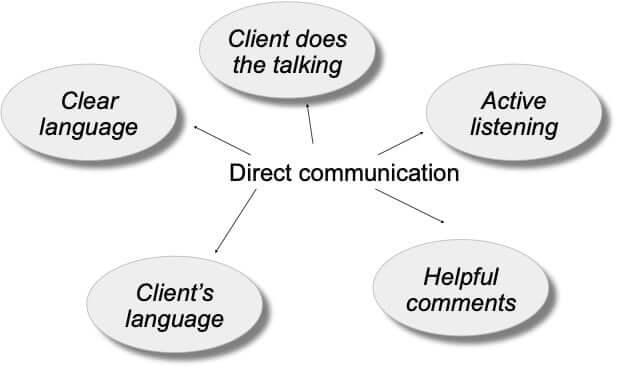
Here are some useful pointers to develop a clear and concise language :
- Use minimum words and be specific
- Ask short questions
- Use understandable language (by the client). If the client is using a jargon or certain type of language, try to mimic this. As we all know, the coach is as a mirror for the client.
Of course the client does most of the talking. As coaches, we should stop looking for our solutions. We are active listeners who are needed mainly because of this quality. When working with clients navigating complex challenges like ADHD work-life balance, this non-directive stance is especially important — the client is the expert on their own brain.
The key to a successful coaching session is keeping focus on the topic. Always keep in mind the goal of the coaching session and the long term goals. The structural framework that holds this directness in check is the ICF relationship agreement competency.
Observe the following :
- Is the client giving you too many details ?
- Is the client focused on his goals? Lack of focus - interruptions are allowed if we need to shift to a more valuable topic!
Look for patterns. As coaches we are allowed to make comments and share observations if those are helping the client to move forward. Always keep in mind that a good question is an open-ended question as it allows the client to think further and discover new horizons.
An example for observation might be, “I am noticing that every time you mention your work, you are making a specific gesture.“
When making comments or sharing observations, keep in mind that the coach needs to create a space for the client and let the client do the work.
Try following those simple steps:
- Always ask for permission without being attached to you being right.
- Drop the information as a data and let the client think further.
- Validate with your client what would be his opinion about what you just said.
Key Takeaways
- Direct communication in coaching means clarity without compromise — fewer words, sharper questions, client-matching language.
- Active listening is the prerequisite for directness; without it, clear language has no foundation to stand on.
- Interrupting an unfocused client is not rudeness — it's a coaching move that protects session value.
- Observations land better when offered as data, with permission, without the coach needing to be right.
- Keeping session goals and long-term goals simultaneously in view is what separates focused coaching from good conversation.
Want Feedback on Your Direct Communication?
Bring a real coaching scenario—we’ll help you sharpen focus, ask cleaner questions, and share observations with permission.
Book a Free Consultation →