
What Your Career Has Taught You — And What It Hasn’t
A CFO on the train home, re-reading her board deck for the third time. The data was clean. The scenarios were tested. The sensitivity analysis covered every downside. She still lost the room on slide seven, and she cannot figure out why.
A CTO in his home office at 11 p.m., reviewing his team’s architecture proposal. His hands keep moving toward the keyboard. He could refactor the data layer in an hour. His team spent two weeks on it. He knows he should close the laptop. He opens the file.
A newly promoted VP staring at a delegation matrix, her name removed from three workstreams she built from scratch. The names replacing hers are competent. She trusts them. Her stomach doesn’t.
Three different leaders. Three different functions. The same thing happening underneath: a career’s worth of training doing exactly what it was designed to do, in a room that no longer rewards it. Nobody told any of them the rules changed. Nobody had to. The rules changed slowly enough that the discomfort felt like a personal failing rather than a structural shift.
Key Takeaways
- Every career installs patterns in how you process information, evaluate risk, and define success. Those patterns are not personality. They are professional formation, shaped by years of immersion in a specific function.
- The strength that earned your promotion is often the same one creating a ceiling at the next level. The currency shifted, but the instincts didn’t.
- What “think more strategically” means depends entirely on which career shaped the person hearing it. A finance leader and a technology leader face fundamentally different versions of that challenge.
- The friction on your leadership team is often not a people problem. It is two professional formations processing the same decision with different operating systems.
- A coach who understands what your specific career installed asks different questions than one who treats every executive the same.
The Patterns Your Career Installed
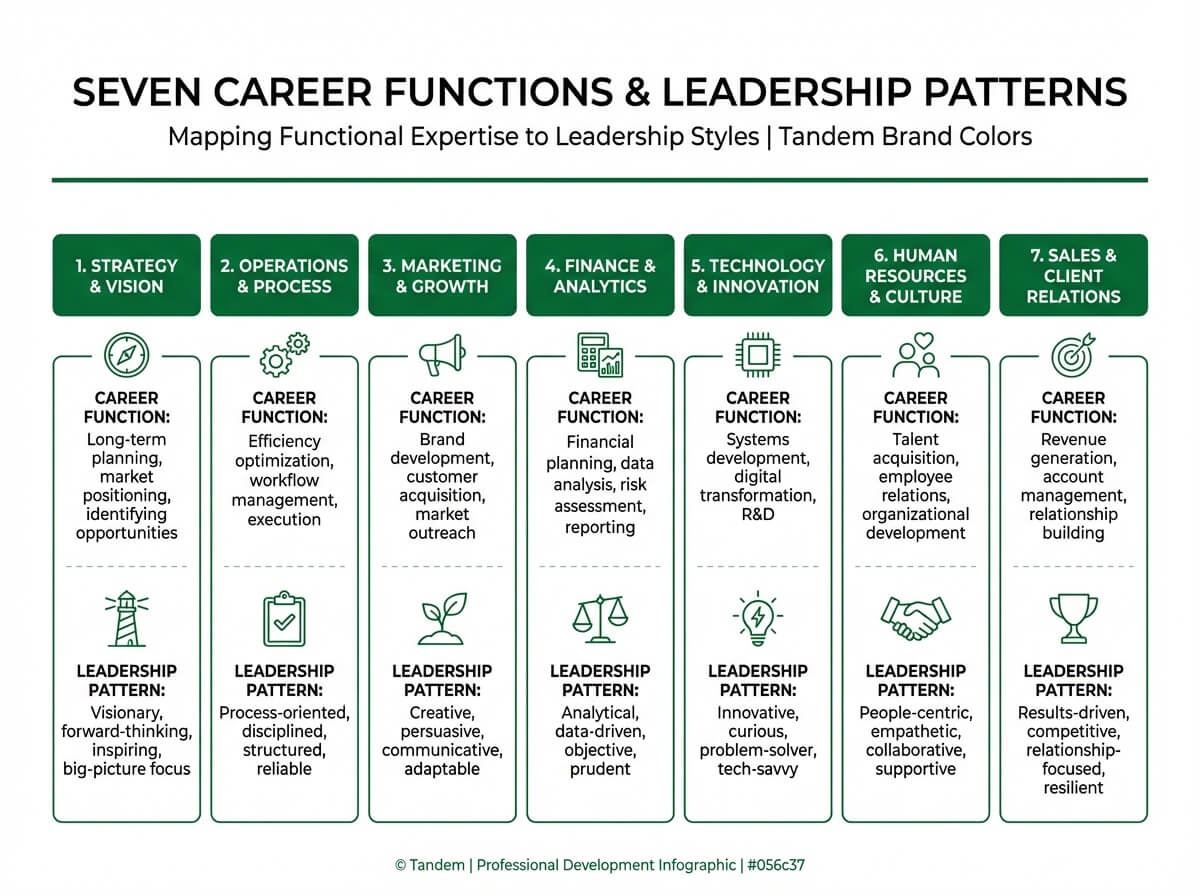
Every career trains you to see the world in specific ways. Not personality. Not talent. Something more structural than either: the patterns that years of immersion in a function install in how you process information, evaluate risk, define success, and earn the right to be taken seriously. These are not habits you can switch off at the end of the quarter. They are the operating system your career wrote, line by line, over fifteen or twenty years of practice, feedback, reward, and repetition.
If you’ve spent twenty years in finance, you didn’t just learn how to build models. You trained yourself to see what others miss. The variance nobody flagged. The assumption buried in the forecast. The exposure hiding in the third scenario. After enough years, that precision stopped being something you turn on at work. It reshaped how you think. You find the flaw in everything now. Budgets. Proposals. Conversations. Someone pitches an idea without evidence, and you don’t hear enthusiasm. You hear an unaudited claim. That filter is what made you exceptional. Precision became personality. And accuracy fused with self-worth so gradually that you cannot remember when one became the other.
If you came up through technology, you built things. Real things. Systems that scaled, platforms that held under load, solutions that were elegant before anyone used that word in a business context. Your career rewarded you for being the smartest technical person in the room. “I am what I’ve shipped” stopped being a job description somewhere around year ten. It became the thing that tells you, every morning, that you are good at what you do. The builder identity runs deep because the feedback is immediate and unambiguous: the code compiles or it doesn’t. The system handles the load or it breaks. No politics, no interpretation. Just the clean signal of something that works.
And if you built your career in operations, your greatest contributions are things that didn’t happen. The crisis that was prevented. The system that didn’t break. The launch that went smoothly because you rebuilt the deployment pipeline the month before. Your career trained you to succeed by being invisible. Nobody mentioned any of it at the leadership meeting. Nothing broke this quarter. So the room doesn’t see you. Organizations reward what they can observe, and continuity is invisible by definition.
These patterns served you brilliantly. They are the reason you’re in the room you’re in. They also have limits you’ve never been asked to notice, because until now, the room kept rewarding the same thing.
When Strengths Become Ceilings
There is a specific mechanism by which professional excellence becomes a constraint. It is not the tired platitude that what got you here won’t get you there. Every leadership book says that. None of them explain what “here” actually installed, function by function, or why the specific strength that earned the promotion is the specific one creating the ceiling. The mechanism is more precise than the platitude: the currency shifted, but the instincts didn’t.
Consider the CFO whose precision earned a promotion to VP. At the director level, precision was the currency. Build the model. Stress-test the assumptions. Be the person who sees the gap in the analysis before anyone else does. That currency bought credibility, promotions, and trust. At VP, the currency changed. The room stopped waiting for the forty-slide deck and started waiting for a three-slide narrative. Not what the numbers say. What the numbers mean. Being right stopped being enough. Being understood became essential.
But narrative feels imprecise. And imprecise feels dangerous to someone whose entire identity was built on being right about the numbers. So the forty-slide deck keeps coming. The analysis gets sharper. The influence doesn’t.
The ceiling isn’t competence. It’s repertoire.
Or the CTO who still reviews every pull request at the VP level. Technical execution provides clear, fast feedback. You read the code. You know immediately whether it’s good. Leadership provides slow, ambiguous feedback you don’t yet trust yourself to read. A meeting goes well or it doesn’t, and the signal is a raised eyebrow or a shifted timeline three weeks later. Letting go of the keyboard means letting go of the only currency that tells you, in real time, that you’re still good at something.
Or the rising VP whose boss keeps saying “think more strategically” without explaining what that means for someone whose entire career has been defined by getting things done. You shipped. You solved. You delivered. Now the game requires something that feels like the opposite of everything that got you here. You’re not failing. You’re succeeding at a game that ended two levels ago.
The Room Changed — You Didn’t
Promotion moves you into a context that doesn’t reward what you were promoted for. This is not ironic. It is structural. And it happens at every transition point, wearing different clothes depending on where you came from and where you landed.
The CTO who shows up to the board meeting with an architecture diagram has missed the point. Not because the architecture doesn’t matter. Because the board doesn’t evaluate technology in technology language. They want to know about market positioning, customer acquisition cost, and how the platform drives revenue. The same person who was indispensable at VP because they could translate technical to business is now expected to think in business language natively, not translate into it. Still translating means still operating one level below where the room needs you to be. The room changed. The instincts are still reaching for the whiteboard.
You were not promoted because the organization wanted more of what you already do. You were promoted because they believe you can become something you have not been yet. The job description changed. The identity didn’t get the memo.
At the rising-leader level, the version is more visceral. You got promoted because you were the best executor on the team. Every problem you solved, every project you shipped, every deadline you hit built the credibility that put you in this chair. Now your boss keeps telling you to stop solving and start steering. Nobody handed you the playbook for steering. The people above you aren’t explaining the rules because they can’t see them either. They absorbed them over years, and the absorption felt like instinct, not learning. So when they tell you to “think more strategically,” they believe they’re giving you a clear instruction.
They’re not. They’re describing an outcome without explaining the mechanism. And the mechanism is different depending on which career shaped you. For a finance leader, “strategic” means tolerating ambiguity and leading with judgment instead of data. For a technology leader, it means letting go of the elegant solution in favor of the politically viable one. For an operations leader, it means accepting that the system you optimized is about to be redesigned. The word is the same. The work behind it is not.
What Your Function Did to How You Think
Not every leader in a given function experiences the same patterns. But careers are not neutral. Years of immersion in a discipline install something, and that something is specific enough to recognize. If something below sounds familiar, it’s not because all people in your function are the same. It’s because the function shaped certain instincts, and those instincts have a signature.
Recognize Your Pattern?
If one of those descriptions landed with uncomfortable precision, that’s what a first conversation feels like too. We start where your career shaped you.
| Function | What It Installed | Where It Creates a Ceiling |
|---|---|---|
| Technology | Systems thinking; “does it work?” as the standard for evidence | Political and emotional dimensions stay invisible until failure |
| Finance | Precision, scenario modeling, distrust of unverifiable claims | Being experienced as cross-examiner rather than collaborator |
| Legal | Adversarial reasoning that feels like intelligence itself | People come to you late, bracing, instead of early and trusting |
| Marketing | Narrative adaptability and rapid reinvention of positioning | Chronic attribution battles and constant pressure to prove ROI |
| Operations | End-to-end flow mapping; seeing downstream consequences first | Success is invisible—prevented crises earn no recognition |
| HR | Relationship mapping and second-order human consequences | Deep people investment in a system that treats people as cost |
| Product | Multi-lens processing; high ambiguity tolerance across functions | Longest validation lag makes confidence look like arrogance |
Technology. You notice system constraints and dependencies before anyone else in the room. You decompose problems into components instinctively. When someone presents an idea, your mind is already mapping the implementation, identifying the bottlenecks, estimating the load. Your standard for what counts as evidence is “does it work?” A working prototype is more trustworthy to you than any amount of analysis or narrative. That epistemic standard made you extraordinary at building. It also means the political and emotional dimensions that make elegant solutions fail in practice are often invisible to you until the failure has already happened. If that gap has been costing you, here is why the best technical leaders struggle when the room changes.
Finance. You notice cost implications and margin impact before anyone finishes the sentence. You organize what you notice into scenario models, probability weights, sensitivity ranges. What counts as evidence for you is verifiable data and auditable methodology. If someone can’t show their work, you don’t trust their conclusion. That rigor earned every seat you’ve occupied. The blind spot is how you’re experienced as a collaborator. Whether people seek your input early because they value it, or late because they’re bracing for the cross-examination. “If the numbers were right, I did my job” is a sentence that stops being true at a certain altitude. To understand what a career in finance does to how you lead, the altitude matters.
Legal. Adversarial reasoning stopped feeling like a skill somewhere around year five. It started feeling like intelligence itself. You stress-test every proposition. You see the exposure, the liability, the precedent that makes this idea dangerous. Your greatest contributions are things that didn’t happen: the contract clause that prevented the lawsuit, the compliance review that caught the eight-figure exposure. The question that rarely gets asked is whether people come to you early because they trust your counsel, or late because they’re trying to get past you. That distinction matters more than any legal brief you’ve written.
Marketing. Your identity shifts with the market. You reinvent positioning, launch campaigns, build narratives that move audiences. That adaptability is genuine and valuable. It also means your signal environment is the fastest and most visible of any function. Everyone can see your results, which means everyone has an opinion. You live in chronic attribution battles, defending whether the pipeline came from the campaign or would have come anyway. “Prove the ROI” is a sentence you hear more than anyone else at the leadership table, and it comes from people whose own contributions are equally difficult to isolate but who never have to prove it.
Operations. You map flows end-to-end. You see the downstream consequences that everyone else misses: how the sales commitment will strain capacity, how the product launch will collide with the infrastructure timeline, where the CEO’s new strategy will break on implementation. You sit at the intersection of every function’s execution reality. And you are only noticed when something breaks. After years of that signal environment, you stop expecting recognition. You start measuring your own performance by what didn’t go wrong. When someone tells you to “demonstrate your strategic value,” you draw a blank, because how do you take credit for a disaster that never happened?
HR. You map relationships and second-order human consequences. Where the CFO sees a cost line, you see the manager who will lose three direct reports. Where the CTO sees a platform migration, you see the team whose identity is tied to the system being replaced. Everyone on the leadership team comes to you for advice. You mediate, translate, hold confidences. And when budget decisions are made, your function is still the first one cut. Your formation instilled a tension that never fully resolves: caring deeply about people while serving the business that sometimes treats people as a cost line.
Product. You process information through every function’s lens simultaneously because the product sits at the intersection of all of them. Engineering wants feasibility. Sales wants features. Finance wants margin. Legal wants compliance. You hold the trade-offs between constituencies that each believe their priority is obvious. Your currency has the longest validation lag of any function: the market may not confirm your direction for a year or more. You make bets with incomplete information and wait longer than anyone else to find out if you were right. That ambiguity tolerance is a genuine strength. It is also why your confidence can look like arrogance to people whose functions provide faster, clearer feedback.
The VP Who Can’t Let Go / The Director Who Can’t Get Heard
If you’re a director, VP, or SVP reading this, the C-suite patterns above probably feel familiar but distant. Your version of this is closer to the skin. The patterns haven’t had twenty-five years to calcify. They’re still fresh enough to notice if someone points them out. They are also fresh enough to shift, which is why the transition years are where the real leverage lives.
Three transitions that generic leadership advice treats as skill gaps but are something more structural:
The delegation trap. Delegation feels like handing your reputation to someone who doesn’t care about it as much as you do. Because for your entire career, your name on the work was the guarantee. The deliverable with your fingerprints was the one that shipped clean. Now you’re supposed to let go, and nobody explains that the transition isn’t a skill problem. It’s a grief problem. Grief for the identity that earned the promotion. What delegation costs someone whose currency was execution precision is fundamentally different from what it costs someone whose currency was building the thing themselves. The finance VP releasing the model and the engineering VP releasing the code review are both delegating. The identity cost is different. The resistance has different roots. If that tension is running in the background of your work right now, here is why letting go feels like losing control.
The influence gap. You have the title but not the room. The decisions that matter are happening in conversations you’re not in, or in meetings where you’re present but not heard. You’re still solving when the room wants you steering. You walk out of a meeting having said the smartest thing anyone said, and somehow no one’s mind changed. The people above you aren’t explaining the rules because they can’t see them either. They learned to navigate influence by absorbing it over years, not by being taught. What got rewarded at director doesn’t get rewarded at VP. The transition is not about getting smarter. It is about learning to read a room that operates on a currency you were never taught to trade in.
The credibility shift. “You need more executive presence.” That feedback arrives without a manual. What it actually means: stop presenting like a director. Stop solving in the room. Stop demonstrating how smart you are. Start making other people feel like they are in the hands of someone who sees the whole board, not just the next move. The distance between “I have the answer” and “I see the landscape” is the distance between a director and a VP. Nobody measures it for you. You have to feel when the room shifts. If that shift is what you’re navigating, the promotion nobody prepares you for describes the specific mechanism underneath it.
When Two Formations Collide
The fight between your CFO and your CMO is not about the budget.
The CMO presents the brand investment case. Market positioning, share of voice, competitive narrative, a window that closes if the company waits another quarter. The CFO’s first question: “What’s the expected return and over what period?” The CMO hears: you don’t trust my judgment. The CFO hears their own question as entirely reasonable. How do you commit capital without a return model?
The CMO cannot produce a return model because brand impact doesn’t work that way. The CFO cannot approve the investment without one because fiduciary discipline doesn’t work any other way. One sees unquantified risk. The other sees unlocked potential. Both are right. Both will keep having the same argument in different rooms until someone names what’s actually happening: two careers’ worth of training doing exactly what they were designed to do, processing the same decision with incompatible operating systems.
Two careers’ worth of training doing exactly what they were designed to do, processing the same decision with incompatible operating systems.
This dynamic plays out across every leadership team in some configuration. Finance and marketing. Legal and technology. Operations and everyone who doesn’t understand why the timeline can’t just “flex.” The specifics change, but the structure is the same: two careers’ worth of professional training producing two accurate, internally coherent, and mutually incompatible reads of the same situation.
The collision is not a communication problem. It is not a personality conflict. It is structural. Your leadership team’s blind spot is not individual. It is collective. Every person around that table was selected for a specific kind of excellence, and that excellence has a shape. Where it doesn’t reach is where the team can’t see. Not because anyone lacks intelligence. Because the room is built from the same few materials. The friction does not resolve through better meeting norms or another offsite. It resolves when the room can see the pattern underneath the argument.
The patterns in this article connect to several related dynamics across careers and levels: coaching for general counsel, the credibility problem marketing leaders face, the operations leader’s visibility paradox, why HR leaders are everyone’s coach, the product leader’s identity tension, leading without a strong institutional mandate, what “think more strategically” actually requires, when technical credibility stops being enough, leading across functions with no shared language, the risk your boss wants you to take, how the currency of success shifts at each level, when your career becomes your identity, how different functions define risk differently, the feedback loop that changes at the top, the tension between instinct and strategic vision, why smart leaders keep solving the wrong problem, when two professional formations collide, the voice your leadership team isn’t hearing, how the strength that got you promoted holds you back, what happens when a turnaround leader goes corporate, the authority pattern no permanent role replicates, the formation consulting careers install, what a turnaround career installs, and when nothing needs fixing and that's the problem.
What Changes When Your Coach Understands This
There is a difference between a coach who asks “How could you be more influential?” and one who asks “When you present to the CEO, what do you want them to feel, not just know?”
The first question is generic. It sends you to a communication workshop or a book on stakeholder management. The second one stops you. It lands because it speaks to a specific gap that a career in finance creates: the trained instinct to lead with what you want people to know rather than what you want them to experience. A finance director sitting across from that second question gets quiet for a few seconds and then says something like, “I’ve never thought about what I want them to feel. I’ve only ever thought about what I want them to understand.” That is not a skill gap. That is a career’s worth of training surfacing in real time. The client doesn’t need presentation skills. They need permission, from themselves, to lead with insight rather than data. That permission is harder to grant than any skill is to learn, because it requires trusting something that feels, to a finance-trained mind, like guessing.
Consider a technology leader being told to “delegate more.” A generic coach asks “What tasks could you hand off?” That question treats delegation as task management. A coach who understands what a career in technology installs asks something different: “Your technical skill is what put you in this room. What would it look like to be the architect of how others build, where your technical judgment shapes the whole system rather than a single component?” The first question triggers an identity threat: you are asking me to give away the thing that makes me valuable. The second question honors the builder identity and offers a way to expand it rather than abandon it. You are still building. The thing you’re building changed. The tech leader who hears this reframe often pauses and says, “That’s not delegation. That’s a different kind of building.” It is. And that distinction is the one that makes the transition survivable.
A coach who understands your professional formation won’t start with personality assessments or generic leadership frameworks. They’ll start with questions that tell you they already understand what your career installed.
These are not clever techniques. They are the result of a coach starting from a different understanding of what is actually happening. When your coach understands what a career in your function did to how you process information, define credibility, and experience risk, the conversation starts in a different place. The questions are not better versions of generic questions. They are questions a coach without that understanding would never think to ask, because the coach would not see what the career installed. They would see a “communication issue” or a “delegation problem” and coach to the surface. The work underneath the surface is where the career lives. That is where how executive coaching actually works matters most, and where choosing a coach who understands your world makes the difference between a productive engagement and a frustrating one.
The patterns your career installed are not a problem to solve. They are the material you built your success from. Every seat you’ve occupied, every room you’ve earned your way into, exists because those patterns worked. They still work. The question is not how to overcome what your function did to how you think. The question is whether you can see where the material stops serving you, and what becomes possible when someone helps you notice the edges you’ve never been asked to examine.
If something in this article described your experience with uncomfortable precision, that is what a first conversation feels like too. Not a diagnosis. Not a development plan. A conversation where someone who understands what your career built, and where it might be limiting you, asks the questions you haven’t been asking yourself. That conversation is here when you’re ready for it.
Start With a Conversation That Gets Your World
A 30-minute call where your coach already understands what a career in your function does to how you lead. No assessment. No intake form. Just a conversation.
Book a Free Consultation →