
Team Coaching ROI: What You Can Measure, What You Cannot, and a Framework That Works
Most team coaching ROI statistics you will find online are unreliable. The two most cited numbers come from studies that measured individual executive coaching, relied on self-reported data, and had no control groups. Applying them to team coaching is not imprecise. It is misleading.
This article separates what organizations can actually measure from what they cannot, provides a five-step measurement framework built on leading and lagging indicators, and names the attribution problems that every other coaching ROI article ignores.
Key Takeaways
- The 788% and 7x coaching ROI statistics come from individual coaching studies with no control groups. Do not apply them to team coaching
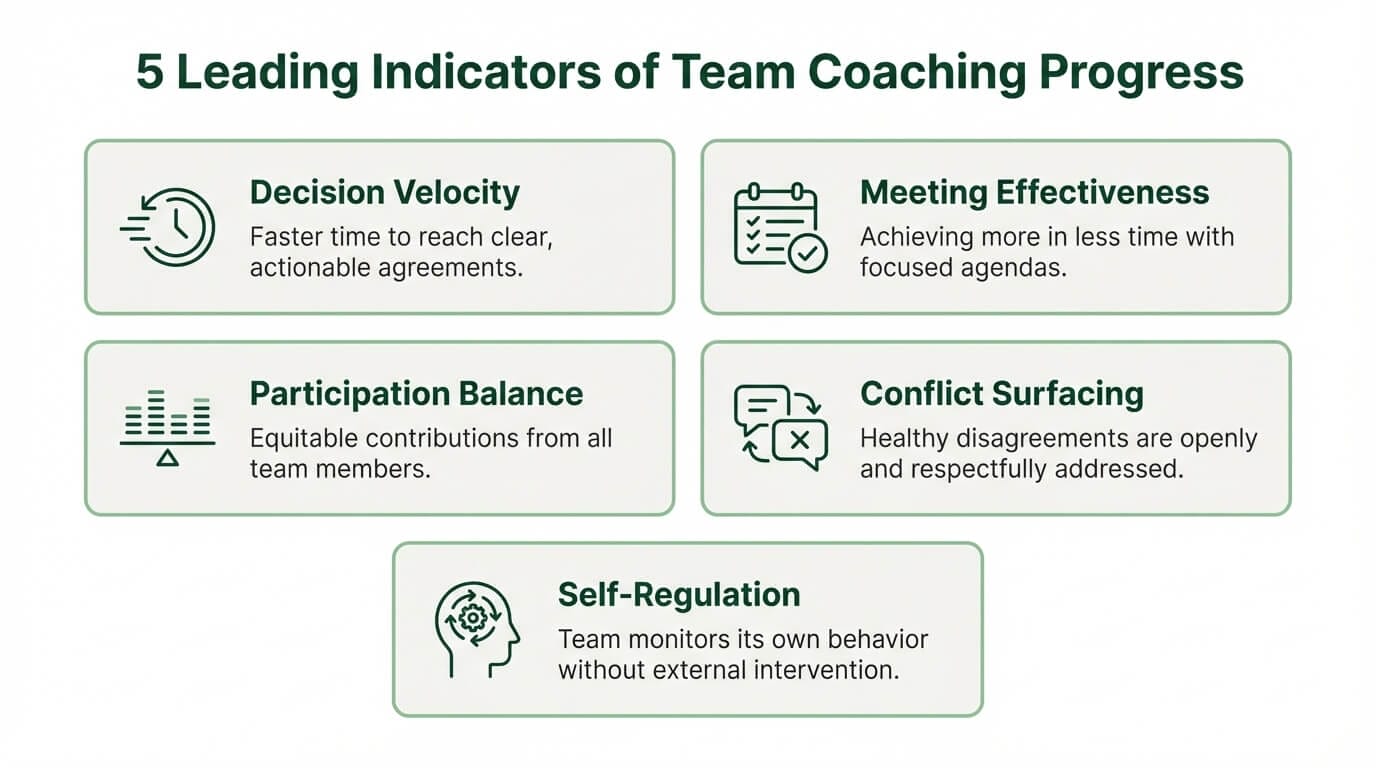
- Leading indicators (decision velocity, meeting effectiveness, participation balance) change within weeks and provide early evidence of coaching impact
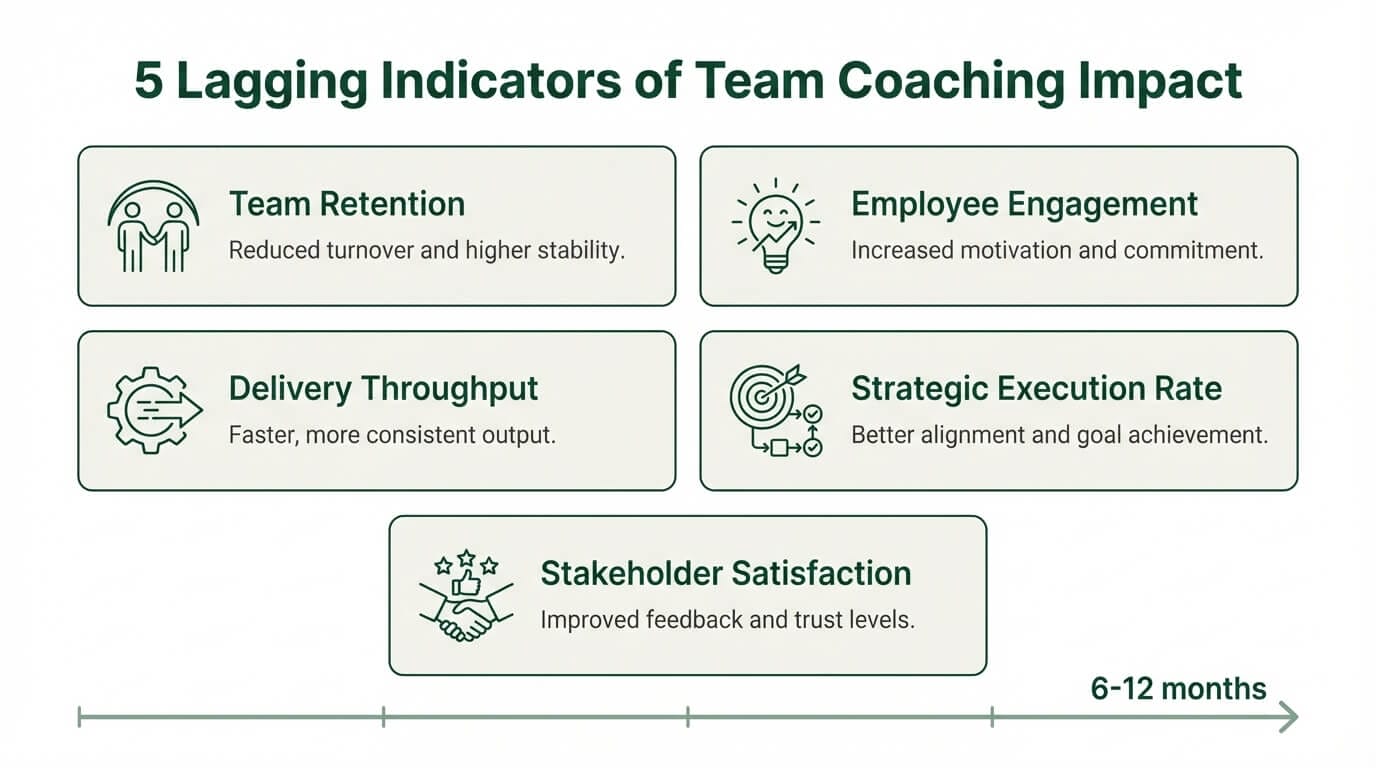
- Lagging indicators (retention, engagement, delivery metrics) take 6–12 months and carry attribution caveats
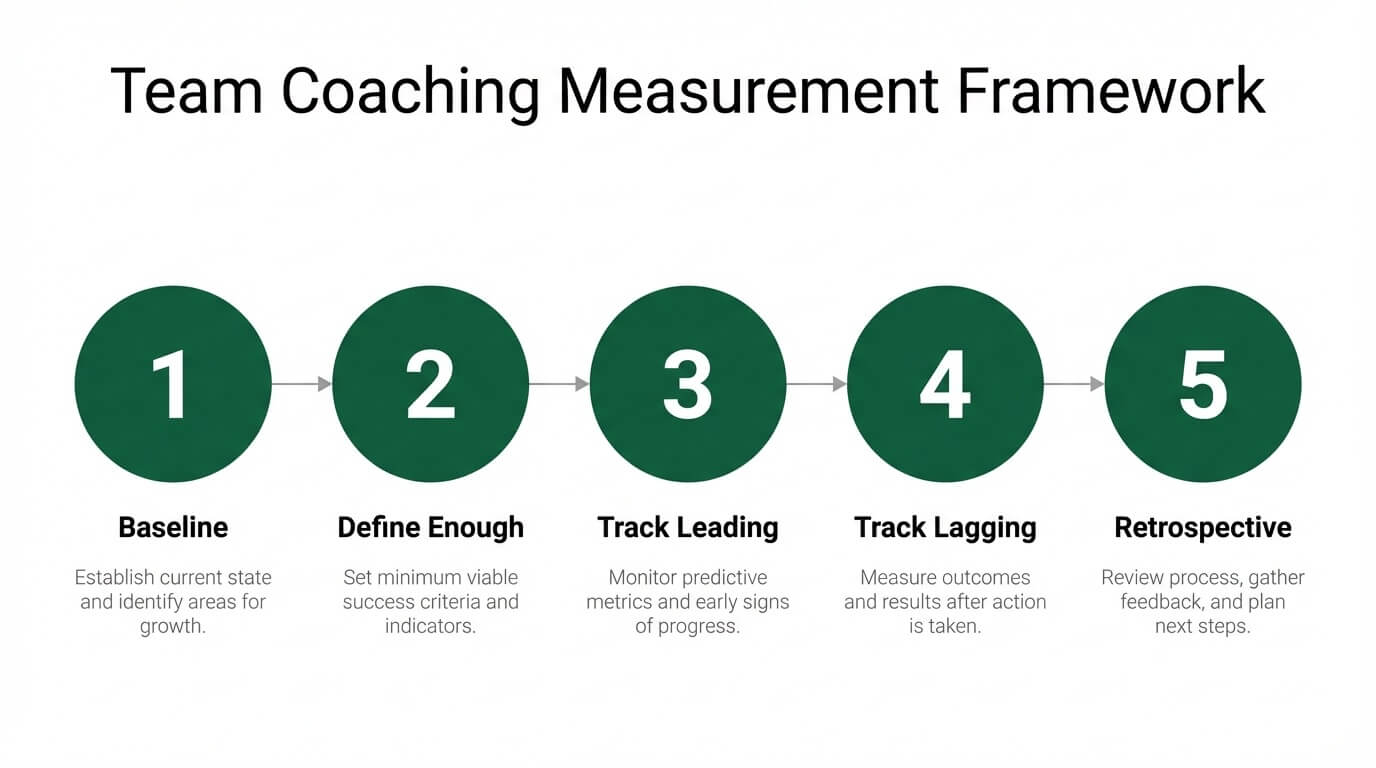
- A five-step measurement framework (baseline, define enough, track monthly, track quarterly, retrospective) structures the ROI conversation around observable evidence
- Satisfaction surveys measure comfort, not effectiveness. Supplement them with behavioral and performance data
The ROI Problem in Coaching
Measuring team coaching return on investment is structurally difficult because four problems compound simultaneously: the counterfactual, the attribution gap, the time lag, and the measurement paradox. No methodology eliminates all four, but naming them allows organizations to build frameworks that account for uncertainty rather than pretending it does not exist.
The counterfactual problem. Organizations cannot observe what would have happened without coaching. A team that improves after a coaching engagement may have improved anyway due to a new leader, a market shift, or simple regression to the mean. Without a control group receiving no coaching under identical conditions, isolating the coaching variable is impossible in most organizational settings.
The attribution problem. Team performance is influenced by dozens of variables: leadership changes, restructuring, market conditions, new tools, hiring decisions. Attributing a measurable business outcome solely to coaching overstates what any single intervention can claim.
The lag problem. Behavioral change is observable within weeks. Performance impact takes months. The metrics that matter most to a CFO operate on quarterly or annual cycles, long after the coaching engagement has ended. By the time lagging indicators move, the causal connection to coaching has weakened.
The measurement paradox. The outcomes organizations value most from coaching (trust, decision quality, the capacity to handle conflict productively) are the hardest to quantify. The outcomes easiest to measure (satisfaction scores, attendance) say the least about impact.
Two statistics dominate every coaching ROI article online. The Metrix Global 788% figure comes from a 2001 study of 43 executives at a single financial services company. It measured self-reported productivity changes with no control group and no independent verification. The ICF 7x return figure comes from a buyer satisfaction survey where coached individuals estimated the value they received. Neither study measured team coaching. Neither used controlled methodology. Citing them as evidence for team coaching ROI is not just inaccurate. It undermines credibility with the procurement teams and CFOs who will audit the source.
Leading Indicators: What Changes First
Leading indicators are behavioral changes observable within weeks of a coaching engagement. They do not require quarterly data cycles or organizational surveys. They are visible in meetings, decisions, and team interactions, and they provide the earliest signal that coaching is producing change in collective performance.
Decision velocity. The time between a team discussing an issue and committing to action. Before coaching, decisions often span multiple meetings: discussed Monday, revisited Wednesday, deferred to next week. Track the gap between discussion and commitment meeting-over-meeting. Improvement looks like decisions resolving in the meeting where they surface.
Meeting effectiveness. Measured not by how people feel about meetings but by whether decisions stick. A team that makes a decision on Tuesday and revisits it on Thursday has a meeting effectiveness problem that coaching directly addresses. Track decisions made versus decisions that hold across a two-week window.
Participation balance. In most teams, two or three members produce 70-80% of the conversation. Coaching shifts that balance. Track speaking distribution across team conversations. Improvement is not equal airtime but meaningful contribution from members who previously defaulted to silence.
Conflict surfacing. Teams that begin naming disagreements rather than avoiding them are progressing, even though the surface behavior may look more contentious. Before coaching, disagreement goes underground and emerges as passive resistance. After coaching, disagreement enters the room. This is a positive leading indicator, though it can alarm sponsors who expect coaching to reduce visible conflict.
Self-regulation. The clearest sign of coaching effectiveness is when the team begins facilitating its own conversations without the coach prompting. The team catches its own patterns: "We are doing the thing again where two people decide and everyone else checks out." This represents internalized learning and is directly tied to leadership team development goals.
Lagging Indicators: What Changes Over Time
Lagging indicators are performance outcomes that take six to twelve months to materialize. They carry more organizational weight than leading indicators because they connect to business results, but they are harder to attribute to coaching alone. Every lagging indicator comes with a built-in attribution caveat.
Team retention and employee engagement scores. Retention is a lagging signal of team health. Track voluntary turnover within the coached team over a 12-month window. Compare against the organizational baseline. Employee engagement scores, measured through pulse surveys or 360-degree feedback instruments, provide a more granular view. The caveat: retention is influenced by compensation, market conditions, and management changes that have nothing to do with coaching.
Delivery metrics. For software and product teams, throughput, cycle time, and quality indicators are the natural measurement framework. These teams already track delivery data, which makes before-and-after comparison straightforward. The caveat: delivery improvements may coincide with tooling changes, process redesigns, or team composition shifts that coaching did not cause.
Strategic execution rate. For executive and leadership teams, the key performance indicator is what percentage of strategic decisions reach implementation within 90 days. Leadership teams that make decisions but fail to execute them are a common pattern. Coaching improves the connective tissue between decision and action. Track quarterly: decisions made versus decisions implemented.
Stakeholder satisfaction. Internal and external customer feedback, collected through structured surveys, provides an outside-in view of team effectiveness. This metric captures downstream organizational impact that team-level metrics alone may miss. Ask stakeholders the same three questions before and after the engagement to create a comparable baseline.
Revenue and cost impact. The metric organizations want most and the one hardest to attribute honestly. Some engagements produce traceable financial outcomes: reduced project overruns, decreased recruitment costs from improved retention, measurable productivity gains. In most cases, financial impact is real but shared across multiple concurrent initiatives.
What You Cannot Measure
Some of the most valuable outcomes of team coaching resist quantification entirely. Acknowledging this is not a weakness in the business case. It is the most honest position a coaching provider or organizational buyer can take, and it is the position no competing article on this topic is willing to publish.
Quality of team conversations. Observable but not quantifiable. A team coach can see the difference between a conversation where people are genuinely thinking together and one where they are performing collaboration. An observer can describe it. A survey cannot capture it. The shift from performative to genuine dialogue is one of the first things coaches notice, and it has no metric.
Capacity to handle future challenges. Coaching builds capability that only becomes visible when a new challenge arrives. A team that handled a product launch crisis effectively because of skills developed through coaching six months earlier cannot attribute that response to a line item in the coaching budget. The value is real. It is also invisible until the moment it matters.
Cascading cultural influence. How one coached team influences adjacent teams through changed norms, better communication patterns, and modeled behavior. This organizational culture change is among the intangible benefits most valued by senior leaders, but the attribution chain is too long and too diffuse to measure.
A software team broke their work into smaller pieces and saw delivery improve. Months later, they decided to revert to larger work items. Within two weeks, they recognized it was not working and recommitted voluntarily. The coach did not fight their decision or say "I told you so." That full cycle of experiment, success, reversion, failure, and recommitment with genuine conviction is the deepest value coaching produces. It resists every measurement framework.
Requiring hard ROI proof before investing in team coaching may itself reflect the measurement-obsessed organizational culture that coaching is designed to surface and challenge. This is not a dodge. It is a genuine tension that organizational buyers should sit with before defaulting to "prove it first."
Building a Measurement Framework
A practical coaching ROI framework does not eliminate uncertainty. It structures the conversation around what can be observed, what can be tracked, and what must remain qualitative. The following five steps work for both software delivery teams and executive leadership teams, though the specific metrics differ by team type.
Need a Measurement Framework for Your Team?
Tandem’s coaches build baseline-to-retrospective measurement into every engagement, tracking leading and lagging indicators on the timelines that matter.
- Baseline before coaching. Capture the current state of both leading indicators (decision velocity, meeting effectiveness, participation balance) and lagging indicators (retention, engagement scores, delivery throughput or strategic execution rate). Without a baseline, post-engagement claims about improvement are anecdotal.
- Define “enough.” Before the engagement begins, agree with the sponsor on what improvement justifies the team coaching investment. Not "maximum possible improvement" but "what would make this worthwhile." Setting this threshold in advance prevents moving goalposts and gives both parties a shared reference point.
- Track leading indicators monthly. Behavioral changes are the earliest evidence. Decision velocity, participation balance, and conflict surfacing can be assessed in monthly check-ins without formal surveys. These provide the feedback loop that keeps the coaching engagement responsive.
- Track lagging indicators quarterly. Performance outcomes need longer cycles. Use existing organizational instruments: employee engagement scores, delivery metrics, stakeholder satisfaction surveys, and 360-degree feedback. Do not create new measurement tools for coaching. Use what the organization already tracks and compare against baseline.
- Retrospective at engagement end. Conduct this with the team, not just the sponsor. Teams observe changes that sponsors miss because sponsors observe from outside the room. Structure the retrospective around three questions: what changed, what did not change, and what changed that was not expected. This captures measurable business outcomes alongside qualitative shifts.
Defining "enough" before the engagement starts is the step most organizations skip. Its absence is what makes post-engagement ROI discussions feel arbitrary. When both parties agree on what improvement justifies the investment, the measurement conversation shifts from proving value to tracking progress.
Three measurement levels provide a quality hierarchy for the data collected. Satisfaction data (post-engagement surveys) is the weakest: it measures comfort, not impact. Behavioral change data (leading indicators tracked over time) is stronger and directly observable. Performance outcome data (lagging indicators with baseline comparison) is the strongest but carries the heaviest attribution burden. Most organizations collect the weakest level and skip the other two. A meaningful framework requires all three, and it requires embedding coaching systemically enough that measurement becomes part of the engagement design, not an afterthought.
The Satisfaction Data Trap
Post-engagement satisfaction surveys are the most commonly collected coaching metric and the least meaningful. They measure whether the team had a comfortable experience, not whether the coaching produced results.
Teams that were genuinely challenged by coaching, pushed to confront avoidance patterns, name unproductive dynamics, and change established habits, may rate the experience lower than teams that had pleasant but inconsequential sessions. The strongest coaching engagements often produce discomfort in the moment and value over time. A satisfaction survey captures the discomfort and misses the value.
Organizations that rely on satisfaction scores as their primary coaching metric will systematically favor coaches who prioritize comfort over effectiveness. If satisfaction data is the only measurement collected, it should be weighted accordingly: useful as a data point, insufficient as an evaluation.
The measurement approach matters more than the ROI statistic. A provider that names what it can and cannot prove is more trustworthy than one citing 7x returns from a methodology that does not apply. Start with a baseline, track leading indicators monthly, lagging indicators quarterly, and conduct the retrospective with the team.
Tandem Coaching publishes its measurement framework because honest measurement is how organizations make informed decisions about team coaching services.
Ready to Measure What Matters?
Book a free consultation to discuss your team coaching goals, measurement approach, and how Tandem builds accountability into every engagement.
Book a Free Consultation →