
5 Team Coaching Failure Patterns Every Coach Should Recognize
The team is twenty minutes into the session. Everyone is nodding. Action items are stacking up on the whiteboard. From the outside, it looks productive. The coach, if they are not watching carefully, might believe the surface is the whole story.
It rarely is.
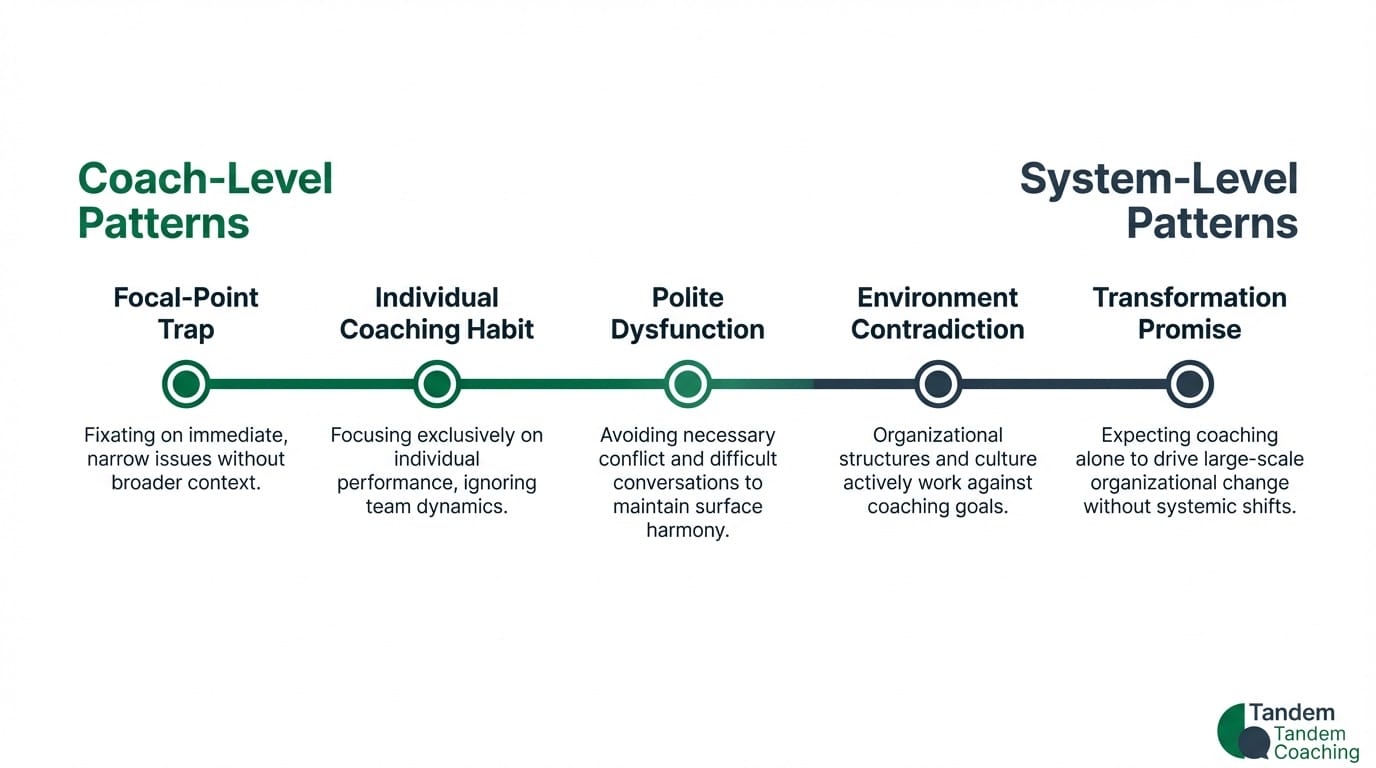
Five patterns account for most of what goes wrong in team coaching. Some are mistakes the coach makes and can correct through practice and feedback. Others are structural problems baked into the organization that no coaching skill can overcome. Recognizing which is which changes how you respond, and whether the response is development or a difficult conversation with the sponsor.
Key Takeaways
- The focal-point trap and coaching individuals in a group setting are the two most common team coaching mistakes, both rooted in individual coaching habits the coach has not unlearned
- Polite dysfunction disguises itself as alignment. Coaches who accept the surface without pushing deeper become part of the pattern
- When organizational systems contradict coaching goals, continuing to coach without naming the contradiction wastes everyone’s time
- Teams that revert to old patterns are not failing. They are completing a learning cycle the coach needs to trust
The Focal-Point Trap
The focal-point trap occurs when the team coach becomes the center of conversation rather than standing outside it. The team talks to the coach, not to each other, replicating an individual coaching dynamic that undermines the entire purpose of coaching a team.
In individual coaching, the rhythm is familiar: the coach asks a question, the client answers, the coach asks another question, the client answers. That dyadic pattern is so deeply practiced that it transfers automatically into team settings. The coach asks a question. One person answers. The coach asks another question. Another person answers. Every exchange flows through the coach like a switchboard. The team members are not in conversation with each other. They are in parallel conversations with one person.
The tell is physical. Watch where team members direct their gaze when they speak. If all eyes turn to the coach after every comment, the coach has become the focal point. This happens so naturally that most coaches do not notice until someone points it out. They feel busy, engaged, connected to the team. The busyness masks the problem.
This matters because the work of team coaching is the conversation between team members, not the conversation between each member and the coach. When the coach occupies the center, the team loses the chance to practice the skills they actually need: listening to each other, building on each other’s ideas, confronting disagreement directly rather than routing it through an authority figure. The team cannot develop its own capacity while depending on the coach to mediate every exchange.
The shift requires a physical and verbal move. Name the pattern to the team: “Notice who you’re all looking at right now.” Step back. Physically move to the edge of the room. Ask a question directed from the team to itself: “What does the team want to do with that?” Not “What do you think, Sarah?” The coach is only stepping in as needed, not serving as the pivot point. They stand on the outside, not at the center.
The first time a coach deliberately steps to the periphery, the room often goes quiet. The team is used to the coach driving the conversation and does not immediately know what to do with the space. That silence is productive. It is the team learning to fill the conversational space themselves. If the coach jumps back in to rescue the moment, the pattern resets. The discipline is to wait.
For coaches trained in individual work, this feels like doing less. It is. And that discomfort is where the learning starts.
For coaches trained in individual work, stepping to the periphery feels like doing less. It is. And that discomfort is where the learning starts.
Coaching Individuals in a Team Setting
Coaching individuals in a team setting means the coach has one-on-one conversations with team members while the rest of the group watches. If the same work could happen with the person in a separate room, it is not team coaching. It is individual coaching with an audience.
The pattern shows up when a team member raises a personal challenge and the coach follows it. The conversation narrows. The coach and one person are in dialogue while five others observe. Sometimes the coach moves around the room doing this with each person in turn, spending seven minutes with each. The sessions feel productive because individual issues get airtime. But the team as an entity, the relationships and dynamics that make them a team, receives no coaching at all.
Why does this happen? Individual issues feel urgent and visible. A team member is struggling with a stakeholder. Another is burned out. The problems are concrete, the person is right there, and the coach knows how to help with that kind of challenge. Team dynamics, by contrast, feel abstract and hard to name. How do you coach the way a team avoids conflict? It is harder to address, harder to see, and harder to know if you are making progress.
The recovery is a specific move: take what surfaces individually and reflect it to the team. If one person describes difficulty giving honest feedback to a colleague, the coaching question is not “What have you tried?” directed at that individual. It is “What does this tell us about how the team handles disagreement?” directed at the group. The individual experience becomes data about the team’s patterns. The team becomes the client again.
Every observation about one person holds information about the whole system. The team member who never speaks in sessions is telling the team something about how safe it feels to disagree. The person who always volunteers first is telling the team something about how responsibility gets distributed. The coach’s role is to name what the team is showing, not to fix what individuals are feeling.
The entity test bears repeating until it becomes automatic: if you could do the same work with this person in a separate room, you are not coaching the team.
The Polite Dysfunction Loop
Polite dysfunction is when a team appears functional on the surface because meetings are cordial and action items get produced, but the real conversations happen in hallways afterward. The alignment the team reports is actually avoidance of the conversation that matters.
The team looks good on paper. Nobody is in open conflict. Deadlines get acknowledged, even if they slip. The coach sees heads nodding during sessions and interprets it as engagement. Underneath, decisions are being made in side conversations. Real concerns are never voiced in the room. People leave the session and immediately talk to each other about what they actually think.
Three recognition signals distinguish polite dysfunction from genuine alignment. First, unanimous agreement with no discussion. If a team agrees on everything immediately, they are not agreeing. They are avoiding. Second, recurring agenda items. When the same topic appears session after session without resolution, the team is performing the appearance of addressing it without doing the work. Third, the gap between session and reality. If the team commits to something in the room and nothing changes afterward, the commitment was performative.
The coach’s failure here is accepting the surface. It feels disrespectful to challenge a team that seems to be doing fine. The team’s comfort can look like progress. But comfort in a team that avoids real issues is not a coaching outcome. It is the problem the coaching should be addressing.
Recognizing polite dysfunction requires the coach to trust their own discomfort. If the sessions feel too smooth, too agreeable, too predictable, that is information worth paying attention to. The question to sit with: what is this team not saying? And what would change if they did?
Knowing when team coaching is not the right intervention sometimes means recognizing that the coaching itself has become part of the polite performance. If the coach is comfortable, the team is probably comfortable too. And in this context, comfort is not the goal.
If the coach is comfortable, the team is probably comfortable too. And in this context, comfort is not the goal.
The Environment Contradiction
The environment contradiction happens when the organizational system actively works against the coaching goals. Individual performance reviews, competing managers, and bonus structures that reward personal survival over team collaboration create conditions where even genuine coaching gains disappear in the gaps between sessions.
Two barriers make this pattern distinct from a coaching skill problem.
The first is readiness. A manager says “go coach that team” and the coach shows up, but the team did not ask for coaching. They feel punished. They wonder what they did wrong. If the team experiences coaching as something done to them rather than something they chose, the relationship cannot function regardless of the coach’s skill or approach.
The second is structural. The organization says it wants teamwork but builds incentive systems that reward individual performance. What matters for each person’s survival is pleasing their boss, not contributing to the team’s goals. Team members cannot dedicate themselves to collective success when their individual success depends on a separate set of metrics entirely. The coach helps the team make genuine progress during sessions. Between sessions, the incentive structure pulls every person back to the old behavior.
The structural barriers are concrete and nameable. Bonus structures tied to individual output. Performance reviews that measure personal contribution but not collaborative effectiveness. Reporting lines where team members answer to different leaders with competing priorities. When the organizational environment contradicts the coaching at this level, the coach is working against forces that no amount of in-session work can overcome.
The recognition pattern is consistent: the team engages genuinely in the room. They have honest conversations, make commitments, identify changes they want to make. Then they come back next session and nothing has shifted. This is not a team that lacks motivation. It is a team embedded in a system that contradicts the coaching.
The response is not more coaching. It is an organizational conversation. Name the contradiction to the team, then escalate to the sponsor. If individual incentive structures undermine team goals, that is a leadership and organizational design problem, not a coaching problem. Coaches working inside their own organization face this challenge with particular intensity because they live within the same system they are trying to change.
Continuing to coach a team while ignoring the structural barriers is the real failure. Not because the coach lacks ability, but because they are operating within a system designed to produce the opposite of what the coaching intends. Naming that honestly is often the most important thing the coach can do.
The Transformation Promise
The transformation promise fails when the coach or the buyer expects dramatic, visible change and measures coaching against that expectation. Team coaching produces incremental shifts in how a team relates, decides, and learns. Some of those shifts take months to become visible.
The expectation problem often starts before the coaching does. The sponsor wants a high-performing team by quarter end. The team leader wants visible behavior change. The coach, wanting to deliver, implicitly accepts these goals and begins measuring their own work against outcomes that coaching alone cannot guarantee. When change does not come fast enough or in the expected form, everyone questions whether the process is working. The question itself reveals the trap: coaching is not a performance intervention with a predictable timeline. It is a developmental process that moves at the team’s pace.
The coach is not there to fix the team. The coach is there to partner with them. When coaches see themselves as the agent of change rather than a thinking partner, they take on a burden that does not belong to them.
The coach is not there to fix the team. The coach is there to partner with them.
Consider what failure looks like from the outside. A team spends three months working with a coach. They adopt new ways of working: smaller deliverables, faster feedback cycles, more direct conversations. Then they decide to go back to the old approach. Large work items. Fewer check-ins. From a reporting standpoint, the coaching failed.
But within two weeks, the team knows the old way is not working. They feel the difference without anyone telling them. They return to the smaller approach voluntarily. Not because the coach recommended it, but because they experienced the contrast themselves. Their commitment deepened because it came from their own learning, not from an external recommendation.
That cycle of change, reversion, and recommitment is the coaching working. The team needed to experience the cost of reverting to truly internalize the new approach. Measuring coaching against a straight line of continuous improvement misses how teams actually develop. The trajectory looks like loops, not lines. A team that tries something, goes back, and comes back again has not failed coaching. It has completed a learning cycle.
From Pattern Recognition to Development
ACTC Team Coaching — $2,499
ICF-accredited team coaching certification. Learn to facilitate team dynamics, group coaching, and organizational development.
Three of these patterns are coach-level development opportunities. The focal-point trap, coaching individuals, and missing polite dysfunction all improve with practice, coaching supervision, and honest self-assessment. They are the kind of professional growth that makes a coach more effective with every team they work with.
The environment contradiction and the transformation promise operate at a different level. They require the coach to recognize where the challenge is systemic and respond with organizational conversations rather than more coaching sessions. Training and support for navigating these situations come through programs like the ACTC team coaching certification, which specifically addresses coaching within complex organizational systems.
Which of these patterns do you recognize in your own work? The answer is worth sitting with before moving on to the next article or the next session.
Ready to Move Past These Patterns?
ICF-accredited team coaching certification. Build the skills to recognize and navigate the failure patterns that derail most team coaching engagements.
See ACTC Program Details →