Team Coaching: The Practitioner’s Definitive Guide
A team tells you they’re aligned. Then you watch them make a decision together and realize their “alignment” was polite avoidance of the conversation that actually matters.
That gap between what a team says and what a team does is where team coaching lives. Not in fixing broken teams. Not in running better meetings. In coaching the team as a single entity toward goals the team itself defines.
This distinction matters because most of what gets called “team coaching” is really individual coaching in a group setting, facilitation with a coaching label, or consulting dressed up in questions. Real team coaching treats the team as the client. The individuals are part of the system, but the system is what the coach works with.
This guide covers what team coaching actually is, who it serves, how engagements work from first session to completion, the ICF competency framework, credential pathways, honest limitations, and what changes when teams go remote. Each section links to deeper coverage so you can follow the thread that matters most to your situation.
Key Takeaways
- Team coaching treats the team as a single entity and client, not as a collection of individuals receiving coaching in the same room.
- Two distinct markets drive demand: software delivery teams facing structural bottlenecks and executive leadership teams working through trust and decision-making challenges.
- The coach stands outside the circle, not at the center. When team members talk to the coach instead of each other, the coaching has stopped working.
- Team coaching fails for two structural reasons: the team doesn’t want it, or the organizational environment contradicts the coaching goals.
- The ACTC credential validates team coaching competency against ICF standards. Tandem’s PCC+ACTC combination program bridges ICF and agile coaching in a single integrated experience.
What Team Coaching Is and Isn’t
Team coaching is a coaching engagement where the client is the team itself. Not the individuals on the team. Not the manager who hired the coach. The team as a system with its own patterns and blind spots. “It is a multi-person single client. You don’t coach the individuals on the team — you coach the team as a single entity.”
This team-as-entity paradigm is the foundational shift that separates team coaching from every adjacent practice. A group of people in a conference room is not automatically a team. A team shares a common purpose, mutual accountability, and interdependent work. The coach’s job is to help the team see how it operates as a system, not to help individual members solve individual problems while others watch.
The confusion runs deep because most coaches trained in individual work carry their habits into the team setting. They pull one person aside for a private conversation. They ask each member what they want to work on. They become the person everyone talks to instead of the person who helps the team talk to itself. The shift from “I am coaching people who are on a team” to “I am coaching the team” changes everything about how the coach shows up, where the coach sits, and what the coach pays attention to.
Tandem’s ACTC program covers system coaching broadly: intact teams, business partners, departments, cross-functional cohorts, and non-profit executive groups. “Team coaching” is the most common entry point, but the methodology extends beyond intact teams.
The distinctions from adjacent practices are sharper than most people expect. In team coaching vs. group coaching, the difference sits in who the client is. Group coaching works with individuals who share a topic but pursue separate goals. A cohort of new managers learning delegation skills is group coaching. An intact product team working on how it makes decisions together is team coaching.
Team coaching vs. facilitation trips up experienced practitioners most often. A facilitator runs the meeting. A team coach helps the team learn to run its own meetings. The facilitator owns the process and leaves the room with the agenda completed. The team coach steps back so the team can struggle with its own process, because that struggle is the learning.
Consulting is the simplest contrast. A consultant assesses the team, diagnoses problems, and prescribes solutions. A team coach does none of that. “The coach’s job is not to come in and assess the team and tell it where it’s making mistakes and how to fix it.” The team builds its own diagnosis. The team designs its own experiments. The coach partners with them to imagine bigger possibilities and supports them in implementing change within their own environment.
Who Hires a Team Coach
Two distinct markets drive the demand for team coaching today, and their presenting problems look nothing alike. Understanding both reveals why team coaching is growing as a professional practice and why the same methodology applies to very different organizational contexts.
Software and Technology Teams
The presenting problem is delivery effectiveness. Organizations say they need to “deliver software better, faster, higher quality.” They want a team coach to improve efficiency. But the real problem underneath is almost always structural: cross-team dependencies, unclear ownership, or a culture that rewards individual heroics over team outcomes.
Agile team coaching emerged from this market. Scrum Masters and agile coaches discovered that retrospectives and process improvements hit a ceiling when the team’s relational dynamics remain unaddressed. A team that cannot have honest conversations about workload, quality trade-offs, or interpersonal friction will keep producing the same results regardless of how many process changes it adopts. The presenting problem is velocity. The real work is trust.
Executive Leadership Teams
At the executive level, the presenting problem is “strategy and conflict resolution.” The real problem is usually trust, decision-making authority, or misaligned incentives across the executive team coaching engagement. A leadership team where each member is optimizing for their own function rather than the organization’s goals needs more than a strategy offsite.
Leadership team coaching addresses this by treating the leadership group as a system with its own dynamics, not as individual executives who happen to sit in the same room once a week. The work often surfaces uncomfortable truths about how decisions actually get made versus how the org chart says they should.
Beyond these two primary markets, business team coaching serves cross-functional project teams, newly formed groups merging after acquisitions, and departments undergoing structural change. Organizations with internal team coaching capability can scale this work without external dependency, though building that capacity requires deliberate investment in training and organizational support.
What both markets share is a gap between how the team describes its problem and what is actually happening underneath. Technology teams say “we need to ship faster” when the real issue is that nobody feels safe enough to raise concerns during planning. Executive teams say “we need strategic alignment” when the real issue is that three VPs are competing for the same resources and nobody will name it. The team coach’s first job is to help the team see this gap for themselves.
Technology teams say “we need to ship faster” when nobody feels safe enough to raise concerns during planning. Executive teams say “we need strategic alignment” when three VPs are competing for the same resources and nobody will name it.
How Team Coaching Works
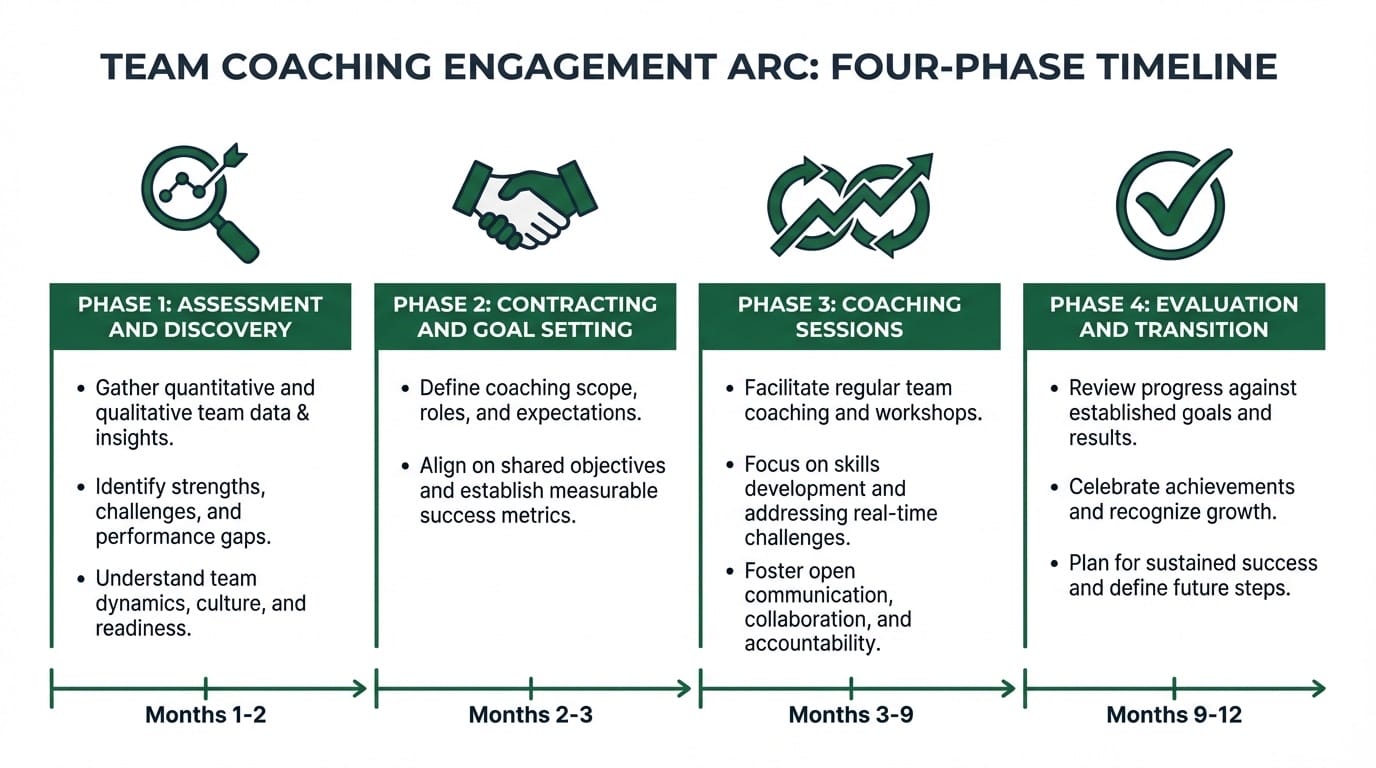
A team coaching engagement follows a predictable arc: contracting with stakeholders, assessing the team’s current state, conducting coaching sessions, and reviewing progress. The specifics vary by context, but the underlying structure stays consistent whether the team is a six-person product squad or a twelve-person executive committee.
Contracting and Assessment
The engagement begins before the first team session. The coach meets with the sponsor (the person or group funding the engagement) to clarify what success looks like and what authority the team has to change its own working agreements. This conversation matters because organizational integration determines whether the coaching has room to work. If the team has no authority to change anything, coaching becomes an exercise in frustration.
Assessment happens with and through the team, not to the team. The coach may use surveys, interviews, or structured observations, but the purpose is to give the team data about itself, not to generate a consultant’s report. The team interprets its own data and decides what matters.
Inside the Room
The coach positions themselves outside the circle. Physically, this means sitting apart from the team, not at the head of the table. The opening question belongs to the team: what matters to you right now? The coach asks one question, then steps back.
What happens next reveals the team’s patterns. Who speaks first. Who stays silent. Whether agreement is genuine or polite avoidance. The coach watches the team talk to each other, not to the coach. “The coach is only stepping in as needed, but they are not the pivot point. They’re standing on the outside, not at the center.”
This is the hardest shift for coaches trained in individual work. In one-on-one coaching, the pattern is coach asks, client answers, coach asks again. In team coaching, that same pattern turns the coach into the center of every conversation. The team talks to the coach instead of each other, and the coaching stops being team coaching.
If you find every team member looking at you when they speak, you have become the focal point. Redirect with: “Say that to the team, not to me.” Simple, immediate, and it resets the dynamic.
The Engagement Arc: A Real Example
A software delivery team was struggling with slow pipeline throughput. Work kept getting stuck and taking too long to move through. Rather than diagnosing the problem for them, the coach partnered with the team to analyze their own data. The team discovered that whenever work items exceeded a certain size threshold, they consistently missed deadlines.
They decided to break work into smaller pieces. Over several months, delivery improved significantly. Then came the real test. The team said: “Things have been a lot better. We think we can go back to doing bigger pieces of work.” The coach’s response: “Sure, that’s your decision. It’s your work.”
Within two weeks of returning to larger work items, the team recognized it was not working. They went back to smaller items voluntarily. No one told them. They felt it.
That is the difference between being coached and being managed. The coach did not fight the team’s decision to revert. No warnings, no “I told you so.” By allowing the team space to experiment and feel the pain of the old way, the coach helped them build genuine conviction. Sometimes people need to experience not just the initial improvement but also the pain of reverting before they truly internalize the change.
Engagements typically run three to twelve months depending on complexity. Sessions happen biweekly or monthly. Between sessions, the team practices. The coach may check in with the sponsor to ensure organizational conditions still support the work. For a detailed breakdown of team coaching cost structures and what drives pricing, the range depends on team size, session frequency, and whether the engagement includes stakeholder work. Measuring team coaching impact requires tracking both the team’s stated goals and the behavioral changes that emerge along the way.
The coach did not fight the team’s decision to revert. No warnings, no “I told you so.” Sometimes people need to experience the pain of the old way before they truly internalize the change.
If you are a coach preparing to lead this kind of engagement, how to coach a team covers the methodology in depth, from contracting through to closure. For coaches interested in systemic team coaching, the approach extends beyond the team to include the broader organizational system the team operates within.
Team Coaching vs. Other Approaches
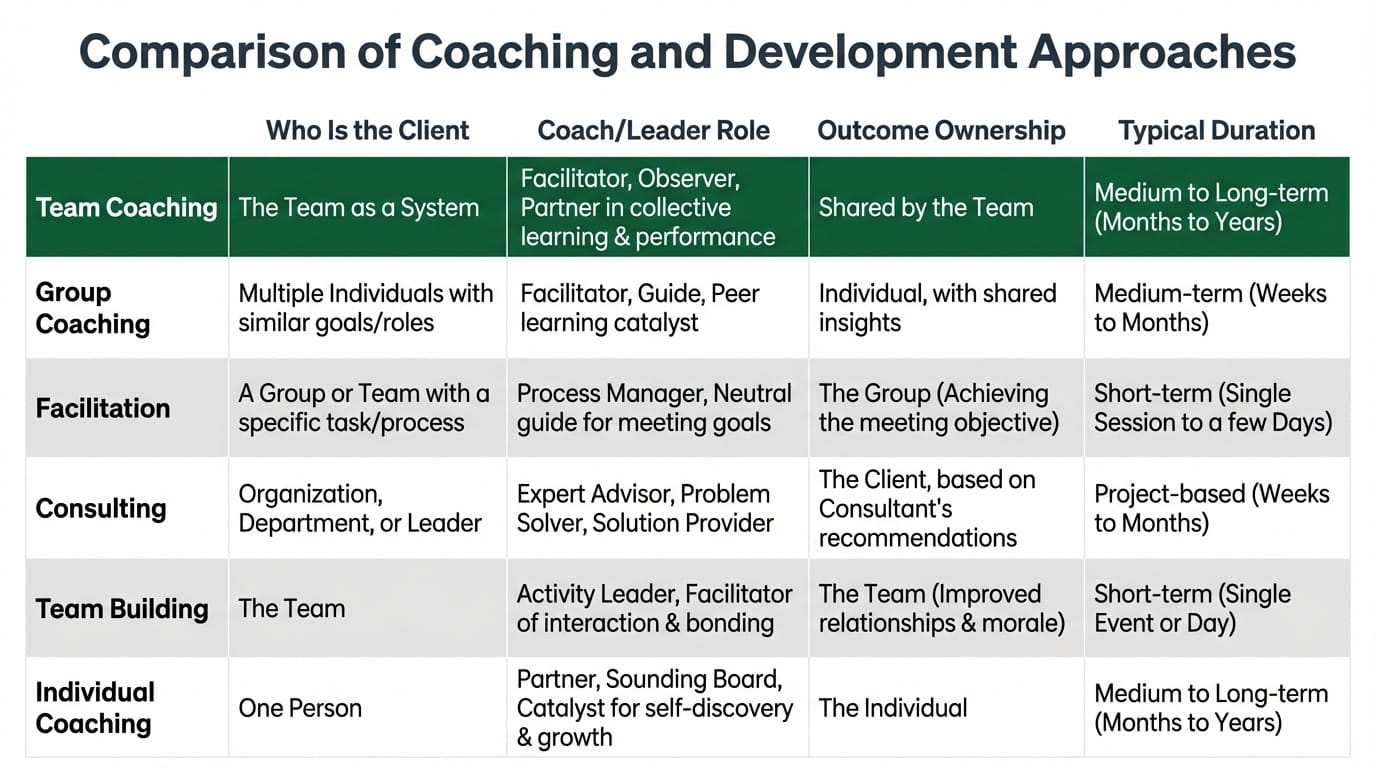
Teams have access to several development approaches, and choosing the wrong one wastes time and budget. The differences are structural, not cosmetic. Each approach has a different client, a different role for the practitioner, and a different definition of success.
| Approach | Client | Practitioner Role | Success Metric | When to Use |
|---|---|---|---|---|
| Team Coaching | The team as an entity | Partners with the team; stands outside the system | Team generates its own solutions and sustains change after coaching ends | Intact team with shared goals needs to change how it works together |
| Group Coaching | Individuals with shared interests | Coaches individuals within a group context | Each individual achieves their personal development goals | People share a role or challenge but don’t work together daily |
| Facilitation | The meeting or process | Designs and runs the process; owns the agenda | Group reaches a decision or output within the session | Team needs to produce a specific deliverable or make a decision |
| Consulting | The organization or sponsor | Analyzes, diagnoses, prescribes solutions | Recommendations are implemented and produce results | Problem requires external expertise the team does not have |
| Team Building | Interpersonal relationships | Designs and leads bonding activities | Team members feel more connected after the event | Team needs social cohesion and trust-building, not behavior change |
The most common confusion sits between team coaching and facilitation. Agile coaches, Scrum Masters, and experienced facilitators often assume they already do team coaching because they run retrospectives, lead planning sessions, and help teams reflect. The gap is in who owns the process. A facilitator owns it. A team coach helps the team learn to own it themselves.
The second confusion is between team coaching and group coaching. Organizations sometimes hire a coach for their leadership team and receive individual coaching sessions for each member, delivered in a group setting. That is group coaching. It builds individual capability. Team coaching builds the team’s collective capability to work as a unit.
None of these approaches is superior. Each serves a different need. A team might need facilitation for a strategy offsite, consulting for a technology decision, team building after a merger, and team coaching for how it makes decisions under pressure. The right choice depends on what the team needs to develop, not on which label sounds most sophisticated.
The ICF Competency Framework
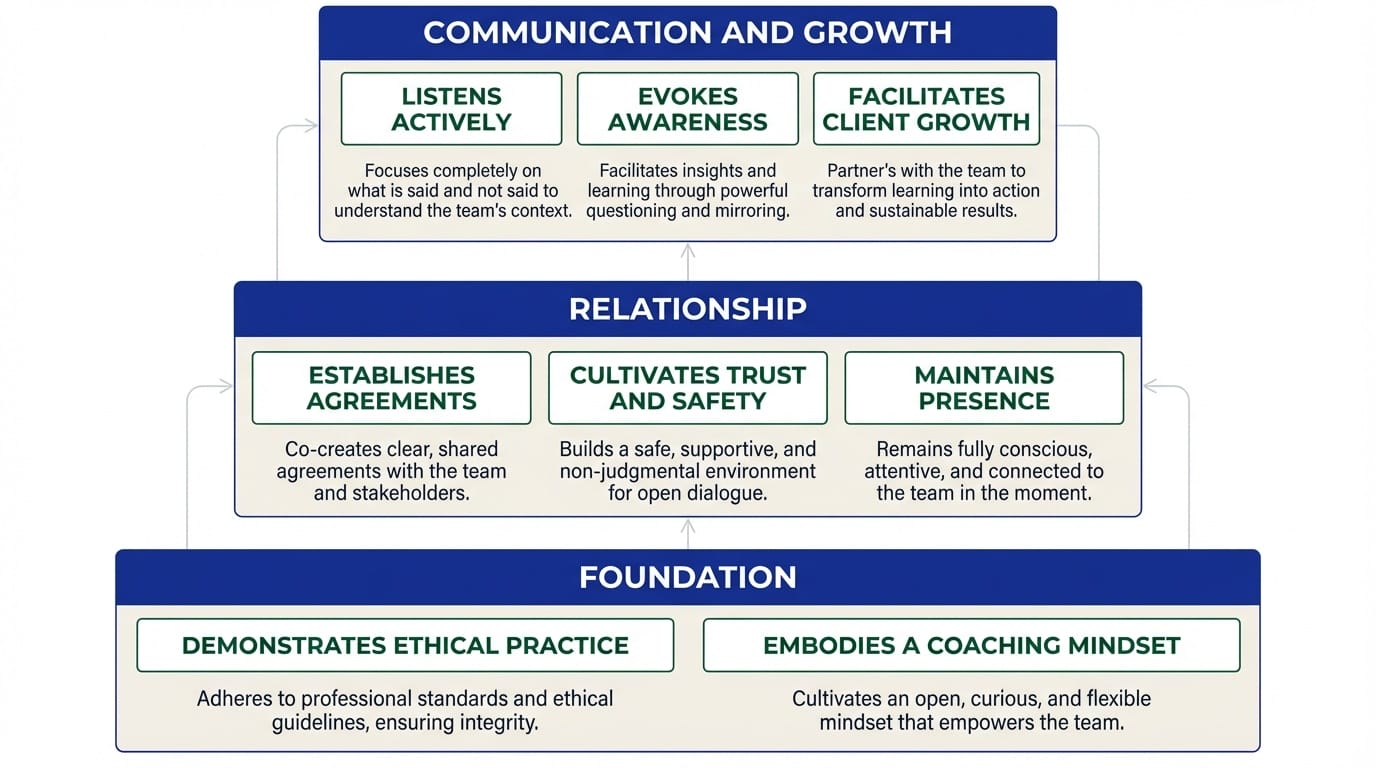
The International Coaching Federation defines a set of ICF team coaching competencies that describe what effective team coaching looks like in practice. These competencies translate the core ICF coaching model into observable behaviors specific to working with teams as systems.
For practitioners, the competencies answer a practical question: what does the coach actually do in the room? The ICF team coaching competencies cover the full scope, from establishing the coaching agreement with the team (not just the sponsor) to creating awareness at the system level (not just the individual level).
Several competencies shift meaningfully from their individual coaching counterparts. Establishing the coaching agreement in team coaching means contracting with multiple stakeholders who may have competing interests. The team has a goal. The sponsor has a goal. Individual members have goals. The coach holds the tension between all of these while keeping the team as the primary client.
Evoking awareness in a team context looks different from a one-on-one session. The coach is not surfacing insights for one person. The coach is helping the team see its own patterns. “The team realizes mid-conversation that their ‘alignment’ was polite avoidance.” That moment of collective recognition, where the team sees itself as a system, is the foundations of effective team coaching in action.
The team realizes mid-conversation that their “alignment” was polite avoidance. That moment of collective recognition — where the team sees itself as a system — is what evoking awareness looks like in practice.
Coaching presence for teams requires the coach to resist the pull of becoming the center. In individual coaching, presence means full attention on one person. In team coaching, presence means holding awareness of the entire system: who is speaking, who is not, what is being said between the lines, and what the team is avoiding. The coach’s physical position matters. Standing outside the circle is a presence decision, not just a seating preference.
The competency framework gives practitioners a shared vocabulary for professional development and peer feedback. It also gives organizational buyers a way to evaluate whether a team coach operates at a professional standard or is relying on personality and intuition alone.
Team Coaching Credentials
The ACTC certification (Advanced Certified Team Coach) is the ICF’s dedicated credential for team coaching. It validates that a coach has demonstrated competency against the ICF team coaching competency standards through documented training hours, supervised practice, and a performance evaluation.
Ready to Formalize Your Team Coaching Practice?
The ACTC credential validates team coaching competency against ICF standards. Tandem’s program bridges ICF coaching credentials and organizational systems thinking in one integrated experience.
ACTC does not stand alone. Coaches pursuing ACTC typically hold PCC (Professional Certified Coach) or are working toward it simultaneously. This is where Tandem’s structural differentiator becomes relevant. Most training organizations offer ICF team coaching certification or agile coaching education. Tandem’s ACTC program integrates both: “ICF coaching credentials AND agile/organizational coaching experience AND system coaching methodology.”
The PCC+ACTC combination matters because the markets hiring team coaches (technology organizations and executive teams) value both coaching rigor and organizational context. A PCC credential signals coaching competency. An ACTC signals team-specific expertise. Holding both tells a buyer this person understands coaching methodology and organizational systems.
For agile team coaching practitioners, the bridge from Scrum Master or agile coach to ICF-credentialed team coach is a common career move. Many agile coaches already do team coaching informally. The ACTC formalizes that practice within a recognized professional standard. Tandem’s program is designed for this transition, integrating coaching education with the organizational systems thinking these practitioners already use.
Both Tandem founders hold MCC (the ICF’s highest individual coaching credential) alongside enterprise-level agile coaching credentials. They co-authored Enterprise Agile Coaching, the book that bridges organizational change with coaching methodology. The program reflects that dual expertise: coaches learn team coaching through both the ICF competency lens and the organizational systems lens, rather than studying them separately and hoping to integrate on their own.
Credential honesty matters here. ACTC demonstrates competency against ICF standards. It does not guarantee mastery of every team situation. Experienced team coaches know that credentials open doors and validate baseline capability, but the real development happens through supervised practice, peer learning, and the accumulating experience of sitting with teams through difficult moments. The credential tells buyers you have met a professional standard. The work tells you whether you can hold the room when the team turns on each other.
When Team Coaching Fails
Team coaching fails for two structural reasons: the team does not want it, or the organizational environment contradicts the coaching goals. Neither has anything to do with the coach’s skill or the team’s willingness to grow. Recognizing these barriers before an engagement begins is more useful than any success story.
The Team Does Not Want It
“Just because a manager says ‘go coach that team’ doesn’t mean that team is ready for coaching. If they feel like they’re being punished by getting a coach, you’re not going to be able to do anything.” Forced coaching produces compliance, not change. The team shows up, goes through the motions, and waits for the engagement to end. Without willingness to participate and a genuine desire to change how they work together, no coaching approach can function.
Readiness matters more than budget. A team that actively wants to improve but has limited resources will get more from three coaching sessions than a team with an unlimited budget and zero interest. Before any engagement begins, the coach needs to assess whether the team sees coaching as an opportunity or an imposition.
The Environment Contradicts the Goal
Organizations say they want teams to collaborate, then build systems that punish collaboration. Individual performance reviews. Bonus structures tied to personal metrics. Competing managers pulling team members in different directions. Promotion criteria that reward individual visibility over team outcomes.
“What is important for their survival is pleasing their boss, and therefore they can’t be dedicated to the team’s success because they’ve got to worry about their individual success.” When the organizational environment contradicts what team coaching aims to build, the coaching hits a ceiling. The team may develop better relational skills inside the coaching sessions, but those skills cannot survive a system designed to reward the opposite behavior.
When the organizational environment contradicts what team coaching aims to build, the coaching hits a ceiling. The team may develop better relational skills inside the sessions, but those skills cannot survive a system designed to reward the opposite behavior.
This is where the conversation with the sponsor becomes critical. Sometimes the most important coaching conversation is not with the team but with the leaders who control the environment the team operates in. For a deeper look at these dynamics, when team coaching doesn’t work covers readiness assessment in detail. Common failure patterns catalogs the recurring scenarios where engagements stall or collapse.
Remote and Hybrid Teams
The core principles of team coaching remain identical whether the team is co-located, remote, or hybrid. The team is still the client. The coach still stands outside the system. The goal is still team-to-team dialogue rather than coach-centered exchange. What changes is the mechanics of observation.
In physical rooms, the coach reads body language, notices side conversations, and sees who leans in and who crosses arms. Remote settings compress these signals to camera angles and chat activity. The coach must create explicit space for what would emerge naturally in person: structured check-ins replace hallway reads, deliberate pauses replace the natural silence of a room, and direct invitations replace the eye contact that draws out quieter voices.
Hybrid is harder than fully remote. The in-room subgroup forms a natural coalition through proximity, shared body language, and side conversations that remote participants cannot hear. Remote team members become observers rather than participants. The coach must actively counter this asymmetry, sometimes insisting that all participants join individually from their own screens even when some are co-located.
The fundamentals hold. A team that avoids hard conversations will avoid them on Zoom just as effectively as in a conference room. A coach who becomes the focal point will become the focal point on a video call just as easily as around a table. The medium changes the mechanics. It does not change the work. For specific adaptations and techniques, remote and hybrid team coaching covers the full set of adjustments.
Frequently Asked Questions
What is team coaching?
Team coaching is a coaching engagement where the team itself is the client. The coach works with the team as a single entity, helping it develop its own capacity to achieve its goals, improve its dynamics, and sustain change after coaching ends. Unlike consulting, the coach does not diagnose problems or prescribe solutions.
How long does a team coaching engagement take?
Most team coaching engagements run three to twelve months with sessions every two to four weeks. Duration depends on the team’s goals, the complexity of the organizational context, and whether the engagement includes stakeholder work alongside team sessions. Some teams achieve their goals in three months; leadership teams with deep-rooted dynamics may need a year.
How much does team coaching cost?
Team coaching pricing varies based on team size, session frequency, coach credentials, and whether the engagement includes assessment and stakeholder work. Expect a higher investment than individual coaching because sessions are longer and preparation is more complex. Team coaching cost structures break down the specific factors that drive pricing.
What is the difference between team coaching and group coaching?
Team coaching works with an intact team that shares a common purpose and interdependent work. The team is the client. Group coaching works with individuals who share a topic or role but pursue separate personal goals. A cohort of new managers learning leadership skills is group coaching. A product team working on its decision-making process is team coaching.
Do you need a certification to coach teams?
Certification is not legally required, but professional credentials signal competency to buyers and provide a structured development path for coaches. The ICF’s ACTC (Advanced Certified Team Coach) is the primary credential. Many organizations now specify ACTC or equivalent when hiring team coaches, particularly at the executive level.
Can team coaching work with remote teams?
Yes. The core methodology is identical for remote, hybrid, and co-located teams. Remote coaching requires more deliberate structure around check-ins, silence, and participation equity. Hybrid settings present the greatest challenge because in-room participants naturally form a subgroup. Effective remote team coaching adapts the mechanics without changing the principles.
Build the Team Coaching Credential That Buyers Recognize
Tandem’s ACTC program integrates ICF team coaching competencies with agile and organizational systems methodology. PCC+ACTC combination available for coaches who want both credentials in a single path.
Explore the ACTC Program →