The Learning Investment Your Leaders Actually Need
Key Takeaways
- Most L&D budgets fund information transfer, not leadership development - and the gap between the two is where organizations lose both money and talent.
- The Training-Development Spectrum reveals four stages: Information, Application, Integration, and Transformation. Most spending clusters at the first two.
- Coaching is not a replacement for training. It is the missing infrastructure that converts training inputs into leadership capability.
- Three immediate moves: audit your training-to-coaching ratio, shift from events to development arcs, and measure behavioral change instead of completion rates.
The Talent Drain Signal
Organizations face a binary that most L&D leaders have been trying to avoid: invest in learning that actually changes how people lead, or watch your best talent leave for organizations that will.
Recent reporting from Coaching at Work puts it directly - invest in learning or accept talent drain. CLO Magazine’s workforce readiness coverage reinforces the same pattern. Access to training programs and AI tools does not automatically produce capable leaders. The disconnect is not about how much organizations spend on L&D. It is about what they spend it on.
Most learning investment goes toward activities that teach people things without changing how they operate. Employees collect credentials and complete courses while the leadership bench stays thin. When development budgets produce certificates instead of capability, the signal is clear to ambitious professionals - and they respond by leaving for organizations that take development seriously.
The benefits of leadership development programs are well-established. The problem is that most organizations are not actually running development programs. They are running training programs and calling them development. That confusion is expensive, and it compounds every year the distinction goes unaddressed.
Why Most L&D Programs Miss the Mark
Most L&D programs are built on a flawed assumption: that giving leaders the right information will change their behavior. It will not.
Measuring Completion, Not Impact?
If satisfaction scores look great but leaders don’t change, let’s talk. We’ll help you define behavioral indicators and design support that drives integration.
Information matters. But behavioral change - the kind that shows up in how a leader runs a meeting, handles conflict, or makes decisions under pressure - requires more than a workshop and a post-course survey. It requires practice, reflection, and sustained support through the discomfort of operating differently.
As Stephanie Ketron recently emphasized in CLO Magazine, the programs that work prioritize clarity, relevance, and outcomes over content volume. The distinction is important: leaders do not need more content. They need content that connects to the work they actually do, delivered in formats that drive lasting change rather than temporary enthusiasm.
Most L&D programs optimize for the wrong metric. Completion rates, satisfaction scores, hours logged - these measure exposure, not impact. A leader can complete forty hours of leadership training and walk back into their team unchanged. The program checked off. The leader did not develop.
The skills gap in leadership is real, especially as AI competencies reshape what leaders actually need. But the gap is not just about what leaders know. It is about what they do differently after the learning ends. When organizations measure L&D success by how many people went through the program, they are measuring input. What matters is output: did anything change in how those leaders operate?
Training Is Not Development
Training and development get used interchangeably in most organizations. They should not be. The difference between them is the difference between giving someone a map and helping them navigate unfamiliar territory.
Training is skill acquisition. You learn a framework, a tool, a process. Development is identity shift - you change how you see yourself as a leader and how you operate in that role. A leader who learns about delegation in a training workshop has acquired a skill. A leader who starts delegating instinctively because they have shifted their understanding of their role has developed.
The distinction becomes clearer across what we can call the Training-Development Spectrum:
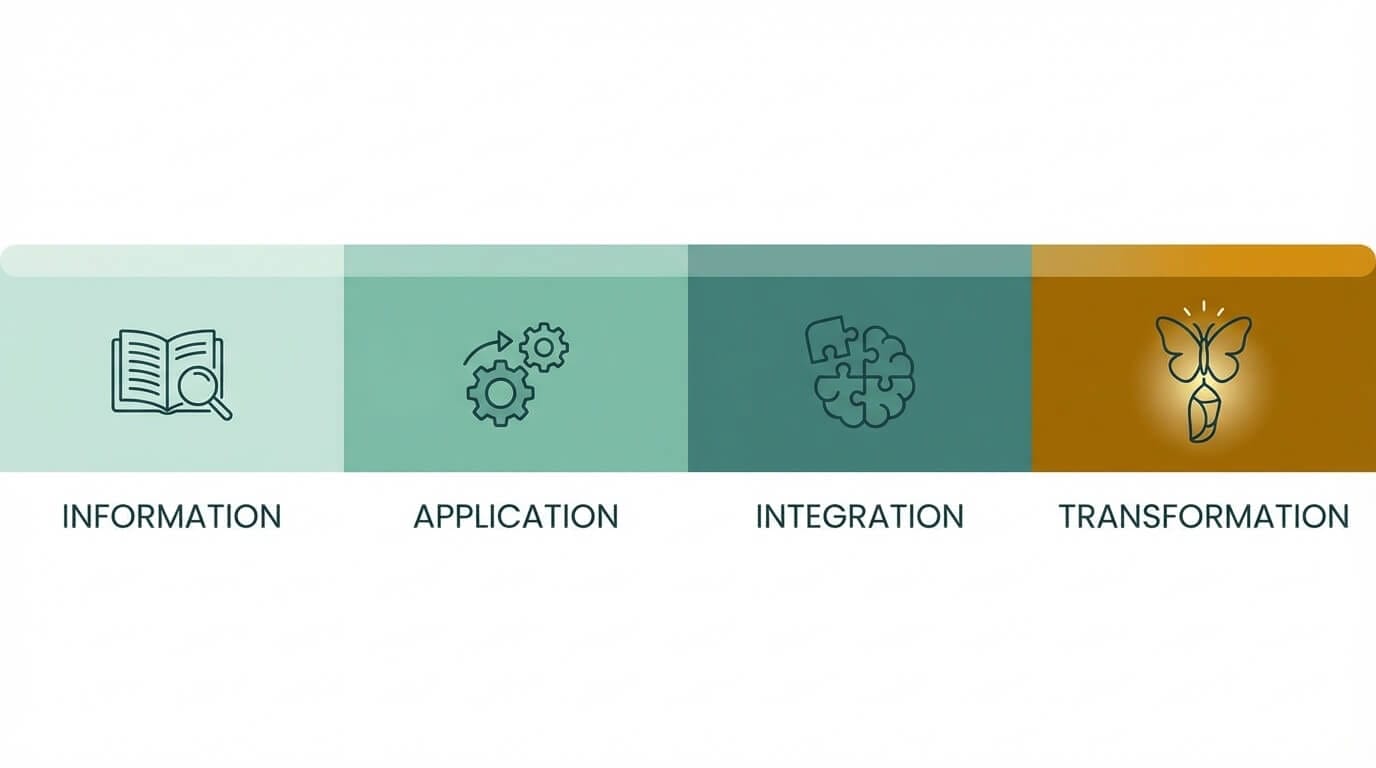
Information: Content is delivered. A leader reads a book, sits through a webinar, or watches a recording. Application: The leader practices the skill in a controlled environment - a workshop exercise, a simulation, a role play. Integration: The skill starts showing up in real work. The leader tries new approaches with their actual team, in actual meetings, under actual pressure. Transformation: The leader’s identity shifts. They do not just use new techniques - they think differently about their role.
Most L&D budgets cluster at Information and Application. That is the straightforward part. It is also where the return on investment flatlines. Any meaningful leadership development strategy must account for the jump from Application to Integration - because that is where organizations lose their money.
A leader who learned about strategic delegation in a workshop but never integrates it into daily practice has consumed budget without producing change. Development does not happen in a classroom. It happens in the transition between learning something and becoming someone who operates differently. That transition requires support most training programs never provide.
The Coaching Multiplier
If the bottleneck is integration and transformation, coaching is what clears it. Not because coaching is inherently superior to training - they serve different functions. Training delivers content. Coaching creates the reflective space where content becomes practice.
Build the Integration Infrastructure
Coaching isn’t more content—it’s the reflective space and accountability that turns training into transformation for your leaders.
The benefits of coaching in this context are specific and measurable. When a leader works with a coach after a training program, the dynamic shifts. The coach is not teaching new content. The coach is helping the leader process what they already learned - testing it against real situations, surfacing the resistance that keeps old patterns in place, and building the self-awareness that turns knowledge into behavior.
Leaders with coaching support show different patterns: higher retention of training content, faster application to real scenarios, and stronger engagement with their teams during the transition period. This should not be surprising. Integration and transformation require exactly what coaching provides - structured reflection, accountability, and a thinking partner who is invested in the leader’s growth without being tangled in their organizational politics.
Training tells leaders what to do differently. Coaching helps them become someone who does it differently. That is not a nuance - it is the entire gap most organizations are failing to close.
This is not about replacing training with coaching. It is about recognizing that training without coaching is an incomplete investment. You pay for the knowledge transfer but skip the step that makes it stick. Organizations that pair coaching with their development programs are not spending more - they are spending differently, investing in the infrastructure that converts training inputs into leadership outputs.
The coaching multiplier is not theoretical. It is the measurable difference between a development program that produces participants and one that produces changed leaders.
Three Moves for Leaders Who Own Development Budgets
If you control L&D spending, three adjustments will shift your development investment from training consumption to leadership production.
1. Audit Your Training-to-Coaching Ratio
Pull your current development budget. What percentage goes to content delivery - courses, workshops, certifications - versus integration support like coaching, peer learning groups, and structured reflection? Most organizations run at 90/10 or higher. A ratio closer to 70/30 produces measurably different outcomes. First step: categorize every L&D line item as “training” (content delivery) or “development” (integration support). The ratio will tell you where your investment actually goes versus where you think it goes.
2. Shift from Events to Development Arcs
A two-day leadership workshop is an event. A six-month program with coaching, application projects, and peer accountability is a development arc. Events produce enthusiasm that fades within weeks. Arcs produce behavioral change that compounds over months. First step: map your current programs by duration. Anything under thirty days is almost certainly an event. Measuring leadership development becomes possible only when programs run long enough to observe and reinforce behavioral change.
3. Measure Behavioral Change, Not Completion Rates
Stop counting who completed the program. Start measuring what changed as a result. Three-sixty feedback shifts, team engagement changes, decision-making quality improvements - these take longer to measure, which is exactly why most organizations default to completion rates. First step: identify three behavioral indicators for your next development cohort and baseline them before the program starts. If you cannot name what should change, the program is not designed for development - it is designed for training.
None of these moves require a bigger budget. They require a different allocation of the budget you already have.
What This Means for Coaches
The L&D conversation is shifting, and coaches who understand the shift will find themselves in a fundamentally different conversation with organizational buyers.
Organizations are starting to recognize that training programs alone do not produce leadership capability. As that recognition spreads, the demand is not for more training content. It is for the integration infrastructure that makes training work. That is coaching.
But positioning matters. Coaches who frame their work as a “nice to have” personal growth experience will stay on the margins of L&D budgets. Coaches who articulate their value in leadership development language - behavioral change, integration support, development arcs, measurable capability shifts - become strategic partners in the spending conversation.
The opportunity is not about convincing organizations to buy coaching. It is about reframing coaching as what it actually is: the missing infrastructure in most development programs. Organizations are already spending the money. They are just spending it on the wrong part of the spectrum. Coaches who can name that gap clearly and offer a specific solution for closing it will find that the budget conversation changes entirely.
The Bottom Line
The learning and development industry has a structural problem. Most spending goes to the part of the spectrum that produces the least behavioral change.
Organizations do not have a training shortage. They have a development shortage. The distinction matters because the fix is different. More training does not solve a development problem - it just produces more completed courses with the same unchanged leaders walking the same hallways making the same decisions.
The question is not whether to invest in learning. It is whether you are investing in the kind of learning that actually develops leaders. Training delivers information. Development changes identity. And the bridge between them - the part most organizations skip - is where coaching lives.
If your L&D budget is producing certificates instead of capability, the problem is not the budget. It is the ratio.
Frequently Asked Questions
What is the difference between training and leadership development?
Training focuses on skill acquisition - learning specific frameworks, tools, or processes that a leader can apply in defined situations. Leadership development goes further, targeting identity shift and behavioral change in how a leader operates across their entire role. A leader who completes a training workshop has learned something new. A leader who has genuinely developed operates differently. The distinction matters because each requires different investments: training needs content delivery, while development needs coaching, reflection, and sustained integration support.
How does coaching accelerate leadership development?
Coaching provides the structured reflection and accountability that training programs typically lack. After leaders learn new concepts in a workshop or course, coaching helps them process that knowledge against real situations, surface the internal resistance that keeps old patterns in place, and build the self-awareness that converts information into consistent behavior. Coaching bridges the gap between knowing what to do differently and actually doing it - the integration and transformation stages that most training programs never reach.
How do you measure whether a leadership development program is working?
Move beyond completion rates and satisfaction scores to track behavioral change. Effective measurement uses 360-degree feedback shifts, changes in team engagement metrics, and improvements in decision-making quality. Baseline these indicators before the program starts and measure again at 90 and 180 days post-program. If the only metric you can report is how many people attended, the program was designed for training, not development.
Fix Your Training-to-Coaching Ratio
Bring your current L&D mix and metrics. In a free consult, we’ll identify where your spend is stuck in Information/Application and how to build a development arc.
Book a Free Consultation →