High-Performing Teams: An Organizational Coaching Perspective
Only 29% of employees say they’re satisfied with how they collaborate at work. That number comes from Gartner, and it’s been dropping for years.
Meanwhile, a search for “high-performing teams” returns more frameworks, listicles, and leadership advice than any single person could absorb. Everyone wants high-performing teams. Very few are creating the conditions that produce them.
I’ve been watching this gap widen. Over the past few weeks, ten separate publications landed on my radar, each exploring a different angle on what makes teams work. MIT Sloan ran neuroscience on how leaders create alignment. Forbes documented a leader who built a $38 million practice by designing belonging from day one. Inc. made the case that quick wins aren’t junk food but fuel.
What struck me wasn’t any single finding. It was the convergence. All of them pointed toward the same uncomfortable truth: high-performing teams aren’t built by hiring better people. They’re built by designing better systems.
That’s organizational coaching territory. And it changes how we think about team performance.
Key Takeaways
- Team performance is a product of organizational conditions, not individual talent or effort
- Neuroscience shows that connectors who listen build deeper team alignment than dominant leaders who command attention
- Quick wins aren’t distractions from long-term strategy; they’re how teams build the trust and momentum needed to sustain transformation
- Belonging doesn’t emerge on its own. The organizations that get it right design for it with rituals, shared tools, and intentional connection points
The System Produces the Performance
High-performing teams emerge from organizational conditions, not individual talent. When you look at the research coming out right now, the pattern is hard to miss: the system matters more than the people in it.
A neuroscience study from MIT Sloan Management Review used fMRI scans to observe what happens in people’s brains before and after group discussions. The finding was striking. After reaching consensus through dialogue, participants’ brains became more synchronized, not just when rewatching the same content but when viewing entirely new material. The discussion changed how they processed information.
But the synchronization wasn’t uniform. The groups with the deepest alignment weren’t led by the loudest voice in the room. They were organized around socially central connectors, people who listened, bridged subgroups, and held relationships across the team.
A parallel story played out in a Forbes account of building a consulting practice from scratch. A leader recruited thirty high-performing professionals. They were talented and credentialed. They were also scattered across the country with no reason to feel connected. So the leader designed for cohesion: quarterly offsites, shared tool development, a team book with photos and personal details. The result was $38 million in revenue built on a foundation of intentional belonging.
These aren’t isolated examples. They’re symptoms of the same principle. When an organization asks, “How do we build a better team?” the coaching question is: what system is this team operating in?
Why Quick Wins Are a Systems Strategy
Quick wins generate systemic momentum that sustains long-term organizational transformation. They aren’t the opposite of strategy. They’re what keeps strategy alive.
Need Quick Wins That Aren’t Busywork?
We’ll help you architect early wins that build psychological safety and momentum—and tie each win to the larger transformation.
An Inc. piece made this argument recently, and it resonated with a pattern I see in organizations all the time. Teams stuck in prolonged transformation efforts start losing energy. The five-year plan feels abstract. People get tired. The phrase “we need some quick wins” comes up in meetings, usually followed by someone cautioning that the team is being “too tactical.”
Both sides are right, and both are wrong. Quick wins disconnected from strategy are busywork. But quick wins designed as part of a larger change architecture do something powerful: they build evidence that this team can deliver together. That evidence creates psychological safety. And psychological safety creates the conditions for bigger risks, harder conversations, and deeper collaboration.
For organizational coaches, this reframes the conversation. Instead of asking whether to pursue quick wins or long-term strategy, the question becomes: how do we architect quick wins that serve the larger transformation? What does early visible progress look like for this team, and how does each win connect to what comes next?
Momentum isn’t a side effect. It’s a design choice.
The Connectors Who Actually Build Alignment
Team alignment comes from socially central connectors who listen and bridge subgroups, not from dominant personalities who command the room.
The MIT Sloan study I mentioned earlier deserves a closer look, because its implications for organizational coaching are significant. Researchers scanned the brains of 49 MBA students as they watched ambiguous film clips. After group discussions to reach consensus, participants were rescanned. Their neural activity was significantly more synchronized.
The twist: the degree of alignment depended on who held central positions in the group’s social network. Not the person with the most authority. Not the person who spoke the most. The person who was most connected across different subgroups within the team.
This challenges a deeply held assumption in organizational life. Many leadership development programs still train people to project confidence, take charge, and drive decisions. The neuroscience says that’s backwards for consensus building. The leaders who actually shift how teams think and perceive are the ones who connect, listen, and bridge.
For coaches working with leadership teams, this opens practical questions. Who are the connectors on this team? Do they know they’re playing that role? How are meetings structured: do they reward the loudest voice, or do they create space for the people who bridge? When I think about redesigning team operating rhythm, these are the levers that matter.
Designing Belonging Into Team Structure
Belonging doesn’t happen organically in most organizations. The teams that have it built it on purpose.
The Forbes story I referenced earlier illustrates this well. When that leader was tasked with building a new practice inside a global consulting firm, she didn’t hope that thirty scattered professionals would gel on their own. She designed the conditions: quarterly offsites where they built their frameworks together, not just attended presentations. A physical team book with photos and personal details so people could connect as humans. Shared standards they co-created rather than received.
The talent was already in place. What changed was the infrastructure of connection. And it produced a $38 million business.
A CLO Magazine analysis of team dynamics reinforces this from a different angle. Cultural differences shape how people build trust, communicate directly or indirectly, and approach conflict. When team members don’t understand each other’s work styles, potential collaboration turns into frustration. The article reported that only 29% of employees are satisfied with collaboration, a number that’s declining.
Organizational coaches sit at the intersection of these forces. We can help teams create the rituals, artifacts, and practices that turn a collection of individuals into a unit. This isn’t soft work. It’s structural. What are the recurring touchpoints where relationships deepen? What shared language does this team need? Where are the gaps between how people think they’re communicating and how they’re actually being received?
Belonging is a design problem. And design problems have solutions.
Productive Tension Over Comfortable Consensus
The highest-performing teams aren’t the smoothest running. They’re the ones that have learned to channel disagreement into better outcomes.
MIT Sloan ran a piece on “the hidden power of messy teams”, a direct challenge to the idea that high performance requires smooth coordination. The premise: teams that look chaotic on the surface often produce better results because their cognitive diversity forces more thorough examination of problems.
An Entrepreneur article offered a complementary lens through the CIA’s four-temperament model. According to a former intelligence officer, high-performing teams need four distinct roles: Lions (decisive drivers), Foxes (strategic thinkers), Cheetahs (fast executors), and Bears (relationship builders). The point isn’t personality typing. It’s intentional diversity of approach.
Organizations tend to optimize for comfort. They hire people who think similarly, reward consensus, and treat conflict as a problem to solve. But the research keeps pointing the other direction. The team that argues productively outperforms the team that agrees quickly.
For coaches, the work is helping leaders hold space for productive tension without letting it become dysfunction. That requires clear agreements about how the team disagrees, explicit norms for decision-making after debate, and a leader who can tolerate discomfort long enough for the better answer to emerge.
What This Means for Organizational Coaches
The research points toward three interventions that organizational coaches should consider building into their practice.
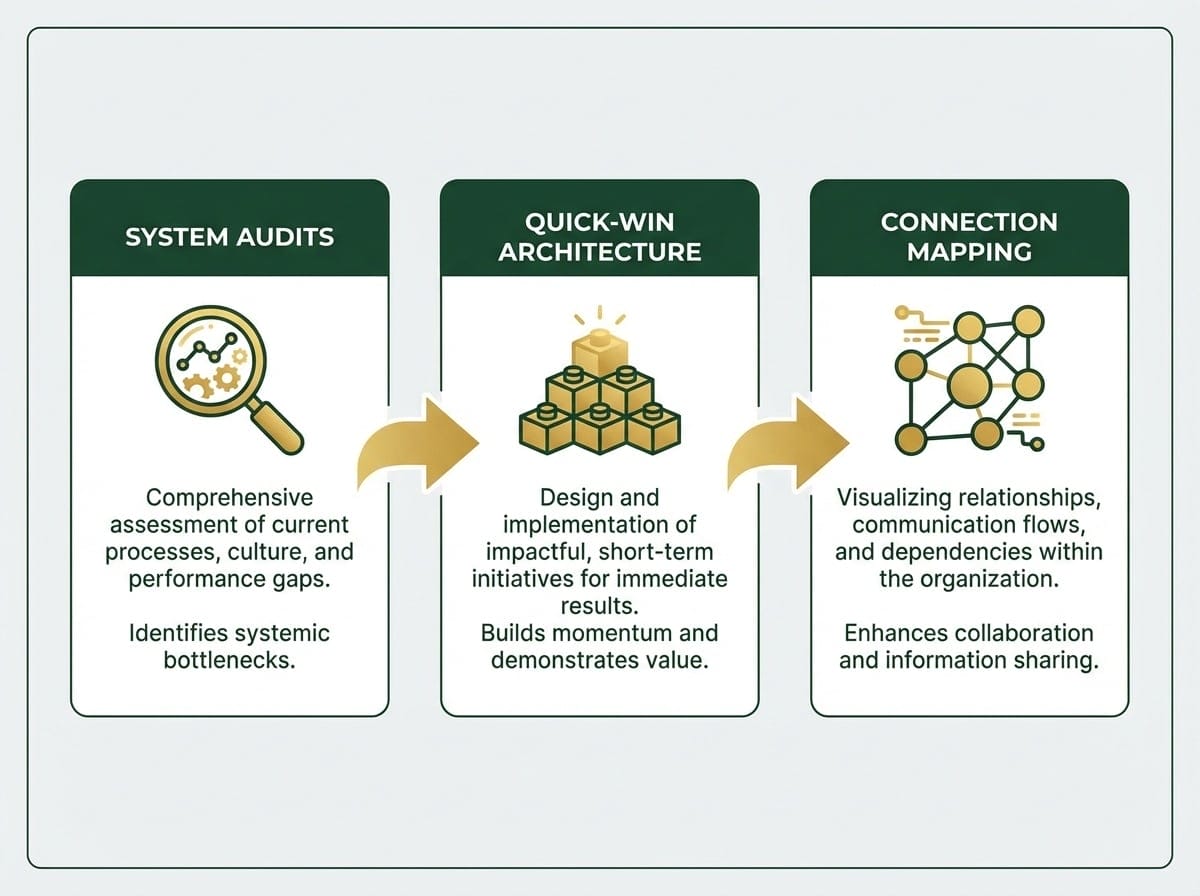
System audits before team interventions. Before coaching a team on communication or trust, step back and examine the organizational conditions the team is operating in. How is the team structured? What does its meeting rhythm reward? Where does information flow, and where does it get stuck? The team’s behavior may be a perfectly rational response to a dysfunctional system.
Quick-win architecture. When working with organizations in transformation, help leaders design early wins that connect to long-term goals. Identify what visible progress looks like in the first 30 days. Map each quick win to a larger strategic objective so the tactical and strategic reinforce each other.
Connection mapping. Identify the connectors on leadership teams, the people who bridge subgroups and build shared understanding. Coach them to recognize their influence. Redesign team processes to amplify their bridging role rather than defaulting to hierarchical decision-making.
The thread running through all of this is a shift in focus. High-performing teams aren’t a talent problem. They’re a conditions problem. And conditions are something we can coach.
So here’s my invitation: the next time you step into a team engagement, resist the pull to start with the people. Start with the system they’re in. Ask what conditions would need to be true for this team to perform at its ceiling. Then work backward from there.
The answers might surprise you.
What makes a team high-performing vs. just functional?
A functional team completes tasks and meets deadlines. A high-performing team does that while also generating new ideas, holding each other accountable without external pressure, and adapting to changing conditions. The difference usually comes down to organizational conditions: psychological safety, designed belonging, clear decision-making norms, and a rhythm that creates momentum. You can have talented individuals on a functional team that never reaches high performance because the system around them doesn’t support it.
How does organizational coaching differ from team coaching?
Team coaching focuses on the team as a unit: its dynamics, communication patterns, and collective goals. Organizational coaching zooms out to examine the systems, structures, and conditions in which teams operate. An organizational coach might discover that a team’s communication problems aren’t about the team at all but about how the organization routes information, structures incentives, or designs reporting lines. Both approaches are valuable, and they’re most powerful when combined.
Can quick wins really sustain long-term team performance?
Quick wins alone can’t sustain anything. But quick wins intentionally connected to a larger strategy can. The mechanism is psychological: when a team delivers something visible and valuable early in a transformation, it creates shared evidence that collaboration works. That evidence builds trust, and trust is what enables the harder, longer work of systemic change. The key is designing quick wins that aren’t just easy tasks but meaningful demonstrations of the team’s capacity.
Turn These Ideas Into a Team Design Plan
Bring your real team challenge—quick-win architecture, connectors, or belonging rituals. In a free consult, we’ll map where to start and what to change.
Book a Free Consultation →