
Coaching Supervision: The Missing Layer in Most Programs
The ICF Global blog (May 1, 2026) describes a moment most experienced coaches recognize but few name. The questions in their sessions get more complex. The ethical edges get sharper. The coach starts noticing how their own assumptions are shaping what happens in the room. ICF frames this as a readiness moment for becoming a supervisor.
For an organization running an internal or external coaching program, the same shift happens at scale. The work matures. The cases get harder. And the people best positioned to spot drift in your coaching quality - the coaches themselves - have nowhere structured to bring what they are seeing.
That is the gap supervision fills. And in most internal coaching programs I see, it is missing - not because anyone decided against it, but because the conversation about coaching capability stops at credentialing.
Key Takeaways
- Coaching supervision is a program-level capability, not a personal-development add-on. It protects coaching quality, surfaces ethical risk, and develops coaches in ways credentials alone cannot.
- The readiness signals ICF describes for individual coaches show up at the program level, too: rising case complexity, ethical fuzziness, and a coach pool that has outgrown one program lead.
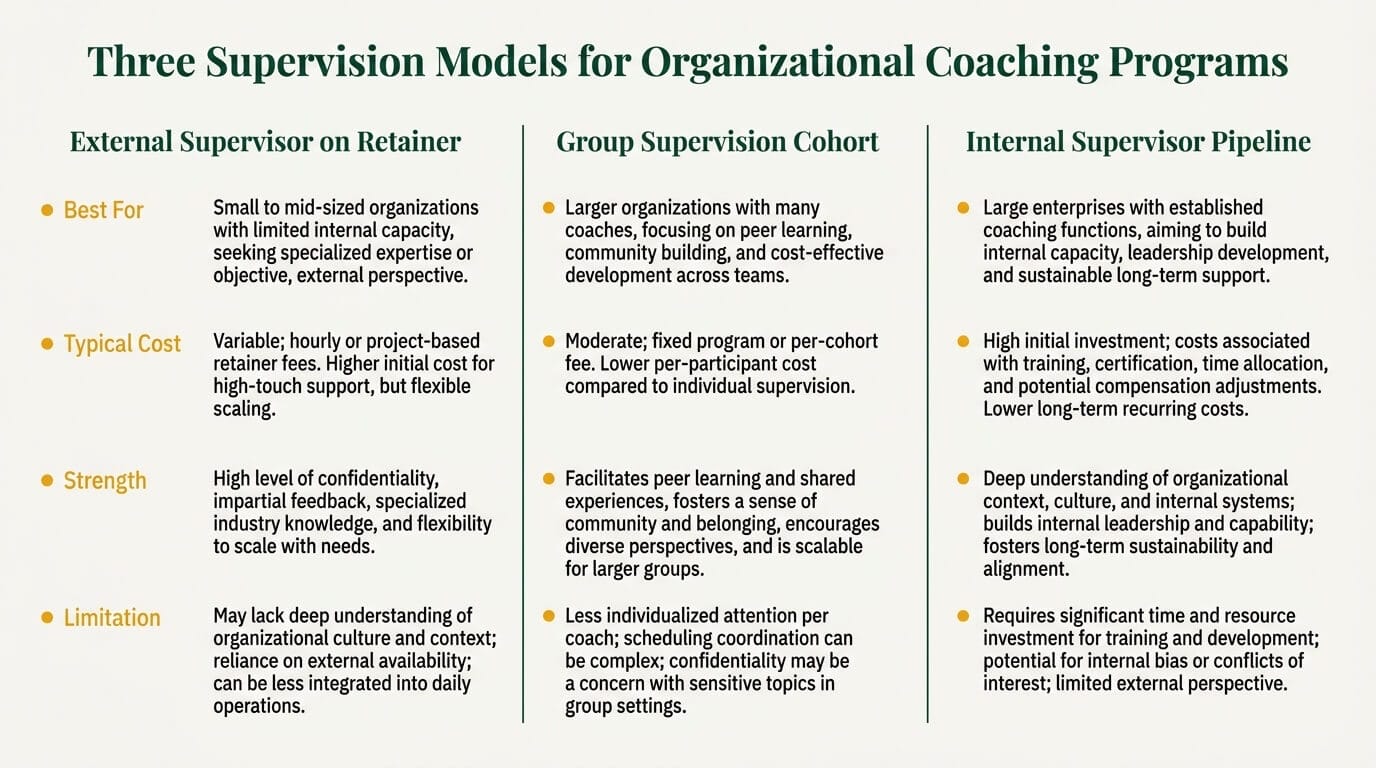
- Three workable models exist for adding a supervision layer: external supervisor on retainer, group supervision cohort, and an internal supervisor pipeline. Each solves a different problem.
- For mid-sized programs, a hybrid usually wins. Use external supervision for senior coaches and sensitive cases; build internal capacity for scale and succession.
What Coaching Supervision Actually Is
Coaching supervision is a structured, confidential reflective practice in which a more experienced coach helps a working coach examine their own coaching - including the cases they find hardest, the ethical edges they are bumping into, and the patterns in how they show up. It is not training, not performance review, and not therapy.
The reason this matters for you, as a program owner, is that supervision sits in a space your other programs do not cover. Mentor coaching prepares a coach for a credential. Peer coaching offers lateral support among working coaches. Performance management protects the organization from underperformance. None of those answer the question supervision is built to answer: is this coach still fit for the work in front of them, and what is shaping how they hold it?
When organizations conflate supervision with mentor coaching, they end up with a credential pipeline but no quality layer. When they conflate it with performance management, coaches stop bringing what is hard - because they have learned that what they bring becomes part of their record. Both moves erode the very reflection supervision is meant to enable.
Why Most Internal Coaching Programs Skip Supervision
Most internal coaching programs assume that ICF credentials equal ongoing competence. A coach earns ACC or PCC, joins your roster, accumulates session hours, renews on schedule. The credential is a floor, not a ceiling, and program owners often treat it as both.
Seeing Drift Between Credentialing and Practice?
If ACC/PCC has become the end of development, we can help you add a supervision layer that keeps coaches fit for purpose as cases get sharper and more complex.
Coaching at Work raised the parallel question for the field this same week: what does it actually take to be fit for purpose as a coach inside an organization? The piece argues - rightly, in my view - that coaching development cannot stop at the credential. The work changes. Clients change. Industries change. A coach who was excellent at one-to-one career conversations five years ago may now be coaching senior leaders through layoffs, identity-level identity transitions, and ethical knots that have no clean answer.
Without supervision, those drifts go unprocessed. I see four common failure patterns in programs that skip the layer. The first is ethical fuzziness: coaches handle dual relationships, confidentiality edges, and conflicts of interest case by case, with no shared standard. The second is shadow consulting: coaches start solving clients' problems for them, often without realizing the contract has shifted. The third is role confusion: internal coaches drift toward acting like managers, mentors, or therapists, depending on which client pulls hardest. And the fourth is complexity that no one is processing: cases involving identity, harm, or organizational power that the coach is holding alone.
Each of these is a quality problem first, and a risk problem second. A supervision layer addresses both. The strongest case I can make to a CFO who is skeptical of the cost is this: the absence of supervision is what makes the actual benefits of coaching supervision invisible until something goes wrong.
Readiness Signals at the Coach Level
The ICF piece describes the readiness moment for individual coaches as a gradual shift, not a sudden decision. The coach notices a growing curiosity about their own practice, not just their client's progress. They become more aware of ethical complexity. They want to reflect more deeply on the impact of their work. Read this as a checklist for your roster, not just for the coaches who might one day become supervisors.
If you run a coaching program, here is what to listen for in coach check-ins. A coach who used to bring you stories about client breakthroughs starts bringing you questions about their own role in the room. That is a readiness signal. A coach who used to ask "what should I do here" starts asking "what assumptions am I bringing." That is a readiness signal. A coach who used to describe cases by what the client did starts describing cases by what the case is teaching them. That is a readiness signal.
The flip side matters too. A coach who has stopped bringing anything hard, who only describes wins, or who starts using the same explanation for every difficult case is showing you a different signal. Not unfitness, exactly. But the absence of reflection that supervision is built to interrupt.
For coaches working with senior populations, the case complexity itself is a readiness signal at the program level. When your coaches are routinely holding the ethical complexity coaches bring to supervision - identity work, power dynamics, organizational change, harm - and there is nowhere structured for them to bring it, you have a quality risk you cannot see from the outside. The coach is fine. The work is fine. Until it is not.
Readiness Signals at the Program Level
The coach-level signals roll up into a program-level pattern. Most program owners I work with discover their need for supervision the same way they discover their need for any infrastructure layer: the absence shows up in friction first, then in failure.
Here is what to watch for in your program data and your conversations.
Volume crossing a threshold. A program lead can hold light oversight for a handful of coaches. Once your coach roster moves past 10 to 12, the lead becomes the bottleneck. Conversations about cases get rushed or skipped. You feel responsible for quality you cannot actually see.
Coaching scope expanding into sensitive populations. Senior leaders, layoff support, post-incident coaching, identity work, organizational change. Each of these widens the ethical surface area. Your coaches may be excellent and still be holding cases that exceed what their training prepared them for.
External coach pool growing past one person's bandwidth. If you contract external coaches, the relationship management itself is a job. Onboarding, rate alignment, case fit, feedback loops, off-boarding. Without supervision in the mix, you are paying for capacity without buying quality.
Cases that involve organizational change, identity, or harm. Reorganizations, layoffs, harassment investigations, leadership transitions. These are not failure cases - they are the actual work. But they are where coaches are most likely to drift into shadow consulting, become quietly destabilized, or freeze.
Coaches who have stopped bringing you anything difficult. Silence is a signal. If your check-ins have become updates on client outcomes, your coaches have learned where the conversation will be useful and where it will not. A supervisor's job is to make the difficult bringable again.
None of these signals on its own forces a decision. Two or three together usually do.
Three Models for Adding a Supervision Layer
If you have decided your program needs a supervision layer, three models cover most of the ground. They are not exclusive - many mature programs run two or all three in combination - and the choice depends less on size than on what you are protecting against.
The first is an external supervisor on retainer. You contract a credentialed supervisor who meets with each of your coaches one-to-one, monthly or bi-monthly. The coach brings cases, the supervisor reflects, and the supervisor reports nothing back to you about content. You see only the engagement metrics: did sessions happen, did themes emerge that the program should know about. This is the cleanest model for confidentiality and the easiest to scale up or down. It is also the most expensive on a per-coach basis.
The second is a group supervision cohort, where four to six coaches meet with one supervisor on a recurring schedule and bring cases collectively. The economics improve. The pattern recognition expands - coaches see how peers handle the cases they are wrestling with. The trade-off is depth: any one coach gets less individual attention. Group supervision works well for established coaches who have a baseline of ethical fluency and can use the room well.
The third is an internal supervisor pipeline: identifying senior coaches in your roster, sponsoring them into supervision training, and bringing the supervision capability inside the organization over time. This is the only model that builds long-term capacity. It is also the slowest, the riskiest if poorly executed, and the one most likely to collide with confidentiality concerns if internal supervisors and the people they supervise share too much organizational history.
Each model solves a real problem. None of them solves all of them. The most common mistake I see is choosing the model that fits this year's budget and assuming it will scale. Budget should follow the decision about what you are protecting against, not the other way around.
Internal vs. External Supervisors
The internal-versus-external question is not the same as the model question. You can run an external supervisor on retainer or build group supervision with an external lead - both are external. You can also rotate internal supervisors into the program over time. The deeper choice is about who holds the role.
External supervisors bring three things internal supervisors usually cannot: independence from the organization's politics, the kind of confidentiality coaches will actually trust, and a broader pattern library across multiple clients. A good external supervisor has seen versions of your coaches' hardest cases at six other organizations. That perspective is hard to replicate inside the building.
Internal supervisors bring two things external supervisors usually cannot: organizational context that lets them help coaches read the actual culture, and scale that pays back into the program over time. An internal supervisor knows what your leaders sound like. They understand which battles are worth coaching toward and which are systemic. They are also a succession asset - the people most likely to step into program leadership when it is time.
For mid-sized programs, the answer is usually both. External supervision for senior coaches, ethically complex cases, and anything involving organizational change. Internal supervision for scale, onboarding, and the ongoing reflective practice of the broader coach roster.
When a Coach on Your Team Asks About Becoming a Supervisor
One of the readiness signals I want you to take seriously is the coach in your own program who starts asking, in their own words, the questions ICF describes. They are noticing their assumptions. They are drawn to the cases other coaches bring. They want to develop other coaches, not just clients.
The conversation to have with them is not whether they should pursue supervision training. It is what kind of supervisor they would become and what your program needs from them. A coach who is excellent at one-to-one work does not automatically become an excellent supervisor. The job requires a different muscle - holding multiple coaches, reflecting on their reflection, recognizing patterns across a roster, and tolerating the slower feedback loop of coach development versus client development.
If you sponsor a coach into supervision training, the investment pays back into the program three ways. The trained coach becomes part of your internal supervision capacity. They model reflective practice for the rest of the roster. And they often become the bridge between your program and your senior leadership, because they have learned to speak about coaching at the level of system, not just session.
Sponsorship is also a retention play. Coaches who feel their development is taken seriously stay. Coaches who feel they have plateaued at the credential level often leave for the next thing.
Common Questions About Adding Supervision
Is coaching supervision the same as mentor coaching?
No. Mentor coaching is targeted development that prepares a coach to meet a credential standard - usually ACC, PCC, or MCC. It is bounded by the rubric. Coaching supervision is open-ended reflective practice with no credential endpoint. A coach can have a current credential, no need for mentor coaching, and still benefit from supervision. The two roles can be held by the same person, but the work is different.
Do credentialed coaches still need supervision?
Yes, especially at PCC and MCC levels. Credentials confirm a coach met a standard at a point in time. Supervision keeps them growing into the work that comes after. In several European coaching bodies, ongoing supervision is a credential requirement, not a recommendation. ICF treats it as best practice rather than a renewal mandate, but the underlying logic is the same.
How often should organizational coaches meet with a supervisor?
The common rhythm is monthly one-to-one supervision or bi-monthly group supervision, with the option to escalate around difficult cases. Newer coaches usually need more frequent supervision; senior coaches often shift to a quarterly rhythm with on-call access for harder cases. The right cadence is the one your coaches actually use.
What is the ROI of adding a supervision layer to a coaching program?
The hard ROI shows up in retention (coaches stay longer in programs that develop them), risk reduction (ethical edges get processed before they become incidents), and case quality (coaches can hold harder work without burnout). The softer return is signal: the existence of a supervision layer tells your coaches, your leaders, and your senior clients that you take coaching quality seriously enough to fund it.
Build Supervision Into Your Coaching Program
The free Coaching Supervision Essentials course covers three-cornered contracts with a sponsor and group supervision formats that internal teams can use.
Explore the Free Course →