
The Voice Your Leadership Team Isn’t Hearing
Every leadership team has a voice it is not hearing. Not because someone is being silenced. Because the room’s dominant formation has made one perspective so normal that the alternative perspective — the one that would complete the picture — does not register as relevant. It is spoken. It is not heard. And the decisions that follow have a specific, predictable shape: they solve for the dimension the room can see and miss the dimension the room cannot.
The voice that is missing is usually not the quietest person in the room. It is the person whose formation processes the situation through a lens the majority does not share. The operations leader in a room full of growth strategists. The legal mind in a room full of builders. The HR perspective in a room that speaks only in revenue and market share. The voice is present. The formation the room was built around makes it invisible.
Key Takeaways
- Every leadership team has a formation center of gravity — one or two dominant formations that shape how the room defines problems, evaluates solutions, and makes decisions.
- The blind spot is structural, not personal. The voice that is missing is usually present but filtered out by the room’s dominant formation.
- The most common team dysfunctions — groupthink on strategy, repeated arguments, decisions that fail in execution — are often formation blind spots rather than leadership failures.
- A team coach who understands the formations in the room can name the missing voice without making anyone wrong.
The Room’s Center of Gravity
Every leadership team has a center of gravity — one or two formations that disproportionately shape how the room operates. In a technology company, the engineering formation often dominates: problems are framed as systems to be designed, solutions are evaluated by technical elegance, and the room speaks in architecture and scalability. In a financial services firm, the finance formation dominates: problems are framed as risk/return equations, solutions are evaluated by provable ROI, and the room speaks in models and scenarios.
The center of gravity is not determined by who talks the most. It is determined by what language the room treats as legitimate. When the CTO says “the architecture cannot support that,” the room hears a hard constraint. When the CHRO says “the culture cannot absorb that pace of change,” the room hears a soft opinion. Both statements may be equally accurate. The room gives one the weight of fact and the other the weight of perspective. That asymmetry is the center of gravity operating.
The leadership team’s blind spot is not a gap in intelligence. It is a gap in formation. The room can only see what its dominant formation has trained it to notice.
The Voices That Disappear
Operations in a growth-obsessed room. The COO sees that the growth strategy will break the operational infrastructure. The supply chain cannot absorb the volume. The deployment pipeline was not built for this pace. The hiring plan does not account for onboarding capacity. The COO raises these concerns. The room hears “resistance to change.” What was actually offered: a reality check that would have prevented the execution failure that arrives six months later. The operations formation’s visibility paradox plays out in real time — the voice that sees the most is heard the least.
HR in a revenue-driven room. The CHRO sees the talent risk underneath the restructuring plan. The senior managers who will leave. The culture debt that will compound. The succession gaps that will widen. The CHRO raises these concerns. The room hears “people stuff.” The CFO asks for the financial impact. The CHRO cannot produce a model because culture debt does not fit in a spreadsheet. The room moves on. Eighteen months later, the turnover spike arrives and the organization wonders what happened.
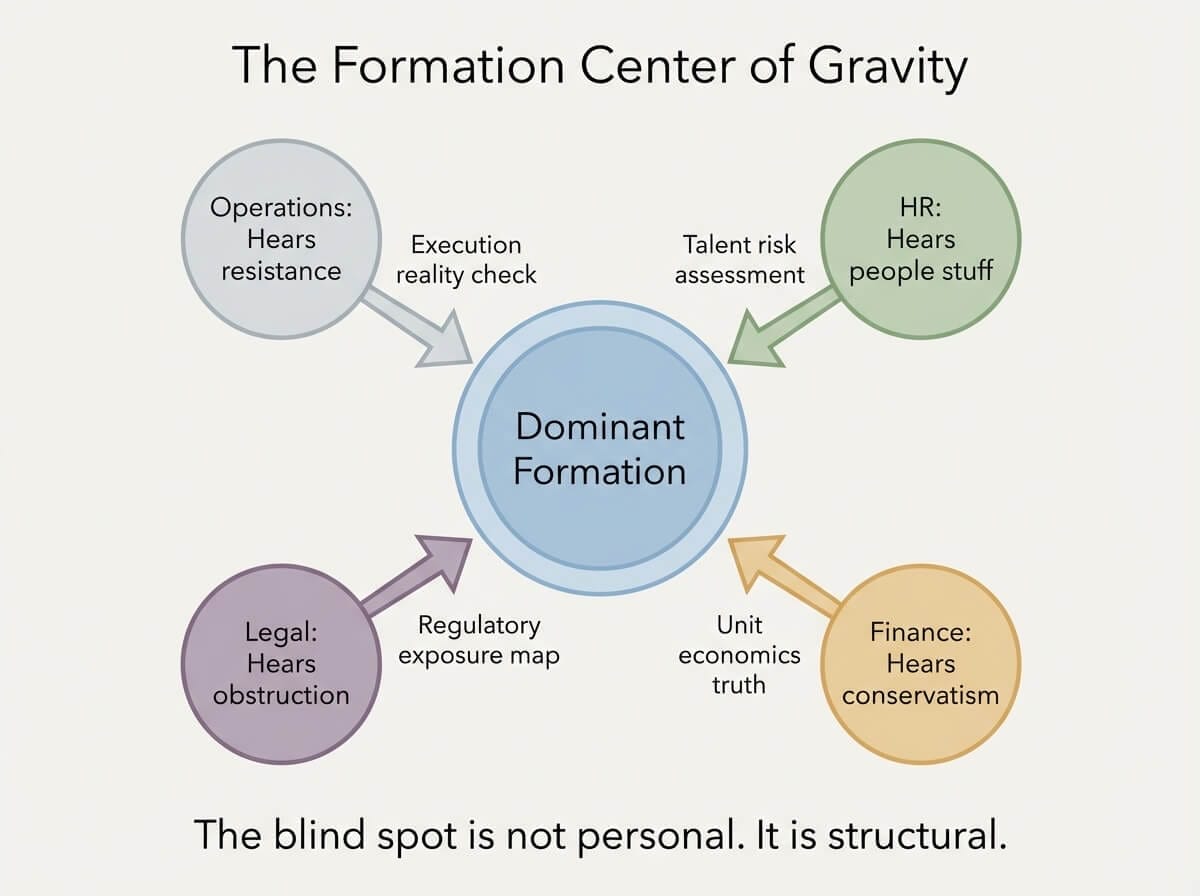
Legal in a move-fast room. The GC sees the regulatory exposure. The privacy gap. The compliance risk that has not been assessed. The GC raises these concerns. The room hears “legal is slowing us down again.” The risk instinct that the legal formation installed reads as obstruction to formations that metabolize risk through speed and iteration.
Finance in a narrative-driven room. The CFO sees the unit economics that do not support the market story. The runway that assumes revenue growth the model cannot justify. The capital allocation that prioritizes story over substance. The CFO raises these concerns. The room hears “finance is being conservative again.” The precision formation reads as excessive caution to formations that lead with conviction.
The pattern is consistent: the voice that would complete the room’s understanding of the decision is the voice the room’s center of gravity has implicitly trained everyone to discount. Not through malice. Through formation.
The Cost of the Blind Spot
Formation blind spots are expensive. Not in the obvious way — not as a single bad decision that can be traced to a single missed input. In the systemic way: a pattern of decisions that consistently solve for one dimension and miss another.
The technology-dominated room builds elegant systems that nobody adopts because the user experience perspective was treated as secondary. The finance-dominated room produces financially sound strategies that fail in execution because operational reality was treated as an implementation detail. The growth-dominated room scales faster than the organization can absorb because the people perspective was treated as a soft concern.
The blind spot does not produce catastrophic failures. It produces predictable patterns of incomplete decisions — and the leadership team that keeps having the same argument in different rooms is usually experiencing the same formation blind spot from different angles.
What Team Coaching Changes
Generic team coaching identifies communication patterns, personality differences, and trust deficits. A team coach who understands formation sees something more structural: which formations are in the room, which one dominates, and which voice the room has implicitly agreed to discount.
The coaching intervention is not “make sure everyone gets to speak.” The intervention is naming the center of gravity: “This room makes decisions in [finance/engineering/growth] language. What decision would you make differently if you gave equal weight to the perspective that just got filtered out?”
That question does not blame the dominant formation. It makes the structure visible. And once the team can see the pattern — “we consistently discount the operations perspective because our center of gravity is growth” — they can adjust without anyone having to change their personality or their formation. The adjustment is structural: build a decision process that formally accounts for the voice the room naturally mutes.
The most effective leadership teams are not the ones where every voice is equally loud. They are the ones where every formation’s contribution is recognized as structural rather than optional.
The patterns in this article connect to several related dynamics across careers and levels: the HR formation that shapes what gets treated as culture, what rising leaders encounter version of this dynamic, and how this dynamic changes when you’re trying to lead the team.
Hearing the Room Fully
Your leadership team has a center of gravity. Every team does. The question is not whether the center of gravity exists. The question is whether your team can see it — and whether the voice it mutes is the one that would complete the picture the room needs to make better decisions.
If your team keeps having the same argument, keeps being surprised by execution failures, or keeps making decisions that look right in the room but break in the field, the issue may not be strategy or alignment or communication. It may be a formation blind spot that no one in the room can see because the room was built around it.
If that pattern sounds familiar, a team coaching conversation that understands the formations in the room is where the blind spot starts becoming visible — and useful.
A Conversation About What Your Room Is Missing
A 30-minute call about the formation center of gravity on your leadership team and the voice it structurally mutes.
Book a Free Consultation →