

Is ICF Certification Worth It? An Honest Answer From Two MCCs
ICF certification is worth it for coaches pursuing genuine professional development, competency building, and a credential that signals ethical commitment to the profession. It is not worth it as a client-generation strategy. The credential functions as a tiebreaker at best. Nobody hires a coach because of a badge—they hire based on fit, track record, and what an executive coach actually delivers.
That claim will not surprise anyone who has been through the credentialing process. It will surprise most people who have only read about it online. Most content on this question comes from coaching schools selling ICF-accredited programs. Their business model needs the answer to be yes. Ours does not.
We have trained hundreds of coaches through ACC and PCC programs. We have watched who thrives after certification and who comes back six months later asking how to build a practice—for advice on the buyer side, see our guide on how to find an executive coach. The answer to whether the International Coaching Federation credential is worth the investment depends entirely on what you expect it to deliver.
This article gives you a framework for deciding rather than a predetermined conclusion.
Key Takeaways
- ICF certification builds genuine coaching competence through structured practice and feedback. It does not generate clients, and treating the credential as a marketing strategy leads to disappointment.
- The real value of the credentialing process is behavioral change: learning to listen differently, hold space, and coach rather than advise. That transformation comes from the hours of practice, not from the badge at the end.
- Whether certification is worth the investment depends on where coaching sits in your career. Internal coaches, career changers, and practice builders each get different returns from the same credential.
- The coaches who struggle most during the certification process often develop the deepest coaching foundation. Persistence through difficulty produces results that early competence sometimes does not.
Why Most Answers Are Wrong
Most content answering whether ICF certification is worth it falls into two camps: coaching schools that conclude yes because their revenue depends on enrollment, and opinion pieces that hedge with “it depends on your goals” without specifying which goals or what happens for each. Neither respects the reader enough to be specific.
The cheerleader camp is easy to spot. Search for this question and you will find coaching schools occupying positions 5 through 12 on the results page, all arriving at the same conclusion. They sell ICF-accredited programs. Saying “this might not be the right investment for you” would undercut their enrollment page. The conflict of interest is structural, not personal.
The hedger camp sounds balanced but delivers nothing actionable. “It depends on your goals” is technically true and practically useless. Which goals? What return corresponds to what investment? What should someone in your specific career situation actually expect? The reader leaves knowing exactly what they arrived with.
The honest answer requires separating what certification is from what it is not. ICF certification documents that a coach completed an accredited training program, accumulated supervised coaching hours, passed a knowledge assessment, and committed to the ICF Code of Ethics. It is a professional credential signaling training completion, competency assessment, and ethical commitment.
It does not generate clients. It does not guarantee career outcomes. It does not differentiate you in a market where most prospective coaching clients cannot name what the International Coaching Federation is—even as research on the benefits of executive coaching confirms the methodology itself delivers strong results. The credential documents competence. Building a coaching practice is a separate problem that the credential does not solve.
That distinction between what the credential documents and what it produces is where every honest conversation about certification value begins.
What Certification Actually Delivers
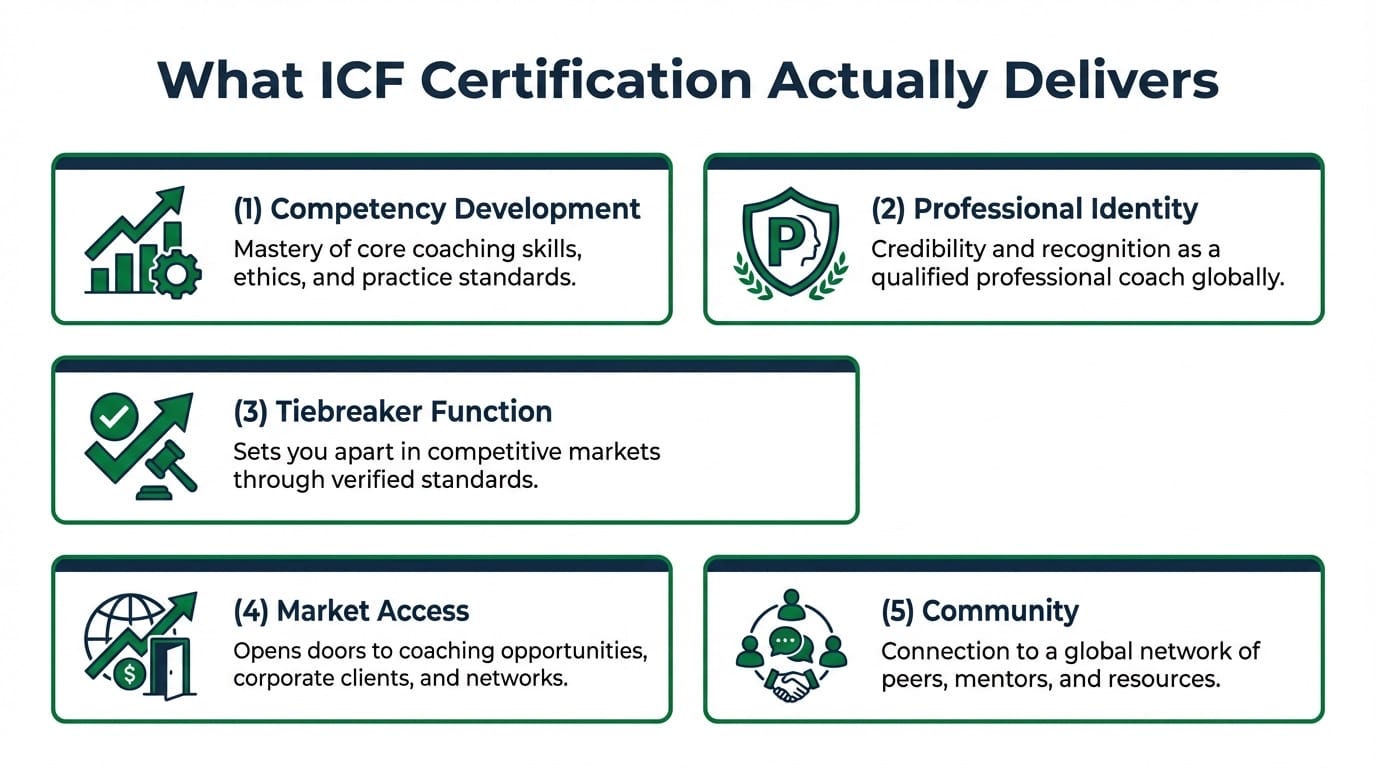
ICF certification delivers five concrete returns: genuine competency development through structured training and supervised practice, professional identity within a global coaching community, a tiebreaker function when buyers compare otherwise similar coaches, access to markets that require credentials, and a professional network through ICF membership and continuing education.
The first of these is where the real value concentrates. It is also the one most certification marketing underplays in favor of the badge itself.
The credential documents what you completed. The competency development changes how you coach. Most certification marketing sells the first and underplays the second.
Competency development. Completing 60 hours of coach-specific training for ACC certification or 125 hours for PCC certification is the starting point. The ICF Core Competencies framework defines eight areas of coaching skill, and the training process forces you to practice them under observation. Add 100 coaching experience hours for ACC or 500 for PCC, plus mentor coaching sessions where your actual coaching is reviewed by a credentialed coach, and the process produces behavioral change that studying cannot replicate. You come out of it listening differently than you went in.
Professional identity. ICF membership places you within a global profession with shared vocabulary, ethical standards, and continuing coach education requirements. For coaches who operate in relative isolation (internal coaches, solo practitioners, career changers entering coaching from other fields), this belonging has value that is difficult to measure but consistently reported by credentialed coaches.
Tiebreaker function. When a prospective client or organization compares two coaches with similar experience and similar presence, the ICF credential creates a margin of preference. This is real but limited. The credential breaks ties. It does not create demand where none exists.
Market access. Some corporate coaching contracts, coaching directories, and organizational buyers require ICF credentials as a prerequisite. Internal coaching positions at larger companies increasingly list ICF certification as preferred or required. This institutional demand for credentialed coaches is the credential's most tangible commercial value, and it varies significantly by industry and geographic market.
Community. ICF chapters, conferences, and peer groups provide ongoing professional development and referral networks. Coaches who stay active in the coaching community after certification consistently report higher satisfaction with their investment than coaches who treat the credential as a one-time purchase and move on.
The coaching profession has growing evidence that professional coaching produces measurable results for the organizations and individuals who invest in it. Certification positions you as a practitioner prepared to contribute to those outcomes. Whether you do depends on your skills and your practice, not your credential level.
Who ICF Certification Is Worth It For
ICF certification is clearly worth the investment for five specific professional profiles. Each has a different reason for pursuing it, and the value shifts accordingly. The question is not whether certification is worth it in the abstract. The question is whether it is worth it for you—and first, whether executive coaching is right for you—given where coaching sits in your career.
ACC Certification — $3,999
60+ training hours, mentor coaching, and supervision included. Everything ICF requires for your Associate Certified Coach credential.
Internal coaches, HR practitioners, and managers who want to understand what coaching competencies actually require in practice. Not the surface behavior, but what active listening demands, what it costs to hold silence, what happens when you stop solving and start asking. ACC certification changes how these professionals lead and documents a formal competency to their organization. The return is not a coaching practice. The return is leadership capacity—the same outcomes documented in research on the benefits of leadership coaching.
Agile coaches and team facilitators with hundreds of hours of group facilitation who want to formalize their coaching skills through the ICF system. The ACTC pathway builds on existing team coaching experience rather than starting from zero. For coaches who already do the work, the credential formalizes what they have been doing and opens doors to coaching contracts that require certification.
Coaches who want development beyond mechanics. AI tools can teach coaching frameworks and conversational structure. What they cannot teach is presence: the ability to hold space, tolerate silence, and respond to what the client is actually communicating rather than what you expected them to say. The certification process, with its live practice hours and mentor observation, develops that capacity in ways that reading and self-study do not.
Professionals who want to belong to the coaching profession. Coaching is an unregulated industry. Anyone can call themselves a coach. ICF credentialing separates coaches who have submitted to external evaluation from coaches who have not. For practitioners exploring the life coach certification path or considering the difference between executive and life coaching, the professional standard matters more than the marketing advantage.
Practitioners building a coaching practice where credential credibility functions at the comparison point. If a prospective client is choosing between two coaches and one holds an ICF credential, that credential creates a margin. Tandem's ACC certification program is designed for coaches at this decision point, covering training, mentor coaching, and exam preparation in a single integrated program.
Who Should Think Carefully First
Not everyone should pursue ICF certification right now. Coaches who expect the credential to generate clients, professionals who already operate in contexts that do not require external credentialing, and people pursuing certification primarily for validation rather than development should evaluate their expectations before committing.
This is not discouragement. It is the conversation we have with potential students before they enroll, because adjusting expectations before the investment protects both the student and the profession.
If you expect immediate business results from the credential alone, adjust that expectation now. The most common wrong expectation we see from coaches entering certification programs is that the credential will generate clients. Coaches believe that an ICF badge will make them stand out and drive client acquisition. It will not. The post-certification question of how to build a coaching practice is real, and the credential does not answer it.
An ACC credential alone will not get you clients. The credential signals competence. Building a coaching practice requires marketing, networking, and demonstrated results that the certification process does not address.
If you are already coaching internally at an organization that does not require or recognize external credentials, evaluate honestly whether the investment serves your career development or your ego. Some internal coaches benefit enormously from the structured competency development. Others are better served by investing in supervision or advanced skills training without the credentialing overhead. The deciding factor is whether your organization values the credential, the competency development behind it, or neither.
If you are not yet certain coaching is your career path, investing $3,000 to $12,000 in an accredited program is premature. There are less expensive ways to find out whether coaching fits you: peer coaching groups, introductory workshops, volunteering as a practice coach in someone else's program. Explore the ICF credentialing requirements and the commitment they represent before you commit financially. The credential path will still be there when you are ready.
The Counterintuitive Truth
The coaches who get the most from certification are often the ones who struggle the most during the process. The value of ICF certification is not the credential at the end. It is the behavioral change that sustained engagement with the process demands over months of practice, feedback, and adjustment.
Consider a coaching candidate who cannot seem to get it right. Session after session, the feedback from mentors is the same: too directive, too eager to solve, not enough space for the client to process. Other candidates in the program are producing solid recordings by month three. This person is still struggling at month six.
A reasonable observer would say this candidate is not cut out for coaching. And yet they keep showing up. They take the feedback, adjust something small, and come back the following week. The improvement is invisible for months.
Then something shifts. The candidate produces a recorded coaching session that is genuinely good. Not just technically correct, but present. Responsive. The kind of coaching that the competency framework describes but cannot teach through description alone. The coaching that emerges when a person stops performing the competencies and starts inhabiting them.
This is not a rare story. We see some version of it in most program cohorts. The candidates who struggle persistently and refuse to quit often develop the deepest coaching foundation. The candidates who produce competent recordings quickly sometimes plateau at competent. The distinction is between performing coaching and doing it.
The candidates who struggle persistently and refuse to quit often develop the deepest coaching foundation. The ones who produce competent recordings quickly sometimes plateau at competent.
What changed was not a technique or a framework. It was that the repetition of real coaching, with real people, receiving direct feedback, and returning to try again eventually produced a shift that no amount of studying can replicate. The certification process provided the structure for that persistence. Without the structure, that candidate would have stopped months earlier and concluded that coaching was not for them.
The certification timeline ends. The coaching development does not. For coaches who treat the credential as the beginning of the evidence rather than the conclusion, the investment pays returns that compound over years of practice.
The Real ROI Calculation
The real return on ICF certification cannot be reduced to a single number. ACC programs typically cost $3,000 to $6,000. PCC adds $5,000 to $12,000 in total investment across training, mentor coaching, and application fees. For the full ICF certification cost breakdown across credential levels, our cost analysis covers what most articles leave out.
Those hidden costs matter. They include the coaching practice hours that do not generate income: 100 hours of coaching experience for ACC, 500 for PCC. They include mentor coaching beyond the minimum if your recording submissions are not ready on the first attempt. And they include the 6 to 18 months after certification before a new coaching practice generates what your previous career did, if it ever does. That math is worth running before you commit.
The ICF Global Coaching Study provides industry-level data on coach earnings and market growth. The numbers are real. But applying industry averages to individual career decisions is the wrong use of aggregate data. Your return depends on your market, your coaching niche, your existing network, and your willingness to build a practice after certification rather than assuming the credential will do that work for you.
Anyone who has evaluated whether hiring an executive coach is worth the investment from the buyer's side knows that the credential matters at the margin but is not the deciding factor. Coaching clients hire coaches they trust, not coaches with the most letters after their name. The credential gets you into the consideration set. Your demonstrated competence and fit determine whether you stay there.
The credential gets you into the consideration set. Your demonstrated competence and fit determine whether you stay there.
The more useful ROI question is not “will this get me clients?” It is “what kind of coach do I want to be, and does this process help me get there?” For coaches who answer that question honestly, the worth question resolves itself. Programs that cover the full credentialing arc reduce hidden costs by integrating mentor coaching and exam preparation rather than leaving graduates to assemble those pieces independently. Tandem’s Systems Coach Program covers PCC in a single all-inclusive structure. For coaches pursuing ACC, PCC, and ACTC together, the Professional Coach Program ($7,499) delivers all three credentials in one integrated pathway—often the most cost-efficient route to a full credential portfolio.
Frequently Asked Questions
Do you need ICF certification to be a coach?
No. Coaching is an unregulated industry, and no license or certification is legally required to practice as a coach. However, ICF certification signals to prospective clients and organizations that you have completed structured training, accumulated supervised coaching hours, and committed to a professional code of ethics. Whether you need it depends on your target market. Corporate buyers and coaching directories increasingly require or prefer ICF credentials as a baseline.
How long does it take to get ICF certified?
ACC certification typically takes 6 to 9 months through a structured program. PCC requires significantly more coaching experience hours (500 total), which extends the timeline to 18 to 36 months for most coaches depending on their coaching volume. The bottleneck is accumulating quality coaching hours, not completing the training itself.
Is life coach certification worth it?
The answer follows the same framework as any coaching niche. Pursuing life coach certification through an ICF-accredited program builds genuine coaching skills and professional credibility. It does not guarantee a viable life coaching practice. The certification develops your coaching competence. The business development is a separate investment of time and effort that the credential does not replace.
What is the difference between ACC and PCC?
ACC (Associate Certified Coach) requires 60 or more hours of coach-specific training and 100 hours of coaching experience. PCC (Professional Certified Coach) requires 125 or more hours of training and 500 hours of coaching experience. Beyond the numbers, PCC represents a meaningfully higher level of demonstrated coaching competency. Most professional coaching clients and corporate buyers begin taking the credential seriously at the PCC level, which is why many coaches who start with ACC continue toward PCC within two to three years.
ACC Certification — $3,999
60+ training hours, mentor coaching, and supervision included. Everything ICF requires for your Associate Certified Coach credential.
See ACC Program Details →