
Growth Mindset Coaching: A Practitioner’s Guide to Facilitating Belief-Level Shifts
A client sits in front of you and says, "I'm just not someone who can do public speaking." Not "I struggle with public speaking" or "I haven't figured out public speaking yet." The language is identity-level: I'm not someone who. That phrasing tells you more about the coaching work ahead than anything on the intake form.
When the challenge is rooted in a fixed belief about ability, ordinary goal-setting stalls. Why build a plan for something you have already decided you cannot do?
Growth mindset coaching addresses that premise. Not by arguing against it or encouraging the client to think positively, but by creating the conditions where the client examines the belief as an object they hold rather than a fact about who they are. This is where how growth mindset fits the practitioner skill set becomes visible: the skill is not in knowing the Dweck research. It is in knowing what to do in the room when a fixed belief surfaces.
For the broader landscape of mindset coaching, see our companion guide. This article is narrower: what does a coach actually do, turn by turn, to facilitate a genuine shift?
Key Takeaways
- Growth mindset coaching follows a three-stage process - identify the fixed belief, create productive disequilibrium, expand possibility - and collapsing any stage turns coaching into encouragement.
- The advocacy trap is the most common error in growth mindset work: the moment a coach becomes invested in the client adopting a growth mindset, they have stopped coaching and started persuading.
- The coach's job is to make fixed beliefs visible as objects the client holds, not to install new beliefs - the client decides whether to keep, modify, or release them.
The Research Behind Growth Mindset
Dweck's framework is often summarized as "believe you can grow." The coaching-relevant insight is more specific: mindset orientations are domain-specific, not global. A client can hold a growth orientation toward strategy while carrying a rigid fixed belief about their capacity for conflict - which is exactly where coaching intervenes.
Carol Dweck's research at Stanford, published in Mindset: The New Psychology of Success (2006), distinguishes two orientations toward ability. In a fixed mindset, intelligence and talent are static traits. You either have them or you do not. In a growth mindset, abilities develop through effort, strategy, and learning from setbacks.
The framework is well-known. What is less discussed is the coaching relevance. Dweck's research describes these orientations as belief systems, not personality types. People hold fixed beliefs in some domains and growth beliefs in others. A senior leader might have a deep growth orientation toward strategic thinking and a rigid fixed belief about their capacity for difficult conversations.
That domain specificity matters for coaches. The client who arrives saying "I have a growth mindset" may be accurate about their general orientation while holding a fixed belief in the exact area causing them problems. The coaching work is not about installing a growth mindset wholesale. It is about finding the specific fixed belief operating beneath the presenting issue.
Performance anxiety, imposter syndrome, avoidance of stretch assignments, resistance to feedback - these patterns often have a fixed belief at root. The client is not lacking courage. They are protecting themselves from confirming what they believe is already true: that they do not have what it takes.
Growth Mindset Work in a Session
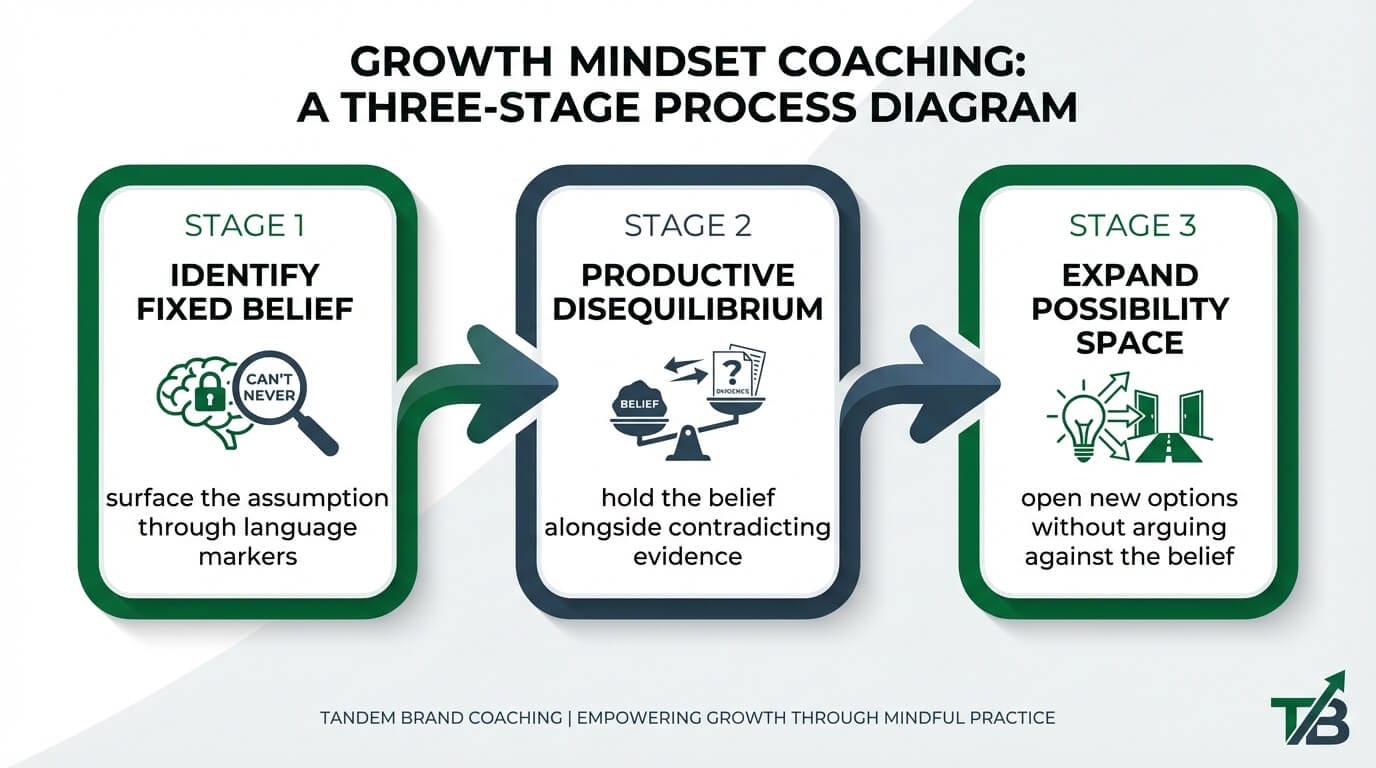
Three stages structure the work: surfacing the fixed belief as a belief, holding it alongside contradicting experience until genuine tension forms, then opening possibility from that tension. Each stage has its own demands. Collapsing the sequence - moving from Stage 1 to Stage 3 before Stage 2 does its work - produces a conversation that looks like coaching but produces encouragement.
Growth mindset coaching follows a three-stage process that aligns with ICF Core Competency 7: Evokes Awareness. Each stage requires different coaching behaviors and a different quality of patience.
Stage 1: Identify the Fixed Belief
Fixed beliefs announce themselves through language. Listen for identity statements: "I'm not a numbers person," "I've never been good at confrontation," "That's just not how I'm wired." These are different from preference statements or skill gaps. The client is not describing what they find difficult. They are describing what they believe they are.
The coaching move here is to get curious about the belief without challenging it. "When did you first decide that about yourself?" or "What experiences taught you that?" You are inviting the client to see the belief as something they acquired, not something they were born with. The shift is subtle but foundational: from "this is who I am" to "this is something I learned to believe about myself."
Some coaches try to skip this stage by pointing out evidence of growth the client has already demonstrated. That move backfires. The client has already rationalized that evidence away. Showing them counter-examples before they have examined the belief only strengthens their defense of it.
Stage 2: Productive Disequilibrium
Once the client can see the belief as a belief, the second stage holds that belief alongside contradicting experience. Not to prove it wrong. To create a productive tension between what the client believes and what they have actually lived.
"You said you're not someone who handles conflict well. Tell me about a time you had a difficult conversation that went better than you expected." The client will likely find one. The work is in sitting with both truths simultaneously: I believe I cannot do this, and I have done it.
This is disequilibrium, and it is uncomfortable. The coach's job is to hold the space without resolving the tension. Not to say "See? You can do it!" That would collapse the disequilibrium and return the client to a binary: either the belief is true or it is not. The more productive position is both: the belief exists, the contradicting experience exists, and the client gets to decide what to do with that.
Stage 3: Expand the Possibility Space
When the client has genuinely held both the belief and the contradicting evidence without resolving into either one, a space opens. They are no longer defending the fixed belief or being convinced to abandon it. They are in a place where new possibilities become thinkable.
The coaching questions here shift from exploration to experimentation. "What would you want to try if this belief turned out to be incomplete?" or "What is one small experiment that would give you new data?" The client is not adopting a growth mindset because someone told them to. They are testing their own assumption because they now see it as an assumption.
What I have noticed in coaching sessions is that the genuine shift is quiet. There is no dramatic moment. The client simply starts using different language: "I haven't figured out how to do that yet" instead of "I can't do that." The word yet signals that they have moved from identity to trajectory.
The clients who say "I can't do that" are not asking you to argue with them. They are asking you to sit with them long enough that they discover, on their own, that "can't" might actually be "haven't yet."
The Coach's Internal Work
Growth mindset work makes an unusual demand on the practitioner: the coach who has read the research and seen results carries a conviction about what the client should do with their fixed beliefs. That conviction is the coach's material, not the client's agenda - and managing it requires ongoing internal work that does not resolve once and stay resolved.
Growth mindset coaching places a specific demand on the coach that most coaching topics do not: the coach must manage their own belief about what the client needs. This is the advocacy trap, and it is the most common error in growth mindset work.
The coach has read the research. They have seen the results. They genuinely believe that a growth mindset serves their clients better than a fixed one. So the session becomes a sophisticated version of persuasion. The questions are open-ended, the tone is supportive, but there is a direction embedded in every intervention: I am helping you see that you can grow.
That is not coaching. It is advocacy with good technique.
Notice the moment you become invested in the client adopting a growth mindset. That investment is your own fixed belief about what the client needs. You have decided, before the client has, that growth mindset is the right answer. That certainty is the opposite of coaching.
The antidote is engaged neutrality. Holding space for the possibility that the client's current belief serves a function they have not yet articulated. The fixed belief may be protective. It may be accurate in a domain-specific way. The client gets to decide whether to keep it, modify it, or release it. The coach's job is to make the belief visible, not to remove it.
In practice, this means the coach must be willing to finish a session where the client examined a fixed belief and chose to keep it. If that outcome feels like a failure to the coach, the coach is the one operating from a fixed belief: that growth mindset is always the right answer.
This internal work is ongoing. It does not resolve once. Every growth mindset session puts the coach's neutrality under pressure, because the research on growth mindset is compelling and the desire to share that conviction with the client is natural. The discipline is in recognizing that conviction as the coach's material, not the client's agenda.
Growth Mindset Coaching Questions
The questions below are organized by stage, each labeled for its cognitive function. A Stage 1 question asked during Stage 2 does not just miss - it interrupts the disequilibrium the client needs to sit with. Knowing what a question is designed to do is how you choose the right one at the right moment.
Effective growth mindset coaching questions do different cognitive work depending on the stage. The questions below are organized by the three-stage process, with each question's cognitive function labeled so you can adapt them to your own sessions. For a deeper exploration of questions that activate growth-oriented thinking, the transformational questions framework offers additional structure.
Stage 1: Making the Belief Visible
- "When did you first decide that about yourself?" (traces the belief to origin, separates identity from experience)
- "Who taught you that was true?" (externalizes the belief source)
- "If someone who knows you well heard you say that, would they agree completely?" (introduces perspective gap)
- "What do you gain from holding this belief?" (surfaces the protective function)
Stage 2: Creating Disequilibrium
- "Tell me about a time this was not true." (locates contradicting evidence)
- "What did you do differently in that situation?" (highlights agency)
- "How do you reconcile that experience with the belief?" (holds the tension without resolving it)
- "What would a person who believed the opposite do in your situation?" (opens alternative frames)
- "If this belief is a story you learned, what would the revised version say?" (reframes belief as narrative)
Stage 3: Expanding Possibility
- "What would you want to try if this belief turned out to be incomplete?" (shifts from identity to experiment)
- "What is the smallest step that would give you new data about this?" (lowers the stakes of testing)
- "What does 'not yet' look like for you here?" (introduces growth language)
- "How would you know if the belief was changing?" (builds awareness of shift markers)
Not every question will land in every session. The labels indicate what cognitive work the question is designed to do, which helps you choose the right question for where the client actually is rather than where you think they should be.
Growth Mindset Across Credential Levels
The ACC challenge in growth mindset work is premature closure: identifying the fixed belief, then reaching for a possibility question before disequilibrium has done its work. The PCC difference is the capacity to stay in Stage 2. That patience is not temperament - it is a skill that develops through supervised practice and mentor coaching feedback.
ACC Certification — $3,999
60+ training hours, mentor coaching, and supervision included. Everything ICF requires for your Associate Certified Coach credential.
Growth mindset work looks different at each ICF credential level, and the difference reveals something important about coaching development itself.
At the ACC level, the coach is learning the mechanics: growth-oriented questions, how to notice fixed-belief language, how to create space for exploration. The typical ACC challenge is moving too quickly from Stage 1 to Stage 3. The coach identifies the fixed belief, feels the pull to help the client shift it, and reaches for a possibility question before the client has sat with the disequilibrium long enough for it to do its work.
At the PCC level, the coach follows the client's lead. They can stay in Stage 2 longer because they trust the process. They are comfortable with sessions where the client examines a fixed belief and does not resolve it that day. The PCC-level coach also starts recognizing the advocacy trap in real time, rather than only in reflection afterward.
That patience produces a more durable shift. The ACC coach often facilitates a mindset shift that the client reports in the next session: "I tried it and it worked." The PCC coach facilitates a shift that the client carries into situations the coaching never discussed, because the shift happened at the belief level rather than the behavior level.
Developing this capacity is one of the core progressions in an ICF ACC program. The program teaches the question mechanics. The practice hours teach the patience. And mentor coaching teaches the internal awareness that prevents the coach from becoming the obstacle to the client's own discovery.
Frequently Asked Questions
How long does a mindset shift take in coaching?
A single belief can shift in one session, but durable mindset change usually unfolds over 3 to 6 sessions. The initial awareness often happens quickly. The integration, where the client automatically responds from a growth orientation rather than consciously choosing it, takes longer. Coaches who expect a one-session transformation are likely confusing intellectual agreement with genuine belief change.
Can a growth mindset be coached or does it have to come from the client?
It must come from the client. The coach creates conditions for the client to examine their fixed beliefs and test them against their own experience. If the coach is driving toward a growth mindset outcome, they have crossed from coaching into persuasion. The client may adopt growth language to satisfy the coach without changing the underlying belief.
How do I know if I am coaching mindset or just encouraging the client?
Check whether your questions have a desired answer. If you would be disappointed by the client saying "I examined that belief and I still think it is true," you are encouraging rather than coaching. Coaching is neutral about the outcome. Encouragement has already decided what the right answer is.
ACC Certification — $3,999
60+ training hours, mentor coaching, and supervision included. Everything ICF requires for your Associate Certified Coach credential.
See the ACC Program →