Why Your Strategic Vision Keeps Clashing With Your Instincts
Ask five C-suite leaders to define “long-term” and you will get five different numbers. The CTO thinks in eighteen-month platform cycles. The CFO thinks in three-to-five-year capital allocation windows. The General Counsel thinks in decades of regulatory precedent. The CMO thinks in six-month campaign arcs. The COO thinks in whatever timeline keeps the operation from breaking. They sit in the same meeting, use the same word, and mean entirely different things. Most strategy disagreements are not disagreements about strategy. They are disagreements about time.
The time horizon you carry into every decision was not chosen. It was installed — by a career that rewarded one rhythm and labeled every other rhythm as either too slow or too reckless. What your career taught you about when to act, how long to wait, and what counts as “too late” is as deeply embedded as any other formation pattern. And it is invisible until you sit across from someone whose career installed a different clock.
Key Takeaways
- Every function installs a specific natural time horizon — a default rhythm for how far ahead the leader thinks, plans, and evaluates decisions.
- When leaders from different formations disagree about strategy, the disagreement is often about time: how far to look, how fast to move, what counts as “long-term.”
- The senior leadership transition requires extending the time horizon beyond the function’s natural rhythm — and that extension creates a tension between instinct and strategic vision.
- A coach who understands your formation’s time horizon helps you see when your instinct about timing is serving the situation and when it is serving the formation.
The Clock Your Career Installed
Technology: sprints, releases, platform cycles. Eighteen months is a long bet. The technology formation thinks in iterative cycles — build, ship, learn, iterate. The instinct is to move fast, validate quickly, and avoid committing to timelines the market might invalidate. A three-year strategic plan feels like a guess dressed up as certainty.
Finance: quarters, fiscal years, capital allocation windows. Three to five years is the natural planning horizon. The finance formation thinks in structured forecasts, scenario models, and investment cycles. A six-month campaign commitment feels rushed. A decade-long infrastructure bet feels speculative.
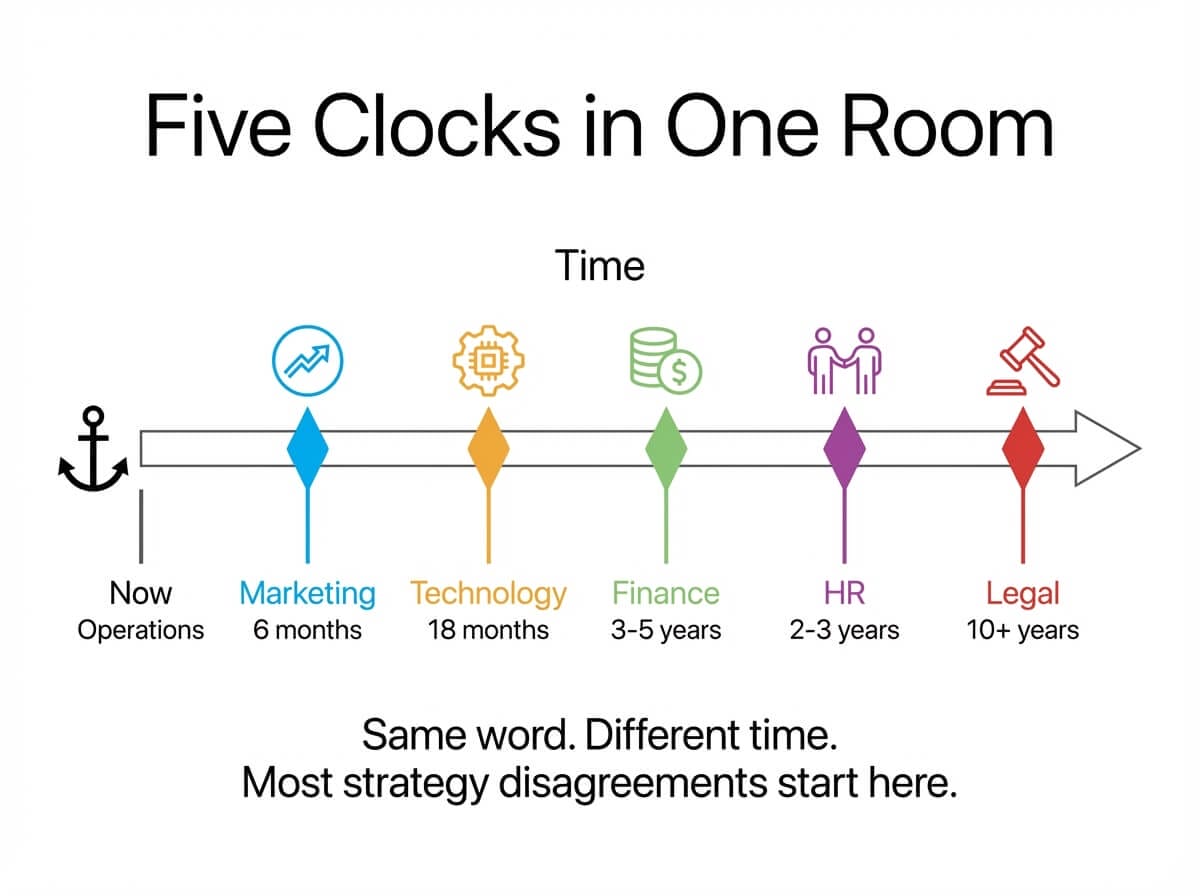
Legal: precedent, regulation, liability timelines. Decades are the natural frame. The legal formation thinks in terms of what has held up over time, what regulatory cycles are in motion, and what exposure might materialize years from now. A quarterly planning cycle feels dangerously short. Legal sees risk that will not arrive for three years. The room is planning for the next three quarters.
Marketing: campaigns, brand cycles, market windows. Six months is a long play. The marketing formation thinks in moments of attention, competitive positioning, and cultural relevance. A window that is open today may be closed next quarter. The instinct is urgency — the market does not wait for models to validate.
Operations: the current timeline. Whatever keeps the system running without disruption. The operations formation is calibrated to the present — what is working now, what is about to break, what capacity exists for the next demand. Long-term thinking is real, but it is always anchored to “what does this mean for operational continuity today?”
HR: naturally long. Culture compounds over years. Talent development takes time. The HR formation often thinks in longer horizons than anyone else at the table — but expresses it in language that does not translate to quarterly metrics. The CHRO who says “this will take two years to show results” is often right and often ignored.
Five leaders sit in the same room and say “long-term.” One means eighteen months. One means five years. One means a decade. They are not speaking the same language. They just think they are.
When Clocks Collide
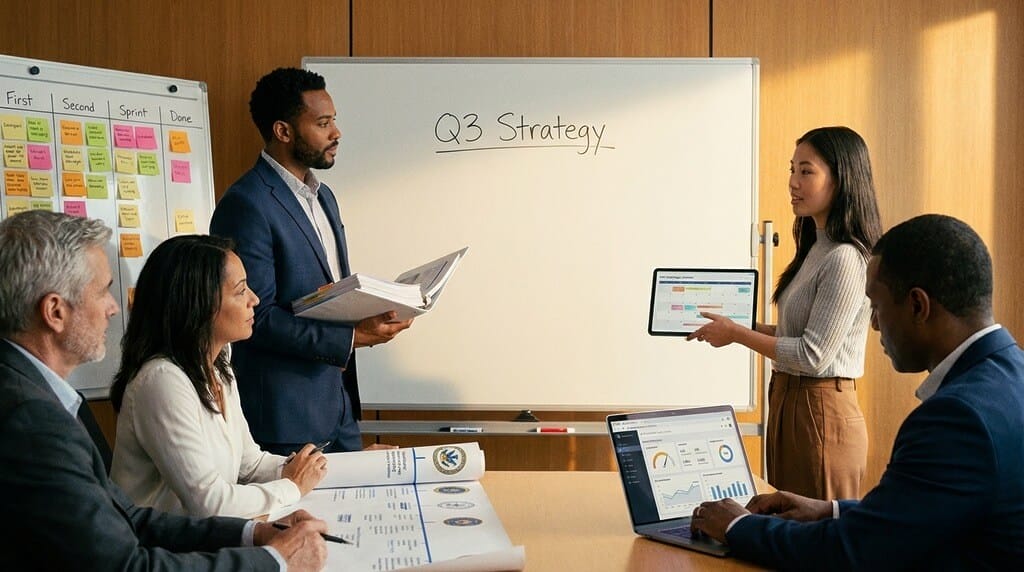
The strategy meeting. The CTO proposes a platform migration. Timeline: eighteen months. The CFO wants a five-year return model before approving the investment. The CMO needs to know how the migration will affect the next two product launches, both within six months. The COO wants to know what breaks during the transition. The GC flags regulatory implications that will not be clear for three years.
Recognize the Collision?
If your instinct about timing keeps clashing with the room, the issue may not be strategy. It may be two different clocks processing the same decision.
Every leader is being reasonable. Each is applying the time horizon their career installed. The disagreement is not about the migration. It is about which clock the decision should be evaluated on — and nobody in the room sees that the disagreement is about time rather than strategy.
The same collision happens at scale in every strategy discussion:
| Tension | Formation A’s Clock | Formation B’s Clock | What It Looks Like |
|---|---|---|---|
| CTO vs. CFO | 18-month platform cycles | 3-5 year return windows | Engineering feels blocked; finance feels rushed |
| CMO vs. Legal | 6-month campaign arcs | Multi-year regulatory cycles | Marketing feels constrained; legal feels ignored |
| COO vs. CEO | Current operational reality | Multi-year transformation vision | Ops feels destabilized; CEO feels resisted |
| CHRO vs. CFO | 2-3 year culture/talent cycles | Quarterly reporting pressure | HR cannot prove ROI on the CFO’s timeline |
Risk disagreements and time horizon disagreements often look identical. The CFO who resists a marketing investment and the CMO who resists financial analysis may both be responding to time, not risk. The CFO needs more time to validate. The CMO has less time before the window closes. Both are managing time pressure from different clocks.
The Extension Challenge
At senior levels, the role asks every leader to extend their natural time horizon. The CTO must think beyond the next platform release to the strategic arc of technology investment over three to five years. The CMO must think beyond the next campaign to the market positioning that will define the company over a decade. The COO must think beyond operational continuity to the organizational design the future strategy requires.
Extending the time horizon is not an intellectual problem. Most leaders can think longer when asked. The challenge is that the instinct — the formation-installed default — keeps pulling the leader back to their natural rhythm. The CTO who commits to a three-year strategy finds themselves re-evaluating every quarter when the technology landscape shifts. The CMO who commits to a long-term brand investment finds themselves anxious when short-term metrics dip. The instinct is not wrong. It is operating on the old clock while the role demands the new one.
The “think more strategically” feedback is often, at its core, a time horizon feedback: the room needs you to extend your planning window beyond the cycle your career installed. That extension creates the tension between instinct and vision. The instinct says “act now, validate fast.” The vision says “hold the direction, trust the longer arc.” Both are right. The question is which clock the situation requires.
What Coaching Changes
A coach who understands the time horizon formation helps the leader distinguish between formation-driven urgency and situation-driven urgency. “This feels too slow” can mean “the market is actually moving faster than our plan” or it can mean “my formation is uncomfortable with any timeline longer than eighteen months.” Both readings are valid. They lead to different responses.
The coaching question is not “How can you think longer-term?” The question is: “When you feel the pull to re-evaluate this decision, is that the situation telling you something or the clock your career installed?” That distinction — between the signal and the formation — is where the leader develops genuine strategic judgment about timing rather than either overriding their instinct or being captive to it.
The Room Needs Every Clock
The leadership team that makes the best strategic decisions is not the one where everyone thinks in the same time horizon. It is the one where every formation’s clock is recognized as a legitimate input rather than an obstruction. The CMO’s urgency catches windows the CFO’s analysis would miss. The CFO’s patience catches risks the CMO’s urgency would accept. The CHRO’s long-term perspective catches the talent and culture costs that the quarterly planning cycle ignores.
If your instinct about timing keeps colliding with the room — or if the room keeps moving at a pace that feels wrong to you — the question is not who is right about the timeline. It is whether you can see the clock your career installed and use it as one input among several, rather than as the only correct rhythm.
If that tension is active, a coach who understands your formation’s time horizon can help you hold the instinct alongside the strategic demand — so the clock serves you rather than runs you.
A Conversation About Your Formation's Clock
A 30-minute call where your coach understands the rhythm your career installed and where the role is asking for a different timeline.
Book a Free Consultation →