
The Meeting Where Nobody Speaks Your Language
You walk into the leadership team meeting for the first time. Not a department meeting. The meeting. Directors and VPs from every function, same table, same agenda, same hour on the calendar. You’ve prepared. You know your material cold. You present your recommendation the way your career trained you to present it: with data, or a prototype, or a risk analysis, or a narrative, or a process map.
And then someone from another function asks a question that makes no sense. Not because it’s a bad question. Because it comes from a world you’ve never operated in. The finance person wants numbers you didn’t bring. The tech person wants to see it working before they’ll commit. The legal person wants to know what could go wrong. The marketing person wants the story. The operations person wants to know who absorbs the downstream impact. You answer one question and three more appear, each from a different direction, each asking for something your preparation didn’t include.
Your preparation was thorough. It was also shaped entirely by the function that trained you. And in this room, your function is one voice among seven.
Nobody in that room is wrong. They are all doing exactly what their careers trained them to do. The problem is that their careers trained them to do fundamentally different things.
Key Takeaways
- Cross-functional friction is not a communication problem. It is a structural collision between professional information processing systems that each evaluate evidence, risk, and success differently.
- Every function installs a perceptual system: what you notice first, how you organize it, what counts as proof, and what you systematically miss. That system served you within your function. In a cross-functional room, it is one of many operating simultaneously.
- The collision patterns are specific and predictable. Technology and finance collide over what counts as evidence. Legal and marketing collide over time horizons. Operations and technology collide over what “speed” costs downstream.
- The room does not need everyone to speak the same language. It needs people who can see the collision for what it is and translate across the gap.
- A coach who can name the collision pattern changes the work from “how do I manage stakeholders?” to “how do I translate between two systems that each make sense on their own terms?”
Why the Room Feels Like a Foreign Country
Your function didn’t just give you expertise. It installed a perceptual system. A way of processing information that operates before you consciously think about it. What you notice first in any problem. How you organize what you notice. What counts as proof that something is true. And what you systematically miss, not because you’re careless, but because your training never pointed your attention there.
That system served you brilliantly within your function, where everyone shares it. Your engineering team processes a problem the same way you do. Your finance colleagues read a spreadsheet with the same instincts. You were swimming in water you couldn’t see because everyone around you was swimming in the same water.
In a cross-functional room, you surface. Suddenly your water is visible because the person across the table is swimming in entirely different water. And what your function did to how you think becomes the thing that puts you at odds with someone who is equally competent and equally certain.
| Function | Notices First | Organizes By | Counts As Evidence | Trained Blind Spot |
|---|---|---|---|---|
| Technology | System constraints and dependencies | Decomposing into components | A working prototype | Political and emotional dimensions |
| Finance | Cost implications and margin impact | Scenario models | Verifiable, auditable data | The emotional undercurrent their precision creates |
| Legal | Exposure and liability | Precedent-based arguments | Documented reasoning | Being experienced as obstacle-first |
| Marketing | Audience response and narrative gaps | Narrative arc | Engagement metrics and market signal | Narrative without quantification reads as speculation |
| Operations | Downstream impact and bottlenecks | End-to-end process flows | Operational data and SLA performance | Focus on “how it works” reads as resistance to change |
When the tech director says “show me the proof of concept,” she is applying her evidence standard. When the finance director responds with “show me the numbers,” he is applying his. Neither is being difficult. They are running different operating systems on the same input, and neither system recognizes the other’s output as valid.
When the marketing director says “here’s the story the market is telling us,” that sentence lands differently in every chair around the table. Finance hears unquantified assertion. Legal hears potential exposure. Operations hears a project about to land on their desk with no implementation plan. Technology hears a requirement without specifications. Each reaction is coherent within the formation that produced it. And each one is invisible to the person who triggered it.
That is why the room feels like a foreign country. Not because your colleagues are difficult. Because every person in that room is processing the same information through a perceptual system the others cannot see.
The Collision Patterns You’ll See Every Week
The friction in cross-functional rooms is not random. It follows patterns so consistent you could set your calendar by them. Once you see the structure, you stop interpreting each disagreement as a personality clash and start recognizing it as two professional formations doing their jobs simultaneously.
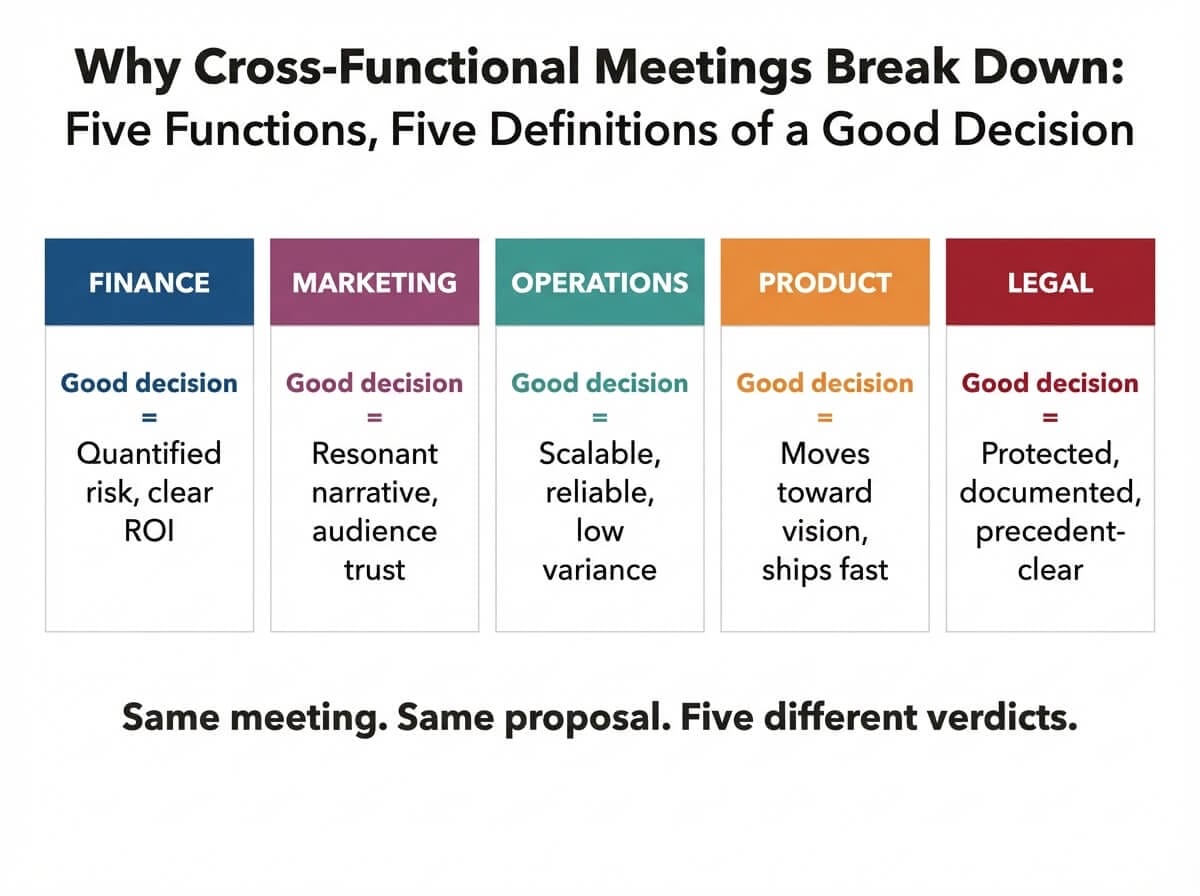
Build vs. Prove (Technology × Finance). The tech director sees a three-year platform bet. The architecture is sound. The investment will compound. But the return is indirect, distributed across systems that don’t show up on a single line item. The finance director sees unquantified risk on a fiscal timeline. “If you can’t model the return, how do you know it’s real?” The collision is not about the budget. It is about what counts as sufficient evidence to invest. One formation trusts what works. The other trusts what’s modeled. They will keep having the same argument until someone names the actual gap: two evidence standards processing the same proposal in fundamentally incompatible ways.
Precision vs. Simplification (Technology × Marketing). When marketing simplifies the technical story for the audience, the tech director experiences it as distortion. When tech insists on precision, the marketing director experiences it as missing the point entirely. The collision lives in a sentence: one formation’s simplification is another formation’s lie. Marketing needs clarity to connect. Technology needs accuracy to be credible. Neither can give the other what they want without betraying what their own formation considers non-negotiable.
One formation’s simplification is another formation’s lie. And both of them are right.
Caution vs. Boldness (Legal × Marketing). Every claim becomes a negotiation between audience connection and risk exposure. But the deepest collision is temporal. Marketing operates in days to months. The campaign window opens and closes. Legal evaluates consequences over years to decades. One regulatory action, one class action, one reputational crisis outlives a hundred campaigns. What marketing experiences as legal “slowing things down,” legal experiences as marketing “creating liability that someone else will have to clean up long after the campaign is forgotten.” The widest time-horizon gap of any pairing in the room.
Stability vs. Iteration (Operations × Technology). Technology iterates fast and tolerates breakage. Ship, learn, adjust. Operations optimizes for reliability. Uptime. SLAs. The promise that the system works the same way at 3 a.m. on a Sunday as it does during a Tuesday demo. Every deployment, every product pivot, every “move fast and learn” decision lands on operations’ desk as downstream chaos. What technology experiences as adaptive speed, operations experiences as someone else’s experiment conducted on their infrastructure.
None of these collisions are bad. The friction is structural, not personal. Two professional formations doing exactly what they were designed to do, in the same room, at the same time. The first step to navigating it is seeing it for what it is.
What Each Side Experiences That the Other Side Can’t See
The collision patterns are easier to name than to navigate, because each side has an internal experience that is invisible to the other. Knowing the pattern exists is one thing. Seeing what it feels like from both chairs is where the real shift happens.
In the Build vs. Prove collision. The tech director is thinking: “This investment will pay off in three years. The architecture is sound. The ROI is real but indirect. Why can’t they see it?” The finance director is thinking: “If you can’t model the return, how do you know it’s real? Every unquantified bet is a liability I’m accountable for. Why won’t they build the business case?” Both are doing their job. Neither is wrong. The collision exists because one formation’s evidence (a working prototype, an architectural plan) is invisible to the other formation’s evidence standard (modeled returns, quantified risk).
In the Caution vs. Boldness collision. The marketing director is thinking: “The market window is closing. If we don’t move now, the competitor gets there first. Legal is killing the momentum.” The legal director is thinking: “This claim creates exposure we’ll be managing for years. One regulatory action will cost more than the campaign will ever earn.” Both are right. Marketing’s career reads market windows in weeks. Legal’s career reads liability timelines in decades. They are not disagreeing about the decision. They are disagreeing about the relevant time horizon for evaluating it.
In the Stability vs. Iteration collision. The tech director is thinking: “We need to ship, learn, and iterate. Speed is how we find the right answer.” The operations director is thinking: “Every time they ship fast, we absorb the downstream chaos. They iterate. We clean up. And when the system goes down at 2 a.m., it’s our SLA on the line, not theirs.” Technology gets to experiment. Operations gets to deal with the consequences. That asymmetry is invisible to the side that doesn’t bear the operational cost.
The frustration in each of these collisions is real. And it is almost never about the other person being unreasonable. It is about two people whose careers installed fundamentally different systems for evaluating what matters, each system invisible to the other, both operating at full power in the same room.
What Changes When Your Coach Gets This
Consider a technology director who tells her coach: “The finance team keeps blocking our infrastructure investment.”
See How Tandem Coaches Differently
Our approach starts with understanding the functional formations in your room. Not communication style assessments. Not generic collaboration frameworks. The actual formation gaps driving the friction you’re experiencing.
A generic coach hears a stakeholder management problem. How to build a better business case. How to communicate ROI to non-technical stakeholders. How to influence the CFO. All reasonable. All missing the structural collision underneath.
A coach who understands what professional careers actually install hears the Build vs. Prove collision. “You’re presenting an architectural plan. They want a financial model. You’re offering evidence in your career’s currency. They need evidence in theirs. This isn’t a communication problem. It’s two professional information processing systems that evaluate evidence differently. The tech career trusts what works. The finance career trusts what’s modeled. The question isn’t how to build a better business case. It’s whether you can translate your conviction into their evidence language without losing the insight your own training provides.”
That reframe shifts the work from tactical (better slides, better numbers) to structural (understanding the evidence collision and learning to translate across it). The technology director stops trying to “win” the budget argument and starts learning to operate in two currencies simultaneously.
The coaching work is translation fluency, not persuasion technique. The goal is not to “get better at presenting to finance.” It is to understand why your evidence and their evidence look like different things, and to learn to bridge that gap without abandoning what your own training taught you to see.
Or consider an operations director who tells his coach: “Nobody thinks about implementation until it’s too late.”
A generic coach validates the frustration. “You’re right. Implementation gets undervalued. Let’s work on making your voice heard earlier in the process.” Supportive. Also incomplete.
A coach who understands what an operations career installs adds a layer the client cannot see on their own: “Your career trained you to see process dependencies and downstream consequences. That’s real. You see things the room misses. But your career also has a trained blind spot: the room sometimes experiences your focus on how things work as resistance to how things could change. You’re seen as the person who says ‘that won’t work’ rather than the person who says ‘here’s how it could work.’ The collision isn’t just that they ignore implementation. It’s that your career’s way of presenting implementation concerns reads as ‘no’ when you mean ‘not yet’ or ‘not like that.’”
That reframe doesn’t dismiss the operations director’s insight. It adds the dimension his career systematically trained him not to see: how his contribution is experienced by other formations in the room. The work shifts from advocacy (make your voice louder) to translation (make your signal readable to people running different operating systems).
The patterns in this article connect to several related dynamics across careers and levels: why risk means something different in every function in the room, why functions keep solving different versions of the same problem, and when formation clash is the meeting dynamic.
The Room Doesn’t Need a Common Language. It Needs Translators.
The cross-functional meeting will never feel comfortable. The finance person will always want numbers. The tech person will always want to see it working. The legal person will always want the risk analysis. The operations person will always want to know who absorbs the downstream impact. That is not dysfunction. That is a room full of well-trained professionals doing exactly what their careers built them to do.
The room does not need everyone to speak the same language. It needs people who can see the collision for what it is: two or three professional perceptual systems doing their jobs in the same room. People who can hear the finance director ask for data and recognize it as an evidence standard, not an attack. People who can hear the tech director push for a prototype and recognize it as a trust currency, not stubbornness. People who can translate across the gap without erasing the value that each career installed.
The advantage nobody teaches is not how to win the cross-functional argument. It is seeing that the argument itself is two careers talking past each other, and knowing how to translate between them.
That skill is not taught in any leadership program. It is not listed in any competency model. It is what changes when someone helps you see not just the patterns your own career installed, but the ones sitting across the table. If that distinction resonates, here is what that conversation looks like.
A Conversation About the Rooms Where Nobody Speaks Your Language
A 30-minute call where your coach already understands cross-functional friction—not as a personality problem but as a formation problem. No assessment. No intake form. Just a conversation that starts with the specific room you’re trying to navigate.
Book a Free Consultation →