Workplace Wellness Audit
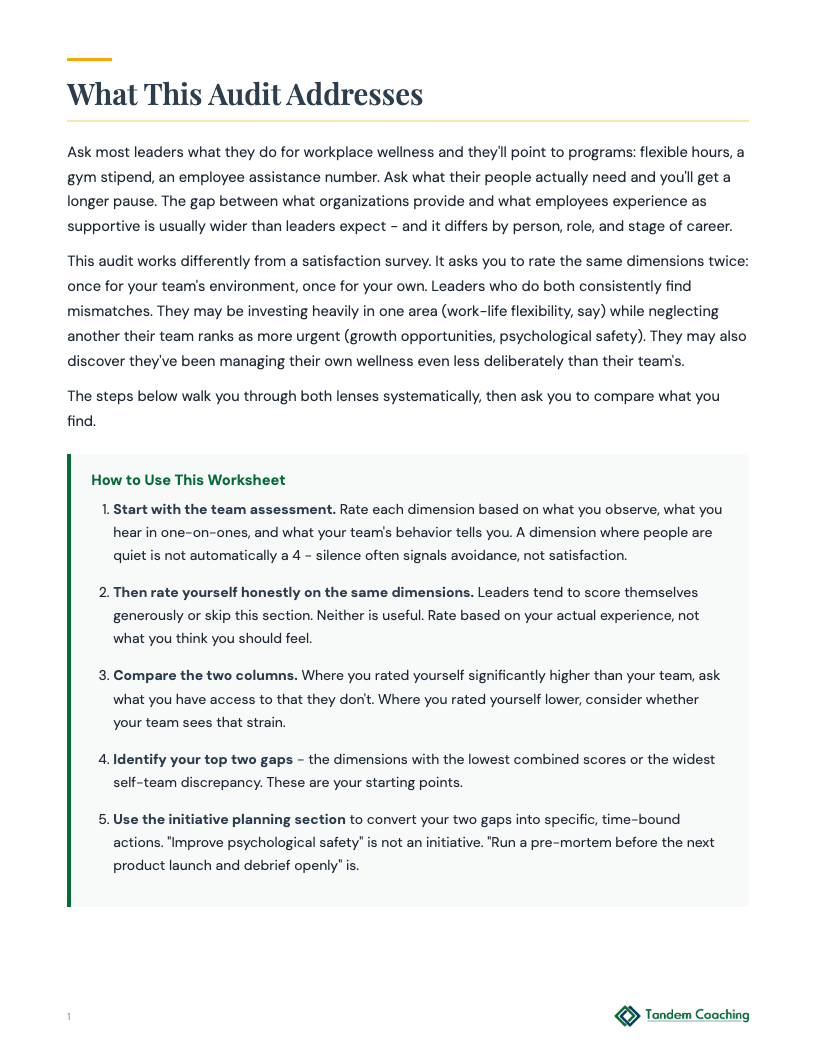
Pinpoint team wellbeing gaps with a structured, executive-ready audit based on evidence-informed wellness and engagement indicators.
Get This Tool
Free, print-ready PDF.
When to Use This Tool
A client is responsible for team wellbeing and wants to understand where the gaps are
A client senses burnout risk on their team but hasn't named what's driving it
A client wants to build a wellness initiative but doesn't know where to start
How to Introduce This Tool Plus
When you completed both the team and self-assessment columns, where did you notice the biggest gap between what your team needs and what you're currently providing?
Browse All Pages
Tool Classification
Domain
Executive
Type
Assessment
Phase
Discovery
Action
Details
30 min
Between sessions
Monthly
Topics
Self-Care
Leadership
For the Coaching Practitioner
Plus
Coaching Scenarios
Plus
1 The VP who runs wellness initiatives while burning out her own team ▶
Context
A 45-year-old VP of people operations at a mid-sized software company launched a team wellness program six months ago: a wellness stipend, flexible Fridays, and a mental health app subscription. The program looks good in the leadership deck. Her team's engagement scores have dropped two quarters in a row. Two senior ICs gave exit interview feedback about 'toxic pace.' She came to coaching after the second exit, describing herself as 'very committed to team well-being.' The Workplace Wellness Audit has both a team-rating column and a self-rating column — the gap between them is where the coaching work lives.
How to Introduce
Frame the dual-column structure explicitly. 'This tool rates eight wellness dimensions twice — once for what your team is experiencing, and once for what you personally experience at work. The interesting data is usually in the gap between those two columns, not in either column alone.' The resistance this scenario invites is narrative protection: she has built an identity around caring for her team, and this tool may challenge it. Don't soften the frame, but don't lead with confrontation: 'The goal is to see what your team needs and what you're currently providing — and whether those match.'
What to Watch For
Watch for the team-rating column to score lower than her self-rating column across most dimensions — especially Work-Life Balance and Psychological Safety. If she rates team Work-Life Balance at a 5 but her own at a 7, she is describing a two-tier system she may not have made explicit. Also watch for Psychological Safety to receive a team score below 6: if her team doesn't feel safe raising concerns, the wellness initiatives she's implemented may be received with skepticism rather than relief. The gap between intent and impact is often visible here.
Debrief
Start with the gap column. 'Where are the largest differences between what your team is experiencing and what you're experiencing? What does that tell you?' Then go specific: 'You rated your team's Work-Life Balance at [score]. If I asked three of your direct reports to fill out this same column right now, do you think they'd agree?' The external-perspective question tests whether her ratings are observations or projections. Close with: 'Your team's engagement scores dropped while you were running a wellness program. Looking at this audit, what might explain that?'
Flags
- Moderate
Client rates her team's Psychological Safety above 7 while having received recent exit interview feedback specifically about team culture or leadership style. The gap between her perception and the exit data indicates a significant blind spot — she may not have access to what her team actually experiences when she's the subject of the feedback.
Response: Continue with adjustment — don't challenge the score directly in the moment. Ask: 'What would your team have said about Psychological Safety in the exit interviews?' If she says she doesn't know or that the feedback was about something else, surface the connection gently: 'Psychological safety is specifically about whether people feel they can raise concerns to leadership. I want to make sure the rating in this column reflects what your team experiences, not just what you intend.' Consider whether a 360 or structured team listening session is the right next step.
2 The operations director who suspects his team is close to breaking but hasn't named it ▶
Context
A 52-year-old director of operations at a logistics company has managed the same team of fourteen through a period of significant org disruption — two layoffs, a leadership change, and a system migration — over the past eighteen months. He describes his team as 'hanging in there.' He's been carrying a private worry that he hasn't surfaced in coaching until last session, when he said 'I think some people are closer to quitting than I'm seeing.' The Workplace Wellness Audit gives him a structured format for rating what his team is actually experiencing across eight dimensions — and for naming what he's been holding privately.
How to Introduce
This tool is assigned for between-session completion, so the introduction is about framing it as a diagnostic rather than a performance review. 'I want you to complete this as honestly as you can — both the team column and the self column. The team column should reflect your genuine read of what your people are experiencing, not your hope or your performance review template. If you think someone is close to burnout, this is where to put that.' The self-column matters here too: directors who are carrying significant organizational anxiety often deprioritize their own wellness while focusing on their team's.
What to Watch For
Watch for his team-rating column to reflect the actual disruption the team has been through — if it's uniformly moderate (5-6 across all dimensions), he may be averaging rather than differentiating. Some people on his team may be at 3 and others at 7; the average conceals the risk. Also watch for his self-column: if his own ratings are also low, the coaching work is both about his team and about his own sustainability in this role. Directors who deplete themselves in high-disruption periods often don't notice until they've hit a hard limit.
Debrief
Start with the team column. 'Walk me through what you wrote for each dimension and what was in your mind when you wrote it.' Then go to his self-column: 'You rated your own [lowest dimension] at [score]. That's the same thing you're worried about in your team. What's the connection?' The parallel is often the most useful data point. Close with: 'Based on this audit, if you had to identify the one person on your team at highest risk right now, who would it be — and what's your plan?'
Flags
- Moderate
Client's team audit shows scores below 5 across Work-Life Balance, Psychological Safety, and Purpose/Meaning simultaneously — three dimensions that together describe a team that is overloaded, afraid to speak, and disconnected from why the work matters. This pattern is a burnout cluster and a retention risk cluster at the same time.
Response: Continue with urgency — this needs to be addressed in the current session, not deferred. Ask: 'If these three scores are accurate, what's your timeline for intervening? And what would intervention actually look like for your team?' If he doesn't have an answer, help him build a short-term listening plan — not a wellness initiative, but direct conversations with the two or three people he's most worried about.
3 The team lead building a wellness initiative without knowing what her team actually needs ▶
Context
A 36-year-old team lead in a fintech compliance department has been asked by her director to 'do something about team morale.' She has good intentions and a small discretionary budget. She came to coaching partially to think through the initiative. She has been planning: a team lunch, a learning budget, a Friday 'fun' event. She has not asked her team what they need. The Workplace Wellness Audit — completed from her perspective of the team — will surface whether her assumptions about what her team is experiencing match what she's observed.
How to Introduce
Frame this as the diagnostic step before the planning step. 'Before you build the initiative, it's worth being clear on what problem you're solving. This tool rates eight wellness dimensions from your perspective of the team. Completing it before you design anything will tell us whether a team lunch addresses the actual gap — or whether it's a solution looking for a problem.' The framing should feel practical rather than critical: she's done the right instinct, which is to take action, but the action needs to be grounded in an accurate diagnosis.
What to Watch For
Watch for her to rate Physical Environment and Work-Life Balance as moderate-to-good while rating Psychological Safety as low. If the team doesn't feel safe raising concerns, a fun event won't move the underlying problem. Also watch for the gap between what she's planned (social/fun interventions) and the dimensions that score lowest — if Purpose/Meaning and Psychological Safety are the low scores, team lunches address neither. The planning-problem alignment gap is what this audit surfaces.
Debrief
Start with what she learned. 'Looking at your ratings across eight dimensions, where are the genuine gaps in your team's wellness right now?' Then: 'The interventions you've been planning — a team lunch, a learning budget, a fun event. Which of those directly addresses the lowest-scoring dimensions?' If there's a mismatch, name it without invalidating her effort: 'The instinct to do something is right. The question is whether what you're planning addresses what you're actually seeing.' Close with: 'What's one thing you could do — within your current budget and authority — that would directly address [the lowest dimension]?'
Flags
- Low
Client has completed the team-rating column based on assumptions rather than observation, and acknowledges she hasn't had direct conversations with her team about their experience in several months. The audit is a guess rather than an assessment.
Response: Continue — but name the data quality limitation. 'These ratings are your best read from the outside. Before we act on them, it might be worth checking them against what your team would say. What's the simplest way you could ask two or three people how they're actually doing — not in a formal way, just a real question?' That moves her from assumption to inquiry before the initiative is designed.
Tool Flow
Plus
Requires
- direct team observation data from one-on-ones
- leader self-awareness of their own work experience
→
Produces
- dual-rated team and self wellness scores across eight dimensions
- gap analysis table with discrepancy flags
- two prioritized wellness initiatives with time-bound actions
Pairs Well With
Executive
Energy Context Reflection
A client wants to use Energy Context Reflection as an optional reflection
Why it pairsAfter flagging wellness gaps across the team, use this to trace whether the leader's own energy depletion is shaping the conditions they rated.
LifeLeadership Interaction Context Reflection
Use this assessment to take stock of emotions and self care before the client chooses what deserves attention.
Why it pairsThe gap analysis often reveals a leader whose team perception diverges from reality - this surfaces whether low EQ is driving that blind spot.
ExecutiveBusiness Future Context and Options
Use this worksheet to explore leadership and creativity and turn the client’s observations into one optional next step.
Why it pairsOnce the client sees wellness initiatives require sustained attention, this tests whether the five-year plan has room for team health as a structural priority.
Related Articles


Executive Productivity Audit: The 7-Day Assessment Tool
Read article →
Executive Burnout Coaching: What Happens Inside the Room
Read article →
Executive Presence in Virtual Meetings: Where the Gaps Get Harder
Read article →
Executive Presence Assessment: How to Measure the Gap
Read article →