Pinpoint the wellness factors behind persistent dissatisfaction using a structured self-rating backed by validated well-being domains.
Free, print-ready PDF.
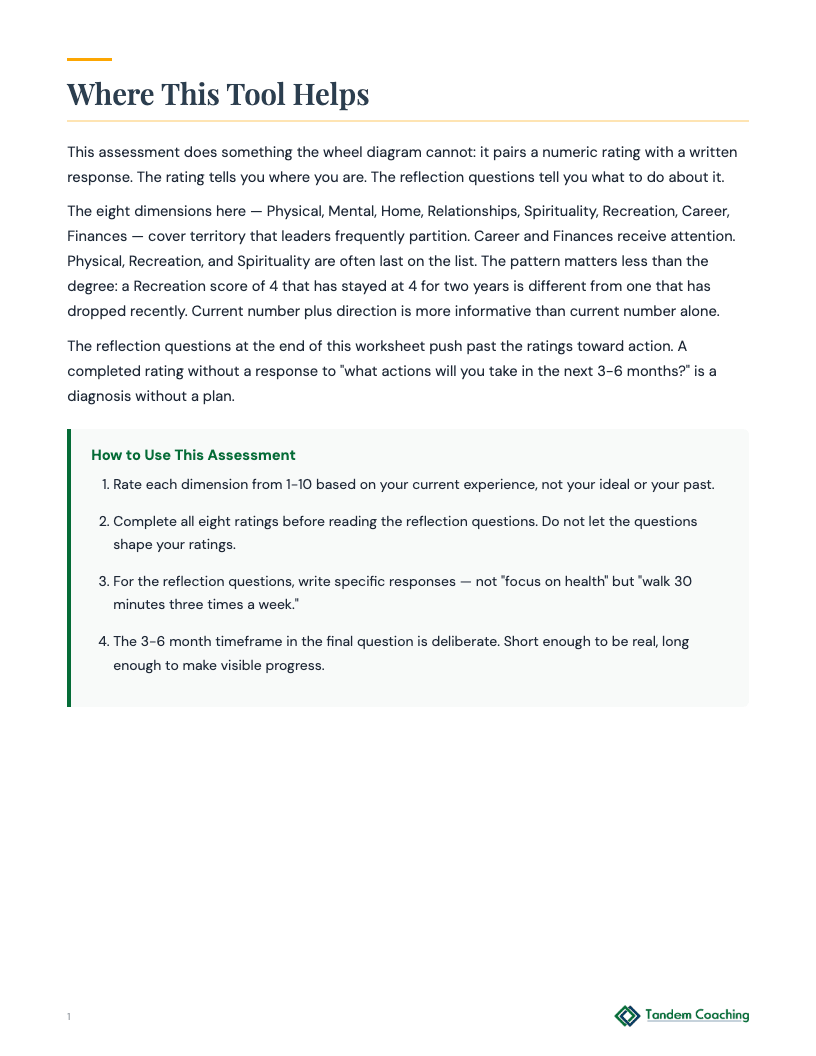
There's an eight-dimension wellness rating that pairs a number with reflection questions — so you get both where you are and what to do about it. Would it be useful to complete it as a starting point?
A 36-year-old director of strategy at a mid-size consulting firm wants to move into non-profit leadership. She has a financially demanding life — mortgage, two kids, aging parents. She's been in coaching for six weeks and keeps circling between 'I should make the move' and 'I can't afford to.' She has framed this as a binary: meaningful work or financial security. The venn diagram format surfaces whether the two circles overlap — and if so, where.
Frame this as a mapping tool rather than a values clarification. 'We've been going back and forth between these two things. Let's put them in a diagram and see if there's an intersection we haven't found yet.' The resistance this scenario invites is binary thinking — she may resist the center circle as a category because she's convinced no overlap exists. Name it directly: 'You may be right that there's no center. Let's find out together rather than assume.'
If she populates the outer circles fully but the center circle stays empty or contains vague items ('work I care about'), she's not yet seeing the intersection. The center should be specific roles, functions, or contexts — not qualities. Also watch for items that appear in one circle that logically belong in the center: if 'using my strategy skills' is in the 'what I do well' circle and 'strategy for mission-driven orgs' is in the 'what I want' circle, those belong together in the center.
Start with the center. 'What's in the intersection?' If it's thin, go to each outer circle and ask: 'What from this circle could belong in the center if the conditions were right?' That moves from fixed categories to possible overlaps. Then: 'What role or type of work would put three things from your center circles into the same job?' Don't reach for a decision. The diagram is a clarifying tool, not a career counseling tool.
Array
A 49-year-old COO at a manufacturing company has been in his current role for twelve years. He's technically excellent but describes his work with no energy. He came to coaching after his youngest child left for college, creating space he's now noticed is entirely empty. He doesn't know what he's passionate about anymore. The venn diagram format will map whether his skills, passions, and current role align — and surface whether the dissatisfaction is structural.
This tool needs a light framing to land well with a COO who is data-oriented. 'We're going to map three circles: what you're good at, what you'd do even if no one paid you, and what you're currently doing in your role. The interesting part is what lives at the center and what doesn't.' Expect some resistance to the 'passionate about' circle — someone whose passion has been dormant may say they don't know what to put there. Have a prompt ready: 'What did you used to do before work took over that you never returned to?'
If the 'current role' circle has minimal overlap with either of the other two, the mismatch is deep. If his skills circle and his passion circle do overlap but neither intersects with current role, the coaching work is about change rather than adjustment. Watch for him to resist populating the passion circle by reframing everything as competence ('I'm good at problem-solving, not passionate about it'). That conflation is a data point.
Start with the overlap between skills and passions, before introducing the current role circle. 'What lives in this intersection for you?' Then bring in the third circle: 'How much of your current role falls inside this overlap?' If the answer is 'very little,' name what you're both looking at: 'So for twelve years you've been doing work that uses your skills but doesn't connect to what you care about. What's kept that sustainable?' That question surfaces the motivator that has substituted for purpose.
Array
A 33-year-old investment banker is two years from making MD. Her family emigrated when she was eight. She's been the family success story since she was a teenager. She's good at her work, earns exceptionally well, and is miserable. She hasn't said the word miserable — she says she's 'tired' and 'looking for more challenge.' The venn diagram will surface whether the intersection of her skills, passions, and current role is as full as she's presenting it to be.
The framing matters more here than with most clients. Don't lead with 'let's see if you're in the right role' — that question carries too much weight given her context. Instead: 'This is a mapping tool. We're going to see where your three circles sit relative to each other. There's no right answer, just a picture.' The resistance this scenario invites is self-silencing — she may populate the diagram to reflect the narrative she's allowed herself to tell, not the one she actually lives. The 'passion' circle is where that tension will be most visible.
If her passion circle is populated with finance-adjacent items that sound like they came from a recruiting pitch ('market complexity,' 'capital allocation'), probe for what she actually does in her free time and how her voice changes when she talks about it. The tell is usually in the energy shift when she accidentally mentions something outside finance — a side project, a volunteering context, a skill she's developed for no career reason. Watch whether those items make it onto the diagram or get dismissed as 'not relevant.'
Start with the passion circle specifically. 'Read me what you put here.' Then: 'Which of these items did you do in the last two months, purely because you wanted to?' If the answer is none, the circle is aspirational. Then ask: 'If none of your family knew what you were doing, what would you put in the passion circle?' That removes the audience from the exercise and tends to reveal the real content.
Array
A client hasn't set goals across all areas of their life — just the loudest one
WellnessClient is performing in multiple life areas but feels an undefined sense of imbalance or emptiness
WellnessClient has a vague sense of needing to take better care of themselves but hasn't defined what that means across different dimensions
Step 1 of 6 in Client rates their life highly overall but can't explain why they feel persistently dissatisfied
Next: Goal Clarity Worksheet → Explore all pathways →