Urge Surfing Practice Sheet
A quick, evidence-based worksheet to help ADHD adults notice urges and pause before reacting, reducing impulsive choices in the moment.
Get This Tool
Free, print-ready PDF.
When to Use This Tool
ADHD adult who acts on impulse before thinking and wants to practice pausing before reacting
A client who struggles to sit with discomfort without immediately reaching for their phone
Person who has tried urge-surfing in session and wants a practice sheet to use independently
How to Introduce This Tool Plus
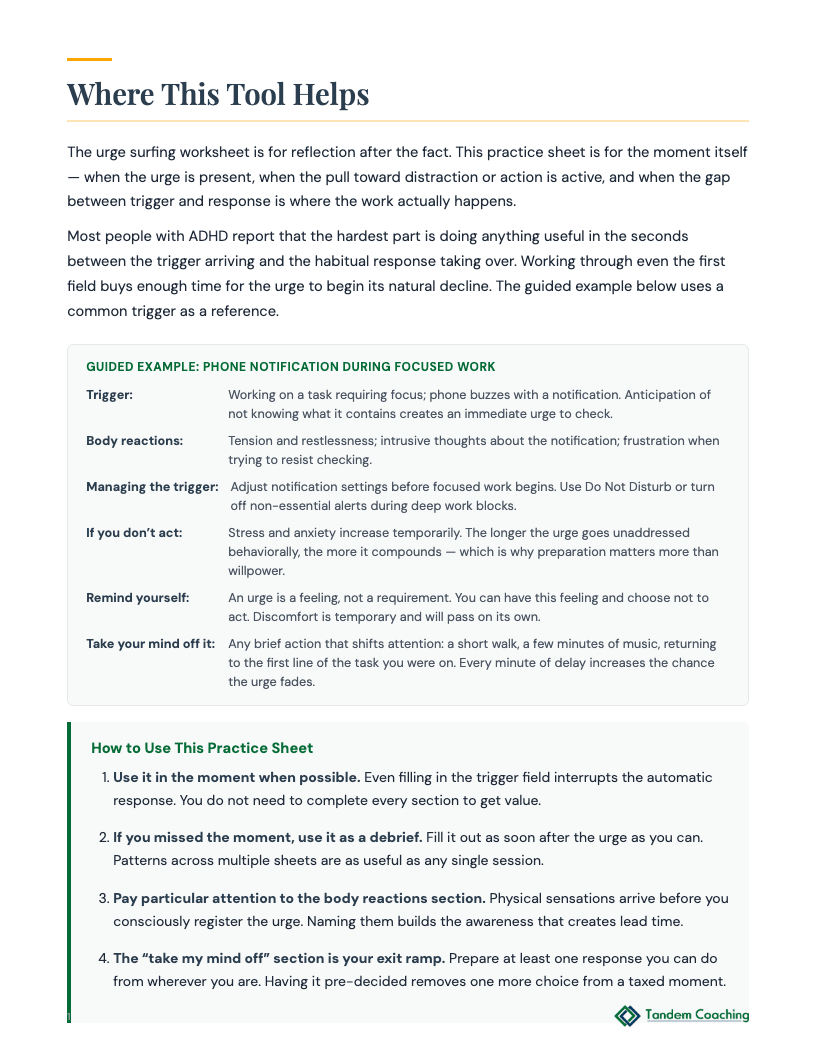
Before the urge, there's always a physical signal. This sheet maps that sequence in real time - what you notice in your body, how intense it is, and what happened when you surfed it rather than acted on it.
Coaching Tool Disclaimer
This tool is designed for coaching contexts, not clinical use. If you or your client is in crisis, contact the 988 Suicide and Crisis Lifeline (call or text 988) or Crisis Text Line (text HOME to 741741).
Browse All Pages
Tool Classification
Domain
ADHD
Type
Worksheet
Phase
Action
Reflection
Details
15 min
Between sessions
As-needed
Topics
Habits
Executive Function
Mindset
For the Coaching Practitioner
Plus
Coaching Scenarios
Plus
1 Building an In-Moment Interrupt for Digital Distraction ▶
Context
A client with ADHD who is a senior software engineer works in deep focus blocks but describes losing them to phone notifications every thirty to forty-five minutes. She has tried turning off notifications, app blockers, and putting her phone in another room - each intervention lasted less than a week before reverting. She can name the pattern in retrospect but cannot interrupt it in the moment. The urge surfing practice sheet is the first tool that addresses the gap between trigger arrival and habitual response rather than trying to remove the trigger entirely.
How to Introduce
Distinguish this from the urge surfing worksheet she may have seen: 'This is the in-moment version. The worksheet we've used before is for reflection after the fact. This one is for the thirty seconds between your phone buzzing and your hand moving toward it. The only goal is to fill in the trigger line before you decide whether to check. Just that - the first field. You don't have to complete the whole sheet in the moment.' That minimal entry point - one line during the urge - is enough to interrupt the automatic response for many clients. The rest can be filled in as a debrief immediately after.
What to Watch For
Watch for the client using the sheet as a post-hoc log rather than an in-moment tool. The debrief version is valuable, but it doesn't build the interrupt. Ask: 'When you filled this in - were you writing it while the urge was happening, or after?' If the answer is 'after,' ask what it would take to have the sheet within arm's reach during her focus blocks. Also watch for the 'I can take my mind off it by' section listing strategies that are more engaging than the original urge - 'take a short walk' for a five-minute urge sometimes becomes a fifteen-minute walk. The exit ramp should be brief enough that it doesn't consume more time than the distraction would have.
Debrief
Start with the body reactions section: 'What did you write about what you noticed physically before you picked up your phone?' The physical signal is almost always present before the cognitive decision to check, and naming it is the first step toward using it as an early warning. Then look at the 'remind myself' section: 'You wrote that you reminded yourself the urge is temporary. Did that land in the moment, or did you write it as something you thought you should say?' The distinction between recalled self-talk and genuine in-moment reframing tells you whether the tool is reaching the behavior or remaining cognitive.
Flags
- Moderate
Client describes urges to check her phone as occurring every five to ten minutes regardless of task type or context, and she reports feeling physically agitated when access to her phone is restricted even briefly in situations where she knows it is appropriate (meetings, family events)
Response: Urges at that frequency and intensity combined with physical agitation during phone restriction may warrant a conversation about screen use beyond behavioral coaching: 'The pattern you're describing - every five to ten minutes, physical agitation with restriction - is on a different scale from typical distraction. That level of intensity is worth mentioning to your physician or a therapist who works with behavioral compulsions. It's not that coaching can't help with the behavioral structure - it can - but the intensity of what you're describing may have a clinical dimension worth evaluating.'
2 EF-Interaction: Pre-Deciding the Exit Ramp Before It's Needed ▶
Context
A client with ADHD who is a management consultant has been using the urge surfing practice sheet for two weeks with mixed results. He completes the tool accurately during low-intensity urges but abandons it during high-intensity ones. He reports that when the urge is strong, he cannot access any of the sheet's content because his working memory is consumed by the urge itself. The coaching focus is on building one specific pre-decided response that requires no working memory retrieval in the high-intensity moment.
How to Introduce
Name the working memory failure explicitly: 'High-intensity urges consume the working memory you would normally use to access the sheet's strategies. You know what to do when you're calm; you can't retrieve it when you're activated. The fix is to pre-decide one exit ramp - not in the moment, but right now, in this session - for the specific trigger that produces your strongest urges.' Walk through the 'I can take my mind off it by' section in session, not as a worksheet exercise but as a pre-commitment. Write down one specific action, timed (two minutes), that he can execute from wherever he typically is when the high-intensity urge hits. That action gets written on a physical card or phone note labeled with the trigger name.
What to Watch For
Watch for the pre-decided exit ramp being too elaborate or requiring too many decisions to execute. 'Go outside for a walk and listen to music' requires finding headphones, deciding where to walk, and transitioning environments - too many steps for a high-activation moment. The effective exit ramp for high-intensity moments is a single, immediate action that can be initiated without leaving the current location. Also watch for the client revising his pre-decided exit ramp week to week rather than practicing one consistently long enough to make it automatic. Novelty-seeking is an ADHD trap in behavior change work - the new strategy feels promising but never becomes habit.
Debrief
After one week of using the pre-decided exit ramp: 'How many times did you reach for the card or phone note during a high-intensity urge?' The consultation rate is more important than the success rate in the first week. If he is not consulting the pre-decided response, ask where it is physically located - the inaccessibility of the cue may be the barrier. Then ask: 'On the times you did use it - what happened to the urge intensity?' The reported trajectory (urge subsided, urge stayed high, urge redirected) calibrates whether this specific exit ramp is the right one for this specific trigger.
Flags
- Moderate
Client describes his highest-intensity urges as occurring in interpersonal contexts - an urge to interrupt, to leave a conversation, to say something reactive - rather than digital contexts, and these urges have resulted in professional feedback about his impulsivity
Response: When urge surfing practice is being applied to impulse control in interpersonal professional contexts - particularly with a feedback trail about impulsivity - the behavioral coaching tool is appropriate but should be situated in a broader conversation: 'The sheet works the same way for interpersonal impulses as it does for digital ones. I also want to name that the feedback you've received about this is professional-stakes territory. Are you working with anyone clinically around the impulsivity? Some of what you're describing - particularly the high-intensity interpersonal urges - can benefit from clinical support alongside the behavioral practice we're doing.'
3 Mapping the Physical Signal That Arrives Before the Urge ▶
Context
A client with ADHD who is a communications director has completed the urge surfing worksheet (the reflective version) twice and has good retrospective awareness of her trigger-urge-behavior sequence. She wants to move from retrospective recognition to real-time awareness, which requires identifying the physical sensation that signals an urge is incoming - before she has already acted. The practice sheet's body reactions section is the mechanism for building that earlier detection.
How to Introduce
Frame the body reactions section as the real objective of this tool: 'The rest of the sheet is useful, but for you the target is that second section - the body reactions. You've already mapped the sequence after the fact. What we don't have yet is the physical signal that tells you the urge is about to arrive. That signal exists and it's always there; most people just don't notice it until the urge is already running. This week, your job is to fill in the body reactions section at the earliest possible moment - not when you're fighting the urge but when you first feel anything shift.' That specific instruction orients her toward earlier detection.
What to Watch For
Watch for the body reactions section being filled with cognitive content ('I was thinking about X, I was worried about Y') rather than physical sensations. Redirect toward the body: 'You described what you were thinking. What were you noticing physically - in your chest, your shoulders, your hands, anywhere?' If she has difficulty accessing physical sensations, the body-awareness practice is earlier in the sequence than the tool itself can address. Also watch for the 'remind myself' section becoming a mantra she recites without it affecting anything - 'I remind myself urges are natural' written and then the urge acted on anyway. The mantra content is less important than whether it creates a gap.
Debrief
Read the body reactions entries across multiple completed sheets: 'What do you notice across all of these? Is there a consistent physical pattern - the same location, the same type of sensation - that precedes the urge?' Most clients with ADHD discover that their physical urge signal is consistent even when their triggers vary. Once that consistent signal is named, it becomes the real interrupt cue: not 'the phone buzzed' but 'my chest tightened' - which happens a few seconds before the hand reaches for the phone. That earlier detection point is where behavioral intervention has the most leverage.
Flags
- Low
Client cannot identify any physical sensations associated with urges even after multiple completed sheets, reporting that she goes directly from 'nothing' to 'already acted' with no perceived interval, and this is consistent across multiple trigger types
Response: Consistent inability to access the interval between trigger and response, combined with no reportable physical sensations, may indicate a low interoceptive awareness that behavioral self-monitoring tools cannot directly address: 'What you're describing - going from nothing to done with no detectable interval - is actually a pattern some people experience, and it's not a failure to pay attention. Interoceptive awareness (noticing body signals) varies a lot between people. A mindfulness-based approach or somatic practice, sometimes developed with a therapist, can build that awareness specifically. It might be a useful complement to the behavioral work we're doing here.'
Tool Flow
Plus
Requires
- identified high-risk trigger patterns
→
Produces
- in-moment urge trigger record with body reactions
- prepared exit-ramp response list for known triggers
- debrief pattern log across multiple urge episodes
Pairs Well With
ADHD
Attention Context Log
Use this tracker to notice patterns in executive function and habits over time before drawing conclusions.
Why it pairsOnce your client has a body-level urge log, this tracker adds time cost and frequency data across the full workday.
ADHDOptional Screen Use Context Log
Use this tracker to notice patterns in habits and time management over time before drawing conclusions.
Why it pairsUse this to show whether urge surfing practice is actually reducing unintentional scrolling episodes over time.
ADHDWork Habits Reflection
A client wants to use Work Habits Reflection as an optional reflection
Why it pairsThe urge log reveals one EF gap; this assessment shows whether impulse control is isolated or part of a broader pattern.
This tool is part of a coaching pathway
Step 4 of 6 in A client acts on digital impulses before they've had a chance to notice and choose
Use after Emotional Regulation Toolkit. Then continue with Check the Facts Worksheet if that next job fits.
Next: Check the Facts Worksheet → Explore all pathways →Related Articles


Coaching Session Blueprints: What ADHD-Informed Executive Coaching Really Looks Like
Read article →
Remote vs In-Person ADHD Coaching: The Research
Read article →
Organize Your Success – ADHD Coaching to Master Organizational Skills
Read article →
ADHD and People-Pleasing: Why I Say Yes When I Should Say No
Read article →