STORMMES Engagement Planner

Structured intake for new coaching engagements to align goals, scope, and success metrics, built on the STORMMES practice-building framework.

Framework · 30 min · Print-ready PDF · Free download

Get This Tool

Free PDF - professionally formatted, ready to print or fill digitally

Preview Framework · 30 min
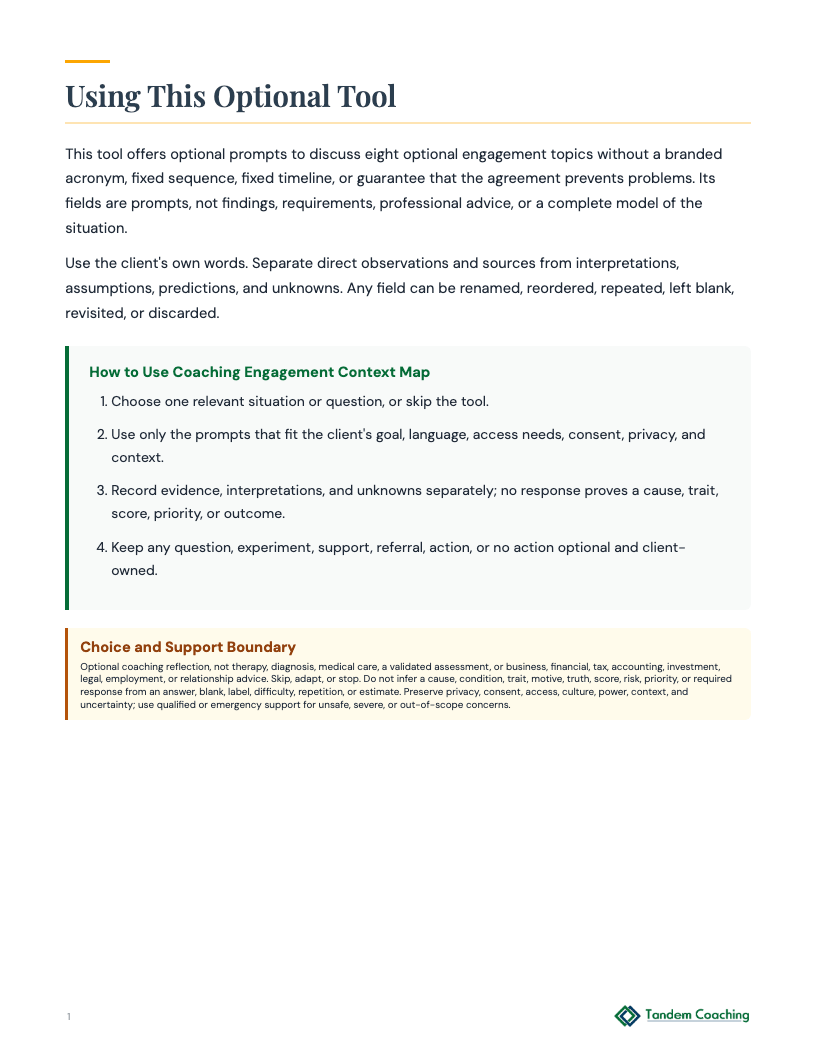
STORMMES Engagement Planner - preview
When to Use This Tool
Starting a new coaching engagement and need a structured intake process
Coaching relationship feels stuck and needs to be re-grounded
Transitioning from chemistry call to formal coaching agreement
Team coaching engagement requires explicit partnership design
Internal coaching program needs documented engagement standards
Client expectations are unclear after three sessions
How to Introduce This Tool Plus

STORMMES is an eight-element framework for designing a complete coaching engagement before the session work begins. Each letter represents one conversation you need to have with your client: Subject, Time, Outcomes, Roles, Measures, Motivation, Environment, and Starting point. These don't happen in order and they don't happen in one sitting. Spread them across the discovery call and first two sessions. The planner maps the essential questions for each element and what to listen for in the client's responses.

Browse All Pages
Interactive Preview Framework · 30 min
Tool Classification
Domain
Coach Practice
Type
Framework
Phase
Discovery Goal Setting
Details
30 min Opener As-needed
Topics
Accountability Communication

For the Coaching Practitioner

Plus
Coaching Scenarios Plus
1 Senior IC promoted to first management role, unsure what coaching means
Context

A software engineering lead has just been promoted to engineering manager at a 200-person startup. Their sponsor suggested coaching but they're unclear on the difference between a coach and a mentor. They arrive at the discovery call expecting advice, case studies, and direct feedback on management decisions. They believe the problem is lack of management experience.

How to Introduce

Open Subject with 'What would you like to actually change in the next six months - not learn, change.' The distinction matters because this client will drift toward information-gathering if you don't anchor to outcomes early. Introduce Roles explicitly and early: 'I don't tell you what to do - you tell me what matters and we figure out how to get there.' Expect a beat of confusion followed by either genuine curiosity or mild frustration. Either response tells you something about how they handle ambiguity.

What to Watch For

If Subject and Motivation fill in quickly but Roles produces slow or vague answers ('you'll challenge me, I guess'), the client doesn't yet have a model for what they're buying. Watch how they describe their relationship to their previous manager - it's usually the proxy model they'll apply to you. If they describe it as advisory ('he'd just tell me what to do'), you have a values mismatch to surface before session two.

Debrief

After covering Subject and Motivation in the discovery call, come back to Outcomes at the start of session one: 'Last time you said you wanted to become a better manager. What does a better manager look like in your team in six months?' Push past the first answer. Then move to Measures: 'How would you know?' The sequence Subject -> Outcomes -> Measures builds the logic chain the rest of the engagement depends on. Starting Point is last: 'Given all of that, where do you want to start this week?'

Flags

If the client's answer to Motivation is entirely external ('my company paid for this,' 'my skip-level suggested it') with no personal stake named, the engagement is structurally fragile. Severity: moderate. This doesn't mean decline the work, but name it directly: 'What would make this useful for you, separate from what your organization expects?' If they can't answer that in session one, return to it in session two. Intrinsic motivation can develop, but it needs to be named as a working hypothesis, not assumed.

2 Seasoned executive re-engaging after a disappointing previous coaching experience
Context

A VP of Operations at a manufacturing company is starting her third coaching engagement. The previous two ended without clear outcomes - in one case, the engagement simply petered out after four months. She arrives prepared, articulate, and somewhat guarded. She has a detailed answer ready for every STORMMES element except Motivation and Measures. She believes the problem is that her previous coaches didn't have enough operational expertise.

How to Introduce

Don't let the prepared answers close the conversation. When she gives you a clean Subject answer, follow it with: 'That's what you'd put on the intake form - what's the version you haven't said out loud yet?' The previous coaching failures are useful data if surfaced early. 'What would have made either of those engagements worth the time?' This gets at Motivation and Measures simultaneously without making it sound like a framework question.

What to Watch For

The polished answers are a risk signal. If all eight elements sound rehearsed and internally consistent, she may be managing you rather than engaging with you. Watch for the element where the fluency breaks - a pause, a hedge, a pivot to a different subject. That's the element worth returning to. Coaches with operational expertise were her stated preference in previous engagements - if Roles surfaces an expectation that you'll validate her business judgments, name that directly.

Debrief

Start with the failure-mode question: 'You've done this before. What made it stop working?' Don't skip to Element by element - that order serves the planner, not the client. Let the prior-engagement debrief surface whichever elements are live for her. Once you've mapped what went wrong, use STORMMES as a diagnostic: 'It sounds like Measures were never defined. How do you want to handle that this time?' This makes her a co-designer of the container rather than a recipient of it.

Flags

If she attributes both previous coaching failures entirely to the coach's domain gap, the pattern may be defensive. Severity: low to moderate. One attribution like this is plausible. Two identical attributions suggests a consistent pattern of externalizing what didn't work. Explore without challenging: 'What did you bring to those engagements that you'd want to bring differently here?' If she can't generate an answer, note it and return to it. This doesn't preclude good work - it just means the Motivation element needs more attention than the first conversation suggests.

3 Executive under HR performance improvement plan referred to coaching
Context

A director-level leader at a financial services firm has been referred to executive coaching by HR as part of a performance improvement process. She is two years from her planned retirement. She knows this coaching was not her choice and her immediate goal is to satisfy the PIP requirement. She believes the problem is that her management style worked for 25 years and the organization's expectations have shifted around her.

How to Introduce

Motivation is the make-or-break element here and it needs to be addressed before anything else. 'I know you're here because HR sent you. That's a starting point, not a reason. What, if anything, would make this time useful for you personally?' Some referred clients find genuine motivation once they have an invitation to name their own stake. Others don't, and that's also information. Roles also needs explicit framing: 'I'm not here to document your compliance with the PIP. What we talk about doesn't go back to HR unless you tell me otherwise.' Establish this in the first five minutes.

What to Watch For

If her answers to Subject and Outcomes mirror the PIP language almost verbatim, she is performing compliance rather than engaging with the work. Real Subject answers are personal; they reference her experience, her relationships, her own sense of what's shifted. PIP-language answers are organizational. Watch whether her Motivation answer includes anything after 'so I can keep my job' - if there's nothing beyond survival, the engagement will be surface-level at best. Also watch for disproportionate time spent on Environment (blaming organizational dynamics) relative to Roles (what she'll bring).

Debrief

Start with: 'Leave the PIP aside for a minute. In the next two years before you retire, what do you actually want this chapter of your career to look like?' This separates her personal stake from the institutional trigger. If she can generate an answer to that question - any answer - you have a Motivation thread to pull. From there, Outcomes become personal rather than compliance-driven, and the engagement has a real container. If she can't answer it, you're working with pure extrinsic motivation and need to name that directly.

Flags

If the client explicitly states she intends to satisfy minimum requirements and exit, the coaching relationship lacks a working foundation. Severity: high. This is not automatically a reason to decline, but it is a reason to be direct: 'I can't make this useful if we're both going through the motions. What's the smallest thing that would make one session worth your two hours?' If she can't generate even that, consider whether to recommend a different format - consulting, mentoring, or structured feedback - rather than coaching. Proceeding as though genuine motivation is present when it isn't produces neither progress nor a defensible outcome.

4 New coach completing first paid client engagement, over-managing the container
Context

A newly credentialed ACC coach is about to begin her first paid coaching engagement with a marketing director she met through a professional network. She has studied STORMMES and arrived at the discovery call with all eight elements on a printed checklist, planning to move through them sequentially. She believes the problem is that she hasn't yet developed her own intake process and needs a structured approach to appear competent.

How to Introduce

Use the context page framing directly with her before the session: 'These elements don't happen in order and they don't happen in one sitting.' The checklist mentality will produce a stilted discovery call. Suggest she read the full planner the night before, then leave it in her bag during the actual call. 'Your job in the discovery call is to be curious, not complete. Subject and Motivation are the two you want before you hang up. Everything else follows.' This distinction - be curious, not complete - is what separates this tool's purpose from a simple intake form.

What to Watch For

If she debriefs the discovery call by listing which elements she 'got' and which she 'missed,' the planner has become a scoring rubric rather than a conversation map. The signal to watch for is whether she can tell you what the client said versus whether she can tell you which elements she covered. One is about the client; the other is about the form. Also watch for over-engineering the Roles discussion in session one - new coaches sometimes spend so much time defining the coaching relationship that the client never gets to their actual Subject.

Debrief

After the discovery call, debrief with her using the eight elements as a retrospective, not a prospectus: 'Which elements surfaced naturally without you prompting them? Which ones did you have to ask about directly? Which one is still unclear?' The pattern of what surfaced versus what had to be extracted is diagnostic - it maps the client's natural disclosure style and her own facilitation instincts. Then use Starting Point as the bridge into session one planning: 'Given what you learned, where does session one need to begin?'

Flags

If she uses STORMMES primarily to manage her own anxiety rather than to understand the client, the tool is functioning as a safety blanket rather than a framework. Severity: low. This is normal for new coaches and doesn't require escalation - it's a natural developmental stage. The response direction is to name the function without pathologizing it: 'Structure is useful and it can also be a place to hide. How do you want to hold it loosely?' Most new coaches can make the shift once they hear the distinction stated plainly.

5 Mid-engagement reset after goals have shifted significantly
Context

A chief of staff at a growth-stage tech company began coaching six months ago focused on influencing without authority. Four months in, her company was acquired and her role has fundamentally changed - she now reports to a different executive, manages a larger scope, and the original goals are no longer relevant. The presenting issue as she names it is that she doesn't know what to work on now. Her coach recognizes the STORMMES elements have drifted substantially from the original agreement.

How to Introduce

Frame the reset explicitly, not as a problem with the engagement but as a natural response to changed conditions: 'The engagement we designed six months ago was built around a reality that doesn't exist anymore. Before we continue, we need to rebuild the container.' This positions the STORMMES review as necessary infrastructure work, not a signal that the coaching has failed. Cover Subject and Motivation first - her motivational landscape has changed with her role, and the original emotional drivers may no longer be the active ones.

What to Watch For

Watch for false continuity - the client naming goals that sound similar to the original but are being carried over from inertia rather than genuine current relevance. 'Influencing without authority' may still sound right, but the political landscape has changed completely. If her new answers to Subject and Environment are substantially different from the original but her Outcomes are unchanged, the Outcomes haven't been genuinely revisited. Also watch for grief or disorientation that isn't being named - acquisitions are disruptive even when they're ostensibly good news.

Debrief

Start with Environment because it's where the change is most concrete: 'Walk me through what's different about your day-to-day now compared to six months ago.' This gives you specific data before you revisit the higher-order elements. Then Motivation: 'What matters to you in this role now that didn't matter before?' Then rebuild Subject and Outcomes from the current reality. Don't reference the original agreement as a baseline - it's not a baseline anymore. The reset is a new starting point, not a correction.

Flags

If the client cannot identify any current motivation for continuing the engagement after the role change, the original driver may have been entirely situational and that situation no longer exists. Severity: low. This isn't a crisis - it's an honest signal. Some coaching engagements reach their natural conclusion when the context that generated them disappears. Explore directly: 'Is coaching still the right use of your time given everything that's changed?' Ending an engagement cleanly when conditions have shifted is better practice than continuing by default.

Tool Flow Plus
Requires
  • discovery call notes
  • client intake information
Produces
  • engagement agreement
  • coaching contract
  • partnership framework
  • success measures

Pairs Well With

Discovery Call Script

Executive

Client Analysis Worksheet

A coach or business owner wants to systematically analyze their current clients to understand patterns in who they serve best

30 min Assessment
Coach Business

Business Focus Planner

A coach is scattered across too many priorities and needs a structured way to identify their highest-leverage focus areas

30 min Planner

Related Articles

ICF Core Competencies: Managing Client Focus, Session Time, and Relationship Completion

ICF Core Competencies: Managing Client Focus, Session Time, and Relationship Completion

Read article →
The STORMMES© Coaching Agreement Model: A Framework for Stronger Engagements

The STORMMES© Coaching Agreement Model: A Framework for Stronger Engagements

Read article →
Coaching Agreements: The ICF Contract That Shapes the Entire Coaching Relationship

Coaching Agreements: The ICF Contract That Shapes the Entire Coaching Relationship

Read article →
ICF Core Competencies: Co-Creating the Relationship

ICF Core Competencies: Co-Creating the Relationship

Read article →
Ethical Practice in Coaching: What ICF Competency 1 Really Requires

Ethical Practice in Coaching: What ICF Competency 1 Really Requires

Read article →

ICF Core Competencies: Empathy, Neutrality, and Vulnerability

ICF Core Competencies: Empathy, Neutrality, and Vulnerability

Read article →