Relationship Repair Prompts
De-escalate conflict and state needs clearly with therapist-informed prompts designed to guide calmer, more productive relationship conversations.
Get This Tool
Free, print-ready PDF.
When to Use This Tool
Client struggles to express needs during conflict without escalating
Couple keeps having the same argument without resolution
Client withdraws or shuts down when conversations get difficult
Leader needs to repair a damaged working relationship
Client wants to break the pattern of silent treatment after disagreements
Partner feels unheard and wants tools to re-engage constructively
How to Introduce This Tool Plus
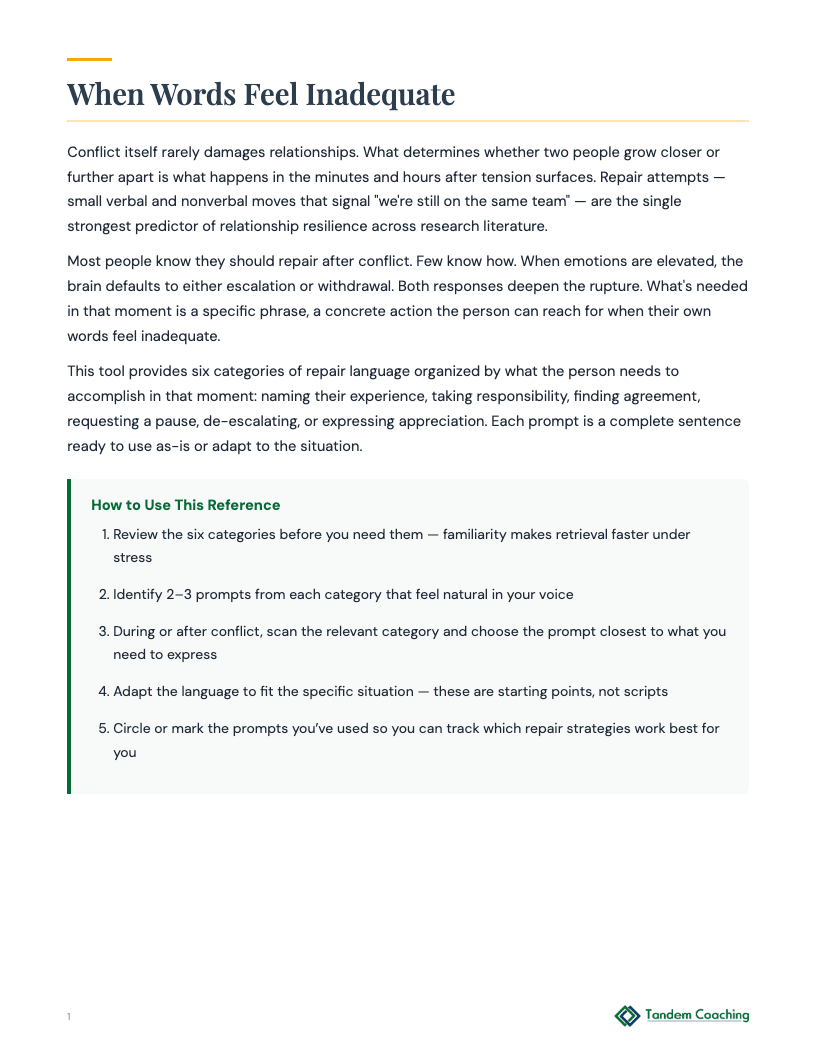
This reference gives you specific language to reach for when emotions run high during conflict. Most people know they should repair after a disagreement but freeze on the words. These six categories cover different repair moves depending on what the moment needs - naming your experience, taking responsibility, finding agreement, requesting a pause, de-escalating, or appreciating. Pick 2-3 from each category that feel natural and keep them where you can find them.
Coaching Tool Disclaimer
This tool is designed for coaching contexts, not clinical use. If you or your client is in crisis, contact the 988 Suicide and Crisis Lifeline (call or text 988) or Crisis Text Line (text HOME to 741741).
Browse All Pages
Tool Classification
Domain
Relationships
Type
Checklist
Phase
Action
Reflection
Details
5 min
Between sessions
As-needed
Topics
Communication
Emotions
Resilience
For the Coaching Practitioner
Plus
Coaching Scenarios
Plus
1 Executive who freezes mid-conflict and defaults to silence for days ▶
Context
A managing director at a consulting firm describes a pattern of going 'radio silent' after difficult conversations with his managing partner. The silence lasts 48-72 hours, his partner interprets it as contempt, and by the time he re-engages the rupture has widened. He believes the problem is that he needs time to process and his partner doesn't respect that. He frames this as a compatibility issue.
How to Introduce
Don't start with the prompts themselves - start with what happens in the room before he goes silent. 'Walk me through the last time this happened. What did you feel right before you stopped talking?' The goal is to map his specific pre-shutdown sequence. Once that's identified, introduce the Requesting Space category as an alternative to full withdrawal: 'There's a difference between pausing and disappearing. These prompts are how you pause without the other person experiencing it as rejection.' Let him read the Requesting Space page on his own before discussing.
What to Watch For
If he dismisses the prompts as too simple or too scripted, he may be protecting the silence as a control mechanism rather than genuinely struggling to find words. Watch whether he engages with the language on the page or immediately explains why each prompt wouldn't work in his specific situation. The latter pattern - generating reasons the prompts fail before trying them - is avoidance with sophisticated packaging. Also watch for the framing of his partner's 'incompatibility': if every difficulty in the relationship is attributed to the other person's failure to accommodate him, this tool is treating a symptom.
Debrief
Start with the Requesting Space prompts since that's where his breakdown happens. 'Read me the two or three that feel closest to something you could actually say.' Then ask: 'What would need to be different about you in that moment for those words to come out?' This shifts from the tool to the internal state the tool requires. If he finds one prompt that fits, anchor it: 'That's the one. Where will you keep it so you can find it when you need it?' Concrete placement - phone notes, paper card - matters for a tool that gets used in elevated-stress moments.
Flags
If his description of the conflict pattern includes repeated experiences of feeling physically unable to speak - not choosing silence but genuinely losing access to words - this may be a freeze response that goes beyond communication skill. Severity: moderate. Coaching on language repertoire won't reach that layer. Explore: 'When you go quiet, is it that you don't have words or that you can't get them out?' If it's the latter consistently, consider whether somatic work or a trauma-informed therapist would be a useful parallel resource. Continue coaching, but be realistic about the ceiling.
2 New team lead who escalates immediately when her authority is challenged ▶
Context
A recently promoted team lead at a healthcare technology company describes recurring conflicts with a senior individual contributor who has been on the team longer than she has. When he pushes back on her decisions, she matches his tone and raises it - then regrets the exchange afterward. She believes the problem is that he is undermining her and the organization isn't backing her up. She wants strategies for managing him.
How to Introduce
She will arrive expecting the conversation to be about him. Redirect to the 6-8 seconds before her tone shifts: 'The escalation isn't the problem - it's a solution to something else. What are you trying to protect when he pushes back?' This reframes the tool as self-management language rather than interpersonal tactics. Introduce the De-escalating category: 'These prompts are designed for the moment you feel yourself accelerating. Not after - during.' The 'I might be wrong about this' prompt is particularly useful to surface early because it's the hardest one for her to accept.
What to Watch For
If she reads the De-escalating prompts and immediately identifies ones she'd use with him while skipping the self-directed ones ('I notice we're both getting louder,' 'I'm choosing this relationship over being right'), she is externalizing the repair work. Watch how she responds to 'I might be wrong about this' specifically - her reaction to that prompt is a direct readout of her relationship to positional authority. Also watch whether she returns from between-session use having marked prompts she tried versus prompts she thought would have worked if she'd remembered them in time - the gap is diagnostic.
Debrief
Start with the Taking Responsibility page, not De-escalating: 'What's your history with apologizing to direct reports?' Her answer to that shapes which category is actually the entry point for her. Some leaders can de-escalate in the moment but cannot repair afterward - the apology page is where they're stuck. Once you've mapped her specific gap, build the practice around that category first. Then: 'Which one prompt from this page would be the most uncomfortable to say out loud to him?' Have her say it in session. Rehearsal in a low-stakes context reduces the access latency in a high-stakes moment.
Flags
If she describes multiple relationships in her current and previous roles where she escalated when her authority was challenged, and if she has a consistent explanation for why each person provoked it, the pattern is structural rather than situational. Severity: moderate. A communication tool treats individual incidents; it doesn't address a standing trigger around authority. Note the pattern and explore: 'What does it mean to you when someone pushes back on a decision you've made?' If the answer connects to identity or safety rather than the specific disagreement, the deeper work is there.
3 Client preparing to re-engage a colleague after a public falling-out ▶
Context
A senior program manager at a nonprofit had a public disagreement with a peer during an all-staff meeting eight weeks ago. Neither has spoken since. He knows the relationship needs to be repaired for the organization's sake and for his own, but every time he drafts a message or rehearses what he'll say, he abandons it. He believes the problem is that he doesn't know how to apologize without it sounding like he's conceding all fault.
How to Introduce
The between-sessions format of this tool is exactly right for his situation - this isn't a session-room exercise, it's preparation for a specific real-world conversation. 'You're not going to use all of these. You're looking for two or three sentences that let you open the door without writing the entire script.' Introduce Taking Responsibility and Finding Common Ground together: the first addresses his fear of over-apologizing, the second gives him language for the shared position. 'I can see the logic in your position' and 'I agree with part of what you're saying' are repair without surrender.
What to Watch For
If he spends the session analyzing the phrases rather than choosing them, he's preparing instead of deciding. Analysis is how he's been delaying this conversation for eight weeks. Watch the ratio of thinking-about-the-prompts to selecting-from-them. Also watch his language about the other person - if he consistently describes her behavior as wrong or inappropriate while describing his own as reasonable, the Finding Common Ground category may surface real resistance. His ability to mark any prompt in that category as genuine is diagnostic.
Debrief
Have him select three prompts - one from Taking Responsibility, one from Finding Common Ground, one from Expressing Appreciation - and arrange them into the opening 90 seconds of the conversation he plans to have. Not a full script: just an opening. 'You don't need to plan the whole conversation. You need a door that you can actually walk through.' Then: 'What's the smallest version of this conversation you could have this week?' A 5-minute hallway conversation or a single-sentence email is a real repair attempt - it doesn't need to resolve everything.
Flags
Eight weeks of avoidance after a single incident, combined with an inability to initiate even low-stakes contact, can indicate the conflict has merged with something bigger - his sense of how he's seen in the organization, a previous pattern he hasn't named, or an unrelated stressor he's carrying. Severity: low. Most clients navigate this with the right language and a small concrete action. But if the avoidance extends past the session work or if he repeatedly generates new reasons the conversation can't happen yet, explore what the conversation represents beyond the professional incident.
4 Couple in life coaching stuck in the same weekly argument with no resolution ▶
Context
A couple working with a life coach on their life planning process keeps returning to a recurring disagreement about financial priorities. One partner focuses on security and saving; the other on current quality of life and spending. They've had versions of this conversation dozens of times. They both agree the other person isn't listening. They believe the problem is a values difference that can't be resolved.
How to Introduce
Introduce the tool as a conversation about how they fight, separate from what they're fighting about. 'The financial disagreement is the content. What we're working on today is the pattern - how the conversation goes once it starts.' Give each partner their own copy. Ask them to read silently and mark any prompt that they wish the other person would say to them. The gap between what they wish for and what they actually say is the coaching territory. Reframe the tool: this isn't about finding common ground on finances, it's about staying in contact during disagreement.
What to Watch For
Watch whether each partner's marked prompts cluster in one category - this reveals what repair move they're most starved for. If one partner marks only Requesting Space prompts and the other marks only Expressing Appreciation prompts, the dynamic is likely pursuer-withdrawer: one needs to de-escalate, the other needs to feel valued before they can. Also watch how they respond to each other's marked prompts in the room - if one partner reviews the other's choices and immediately explains why those moves wouldn't work, that response is itself data about the repair barrier.
Debrief
Start with the exchange of marked prompts rather than a general discussion. 'Share with each other what you circled and why.' This creates a moment of genuine listening in the session that the conflict pattern has been preventing outside it. Then: 'Of everything you just heard, what's the one thing you want to try first?' Focus on one move each, not a complete new protocol. The goal at the end of this session is a single agreed-upon repair signal - a phrase or a request - that either person can use when the next version of the money conversation starts escalating.
Flags
If one partner engages with the tool seriously and the other treats it as irrelevant or performs compliance without genuine selection, the asymmetry is more important than the tool content. Severity: moderate. One partner trying to repair while the other opts out is a structural problem the language prompts can't solve. Explore the opting-out partner directly: 'Is there anything on this page that would be worth trying, even if you're skeptical?' If the answer is no, the coaching conversation needs to shift to what each person is willing to do, before working on how they communicate.
5 Mid-level manager rebuilding trust after breaking a commitment to a direct report ▶
Context
A product manager at a software company promised a strong performer on her team a promotion recommendation that didn't materialize due to a budget freeze. The direct report knows this, but the manager handled the communication poorly - she told him after the fact and minimized the impact. He has become visibly disengaged and their one-on-ones have become brief and transactional. She believes the problem is the budget situation and the direct report's expectations being unrealistic.
How to Introduce
This is a repair scenario, not a conflict scenario - the rupture happened from a broken promise, not a fight. Reframe the category selection accordingly: Taking Responsibility and Expressing Appreciation are the active pages here; De-escalating is not. 'The conversation you need to have with him isn't about managing his expectations. It's about acknowledging that something happened and it affected him.' Walk her through Taking Responsibility specifically. 'I owe you an apology for how I said that' is likely closer to the truth than she has yet admitted to herself.
What to Watch For
Watch how she describes his disengagement - specifically whether she attributes it to his disappointment about the promotion or to how she handled the communication. These are different root causes with different repair paths. If she consistently returns to the budget as the explanation, she may not yet have accepted that the communication failure is the more addressable injury. Also watch her comfort with the Expressing Appreciation prompts. 'Thank you for staying in this conversation' and 'One thing I respect about how you handle conflict is...' require genuine appreciation, not performance - her engagement with these prompts tells you whether the relationship still has emotional equity for her.
Debrief
Start with the Taking Responsibility page and ask her to identify exactly what she would be taking responsibility for - not the budget decision (which was outside her control) but the specific communication choice (which wasn't). This precision matters: a vague apology reopens rather than closes the rupture. Then map the Expressing Appreciation prompts to specific things he has actually done that she genuinely values. Appreciation without specificity reads as damage control. 'You made a fair point when you said...' only works if she can complete the sentence authentically.
Flags
If she cannot identify any specific thing she did wrong - if the budget and his expectations remain the entire explanation - the repair work has no foundation. Severity: moderate. An apology she doesn't mean will make the relationship worse, not better. Explore: 'If he told his version of what happened to someone outside the organization, what would he say you did?' If she can generate that perspective, there's something to work with. If she can't, the prior step is helping her see the situation from outside her own justifications before introducing any repair language.
Tool Flow
Plus
Requires
- identified conflict pattern
- communication assessment
→
Produces
- repair language repertoire
- conflict communication pattern
- relationship repair strategy
Pairs Well With
Feel Wheel
Why it pairsChoose this tool for a different angle on the same coaching area; use it only if that separate job fits the client.
Healthy Anger Expression
Why it pairsChoose this tool for a different angle on the same coaching area; use it only if that separate job fits the client.
When I Feel Angry
Why it pairsChoose this tool for a different angle on the same coaching area; use it only if that separate job fits the client.
Related Articles


Exploring Different Types of Coaching: Finding the Right Fit for Your Needs
Read article →
ADHD and People-Pleasing: Why I Say Yes When I Should Say No
Read article →
The Meeting Where Nobody Speaks Your Language
Read article →
Executive Team Coaching: What It Is, How It Works, and When Your Team Needs It
Read article →