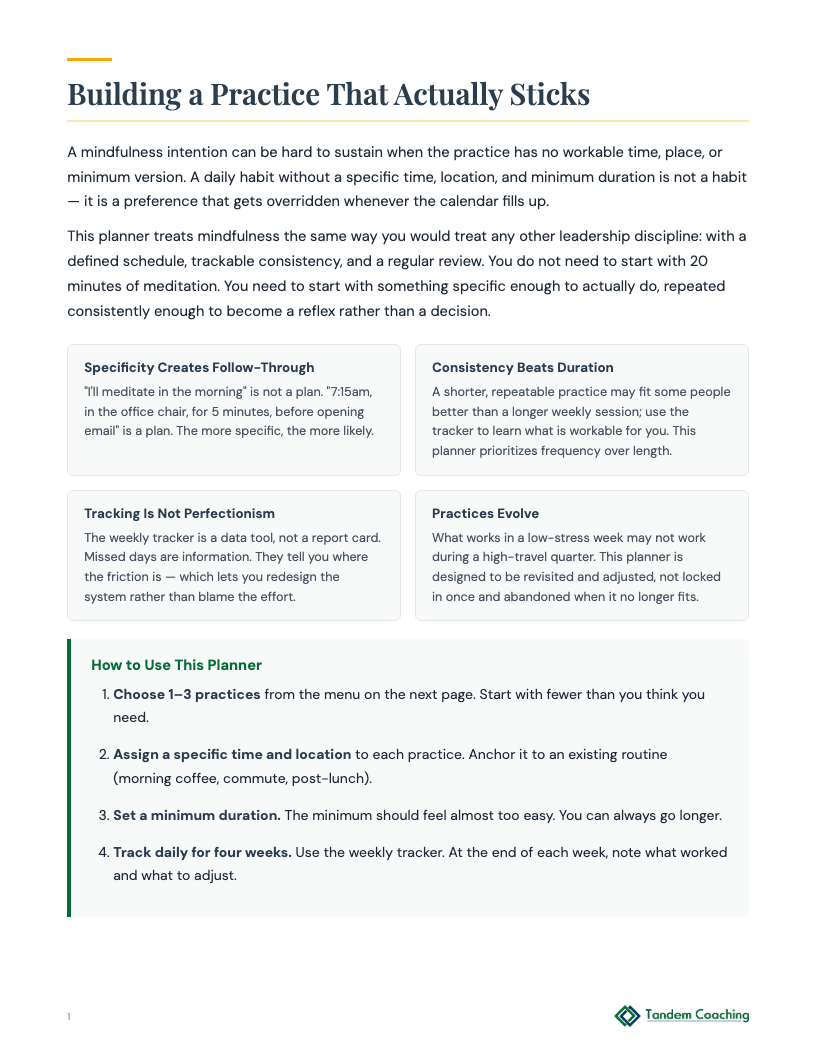
Mindfulness Practice Planner
A client wants to build a mindfulness practice but has never made it stick
Get This Tool
Free, print-ready PDF.
When to Use This Tool
A client wants to build a mindfulness practice but has never made it stick
Choosing specific practices and scheduling them rather than leaving it to intention
Tracking consistency over four weeks to build a reliable self-care habit
How to Introduce This Tool Plus
What short mindfulness practice feels workable in your actual week, and what will you learn by tracking it?
Browse All Pages
Tool Classification
Domain
Wellness
Type
Planner
Phase
Action
Details
15 min
Closing
Monthly
Topics
Habits
Self-Care
For the Coaching Practitioner
Plus
Coaching Scenarios
Plus
1 Burned-Out Professional Attempting to Build a Mindfulness Practice ▶
Context
A high-functioning professional who has read the research, downloaded the apps, and attended a workshop - and still has no consistent practice. They arrive with mild embarrassment about the gap between knowing and doing. The request is practical: help me actually do this, not just know I should.
How to Introduce
Position this as a scheduling tool, not a motivation tool. 'The biggest reason mindfulness practices fail isn't willpower - it's the absence of specifics. You've decided to practice; now we're deciding exactly when, where, and for how long on your worst week.' The Practice Plan section's minimum duration field is the operational core: a client who writes '2 minutes' for their minimum has a practice that will survive a brutal Monday. One who writes '20 minutes' has a practice that will only survive their best days. Address this directly.
What to Watch For
Watch the practice selection for complexity. Clients who list five different practices across the week are designing a variety program, not a habit. One or two anchored practices build consistency faster. Also watch what the client selects as their time and location - 'whenever I have time' in the location field means the practice has no trigger. The weekly notes column across weeks 1-4 is diagnostic: if weeks 3-4 notes are blank, the client disengaged before gathering the data that would have made the practice sustainable.
Debrief
Start with the minimum duration field and whether the client actually used it. 'Tell me about a day when you did the short version instead of the full version.' If that never happened, either every day was a good day (unlikely) or the client avoided the minimum version because it felt like cheating. That avoidance is the coaching conversation. Move to the intention field: does what the client wrote there connect to anything that came up in their weekly notes? If the intention was aspirational and the notes were mundane, explore the gap.
Flags
If the client's stated intention involves 'stopping my mind' or 'not thinking about work,' explore their understanding of what mindfulness practice actually does before proceeding. Misconceptions about the goal create abandonment when the practice doesn't deliver the expected result. Severity: low. Response: reframe, continue. If the client pursues mindfulness as a strategy for managing clinical anxiety symptoms and the four-week practice doesn't move the needle, the tool is undersized for the problem. Severity: moderate. Explore whether additional professional support is warranted.
2 Leader Whose Team Culture Suffers From Their Reactivity ▶
Context
A manager whose direct reports and 360 feedback have identified a pattern of reactive decision-making and impatient communication under pressure. The leader accepts the feedback intellectually but doesn't experience themselves as reactive in the moment. They want to change the behavior but aren't sure where the leverage point is.
How to Introduce
Frame this as a between-stimulus-and-response training tool, not a relaxation tool. 'This isn't about feeling calmer. It's about building enough pause between what happens and how you respond that you have a choice.' The location field is the key: practices done at a desk before the first meeting create a different physiological baseline than practices done only on weekends. Ask the client to identify which meeting or interaction type tends to produce their most reactive responses - then anchor the practice to the 10 minutes before that regular trigger.
What to Watch For
Watch for clients who select only the most cognitively passive practices - body scans, breathing - and avoid anything with a reflective component. For leaders working on reactivity, practices that build meta-awareness (noticing what thoughts arise, not just calming the breath) are more relevant. Also watch whether the client is tracking the practice on the days before their highest-demand meetings. If not, the practice has been placed in the wrong structural position.
Debrief
Start with a specific incident from the tracking period where the client had a reactive response. 'Walk me through the 30 minutes before that conversation. Where were you? What were you doing?' This often reveals that the incidents happen on the days the practice was skipped. If that pattern holds, name it directly: 'Your data suggests the practice is load-bearing for days like that one.' The question that typically opens up the reactivity discussion: 'What would you have needed to have a 10-second pause before you responded?'
Flags
If the leader's reactivity pattern has already damaged key relationships on the team, mindfulness practice alone is unlikely to repair the relational damage even if it shifts the underlying behavior. Severity: moderate. Continue building the practice AND address the relational repair directly as a separate coaching thread. If the client describes the reactive responses as completely outside their awareness - they only learn they were reactive from others afterward - explore whether this warrants a deeper conversation about stress response patterns. Severity: moderate.
3 Client in Recovery Who Wants to Rebuild a Lapsed Mindfulness Practice ▶
Context
A client who had a solid mindfulness practice for several years that disintegrated during a major life disruption - a divorce, a career change, a period of illness. They describe the lost practice with grief. They want to rebuild it but report that starting again feels harder than starting for the first time because they remember what they had.
How to Introduce
Name the re-entry challenge explicitly before introducing the tool. 'Coming back to a practice after a long gap feels different from starting fresh because you have a reference point for what it should feel like - and you're not there yet. We're designing a practice that starts much smaller than where you were, on purpose.' The minimum duration field is critical here: the client needs permission to do two minutes on hard days without that feeling like failure. Their previous practice is the ceiling, not the floor.
What to Watch For
Watch for grief masquerading as motivation in the intention field. Clients who write intentions about 'getting back to who I was' or 'returning to how I felt when I was practicing' are oriented toward reclaiming a past self, not building a present practice. That's a different conversation. Also watch for the client abandoning the tracker if the early weeks feel worse than expected. The first two weeks of rebuilding often feel more effortful than the first time because the comparison to the previous practice creates friction.
Debrief
Start with the weekly notes rather than the tracking grid. The notes will reveal whether the client is observing their practice with curiosity or judging it against a memory. 'What surprised you about how this felt compared to what you expected?' If the practice is already resembling what they had before, name that - clients in re-entry often don't notice they've arrived because they're still comparing to the peak version. If it hasn't matched the memory yet, explore what that gap means to them.
Flags
If the original practice was disrupted by a significant loss or trauma and the client connects the lapsed practice to that period, returning to the practice may surface unprocessed material from the disruption event. Severity: moderate. Continue coaching but monitor for signs that the return to practice is activating grief or distress rather than building regulation. If warranted, suggest parallel support. If the client cannot engage with the practice at all - even two minutes triggers avoidance - the cue may be connected to a difficult memory, not a scheduling problem. Severity: moderate. Slow down and explore.
Tool Flow
Plus
Requires
- None - standalone tool
→
Produces
- scheduled mindfulness practice plan with specific times
- four-week consistency tracking record
- identified friction points and adjustments
Pairs Well With
Wellness
Weekly Well-Being Context Log
A client wants to use Weekly Well-Being Context Log as an optional reflection
Why it pairsOnce the mindfulness schedule is set, this tracker shows whether practice completion actually shifts the client's energy and mood across the week.
WellnessWeekly Well-Being Practices Check-In
A client wants to use Weekly Well-Being Practices Check-In as an optional reflection
Why it pairsAfter four weeks of planning, this reveals whether mindfulness gains are spreading into the client's other wellness behaviors or staying siloed.
WellnessWeekly Feeling and Context Notes
Use this tracker to notice patterns in emotions and self care over time before drawing conclusions.
Why it pairsThe planner fixes when practice happens - this shows whether those scheduled sessions correspond to calmer or more grounded days.
Related Articles


Definition of Done – More Than a Checklist
Read article →AI and Coach Training: What to Focus On While You Learn the Craft
Read article →
CMO Coaching: Benefits, Programs & Choosing the Right Coach
Read article →
5 Top Employee Development Plan Examples - Learn to Make Your Own
Read article →