Interrupt autopilot reactions with a structured worksheet that guides intentional, values-based decisions in high-stakes leadership moments.
Free, print-ready PDF.
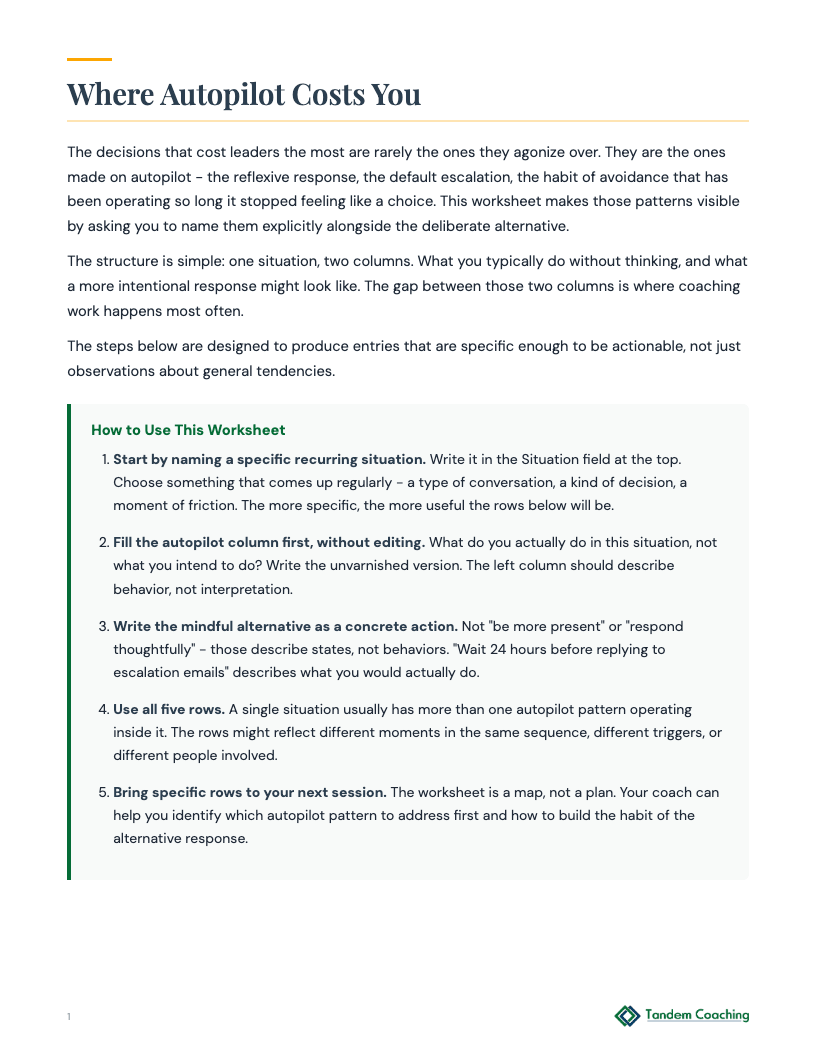
Is there a situation you find yourself in regularly where you know your response isn't the one you'd choose if you had a moment to think?
A VP of product at a software company receives 360 feedback indicating that her team finds her unreadable in ambiguous situations - particularly in decision discussions where the direction is unclear or contested. Team members report that she goes quiet in those moments, which they interpret as disapproval of their contributions or withdrawal from the conversation. In coaching sessions, she reports that the silence is intentional - she is processing, not disengaging. She has not examined whether her intentional silence in ambiguous situations is a mindful choice or an autopilot response to discomfort, and whether the impact on her team is something she has accepted as a trade-off.
Frame the tool around the specific situation the 360 identified. 'This worksheet asks you to name a specific recurring situation and then identify what you do automatically in that situation - and what you would choose to do if you were being intentional. The situation is clear from the feedback: ambiguous decision discussions where direction is contested. Write that as your named situation. The five-row table will map what you do automatically in those moments and what you would choose to do mindfully. The post-tool question asks which autopilot pattern has the most impact on people around you. I think we both know the answer, but I want you to write it.' Naming the situation before the client enters the table prevents the worksheet from being completed for a safer scenario.
Watch what she writes in the Autopilot column for the situation. If she writes 'I go quiet to process' without noting the effect on others, the autopilot column is describing her internal experience rather than her observable behavior. The autopilot column should describe what is visible - 'I stop responding, break eye contact, and pause the conversation' - not the internal reason for the behavior. In the Mindful column, watch whether her alternatives are behavioral ('I name what I'm doing: I say I need 30 seconds to think') or simply internal ('I stay present'). Behavioral alternatives are actionable; internal alternatives often describe the aspiration without specifying what would be different for someone watching her. The post-tool question about interrupting the pattern once this week is the action commitment - watch for specificity.
Start with the Autopilot column. 'Read me what you wrote for your automatic behavior in that situation. Is what you've written what a team member would see, or is it your internal experience of the moment?' If it's internal, work through the behavioral description together: 'If I were watching you in that discussion from across the table, what would I observe?' Then compare Autopilot to Mindful: 'The mindful choice you've named - what specifically would a team member experience differently if you made that choice instead?' And for the post-tool question: 'You said you'd interrupt this pattern once this week. Which meeting specifically, and what's the one sentence you'd say to name what you're doing?'
If the Mindful column produces alternatives that are internal shifts rather than behavioral changes - 'stay more present,' 'remind myself that silence is okay' - the worksheet has produced self-management strategies rather than behavior changes visible to her team. Severity: low. The 360 feedback is about impact, not internal state. Name the gap: 'Everything you've written in the Mindful column describes what happens inside you. The feedback is about what your team experiences. What would be different for them if you made the mindful choice?' The shift from self-management to observable behavior is the reframe this client needs.
A senior manager of engineering at a manufacturing company leads a team that operates under consistent technical and schedule pressure. He is widely recognized as a strong problem-solver. His team has described in informal feedback that they frequently feel cut off - that conversations about problems or concerns become solution discussions before the problem has been fully heard. He brings this autopilot pattern into coaching sessions as well: when his coach reflects something back to him, he moves quickly to what he'll do differently rather than staying with what the coach has said. He is aware of the pattern in the abstract but has not examined what triggers the solution jump and what it would take to interrupt it.
Use his in-session pattern as the entry point before introducing the tool. 'I want to name something before we work through this. The pattern I've just described - moving quickly to solutions - has happened in our last three sessions as well. I mention it not as a criticism but as a data point: the autopilot that your team is experiencing is the same one that runs in here. This worksheet asks you to name a specific situation and map the autopilot versus the mindful alternative. The situation to work with is team conversations about problems. The post-tool question asks which autopilot pattern has the most impact on the people around you. Given the feedback, I think we can answer that before you start. Let's verify it and then find what would interrupt it.' Using the coaching relationship as evidence grounds the tool in direct experience.
Watch whether his Autopilot column describes the behavior ('I jump to solutions within two exchanges of someone naming a problem') or the intention behind it ('I want to help quickly'). Intention-based autopilot descriptions protect the behavior from examination. The behavior description is what's needed. In the Mindful column, watch whether his alternatives are observably different - 'I ask two questions before offering a direction' vs 'I listen better.' In the post-tool question about what would interrupt the pattern once this week, watch for a commitment that is specific enough to be verifiable: naming a specific meeting, a specific trigger, and a specific behavior he'll do instead of solving.
After completing the tool, start with the Mindful column. 'Read me what you've written as the mindful alternative. If I told you that you did this in your Monday engineering standup and I watched you do it - what specifically would I have seen?' The observability test converts abstract alternatives into concrete behaviors. Then: 'You've said you'll interrupt this pattern once this week. Which conversation, and what's the first thing you'll do that's different from what you normally do in that moment?' The first-thing specificity is the commitment. After the next session: 'Did you interrupt it? What happened?'
If the Mindful column produces 'listen more carefully' or 'stay curious' without specifying what that looks like in the two-to-five exchange window before solutions enter, the alternative is aspirational rather than behavioral. Severity: low. Work through a concrete version in session: 'If you're in a problem conversation and the autopilot fires - if you feel the solution forming - what is the one thing you'd do in that specific moment? Not a disposition, an action.' If he can name the action ('I'd ask one more question before I speak'), the tool has produced something he can actually use.
A director of operations at a regional retail company leads a team that operates at the intersection of corporate directives and frontline realities. Over eighteen months, her team has increasingly stopped raising operational problems to her directly. In an engagement survey, two comments noted that she 'tends to explain away problems rather than engage with them.' She was surprised by this. In coaching, she has described her approach as providing perspective and context. Her coach recognizes the pattern: when problems are raised, she moves quickly to context that minimizes them - there's a reason this happened, it's not as bad as it looks, this is being worked on at the corporate level. She has not examined whether this is an autopilot or an intentional leadership stance.
Position the tool around the situation the survey named, not around a general pattern. 'The engagement survey named a specific type of situation: conversations where a team member raises an operational problem. This tool asks you to name that situation specifically and map what you do automatically in it versus what you'd choose to do if you were being intentional. The question about which autopilot pattern has the most impact on people around you - the survey may have already answered that. I want you to complete the worksheet and see whether what you write in the Autopilot column matches what the survey described.' Using the survey as the evidence base frames this as calibration rather than critique.
Watch what she writes in the Autopilot column. If she writes 'I provide context' or 'I help them understand the bigger picture,' the autopilot description is framed from her intention rather than from observable impact. The autopilot column should reflect what her team experiences: 'I explain why the problem exists or is being addressed, which tends to end the conversation before the team member has felt heard.' In the Mindful column, watch whether her alternatives involve any acknowledgment step before context - 'I name what they've raised before I respond to it' - or whether the mindful choice is still context-provision, just delivered differently. The post-tool question about interrupting the pattern this week needs to name a specific team conversation, not a general commitment to 'listen more.'
Start with the Autopilot column. 'The survey described this as explaining away problems. Does what you've written match that description, or does it feel different to you?' The comparison between her self-description and the external description surfaces whether she has accurately captured the observable pattern. Then: 'The mindful choice you've named - what would be different for the team member who raised the problem if you made that choice instead of the autopilot?' The impact-on-other question keeps the debrief grounded in the team's experience rather than her internal experience. Then: 'Which team member is most likely to raise an operational problem to you in the next week? What will you do differently when they do?'
If the Autopilot column describes the behavior from her intention ('I try to give context and perspective') and the Mindful column produces a similar behavior with slightly different framing ('I'll give context more carefully'), the worksheet has not surfaced the impact gap between her intention and her team's experience. Severity: low to moderate. The engagement survey provides evidence she does not have direct access to from her own experience. Name the gap: 'What you've written in both columns describes an intention. The survey described an impact. The disconnect between those two may be more useful than the columns themselves. What would it mean if the impact description is accurate?' The conversation about the gap between intention and impact is often more productive than the worksheet completion in cases where the autopilot is strongly defended.
Client is perpetually reactive and cannot distinguish between what is urgent and what actually matters
ExecutiveA client is running business development activities but has no systematic way to track what's in motion and what's stalled
ExecutiveI want to see my business situation clearly before I decide on next steps