Life Satisfaction Survey
Assess a new client’s overall life satisfaction across four key domains to pinpoint priorities and establish a clear, trackable coaching baseline.
Get This Tool
Free, print-ready PDF.
When to Use This Tool
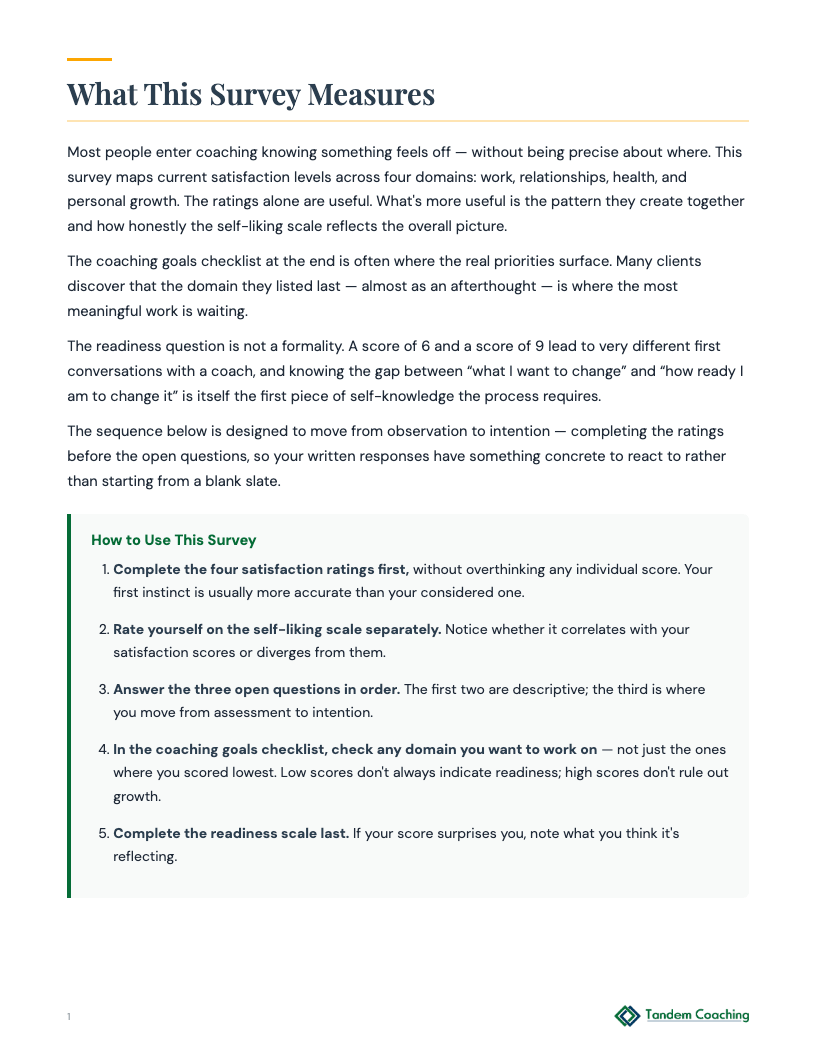
New client checking in on overall life satisfaction across four domains before starting coaching
Someone rating how much they like themselves alongside their readiness to commit to change
Surfacing which life area has the most distance between where they are and where they want to be
How to Introduce This Tool Plus
Looking at where you rated yourself across these areas — where does the gap between current and desired feel most important to close right now?
Coaching Tool Disclaimer
This tool is designed for coaching contexts, not clinical use. If you or your client is in crisis, contact the 988 Suicide and Crisis Lifeline (call or text 988) or Crisis Text Line (text HOME to 741741).
Browse All Pages
Tool Classification
Domain
Life Coaching
Type
Assessment
Phase
Discovery
Details
15 min
Between sessions
Monthly
Topics
Values
Self-Care
For the Coaching Practitioner
Plus
Coaching Scenarios
Plus
1 Senior executive who thinks coaching is about performance optimization ▶
Context
A C-suite executive whose board mandated coaching after 360 feedback showed interpersonal issues. Client frames this as leadership development and expects tactical skill-building. Views satisfaction as weakness - successful people don't need to be satisfied, they need to be effective.
How to Introduce
Frame as a baseline diagnostic, not a happiness assessment. 'Before we work on leadership effectiveness, I need to understand your current resource allocation across life domains. High performers often optimize one area at the expense of others without realizing the performance cost.' Expect resistance to the self-liking question - they'll want to skip it or intellectualize it.
What to Watch For
Client completes work/career rating quickly with high confidence, spends longer on relationships and health. Self-liking score significantly lower than satisfaction scores suggests identity fusion with role performance. If they rate readiness at 8+ but can't articulate what they want to change, they're performing compliance.
Debrief
Start with the gap between satisfaction scores and self-liking. 'You rated three domains at 7 or higher, but rated liking yourself at 4. What accounts for that difference?' Then move to readiness: 'You say you're ready to change but struggle to name what needs changing. What does readiness mean to you in this context?'
Flags
Self-liking score 3+ points below average satisfaction scores indicates possible identity-performance fusion. Severity: moderate. If client dismisses self-liking as irrelevant or 'touchy-feely,' the resistance itself may be protecting against deeper work coaching alone won't address. Response: name the pattern directly and assess whether executive coaching or personal coaching is the better fit.
2 Mid-career professional returning to work after extended medical leave ▶
Context
A marketing director returning after six months of cancer treatment. Physically cleared to work but struggling with energy management and shifting priorities. Company is supportive but client feels pressure to prove they're 'back to normal.' Coaching requested to help with transition planning.
How to Introduce
Position as a recalibration tool, not a deficit assessment. 'Your priorities and capacity have shifted - that's information, not failure. This survey maps where you are now so we can design a sustainable re-entry.' Acknowledge that health ratings may feel loaded given recent medical history. The goal is current state, not comparison to pre-illness baseline.
What to Watch For
Health domain rating often surprisingly high - client may be rating 'not actively sick' rather than actual wellness. Personal growth scores tend to be elevated due to perspective shifts from illness experience. Watch for perfectionist patterns in readiness scores - rating themselves 9-10 ready when other responses suggest significant adjustment needed.
Debrief
Start with personal growth scores if elevated. 'You rated personal growth highly - what's shifted in your perspective?' Then address the gap between readiness and actual change capacity: 'You say you're ready to make changes, but your energy and priorities have fundamentally shifted. What does readiness look like with your current resources?'
Flags
Client rates health satisfaction at 8+ while describing ongoing fatigue and capacity issues. This disconnect between rating and reality suggests denial or pressure to appear recovered. Severity: moderate. Response: explore the gap between 'medically cleared' and 'actually ready' - may need integration support beyond coaching scope.
3 High-achieving professional whose relationships are failing despite career success ▶
Context
A successful consultant whose marriage is ending and teenage children barely speak to them. Recently promoted to partner but the personal cost is becoming undeniable. Enters coaching saying they want 'better work-life balance' but resistant to examining whether their definition of success needs updating.
How to Introduce
Frame as a systems check, not a balance assessment. 'Success in one domain often comes at a cost to others. This isn't about judgment - it's about seeing the full picture of what your current approach is producing.' Expect them to minimize relationship scores or blame external factors. The pattern matters more than individual ratings.
What to Watch For
Work satisfaction rated 8-9 while relationships rated 3-5, but client spends more time explaining relationship scores than work scores. Self-liking often falls between the two domains. If they check 'Life Balance' in coaching goals but rate readiness low, they know what needs to change but aren't prepared for the trade-offs.
Debrief
Start with the pattern, not individual scores. 'Your work satisfaction is high and relationship satisfaction is low. You've optimized for one at the expense of the other. What would need to change for relationships to move up two points?' Then explore readiness: 'You want balance but rate readiness at 5. What makes this hard to change?'
Flags
Client dismisses low relationship scores as 'temporary' or blames partner/children while maintaining high work satisfaction. If they can't acknowledge their role in relationship deterioration, coaching may reinforce existing patterns rather than challenge them. Severity: moderate. Response: assess whether they're seeking coaching to change or to justify current choices.
4 Recently divorced parent rebuilding life while managing demanding job ▶
Context
A project manager six months post-divorce, sharing custody of two young children. Financially stretched, living in a smaller space, trying to maintain career momentum while learning single parenting. Feels like they're failing at everything and requested coaching to 'get back on track.'
How to Introduce
Frame as a triage tool for someone managing multiple transitions simultaneously. 'You're rebuilding in several domains at once. This helps us see which areas need immediate attention versus which can wait.' Normalize that most scores will be lower than pre-divorce baseline - the goal is identifying where to focus limited energy, not achieving previous levels immediately.
What to Watch For
Scores tend to cluster in the 4-6 range across domains - everything feels hard but nothing feels impossible. Self-liking often lowest score, reflecting shame about divorce/life changes. If they rate readiness high but describe feeling overwhelmed, they may be confusing desperation with readiness. Multiple coaching goals checked suggests scattered focus.
Debrief
Start with self-compassion around the scores. 'These ratings reflect someone managing multiple major transitions - of course everything feels harder right now.' Then prioritize: 'You checked five coaching areas. If you could only improve one domain in the next three months, which would have the biggest positive impact on the others?'
Flags
Self-liking score below 3 combined with high readiness ratings may indicate desperation rather than sustainable motivation. Severity: low to moderate. If client describes feeling like a failure as a parent/partner/professional simultaneously, the shame spiral may need therapeutic support alongside coaching. Response: assess whether they have adequate emotional support systems outside coaching.
5 ADHD professional whose coping strategies stopped working after promotion ▶
Context
A software engineer with ADHD recently promoted to team lead. Previous role allowed hyperfocus and minimal meetings; new role requires sustained attention to people management and administrative tasks. Stimulant medication helps with focus but not with executive function demands of leadership. Feels like they're failing at a job they thought they wanted.
How to Introduce
Frame as a diagnostic for role-brain fit, not personal deficiency. 'Your brain worked well with your previous role demands. Now the demands changed and your strategies need updating.' Expect frustration with rating scales - ADHD brains often experience satisfaction as highly variable day-to-day. Suggest rating based on overall patterns, not recent bad days.
What to Watch For
Work satisfaction often shows dramatic internal conflict - high scores for technical work, low for management tasks, but they average it out. Personal growth may be rated high due to recent ADHD diagnosis/treatment. Readiness scores often inflated because ADHD brains crave immediate change, but 'what's holding you back' reveals executive function barriers.
Debrief
Separate technical satisfaction from role satisfaction. 'You love the engineering work but struggle with the management parts. What percentage of your current role is each?' Then address the readiness-barrier gap: 'You rate readiness at 8 but describe executive function challenges. What would make change more sustainable for your brain?'
Flags
Client describes dramatic daily swings in satisfaction levels or says ratings depend entirely on 'good brain days' versus 'bad brain days.' This variability may indicate medication needs adjustment or role demands exceeding ADHD management strategies. Severity: moderate. Response: explore whether accommodations or role modification needed alongside coaching.
Tool Flow
Plus
Requires
- None - standalone tool
→
Produces
- satisfaction scores across four life domains
- prioritized coaching focus areas checklist
- readiness-to-change score with named barriers
Pairs Well With
Life
Optional Multi-Area Goal Notes
Use this worksheet to explore values and identity and turn the client’s observations into one optional next step.
Why it pairsOnce you have domain scores and a prioritized focus list, this worksheet gives clients a structured place to set concrete goals in each flagged area.
WellnessOptional Wellbeing Intentions
Use this worksheet to explore self care and values and turn the client’s observations into one optional next step.
Why it pairsWhen self-care scores low on the survey, this worksheet moves the client from a named gap to specific, dimension-by-dimension commitments they can review monthly.
WellnessWhole-Life Satisfaction Wheel
Client is performing in multiple life areas but feels an undefined sense of imbalance or emptiness
Why it pairsUse this after the survey to add a visual balance map and four additional dimensions the survey doesn't cover, before narrowing to a coaching focus.
Related Articles


Executive Psychological Readiness Assessment for Career Change
Read article →
Career Change for Teachers: Is ICF Coaching Right for You?
Read article →
Executive AI Vulnerability Assessment | Know Where You Stand
Read article →
ADKAR Change Management Model: What to Do When You Find the Gap
Read article →