Goal Setting Framework
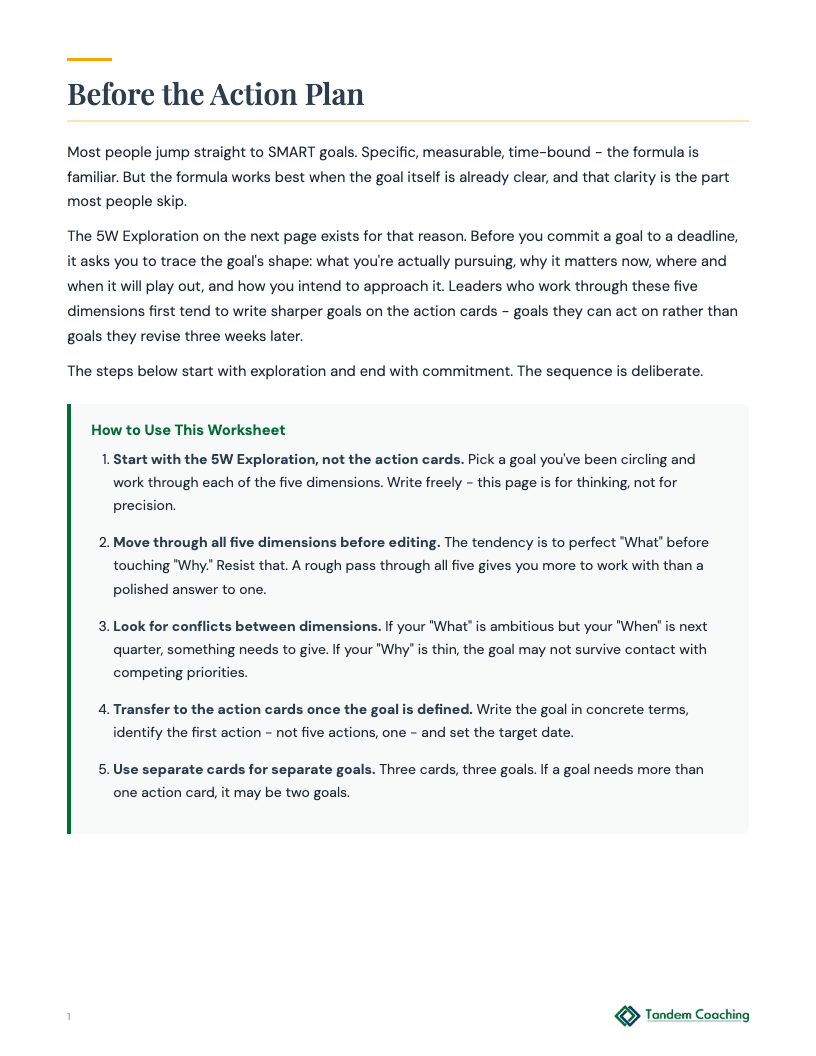
Clarify a goal through what, why, where, when, and how before choosing the first action.
Get This Tool
Free, print-ready PDF.
When to Use This Tool
Client jumps to action steps before the goal itself has been clearly defined
Client's goals stall because the why and the when have not been examined together
Client writes goals that look complete on paper but collapse when specificity is required
How to Introduce This Tool Plus
This framework starts with exploration across five dimensions before committing anything to a timeline - would you be willing to work through a goal you're circling using that sequence?
Browse All Pages
Tool Classification
Domain
Life Coaching
Type
Framework
Phase
Goal Setting
Action
Details
30 min
Mid session
As-needed
Topics
Accountability
Mindset
Identity
For the Coaching Practitioner
Plus
Coaching Scenarios
Plus
1 The client who arrives with a solution before the goal is defined ▶
Context
Client presents an action they have already decided to take — switching jobs, launching a product, moving cities — and wants coaching support to execute it. When pressed on the underlying goal, they struggle to articulate one. The action has become the goal, which means there is no way to evaluate whether it is the right action.
How to Introduce
Frame this as a pre-flight check, not a challenge to the decision. 'Before we build the plan, let's back up one level and get clear on what you're trying to accomplish. The action you're describing may be exactly right — or there may be a better path we haven't seen yet. The 5W questions will help us find out.' Clients who have already committed emotionally to an action resist this reframe because examining the goal feels like reopening a decision they have made. Name that: 'I'm not asking you to question whether to move forward. I'm asking what you want this to produce.'
What to Watch For
Watch the Who, Why, and When responses. If Who is vague ('for everyone,' 'for my team'), the goal lacks a real beneficiary. If Why is instrumental rather than purposive ('because I should,' 'because it's next'), the client does not have a personal stake in the outcome. If When is absent or vague, the goal has no accountability anchor. A goal card filled in under three minutes with short answers is performing compliance — the client is completing the exercise to get back to execution.
Debrief
Start with the Why card. Ask the client to read it aloud. Then: 'Is that the real why, or is that what sounds good?' Most clients know the difference. Then move to the When card and ask them to put a specific date on it — not a quarter or a season, a date. The resistance to specificity on When is usually where the real obstacle lives.
Flags
- Low
Client cannot answer the Why question in a way that resonates with them across two attempts. They are articulate about What and How but the Why question produces deflection or silence.
Response: Note this as a goal without a personal stake. Continue with the session but flag for follow-up. A goal the client cannot personally justify rarely survives the first obstacle.
2 The client with a goal that has been on the list for more than a year ▶
Context
Client names a goal that has appeared in multiple previous sessions — or that they describe as 'I've been wanting to do this for years.' The goal is familiar enough to discuss fluently but has not moved. The fluency itself is part of the problem: this client has talked about the goal so many times that the talking has replaced the doing.
How to Introduce
Introduce this as a diagnostic, not another round of planning. 'You've described this goal before. Rather than build another plan, let's figure out what's actually keeping it in place. The 5W questions are a way to find the specific assumption that has been wrong.' The resistance pattern here is that the client will want to produce a new plan — more specific, more detailed. Name it: 'More planning hasn't moved this yet. Let's find the question that hasn't been asked.'
What to Watch For
The most diagnostic question is Why — not why they want the goal, but why it has not happened yet. If the client attributes non-progress entirely to external factors ('my boss,' 'the economy,' 'my schedule'), the internal obstacle has not been examined. Also watch for a When that is identical to a When set in a previous session. The same deadline moving forward is a signal that the client does not believe the deadline is real.
Debrief
Start with the gap between the goal and the longest time it has been on the list. Ask: 'What has been the story you have told yourself about why it has not happened yet?' Then ask: 'What would have to be different for that story to stop being true?' This sequence moves from diagnosis to agency without skipping the accountability step.
Flags
- Moderate
Client names the same goal with identical language across three or more sessions without movement. The coaching sessions may be providing enough resolution of the discomfort that the client does not need to actually change.
Response: Name the pattern directly: 'We have visited this goal several times. I want to understand whether you want to pursue it or want to want to pursue it — those are different, and both are valid.' Explore whether the goal is genuinely the client's or belongs to an external expectation.
3 The first-session client who does not know what they want from coaching ▶
Context
Client comes to coaching with a general sense of dissatisfaction or wanting 'more' but cannot name a specific goal. They are articulate about what is not working but vague about what they want instead. The 5W framework applied to a fuzzy goal produces a fuzzy plan — the tool's value here is in forcing specificity, which reveals what the client does not yet know.
How to Introduce
Frame this as exploration, not problem-solving. 'Let's use this framework not to set the goal — you don't have to know that yet — but to find the shape of it. The questions are designed to pull out what you do know and show us where the blanks are.' The resistance here is often from clients who feel they should arrive with a clear goal. Normalize ambiguity: 'Most people don't walk in knowing exactly what they want. The framework helps us find it.'
What to Watch For
Watch where the client produces energy rather than accuracy. A technically complete answer that is delivered flatly is less useful than an incomplete answer delivered with conviction. The Who question is particularly revealing for clients in this state — who do you want this goal to matter to? A client who pauses at Who may be working through a question about whose life they are actually building.
Debrief
After the five questions, step back and ask: 'Looking at everything you wrote, what surprised you?' That question surfaces information the client did not know they had. Then: 'Which of these five answers feels most uncertain to you right now?' The uncertain answer is often the one that most needs exploration before goal-setting can happen.
Flags
- Low
Client cannot answer any of the five questions with any specificity after two attempts. Every answer is hedged with 'I don't know' or 'it depends.' This goes beyond normal ambiguity at the start of coaching.
Response: Set the framework aside for this session. The client may need more exploratory work before a goal-setting structure is useful. Move to values clarification or life review work and return to this tool when there is more material to anchor it.
Tool Flow
Plus
Requires
- None - standalone tool
→
Produces
- 5W goal exploration across all dimensions
- up to three SMART goal action cards
- identified conflicts between goal dimensions
This tool is part of a coaching pathway
Step 1 of 6 in Client jumps to action steps before the goal itself has been clearly defined
Continue with Motivation Depth Drill if that next job fits.
Next: Motivation Depth Drill → Explore all pathways →Related Articles


Leadership Development Goals That Actually Work: Framework and Examples
Read article →
5 Steps to Establishing Effective Coaching Agreements with Agile Leaders
Read article →
The Change Management Process: Phases, Steps & Timeline
Read article →
Leadership Through Change: What's Actually Required
Read article →