Anticipate real-life barriers before they derail your goals, with a coach-guided plan that maps obstacles to practical responses and support.
Free PDF - professionally formatted, ready to print or fill digitally
Download Free PDF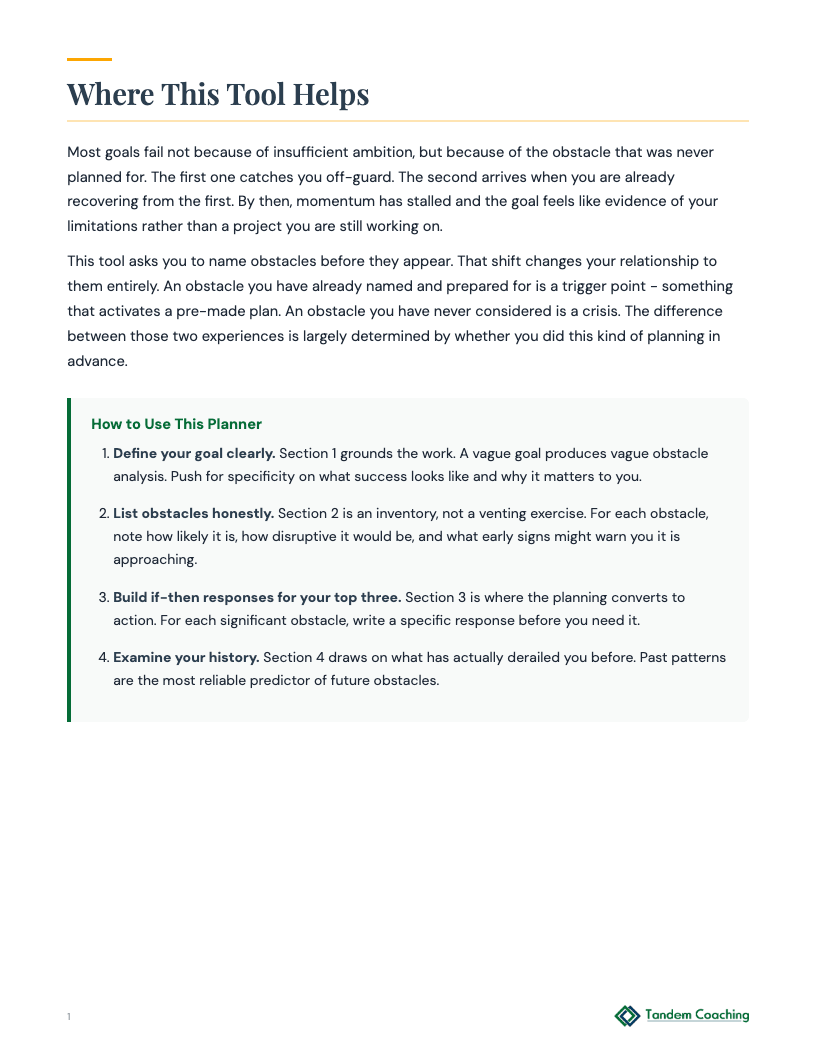
This worksheet pairs each obstacle with a specific response plan before you leave the session - would building that contingency layer into the goal you're working on be worth doing together?
A director of strategy has been in two prior coaching engagements and describes both as 'useful but incomplete.' In the current engagement, she has defined a clear goal — building a strategic planning practice for her team — and has made early progress. Her previous engagements also began well before losing momentum at roughly the month-three mark. She attributes the stalls to external factors: organizational change, competing priorities, a manager transition. Her coach suspects the stall pattern is predictable and connected to a specific type of obstacle she has not yet prepared for.
Use the pattern directly as the entry point. 'You've named external factors as what derailed the last two goals, and those were probably real. What we haven't yet built into this engagement is a contingency layer: what are the obstacles you can anticipate for this goal, and what's your prepared response for each? The research on goal failure is consistent — it's usually not the first hard thing that derails progress, it's the second one arriving before you've recovered from the first. This planner builds the response before you need it.' The pattern acknowledgment positions the tool as pattern-interruption rather than generic planning.
Section 4 (Resilience Check) is where the historical pattern becomes visible. Watch whether she names a specific recurring obstacle — the same type of thing that derailed the previous two goals — or whether the past-derailment field produces a different answer each time. Consistent past obstacles that she hasn't prepared for are more predictive than situationally different ones. Also watch the likelihood ratings in Section 2: clients who rate everything as 'low likelihood' are not engaging with the planner honestly. If her obstacles are all rated low-likelihood and she cannot name an early warning sign for any of them, the inventory isn't serving as contingency planning.
Start with Section 4. 'What derailed the previous engagements — as you've written it here — shows up with a likelihood of [x] in Section 2. Is the response plan you built for it actually different from what you tried before?' This compares the historical pattern to the current plan without requiring the coach to make the connection explicitly. Then move to the response plan that feels least solid: 'Which of the three response plans would you not actually follow through on if you were in the middle of a difficult week? What would make it more real?'
If the Section 4 Resilience Check reveals a recurring obstacle that she has named identically across two prior engagements — same type of disruption, same type of response, same stall — and the current response plan in Section 3 reads identically to what she tried before, the barrier may not be planning-level. Severity: low to moderate. The planner is appropriate, but a direct conversation about whether the recurring obstacle is external or whether it is an exit ramp she is unconsciously choosing may be more useful than a more detailed contingency plan.
A VP of operations is executing a significant organizational change: restructuring three functions under a unified operating model over 12 months. He is confident, experienced, and has executed large initiatives before. He has a detailed project plan. He does not have a personal contingency map for the obstacles that will affect his own capacity, motivation, and decision-making during the initiative — only for the project-level risks. His coach has observed that he treats his own resilience as a constant rather than a variable that needs to be managed. When obstacles appear in prior engagements, he pushes through rather than adapting.
Distinguish personal obstacle planning from project risk management. 'You have a risk register for the initiative. What you don't have is the equivalent for yourself: what are the specific obstacles that will affect your ability to lead this initiative — not the project risks, the personal ones — and what is your prepared response for each? This tool builds that map. Section 4 asks what has derailed you before on goals of this scale. The question is about you, not the project.' Framing this as personal risk management respects his planning orientation while expanding its scope.
The most important columns in Section 2 for this client are 'Likelihood' and 'Early Warning Signs.' Experienced executives often underrate the likelihood of internal obstacles — they have managed through external ones before, but personal capacity, relationship friction, and motivation shifts are harder to assess accurately. Watch whether his early warning signs are concrete ('I start canceling 1:1s') or abstract ('I get stressed'). Concrete early warning signs activate the response plan; abstract ones don't. If the warning signs are all abstract, work through one obstacle with him to identify the behavioral signal.
After completing the planner, lead with Section 3's response plans for the top three obstacles. 'For each of these — if this obstacle arrived on a Tuesday in month four, who specifically would you call and what specifically would you do in the next 48 hours?' If the response plans read as intentions ('I would reassess the timeline') rather than concrete actions, they are not functioning as pre-made decisions. Then: 'Which of these three obstacles would you be most tempted to push through rather than respond to — and what would that cost?' The push-through tendency is the gap the tool is designed to address.
If his obstacle inventory for his own capacity is genuinely sparse — if he cannot identify more than one or two personal obstacles for a 12-month organizational restructuring — the self-assessment may not be accurate. Severity: low. Probe with specifics: 'In your previous large initiative, what happened to your energy by month six? What happened to your availability to your team?' Historical data often surfaces obstacles that current optimism obscures.
A senior manager in a healthcare organization has set a goal she genuinely cares about: completing a credential that will advance her clinical leadership role. She has started the credential process twice over the past three years and withdrawn from both attempts during the final quarter of preparation. She attributes both withdrawals to workload and timing. She is starting the third attempt and believes 'this time is different' because she has negotiated protected study time. Her coach is skeptical that scheduling was the root obstacle and wants to build a more honest obstacle map before she begins.
Name the pattern honestly before introducing the tool. 'You've gotten to the final quarter twice and withdrawn both times. You've named the obstacle as workload and timing, and we've addressed that with the schedule negotiation. I want to make sure we've also named the other obstacles — including the ones that might appear in the final quarter specifically — and built a response for each. The goal is to have a prepared plan for the moment the obstacles arrive, not to figure it out when you're already in them.' This frames the planner as due diligence for a third attempt, not skepticism about her commitment.
The Section 4 Resilience Check is the diagnostic for this client. 'What derailed me before in this attempt?' If she writes the same external factors she's named previously — workload, timing — without naming any internal factors (anxiety about the assessment, comparison to peer performance, perfectionism about preparation quality), she has not yet mapped the obstacle that is most likely to recur. Watch whether the internal and external columns of her obstacle inventory balance. An obstacle inventory that is entirely external often means the internal obstacles haven't been examined.
Start with Section 4's third field: 'What I would do differently now.' 'Looking at what you've written — how is this response plan different from the response available to you in the previous attempts, when you ultimately withdrew?' If the difference is structural (protected time, different supervisor), the structural obstacle may have been addressed. If the difference is motivational or procedural ('I'll push through this time'), the response plan isn't stronger than what failed before. Then: 'If you imagine yourself in month eight, two weeks before the assessment, at the highest pressure point — what does your response plan say to do in that specific moment?'
If the obstacle inventory for the final quarter is sparse — if she cannot anticipate what has specifically activated withdrawal twice before — or if the response plan for the final-quarter obstacle is 'remind myself why it matters,' consider whether the underlying driver of the withdrawal is clearer than the planning addresses. Severity: low. The planner is appropriate, but if the withdrawal pattern is connected to performance anxiety or perfectionism rather than workload, those require targeted work alongside the contingency planning.
A client knows what they need to do but keeps hitting the same wall
LifeI tend to shut down after setbacks rather than learning from them
LifeClient keeps setting goals but stalls when obstacles appear