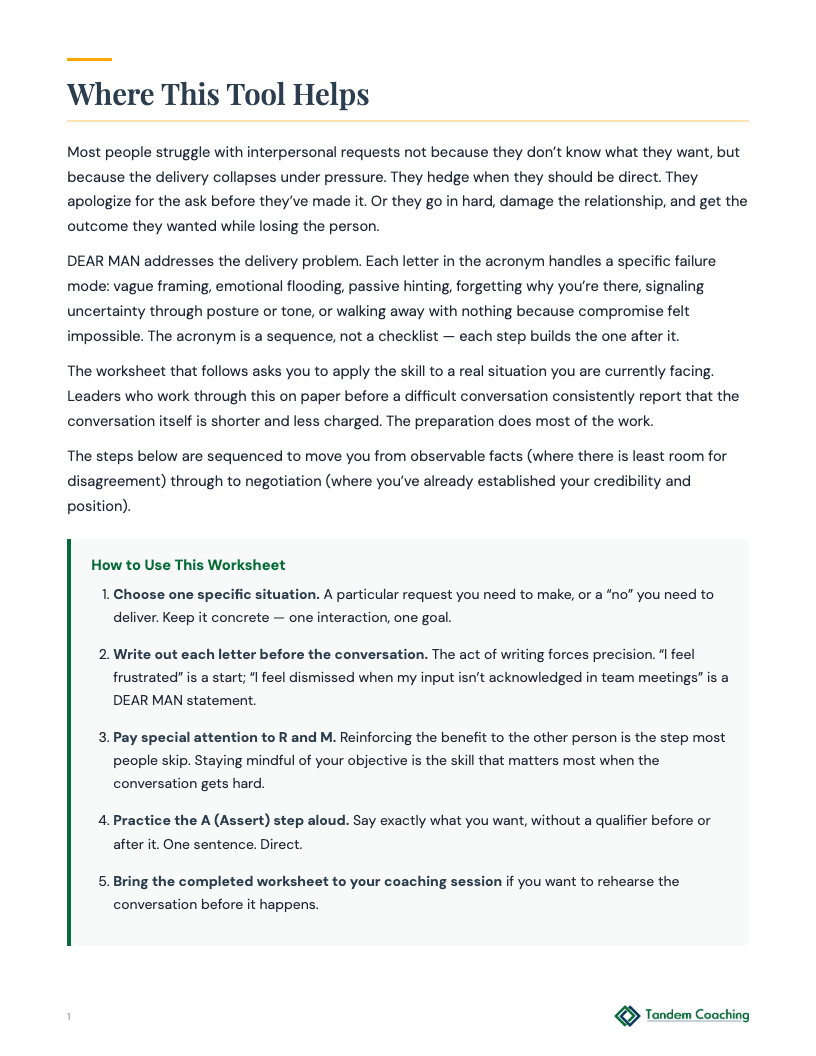
DBT DEAR MAN Skill

Pathway Builder 🔒
Domain
Relationships
Type
Worksheet
Phase
Action
Details
30 min Mid session As-needed
Topics
Communication

Tools for strengthening communication and team dynamics.

When to Use This Tool
A client needs to make a specific request or say no and wants to do it effectively
Someone preparing for a high-stakes conversation where the outcome genuinely matters
Walking through Describe, Express, Assert, Reinforce before a difficult ask
How to Introduce This Tool

There's a conversation you need to have where what you ask for matters — what would it look like to go in with a clear structure instead of improvising?

Coaching Tool Disclaimer
This tool is designed for coaching contexts, not clinical use. If you or your client is in crisis, contact the 988 Suicide and Crisis Lifeline (call or text 988) or Crisis Text Line (text HOME to 741741).

Download This Tool

Free PDF - print-ready, professionally formatted

Download Free PDF
Preview Worksheet · 30 min

For the Coaching Practitioner

Coaching Scenarios Plus
1 Manager who hints instead of asking and then resents the outcome
Context

A senior manager regularly signals what he wants in meetings through leading questions and indirect comments, then expresses frustration when others don't respond as he hoped. He describes himself as direct but his team and peers experience him as unclear.

How to Introduce

Frame the worksheet as a delivery problem, not a communication style overhaul. 'You know what you want — the worksheet helps you state it in a form other people can actually respond to. The Assert step is the one worth spending time on: write exactly what you are asking for, one sentence, before you're in the room.' Clients who resist direct communication often have an implicit belief that the other person should figure it out — worth naming: 'Is there a concern about what it means to ask directly? About how it looks?'

What to Watch For

If the Assert section contains a question instead of a statement — 'Could we possibly...?' or 'I was wondering if...' — the client has not completed the step. The Assert step requires a declarative sentence with a specific request. Ask him to read it aloud and notice whether it is something the other person could say yes or no to, unambiguously.

Debrief

Start with the Assert section. Ask him to read it aloud. Then ask: 'Is that what you actually want, or is that a softened version of what you want?' That question often surfaces a more specific underlying ask that the written version papers over. Then move to R — Reinforce: 'What did you name as the benefit to them? Is that genuinely true, or was it invented to smooth the ask?'

Flags

If the Negotiate section lists concessions that give away the core of what he wanted — not the edges — the client may be capitulating on paper before the conversation has happened. Severity: low. Hold him on the distinction between negotiating range and pre-emptive surrender.

2 Leader who goes emotionally hard in conflict and loses the outcome
Context

A VP knows how to advocate but tips into aggression when she feels dismissed. She wins short-term compliance while creating lasting wariness in peers. She wants to maintain her directness without the collateral damage.

How to Introduce

Position DEAR MAN as a structure that lets her stay in the conversation longer without tipping into the register that triggers defensiveness. 'You don't need to become less direct — you need the sequence to hold when the pressure goes up. The M step is the one that matters most for you: staying on your objective when the other person reacts in a way that pulls you off it.' Clients in this pattern often resist any tool that sounds like softening. Name it: 'This isn't about lowering your intensity — it's about channeling it so it doesn't undercut your own outcome.'

What to Watch For

Watch whether the M (Mindful) section identifies specific pulls — particular words, particular behaviors from the other person — or stays vague ('if things go sideways'). The more specifically she can name what historically pulls her off-track, the more the preparation is doing real work. If M is empty or generic, she has not thought through the moment where the conversation gets hard.

Debrief

After the conversation, start with the debrief question from M: 'Did anything pull you off your objective? What was it?' Then compare what she wrote in Assert with what she actually said in the room. The gap between the prepared statement and the in-room statement tells you whether the structure held under pressure.

Flags

If the R (Reinforce) section is blank or token — 'I told them it would be good for the team' — the client is skipping the step most likely to reduce defensiveness. Severity: low. A skipped Reinforce often correlates with the aggressive outcome she is trying to avoid: when the other person doesn't see what's in it for them, they get defensive, and she escalates.

3 New director needing to say no to her own manager for the first time
Context

A recently promoted director has been given an additional project that conflicts directly with a strategic priority she owns. She has never declined an assignment from her manager and is uncertain whether she is allowed to push back at her level.

How to Introduce

Frame the worksheet around clarity, not confrontation. 'This isn't about refusing — it's about having the conversation in a way that lands as problem-solving rather than resistance. The Describe step matters most here: if you start with the facts of your current load before you say anything about the new project, the ask makes sense in context rather than looking like avoidance.' Clients who have never declined an assignment often fear what it signals — worth checking whether she has a story about what no means.

What to Watch For

Watch the A (Assert) step for hedging language: 'I'm not sure I can...', 'I might need some help with...', 'Would it be possible to...'. The worksheet requires a direct statement of what she is asking for — a delay, a resource, a re-prioritization decision. If the Assert section does not contain a clear ask, the conversation will not produce a clear outcome.

Debrief

Start with the D (Describe) section and ask: 'Did you state the facts without interpretation — or did the description already contain your concern about the request?' Then move to N (Negotiate): what was she actually willing to offer as a path forward, and did the conversation stay there long enough to explore it?

Flags

If the 'After' reflection is blank — she did not use the tool for the actual conversation, only the preparation — the preparation and the delivery disconnected. Severity: low. Ask what got in the way of bringing the structure into the room. The answer usually reveals the underlying belief about what direct communication costs her.

4 Client with chronic boundary erosion who can't hold a negotiated agreement
Context

A chief of staff negotiates agreements — on scope, pace, decision rights — and then watches them erode within weeks. She is clear in the room and unclear in the follow-through. Each new conversation about the same issue starts from scratch.

How to Introduce

Position this tool around the N (Negotiate) step specifically. 'The conversation you're having isn't the problem — it's that the outcome isn't holding. This worksheet helps you build the Negotiate section with more specificity: not just what you will accept but what you will not, and what the path back looks like if the agreement gets ignored.' Some clients in this pattern need to see that negotiation includes naming the consequence of non-compliance, not just the preferred outcome.

What to Watch For

If the Negotiate section lists only what she is willing to accept — and nothing about what happens if the agreement is broken — the structure has a gap. The negotiation needs to include what she will do when the boundary is tested again. If that section is empty, ask: 'What's the plan when this comes up again in three weeks?'

Debrief

After she has used the tool and had the conversation, return to the Negotiate section and ask: 'What specifically did you agree to, and what did they agree to? Is that written down somewhere other than this worksheet?' The durability of the agreement often depends on whether it was made explicit in both directions.

Flags

If the M (Mindful) section names 'wanting to avoid conflict' as the primary pull off-track, and the client has been in this erosion pattern for more than one relationship or context, the worksheet may surface a pattern that belongs in the coaching agenda, not just the conversation preparation. Severity: low to moderate. Note it and decide whether to address the pattern directly.

Tool Flow
Requires
  • named specific interpersonal situation with concrete ask
Produces
  • scripted direct request or refusal statement
  • reinforcement framing naming benefit to other party
  • negotiation range map for the conversation

Pairs Well With

Executive

Communication Quality Checklist

A client wants to audit a specific message or presentation before sending it

15 min Checklist
Executive

Team Engagement Planner

A client is concerned about low morale or disengagement on their team

30 min Planner
Executive

Johari Window

A client wants to understand how others perceive them versus how they see themselves

30 min Framework

Related Articles

Executive Coaching for Career Transitions: What Changes Your Trajectory

Executive Coaching for Career Transitions: What Changes Your Trajectory

Read article →
The Power of Active Listening in Coaching: A Guide to Transforming Client Relationships

The Power of Active Listening in Coaching: A Guide to Transforming Client Relationships

Read article →
Why is Leadership Development Important? [Quick Answer]

Why is Leadership Development Important? [Quick Answer]

Read article →
Coaching Supervision for Internal vs. External Coaches

Coaching Supervision for Internal vs. External Coaches

Read article →
Coaching Confidence Boost: Develop Essential Skills and Thrive in Your Coaching Practice

Coaching Confidence Boost: Develop Essential Skills and Thrive in Your Coaching Practice

Read article →
Leadership Skills for Managing Hybrid & Remote Teams Effectively

Leadership Skills for Managing Hybrid & Remote Teams Effectively

Read article →