Daily Gratitude Tracker
Build a consistent gratitude habit with a simple daily prompt and streak tracking, designed by coaches to fit real-life routines.
Get This Tool
Free, print-ready PDF.
When to Use This Tool
Client wants to build a gratitude practice but has no structure to make it consistent
Client's emotional baseline is low and they have not been deliberately attending to what is going well
Client makes gratitude intentions that do not survive the demands of a full week without a tracking system
How to Introduce This Tool Plus
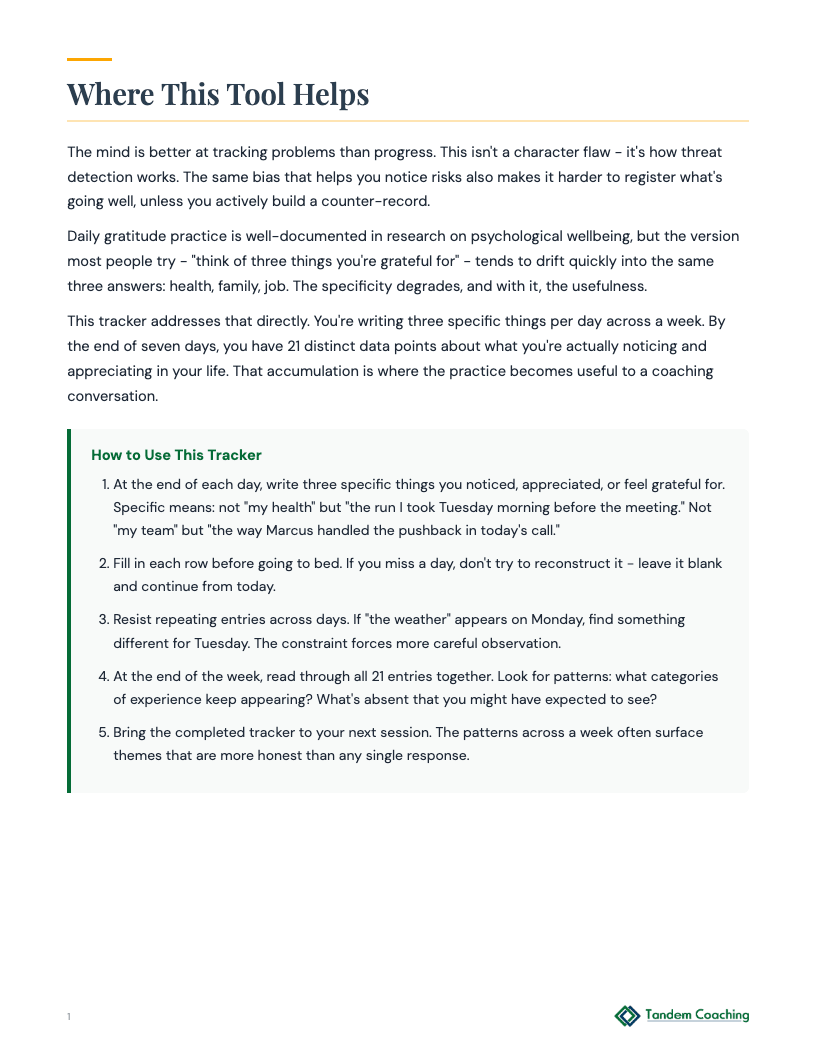
This is a seven-day gratitude grid with space for three specific items each day - would keeping it on your desk for the next week and bringing it to our session give us a different kind of data to work with?
Browse All Pages
Tool Classification
Domain
Life Coaching
Type
Tracker
Phase
Action
Reflection
Details
5 min
Between sessions
Weekly
Topics
Habits
Mindset
Self-Care
For the Coaching Practitioner
Plus
Coaching Scenarios
Plus
1 High-performer who only notices what's broken ▶
Context
A senior product manager runs fast, ships consistently, and rarely stops to acknowledge what's working. Their attention is consumed by what's behind, what's at risk, and what needs fixing. The low points feel louder than the wins, even when the wins are real.
How to Introduce
Frame this as a data-collection exercise, not a positivity exercise. 'You track metrics for everything else - this is a week's worth of data on what's actually going right. Three specific entries a day, end of day, before you close your laptop.' Clients who dismiss gratitude as soft are more willing to engage when the frame is observational rather than emotional.
What to Watch For
Vague entries are the signal. 'Good collaboration' means the client is filling boxes to complete the task. 'Tariq caught the API issue before it hit production and didn't wait to be asked' means the exercise is working. Check specificity: if most entries are categories rather than named events, the client is going through the motions. Also watch the Sunday read-back - clients who say 'it was fine, mostly similar things' have not looked for patterns.
Debrief
Start by asking them to read three entries aloud - not summarize, read. The act of saying them out loud changes the register. Then ask: 'What themes showed up more than once?' Patterns in a seven-day log are often more informative than the individual entries - relationships that appear repeatedly, times of day that generate better entries, areas of work that never show up. The question that tends to open things up: 'What surprised you about what made the list?'
Flags
If every entry is task completion ('finished the report,' 'cleared my inbox') and no entries name relationships, interactions, or non-work items, the client may have a narrowed attentional range that extends beyond professional habits. Severity: low to moderate. Continue coaching with the observation that work-only entries may reflect something worth exploring, not a bug in the exercise.
2 Client rebuilding after a difficult quarter or major setback ▶
Context
A director has come through a rough stretch - a failed product launch, a team conflict, or a personal loss - and is functionally back at work but carrying residual low-level demoralization. They are executing but their baseline is flat. The standard 'what's going well' question gets thin answers.
How to Introduce
Introduce this with explicit permission for the exercise to feel hard at first. 'Some days the three items will come easily. Other days you'll sit there for a few minutes. Both are useful. The ones you have to work for tell you something about where your attention has been living.' Don't promise it will feel different after a week - say it will give you both something concrete to look at.
What to Watch For
Entries that mix what went well with what went wrong ('I finished the deck, but the feedback wasn't great') indicate the client is editing positive entries before writing them. Watch also for blank days or days where entries are completed retroactively (several days at once). The pattern of when entries get made is as informative as what they contain.
Debrief
Start with the last two or three days, which are freshest. Ask: 'Were there entries that surprised you - things you wouldn't have noticed if you hadn't been looking?' Then move to the full week: 'What's here that you wouldn't have named if I asked you how the week went?' The gap between their verbal summary and what's actually on the page is often significant and worth naming.
Flags
If a client completes the full week but describes most entries as 'forced' or 'felt fake,' and the low-baseline mood persists beyond 3-4 weeks of consistent practice, the presentation may be more than situational demoralization. Severity: moderate. Explore whether coaching is the right sole modality, and whether clinical support might be appropriate.
3 Leader who gives generously but rarely receives or acknowledges ▶
Context
An executive director at a nonprofit is highly attuned to team recognition - sends notes, acknowledges effort publicly, names wins in all-hands meetings. When asked what's going well for them personally, they deflect immediately. Their own wellbeing is a blind spot maintained by relentless outward focus.
How to Introduce
Name the asymmetry upfront: 'You're good at noticing this for your team. This week, the exercise is about noticing it for yourself - specifically, what you appreciated about your own work and your own life.' Some clients in this profile will treat the exercise as another giving practice. Redirect: 'These entries are private. No one else reads them. They don't have to be useful to anyone else.'
What to Watch For
Entries that are about others ('my team handled the funder call well') rather than about the client's own experience. The tracker is designed to surface the client's positive attentional field, not their recognition of others. If three or more entries per day are other-focused, name it in session without judgment: 'I notice most of your entries are about other people. What shows up when you try to name something specifically about you?'
Debrief
Ask them to read the self-appreciation entries - the ones that are clearly about them, not others. Then ask: 'How did those feel to write?' The answer is usually 'awkward' or 'strange.' That awkwardness is the coaching conversation. 'What makes it easier to notice this in your team than in yourself?' - that question tends to open the real territory.
Flags
A client who cannot generate a single self-appreciating entry across a full week, and who experiences strong discomfort with the attempt, may have an internalized self-negation pattern that goes deeper than professional style. Severity: moderate. Note the pattern, name it gently, and explore whether it has roots the client has identified before.
Tool Flow
Plus
Requires
- None - standalone tool
→
Produces
- seven-day gratitude log with 21 specific entries
- weekly pattern map of recurring positives
- session-ready data on what actually went well
Pairs Well With
Wellness
Optional Daily Practice Context Log
Use this tracker to notice patterns in habits and self care over time before drawing conclusions.
Why it pairsThe log's momentum carries into this - use it to layer a second daily habit before the first one hardens.
ADHDOptional Week Review
Use this worksheet to explore executive function and accountability and turn the client’s observations into one optional next step.
Why it pairsAdd this to give the gratitude data a full-week context - the planner surfaces drains alongside the positives the tracker collected.
LifeDaily Practice Options
Use this planner to organize habits and self care into a client-owned sequence of possible next steps.
Why it pairsUse the recurring positives from the tracker to anchor all three committed habits to things the client already cares about.
Related Articles

How to Structure a Coaching Conversation That Actually Moves
Read article →
Information Radiator - Gut Check
Read article →
Coaching Supervision Models: How They Actually Work in Practice
Read article →
Managing Stress and Anxiety: Coaching Strategies for Leaders’ Well-Being
Read article →