Career Goal Action Map

Clarify what you want more and less of in your career with a structured, coach-tested map that turns preferences into actionable goals.

Worksheet · 30 min · Print-ready PDF · Free download

Get This Tool

Free PDF - professionally formatted, ready to print or fill digitally

Preview Worksheet · 30 min
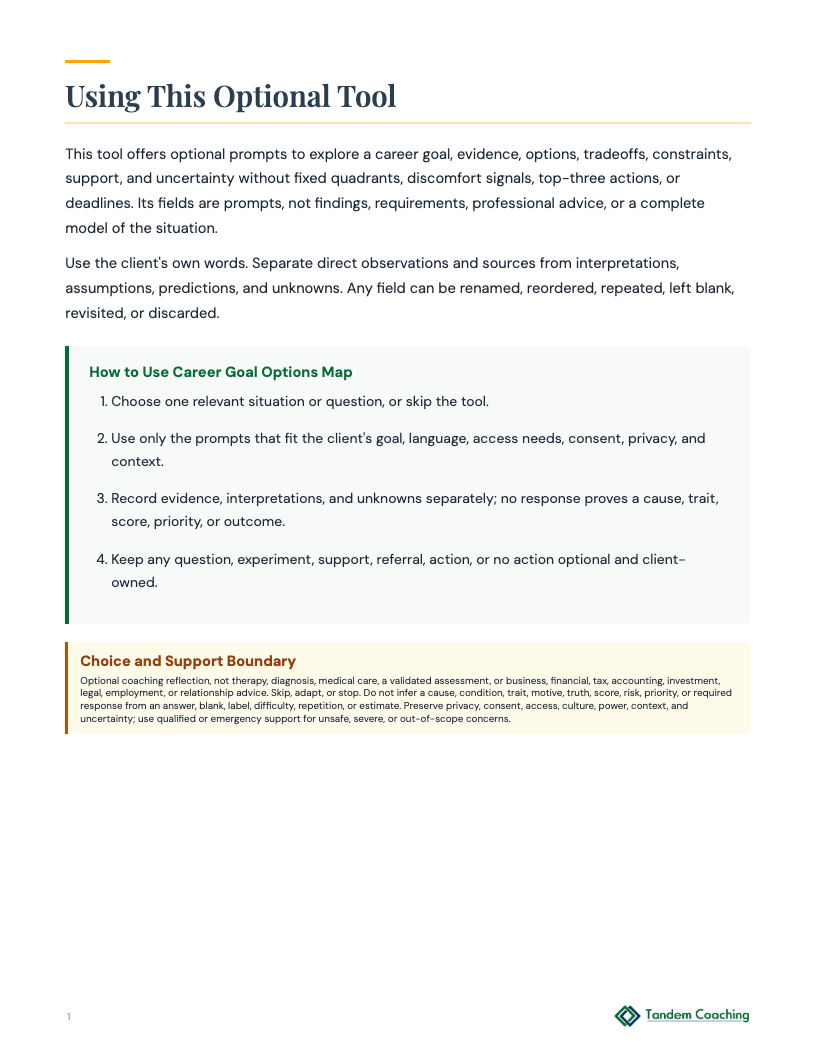
Career Goal Action Map - preview
When to Use This Tool
A client wants to clarify what they want more of and less of in their career
A client is evaluating their current role against what they actually want
A client wants to build a clear three-action next step from their career reflection
How to Introduce This Tool Plus

When you filled in the six quadrants, what landed in 'start' that surprised you — and what are you still unsure about?

Browse All Pages
Interactive Preview Worksheet · 30 min
Tool Classification
Domain
Career
Type
Worksheet
Phase
Goal Setting Reflection
Details
30 min Between sessions As-needed
Topics
Career Transition Accountability

For the Coaching Practitioner

Plus
Coaching Scenarios Plus
1 Mid-career professional who describes their career as 'fine' but has specific things they resent
Context

Your client is technically satisfied. They have a title they worked for, compensation that reflects their level, and a manager who is not a problem. When you ask what is not working, they need time to answer. The answer, when it comes, is a list of specific things: they resent being in meetings that produce nothing. They resent that their work is reviewed by someone less technical than them. They resent that they stopped doing the hands-on work they were best at three years ago. None of these are crisis-level. All of them are consistent. The Start/Stop/Continue format is the right tool because it produces a structured picture of what the client would actually change, as distinct from what they are resigned to.

How to Introduce

Frame this as making the implicit explicit. 'You've named a few things that aren't working. The worksheet maps those against all six quadrants - what you'd start, stop, continue, do more of, less of, or differently - so we have a complete picture rather than a list of grievances.' The resistance pattern: clients who describe their situation as 'fine' sometimes use the worksheet to confirm that it is fine. They produce entries in Continue, leave Start and Stop sparse, and confirm their resignation. Watch for that pattern from the first few entries - if everything is landing in Continue, the permission to name what isn't working has not been taken.

What to Watch For

Watch the Stop quadrant carefully. Clients who resent specific things often write Stop entries that are diplomatic versions of what they actually mean: 'Stop attending recurring meetings that aren't productive' when what they mean is 'Stop being required to attend the weekly leadership call that wastes two hours.' The more specific the Stop entry, the more actionable the conversation becomes. Also watch whether the Do Less Of quadrant contains anything that the client's manager currently values. If the client wants to do less of something their manager explicitly wants them to do more of, that tension is the coaching material, not the quadrant.

Debrief

Start with the Stop and Do Less Of quadrants together. Ask: 'For each of these, is it something you have the authority to stop, something you would need permission to stop, or something outside your control entirely?' That categorization separates the actionable items from the ones that require a negotiation or a different conversation. Then look at the first three actions and deadline field: 'Which action, if taken in the next three weeks, would change how you feel about coming to work?' That question identifies the highest-leverage move and connects the worksheet to the motivational question underneath the 'fine' presentation.

Flags

If the client's Stop and Do Less Of quadrants are dominated by things their role structurally requires - not by chance assignments but by the core responsibilities of their position - the Career Goal Action Map may be surfacing a person-role mismatch rather than a career optimization opportunity. Severity: low. Response: note the pattern and explore directly: 'Looking at what you want to stop doing against what this role requires, how much of the role is actually in the Continue and Do More Of columns?'

2 Senior professional considering a career pivot who hasn't mapped what they would leave and gain
Context

Your client is contemplating moving from one career track to another - from practitioner to manager, from corporate to independent, from their current industry to an adjacent one. The contemplation has been happening for two years. They can articulate the attraction of the new path clearly and the frustrations of the current one clearly. They have not formally examined what the pivot would require them to stop doing, continue doing, start doing, or do differently - which means they are making a two-year decision based on emotional pull and professional dissatisfaction rather than a mapped comparison. The Career Goal Action Map creates the structural inventory.

How to Introduce

Frame this as a mapping exercise for both paths simultaneously. 'The six quadrants apply to the current path and the proposed path. For the current path, what would you stop, continue, and do more of - and for the new path, what would you have to start and what would you lose from the Continue column? The map shows you what the trade is, not just what you're moving toward.' The resistance pattern: clients who have been considering a pivot for a long time sometimes want validation more than mapping. Watch for entries in the new path's Start quadrant that are all positives and entries in the current path's Stop quadrant that are all negatives - that pattern signals the client is using the worksheet to confirm a decision rather than examine it.

What to Watch For

Watch the Continue quadrant for this client. The most useful Continue entries for a pivot scenario are the skills, relationships, or work types the client can carry across paths - these are the assets the pivot preserves. If the Continue quadrant is sparse, either the mapping has not been done carefully or the proposed pivot is more of a break than a transition, which changes the conversation. Also watch the Do Differently quadrant - this is often where the most interesting material lives for pivot clients, because it contains things the client wants to change about how they work regardless of which path they choose.

Debrief

After the map is complete, read the Stop quadrant aloud and ask: 'Is each of these something you actually can't do on the new path, or something you're assuming you can't do because of how you've seen other people take that path?' That question often uncovers assumptions that haven't been tested. Then look at the first three actions: 'What is the one action on this list that would give you the most information about whether the new path is what you think it is - before you make any structural commitment?' That question redirects from deciding to experimenting.

Flags

If the client's two-year contemplation has been accompanied by inaction that is affecting their engagement with their current role - if they are waiting for the pivot rather than working in the present - the Career Goal Action Map is appropriate but the stasis pattern may need direct attention. Severity: low. Response: note the duration of the contemplation period and explore: 'What would need to be true for you to either commit to the pivot or commit to the current path - and what is preventing that decision?'

3 High performer who has been promoted into a role they're succeeding in but not finding meaningful
Context

Your client is objectively successful in their current role. They were promoted because of demonstrated capability. The promotion was into a general management role; they came from a specialist track. Twelve months in, they are meeting expectations, developing their team, and disengaged. The work does not interest them. They are good at it and bored by it. They have not said this to anyone because being good at the role and not finding it meaningful feels like ingratitude. The Career Goal Action Map is the right tool because the Do Less Of and Stop quadrants create a sanctioned way to name what is not working without requiring the client to frame it as a problem.

How to Introduce

Frame this as a routine career mapping, not a dissatisfaction exercise. 'The worksheet works through what you'd keep, change, and move toward in your career - independent of your current role. It is just as applicable when things are going well as when they aren't.' The resistance pattern: high performers who are quietly disengaged sometimes use the worksheet to reinforce their official story: everything in Continue, 'nothing to stop,' ambitious entries in Start that they will never act on because acting on them would require naming the disengagement. The task is to create enough permission that the Do Less Of and Stop quadrants get honest entries.

What to Watch For

Watch the Start quadrant for this client especially. High performers who are disengaged often know exactly what they would start doing if they could - they have a specific, vivid answer to this question, and it is usually the specialist work they left when they were promoted. If the Start quadrant produces unusually specific entries while the Continue quadrant for their current role is tepid, you have found the finding. Also watch the Do More Of quadrant: if the things the client wants to do more of are all things outside their current role, the map is showing you that the current role is not in the client's Continue column regardless of what is written there.

Debrief

After the map is complete, read the Start and Do More Of quadrants together and ask: 'How much of what's in these two columns can you access in your current role - and how much of it requires a different role?' That question is direct and gives the client a way to name the mismatch without framing it as failure. Then look at the first three actions: 'If you took the top action on this list seriously, where would it point you?' The answer to that question is usually more honest than anything that was written in the quadrants.

Flags

If the client's disengagement is severe enough that it is affecting their performance in ways they have not yet acknowledged - if what looks like success is actually coast - the Career Goal Action Map is the right starting point but the conversation about trajectory needs to happen soon. Severity: low to moderate. Response: note whether the client has given any signal of plateauing effort, and whether the coaching should name the trajectory question directly in the next session.

Tool Flow Plus
Requires
  • specific named career goal
Produces
  • six-quadrant behavioral change map
  • three prioritized first actions with deadlines
  • named habits working against the career goal

Pairs Well With

Career

Personal Budget Tracker

My client wants to make a career move but says they can't afford to take the risk

30 min Tracker
Career

Career Transition Planner

A client is seriously considering leaving their current role or field

45+ min Planner
Career

Performance and Development Planner

A client wants to take ownership of their own development rather than waiting for a manager to drive it

45+ min Planner

Related Articles

Executive Career Pivot Strategy: Framework for Adjacent Moves

Executive Career Pivot Strategy: Framework for Adjacent Moves

Read article →

AI Opportunity Evaluation Framework for Executives | 3 Filters

AI Opportunity Evaluation Framework for Executives | 3 Filters

Read article →
Executive Career Reinvention: When Starting Over Makes Sense

Executive Career Reinvention: When Starting Over Makes Sense

Read article →

Transform Your Executive Role for AI | Strategic Guide 2026

Transform Your Executive Role for AI | Strategic Guide 2026

Read article →
5 Signs Your Executive Role Is Changing Due to AI

5 Signs Your Executive Role Is Changing Due to AI

Read article →
Chief AI Officer Career Path: Is CAIO Right for You?

Chief AI Officer Career Path: Is CAIO Right for You?

Read article →