Coaching Skills: A Practitioner’s Guide to ICF Competency Development
The ICF’s eight core competencies have been describing the same thing since their 2019 update: what a coaching skill looks like when it is fully developed. Not when it has been learned - when it has been developed. The distinction matters because most discussions of coaching skills stop at learning. Here is how active listening in coaching works. Here is a powerful questioning technique. Here is the GROW model in coaching. What the competencies actually measure is the quality of skill expression in a live session. That is a different question, and this guide is organized around it.
The gap between understanding a coaching skill intellectually and possessing it as a reliable capacity is wider than most new coaches expect. In every ACC cohort we teach, there is a moment - usually around week four - where a student coaches a peer and says: “I thought I was listening. But I was actually just waiting for a pause so I could ask my next question.” That recognition is not a failure. It is the point where skill development begins.
This guide covers what makes a coaching behavior into a coaching skill, the five core skills professional coaches develop, how those skills change expression from ACC through PCC to MCC, the inner game that determines whether skills fire or misfire in session, how skills operate inside coaching models, the specific ways coaching skills fail, and how development actually works when it is working. Each section links to deeper practitioner coverage across 20 supporting articles.
Key Takeaways
- Coaching skills are a developmental arc, not a technique checklist - the same behavior operates differently at ACC, PCC, and MCC levels
- Five core skills (active listening, powerful questioning, building trust, coaching presence, and direct communication) form the practitioner foundation mapped to ICF competencies
- The coach’s inner game - self-awareness, engaged neutrality, managing reactivity - is the mechanism that determines whether technical skills produce coaching or performance
- Volume alone does not develop skills; 500 sessions without reflective practice is 500 sessions of confirming existing patterns
- Skill failure modes (over-questioning, performative listening, accountability before trust) are specific and recognizable, not abstract warnings
What Makes a Coaching Skill
A coaching technique is what a coach does in a specific moment: a reframe, a scaling question, a silence held deliberately. A coaching skill is the capacity the coach has developed that determines which moment calls for which technique. The technique is the move. The skill is the judgment, timing, and presence behind it.
Build These Skills with ICF Training
Tandem's ACC program develops these competencies through structured practice with MCC-level mentors.
This distinction separates coaching skills from coaching behaviors. A behavior is observable: the coach asks an open-ended question. A skill is the consistent access to the right behavior at the right moment across the full arc of a session, even when the session goes somewhere the coach did not plan. A coach who has memorized ten types of questions has ten techniques. A coach who can read a session and select the right question for the right moment in the right tone has a skill.
The ICF organizes its eight core competencies into four domains: Foundation (ethics, coaching mindset), Co-creating the Relationship (trust, presence), Communicating Effectively (active listening, powerful questioning), and Cultivating Learning and Growth (awareness, designing actions, managing progress). Understanding the ICF core competency model matters because these are not categories of knowledge. They are categories of developed capacity. Each competency describes what the skill looks like when the coach can produce it reliably in session.
A coach who has memorized ten types of questions has ten techniques. A coach who can read a session and select the right question at the right moment has a skill. The difference is not volume of knowledge - it is quality of access under pressure.
The same is true of the relationship between skills and models. The GROW model is a map: Goal, Reality, Options, Will. Active listening is what happens inside that map. GROW does not listen for the coach. GROW does not produce powerful questions. The model provides sequence. The skill provides quality. A coach who knows GROW but has not developed listening skill will walk through the phases competently and miss everything that matters.
The 5 Core Coaching Skills
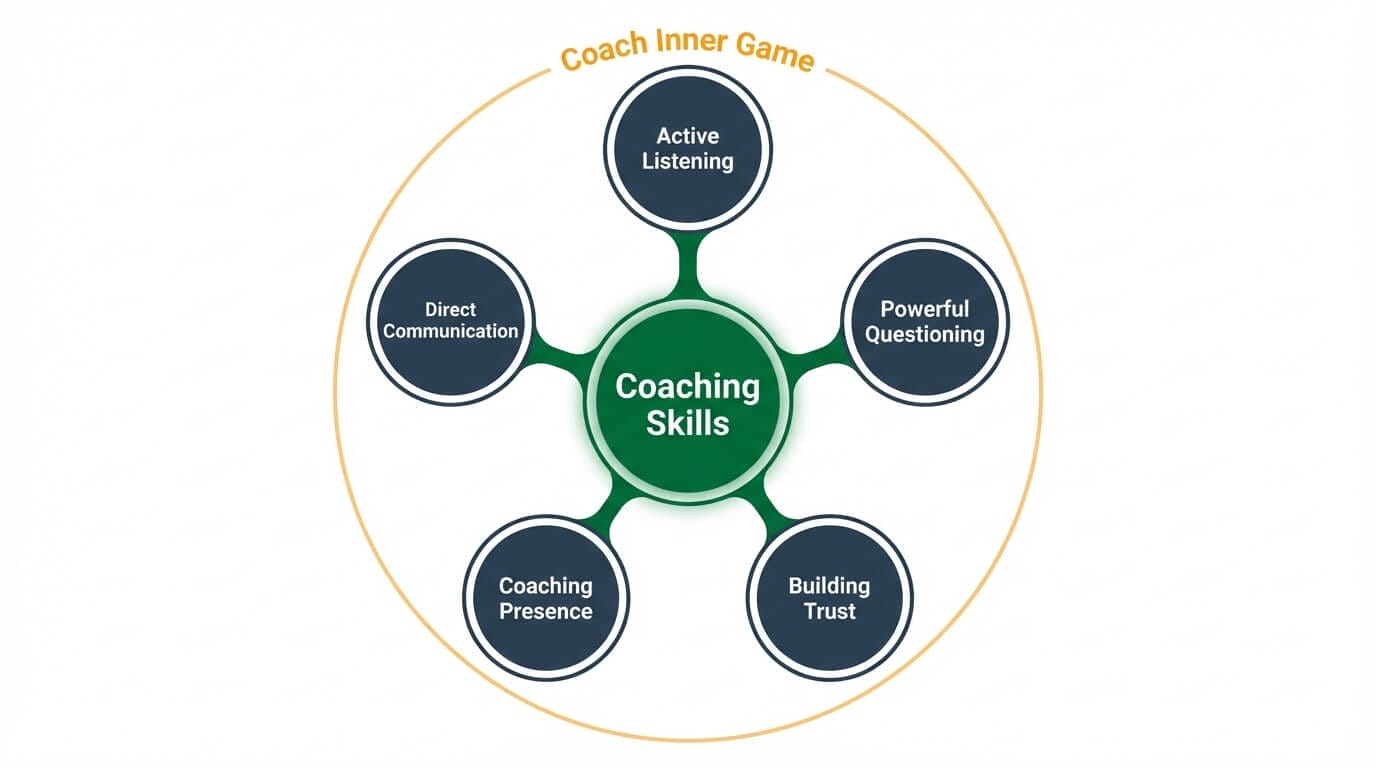
Five skills form the practitioner foundation. Every ICF credential level measures some expression of these five. Every coaching model assumes the coach possesses them. What follows is not a summary of what each skill is - it is a practitioner account of what each skill demands and where it breaks down.
Active Listening
ICF Competency 6 describes active listening as focusing on “what the client is and is not saying to fully understand what is being communicated.” In practice, this means three concurrent levels of attention. Level 1 (internal listening) tracks the content - what the client is saying, the facts, the narrative. Level 2 (focused listening) tracks the person - tone shifts, energy changes, what gets repeated and what gets avoided. Level 3 (global listening) tracks the system - what is present in the room that neither person has named.
What degrades listening is not distraction. It is the coach’s own thinking. The moment the coach starts composing their next question while the client is still speaking, they have dropped from Level 2 to Level 1. This happens in every session. The skill is not preventing it. The skill is noticing it and returning. A deeper treatment of what distinguishes each level, including what to do when listening collapses mid-session, is covered in our guide to active listening in coaching.
Powerful Questioning
The beginner thinks the skill is the question itself. The practitioner knows the skill is the timing. A question that opens a door the client did not know was there, asked thirty seconds too early, before the client has finished describing what is actually happening, produces defensiveness instead of insight. The ICF calls this productive disequilibrium - the cognitive state a well-timed question creates where the client’s current frame of understanding does not quite hold, and they need to construct a new one.
The common failure is volume. A session that is 80% questions is not coaching. It is interrogation with good intentions. For a detailed treatment of what separates purposeful inquiry from patterned questioning, see powerful questions in coaching and why masterful coaches never ask randomly.
A powerful question asked thirty seconds too early is not a powerful question. It is pressure wearing a coaching costume.
Building Trust
Trust is not built once. It is earned, spent, eroded, and rebuilt across the arc of a coaching relationship. ICF Competency 4 (Cultivates Trust and Safety) treats it as a state to establish. In practice, trust is a currency. A coach spends trust capital every time they offer a direct observation. They earn it every time they demonstrate that they heard something the client did not expect to be heard.
Trust builds when the coach names what they observe without evaluating it. “I notice you paused just then” is a trust move. “You seem hesitant” is an interpretation that can erode it. The difference is one sentence, and it separates coaches who build trust from coaches who assume they have it. For the full treatment of trust formation, rupture, and repair across a coaching engagement, see building trust in coaching relationships.
Coaching Presence
Coaching presence is the container inside which the other four skills operate. ICF Competency 5 describes it as being “present and flexible during the coaching process, dancing in the moment with the client.” In mentor coaching groups, when coaches are asked what “dancing in the moment” actually looks like in their body, in their breath, in the pacing of their questions, most go quiet.
That silence is not a knowledge gap. It is a practice gap. Presence is the first skill to atrophy under caseload pressure, the first to degrade when a coach is fatigued, and the hardest to recover mid-session once lost. It is also the skill that, when fully developed, makes the other four feel effortless to the client. What the client experiences as a good coach is, more often than not, a present coach.
Direct Communication
Direct communication is the undertaught fifth skill. ICF Competency 7 (Evokes Awareness) includes sharing observations, insights, and feelings without attachment to being right. In practice, most coaches err on the side of softening their observations until the observation disappears. “I wonder if there might possibly be something about the way this situation feels that could perhaps be worth exploring” is a sentence that says nothing while using many words.
The skill is naming what you observe clearly, without evaluation and without softening to the point of meaninglessness. It requires trust (which is why it builds on the previous three skills) and presence (to know whether the timing is right). For the full range of core coaching techniques that support direct communication in session, including NLP-informed approaches, see the supporting guides.
Coaching Skills Across Credential Levels
The same five skills operate at every credential level. What changes is the quality of expression - how reliably, responsively, and invisibly the coach produces the skill under session conditions. The ICF's ICF Core Competencies define the behaviors. The credential levels describe how deeply those behaviors have been internalized.
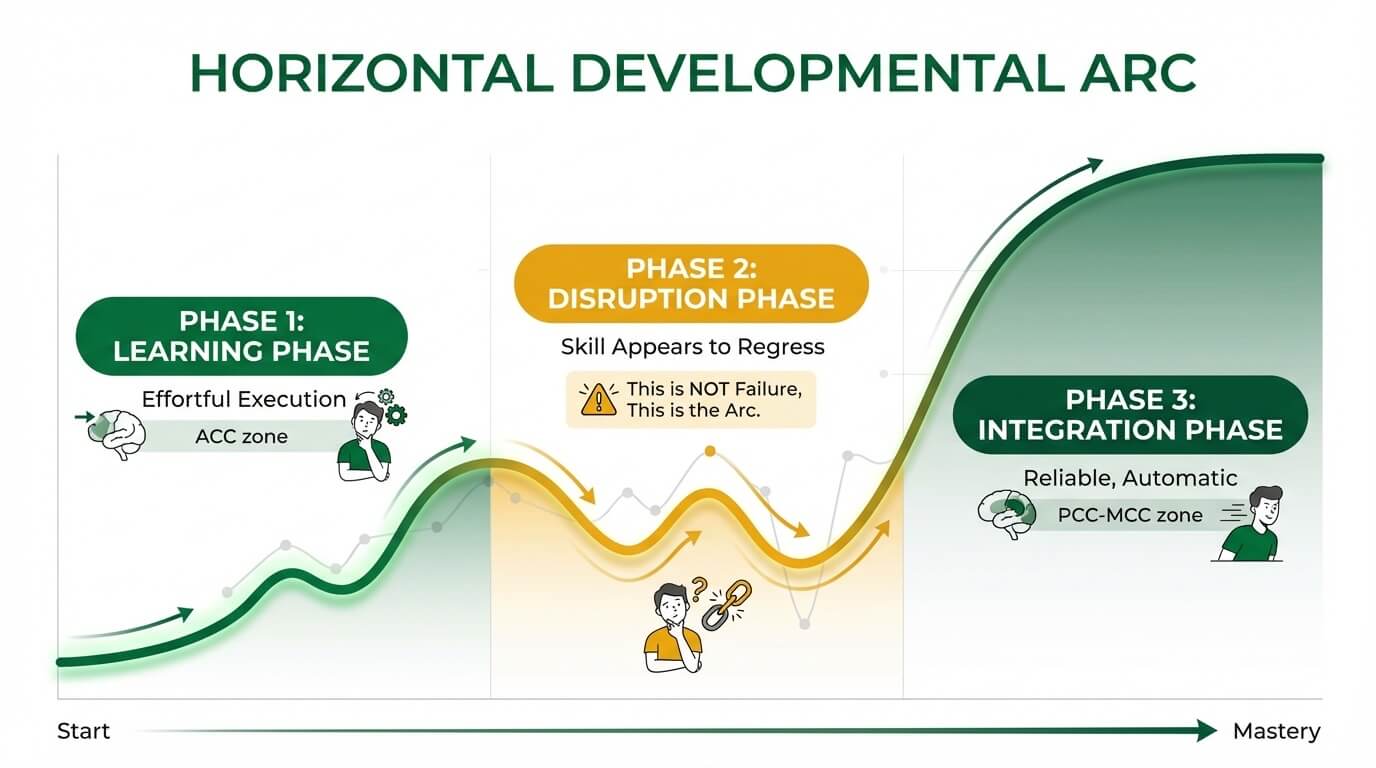
At ACC level, coaching skills are learned and execution is effortful. The coach knows what active listening is and can produce it when they concentrate. They ask open-ended questions because they have been taught to. They follow the coaching model because the structure provides safety. The work at this level is building automaticity - moving skills from conscious execution to reliable access. An ICF ACC certification training program is designed around exactly this transition: from understanding the competencies to demonstrating them under live observation.
At PCC level, skills are reliable. The coach does not think about whether to ask an open-ended question. They think about which question fits this moment for this client. PCC Marker 6.1 asks assessors to evaluate whether the coach “explores beyond what the client says in order to understand the client’s thinking, perspective, feelings, needs, wants, meaning, or belief systems.” This is not a technique. It is a settled capacity. Coaches at this level adapt in real time because the basic skills no longer consume their cognitive bandwidth. The PCC certification program develops this fluency through mentor coaching and extended supervised practice.
At MCC level, skills become invisible. What we observe in coaching sessions at the MCC level is that the coach is not performing the competencies. The skills are internalized enough that cognitive bandwidth is freed for full presence. MCC-level coaches spend less time planning session structure but produce sessions rated higher on both focus and flexibility. The paradox only makes sense when you understand the developmental arc: structure becomes unnecessary when the skills underneath it are fully developed. This is where coaching becomes transformational coaching - not because the coach has different techniques, but because the depth of skill integration allows something qualitatively different to happen in the room.
| Skill | ACC Expression | PCC Expression | MCC Expression |
|---|---|---|---|
| Active Listening | Tracks content; catches obvious themes | Tracks person and patterns across sessions | Tracks the system - what is present but unnamed |
| Powerful Questioning | Asks open-ended questions from training | Times questions to the client’s readiness | Questions emerge from deep presence, not planning |
| Building Trust | Follows contracting protocol reliably | Notices and repairs trust ruptures in real time | Trust is the medium the session operates inside |
| Coaching Presence | Maintains focus with conscious effort | Recovers quickly when presence slips | Presence is the default state, not the goal |
| Direct Communication | Shares observations with hedging | Names observations clearly without attachment | Observations land precisely because timing is instinctive |
The Coach’s Inner Game
Every skill described above can be understood, practiced, and still fail in session. The reason is almost never technical. It is internal. The coach’s inner game - the capacity for self-awareness, emotional regulation, and engaged neutrality - is the mechanism that determines whether the five core skills produce coaching or produce performance.
Engaged neutrality means caring about the person without caring about the outcome. Not detachment - that is something different and easier. Neutrality means noticing the moment your brain offers you an opinion, then a suggestion, then a solution, and choosing none of them. It means sitting with a client who is about to make a decision you think is wrong and staying curious about their reasoning instead of steering them away from it.
Consider this scenario. A coach is halfway through session seven. They realize they have been hoping the client will mention the feedback they received from their team. The client has not mentioned it. The coach notices this hope. The question surfaces: where is the coaching now - in what the client is bringing, or in what the coach wants to explore? That noticing is the inner game. Most coaches do not catch this until well after the session, if they catch it at all.
Engaged neutrality is not detachment. It is noticing the moment your brain offers you an opinion, then a suggestion, then a solution - and choosing none of them while staying fully invested in the person across from you.
Self-awareness is the meta-skill because a coach cannot manage reactivity they cannot detect. The pull toward advice-giving, the urge to steer the conversation, the subtle frustration when a client does not see what seems obvious - these are not character flaws. They are the internal conditions that every coach manages, session after session. The coaches who develop further are the ones who develop the capacity to notice these conditions while they are happening, not in reflection afterward. For the relationship between self-awareness and coaching orientation, see the guides on mindset coaching and growth mindset coaching.
Coaching Skills and Models
A coaching model is not the source of coaching skill. It is the architecture inside which skills operate. The GROW model in coaching maps four phases - Goal, Reality, Options, Will - but does not tell the coach how to listen during Reality, how to time a question during Options, or how to hold presence when the client’s stated goal turns out to be a cover for a deeper issue halfway through the session.
The most common error we observe in coaches learning GROW is asking “What have you tried?” during the Reality phase before the client has fully described what is actually happening. The client has described their interpretation of reality. They have not described reality. The coach, eager to move the conversation forward, treats the first account as complete. That is not a model error. It is a listening error inside the model.
When comparing coaching models - GROW, CLEAR, OSCAR, and others - the selection question is not which model is “best.” It is which model fits the client’s presenting issue. CLEAR outperforms GROW when the issue is relational rather than goal-oriented, because CLEAR’s Contracting phase front-loads the relationship dynamics that GROW’s Goal phase can skip entirely. The skill of selecting a coaching framework is a meta-skill: the capacity to read the session and choose the right structure before defaulting to the one you know best.
The model does not listen. The coach does. GROW does not produce good questions. The coach’s skill of powerful questioning does. Understanding this relationship changes how a coach develops: you do not get better at coaching by learning more models. You get better by developing deeper skills inside the models you already know. For the practical mechanics of how skills and structure combine in real time, see the guide on how to structure a coaching conversation.
Coaching Skills for Leaders
The five core coaching skills transfer directly to leadership practice. Active listening, powerful questioning, building trust, presence, and direct communication are the behavioral foundation of executive coaching as a primary application of coaching skills. But a leader using coaching skills is not practicing coaching, and the distinction matters.
A professional coach operates under a clear agreement: the client sets the agenda, the coach does not advise, the relationship is bounded by a contract. A leader operates under different constraints entirely. They have organizational obligations. They hold positional authority. They sometimes need to give direction. A manager who adopts a pure coaching stance - never advising, always questioning - has misunderstood the role. The skill for leaders is knowing when to coach and when to direct, and making that transition transparent rather than manipulative.
What changes is the ethical boundary around advice. A professional coach who offers unsolicited advice has broken the coaching agreement. A leader who withholds critical information from a direct report in order to “let them discover it themselves” has confused coaching with an abdication of responsibility. The coaching stance for leaders includes role clarity: being explicit about when you are coaching, when you are mentoring, and when you are directing. The same listening and questioning skills apply in all three modes. The framing around them shifts. For leaders pursuing formal coaching credentials alongside their leadership role, a team coaching credential addresses the specific demands of coaching within organizational systems.
How Coaching Skills Develop
The only way to develop a coaching competency is to practice it. You can read every article and every book about coaching and you will not become a coach. This is not rhetoric. It is a structural fact about skill acquisition. Coaching skills are embodied capacities - they require repeated execution under live conditions with reflective feedback to develop.
But volume alone does not produce development. A coach with 500 sessions and no structured supervision has 500 sessions of confirming their existing patterns. They have developed fluency - the ability to conduct a session that feels smooth and competent. They have not necessarily developed precision - the ability to do the right thing at the right moment for the right reason. The difference between fluency and precision is what separates experienced coaches who plateau from experienced coaches who continue to develop.
What atrophies without deliberate attention: presence is the first skill to degrade under caseload pressure. Neutrality is the first to slip when a client’s situation resonates with the coach’s own material. Listening depth is the first to go when the coach is fatigued. These patterns are not failures of commitment. They are the natural consequences of cognitive load, and recognizing them is itself a developmental skill.
The developmental arc also has a disruption phase that most coaches do not expect. A coach who is naturally strong at internal listening (tracking content) will often regress when they begin developing global listening (tracking the system). The old skill stops working before the new skill is reliable. This is not failure. It is the arc. Coaches who are warned about this phase weather it. Coaches who are not warned often interpret the regression as evidence that they are getting worse, and retreat to what was already comfortable.
Supervision, mentor coaching, and peer reflection groups are not remedial. They are the institutional mechanism for skill development at the PCC-to-MCC transition. Reflective practice in coaching and learning loops in coaching cover the specific structures that support ongoing development beyond the initial credential.
Skill Failure Modes
Coaching skills do not fail abstractly. They fail in specific, recognizable patterns that experienced coaches and supervisors can name. Three failure modes appear consistently enough to be worth knowing by sight.
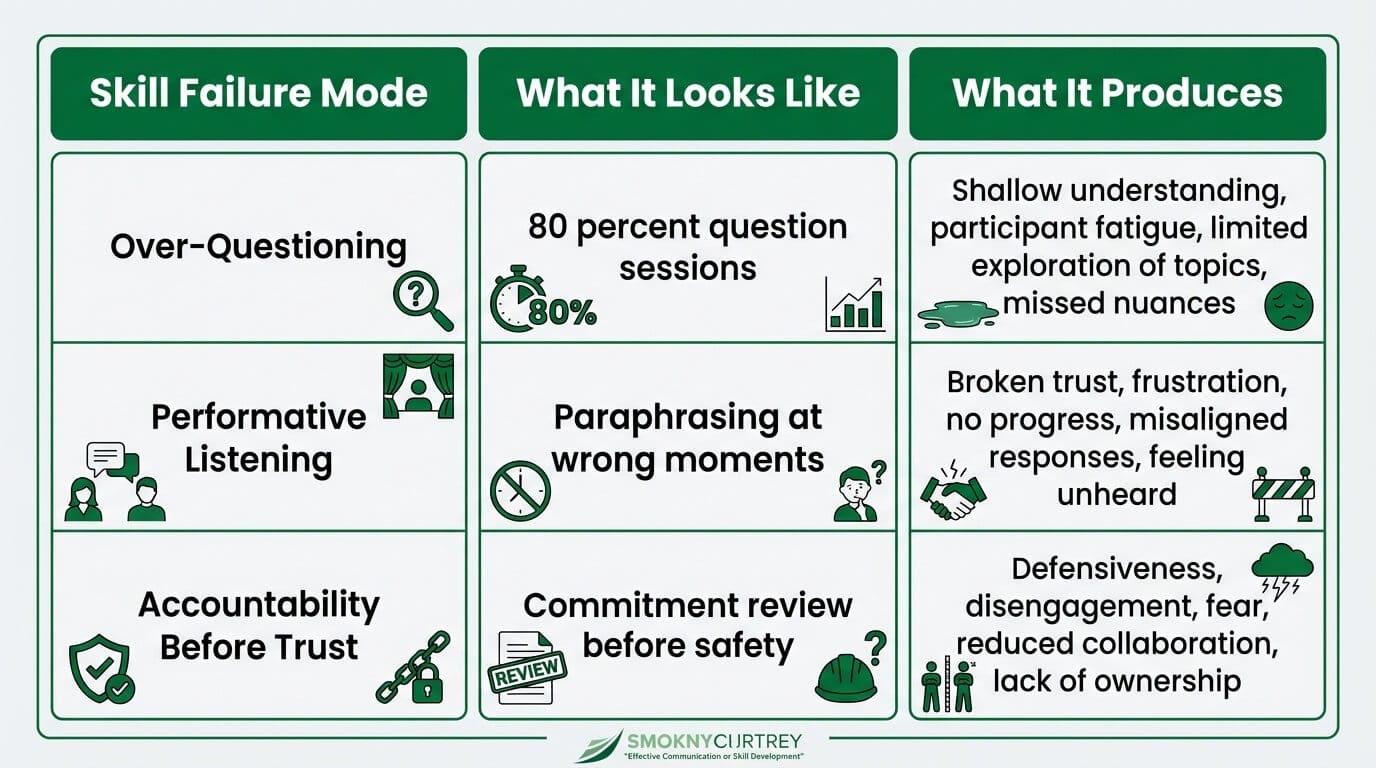
Over-questioning. A session that is 80% questions and 10% silence and 10% paraphrase is not coaching. It is interrogation. The client experiences rapid-fire questioning as pressure, not exploration. The coach often does not notice because each individual question seems reasonable. The pattern, not the individual question, is the problem. Coaches who discover they over-question typically need to develop their direct communication and silence skills as counterweights.
Performative listening. The coach makes eye contact, nods, paraphrases at regular intervals, and is not actually listening. The client can tell because the responses come at the wrong moments - the paraphrase captures the content but misses the emotional weight, the reflection comes a beat too late, the follow-up question addresses what was said rather than what was meant. Performative listening is harder to detect from the outside than from inside the coaching relationship, which is why accountability coaching structures often include client feedback mechanisms.
Consider this scenario. A coach opens session two with a commitment review. The client made three commitments last session and completed one. The coach reviews the two incomplete items methodically. The client becomes progressively quieter. By the end of the review, both are looking at the same data: a client who did not do what they said they would. The conversation that follows is a slightly more sophisticated version of “what happened and what will you do differently?” Nothing in this exchange is coaching. It is compliance management with coaching vocabulary. Accountability before trust - driving commitment review before the relationship has developed enough safety for honest exploration of what got in the way - is the third failure mode, and it is the one coaches most often mistake for good practice.
Frequently Asked Questions
What are the core coaching skills?
The five core coaching skills are active listening, powerful questioning, building trust, coaching presence, and direct communication. These map to the ICF’s eight core competencies organized across four domains: Foundation, Co-creating the Relationship, Communicating Effectively, and Cultivating Learning and Growth. Each skill operates at different levels of depth depending on the coach’s development.
How long does it take to develop coaching skills?
ACC-level skill reliability requires 60-100 hours of supervised practice alongside formal training. PCC-level expression typically requires 500+ coaching hours plus ongoing mentor coaching and reflective practice. The timeline varies, but most working professionals reach ACC in 6-9 months and PCC within 2-3 years of active practice with structured feedback.
What is the difference between coaching skills and coaching techniques?
A coaching technique is a specific intervention - a reframe, a scaling question, a deliberate silence. A coaching skill is the developed capacity that determines when a technique is appropriate, how to execute it in context, and whether the timing serves the client. Skills produce technique selection. Techniques without underlying skills produce mechanical sessions.
Do leaders need different coaching skills than professional coaches?
The core skills are the same. What differs is the context: leaders hold positional authority, have organizational obligations, and sometimes need to direct rather than coach. The additional skill leaders need is role clarity - knowing when they are coaching, when they are mentoring, and when they are directing, and being transparent about each transition.
How does ICF certification relate to coaching skill development?
ICF certification (ACC, PCC, MCC) measures the quality of skill expression at progressively higher levels. The credential is not a knowledge test. It assesses whether the coach can demonstrate the competencies in live or recorded sessions. The certification path structures skill development through required training hours, supervised practice, and mentor coaching.
Explore the Full Coaching Skills Library
Core Skills: Active Listening in Coaching | Powerful Questions | No Random Questions | Building Trust | Coaching Presence | Engaged Neutrality
Models and Frameworks: The GROW Model | Coaching Models Compared | Selecting a Framework | Conversation Structure
The Coach’s Development: Accountability Coaching | Mindset Coaching | Growth Mindset | Reflective Practice | Learning Loops | Transformational Coaching
Advanced Techniques: Core Coaching Techniques | NLP Techniques for Coaching | NLP Presuppositions in Coaching
These are worth bringing to your next mentor coaching session or peer supervision group: Which of the five core skills do you most confidently perform, and which do you most confidently identify in yourself? The gap between those two questions is usually where the development is. The skill you perform most consistently may not be the skill you most need. That discrepancy, and what it reveals about your developmental edge, is what supervision is designed to surface.
Start Your Coaching Journey
60+ training hours, mentor coaching, and supervision included. Everything ICF requires for your Associate Certified Coach credential.
See ACC Program Details →