
Coaching Frameworks: How to Choose the Right Model
A coaching framework is a coaching model you have decided to use. That distinction matters more than it sounds. Every coach has access to GROW, CLEAR, OSCAR, and a dozen others. The ones who coach well are not the ones who know the most coaching models. They are the ones who can match the right framework to what is actually happening in the room.
Most coaches pick a coaching framework the way they pick a restaurant - based on familiarity. They learned GROW in training, it worked, and it became the default. The problem surfaces when the client needs something GROW was not built for, and the coach does not recognize it until the session stalls.
This article is about that recognition. If you want the catalog of named coaching models - what each one contains, how the phases work - that exists separately. This is the selection layer above it: how to determine which coaching framework fits the client, the challenge, and the coaching session conditions you are working with. The skill set that any framework activates remains constant. The structure you put around those skills should not be.
Key Takeaways
- Framework selection is situational, not preferential - the client's goal type, presenting challenge, available session time, and your experience with the model all factor in.
- A decision matrix mapping four variables to four common frameworks eliminates guesswork and makes your reasoning transparent to mentor coaches.
- The clearest signal of a mismatched framework is cycling - the client keeps returning to the same issue because the structure cannot hold what they are processing.
- Three supervision questions turn framework choice from an unconscious habit into a deliberate coaching skill you can develop over time.
The Four Selection Variables
ICF Core Competency 8 (Facilitates Client Growth) requires coaches to partner with clients to design their approach - meaning framework selection is a competency, not a preference. Research on expert coaches consistently shows adaptability to client needs as a primary differentiator from novice coaches who rely on a single default model.
Four variables interact during every engagement. Read all four before the coaching session starts - and re-read them when the session reveals something the intake did not.
1. Client Goal Type
Goals break into three categories that each demand different structural support. Task goals - complete a project, build a skill, hit a metric - need a framework with a clear action phase. GROW handles these well because its Options and Will phases are built for concrete commitments. Relational goals - repair trust with a board, change a leadership dynamic, navigate a difficult partnership - need a framework that gives the relationship space before pushing toward action. CLEAR's Contracting and Listening phases serve this. Transformational goals - shift an identity, redefine a career, change a fundamental belief about leadership - need frameworks for transformational work that can hold ambiguity longer than task-oriented models allow.
The trap: clients rarely arrive with their real goal. A director who says "I need to delegate better" may actually need to examine why they do not trust their team. Start with the stated goal. Continue with what the session reveals.
2. Presenting Challenge
The nature of the challenge narrows the field further. A performance gap with clear metrics points to GROW or OSCAR. An interpersonal conflict where the client needs to understand their own contribution before they can act points to CLEAR. A stuck pattern where the client keeps trying the same solution - points to solution-focused coaching, which sidesteps the problem entirely and builds on exceptions where the pattern did not hold.
3. Session Length
A 30-minute check-in and a 90-minute deep session are different containers. CLEAR's Contracting and Listening phases can consume half a session - fine in 90 minutes, unworkable in 30. GROW compresses better because its phases flex. OSCAR similarly compresses for shorter containers.
4. Coach Experience With the Framework
A framework you know deeply serves the client better than a theoretically superior one you are learning. A coach fumbling through an unfamiliar structure creates more disruption than a well-executed second-best choice. Build new frameworks in low-stakes engagements first.
The Framework Selection Matrix
Decision matrices reduce cognitive load during high-stakes moments. In coaching, the stakes are the client's time and trust. A pre-built framework-to-condition map lets coaches make structural choices before the session starts - so in-session attention stays on the client rather than on which model to run.
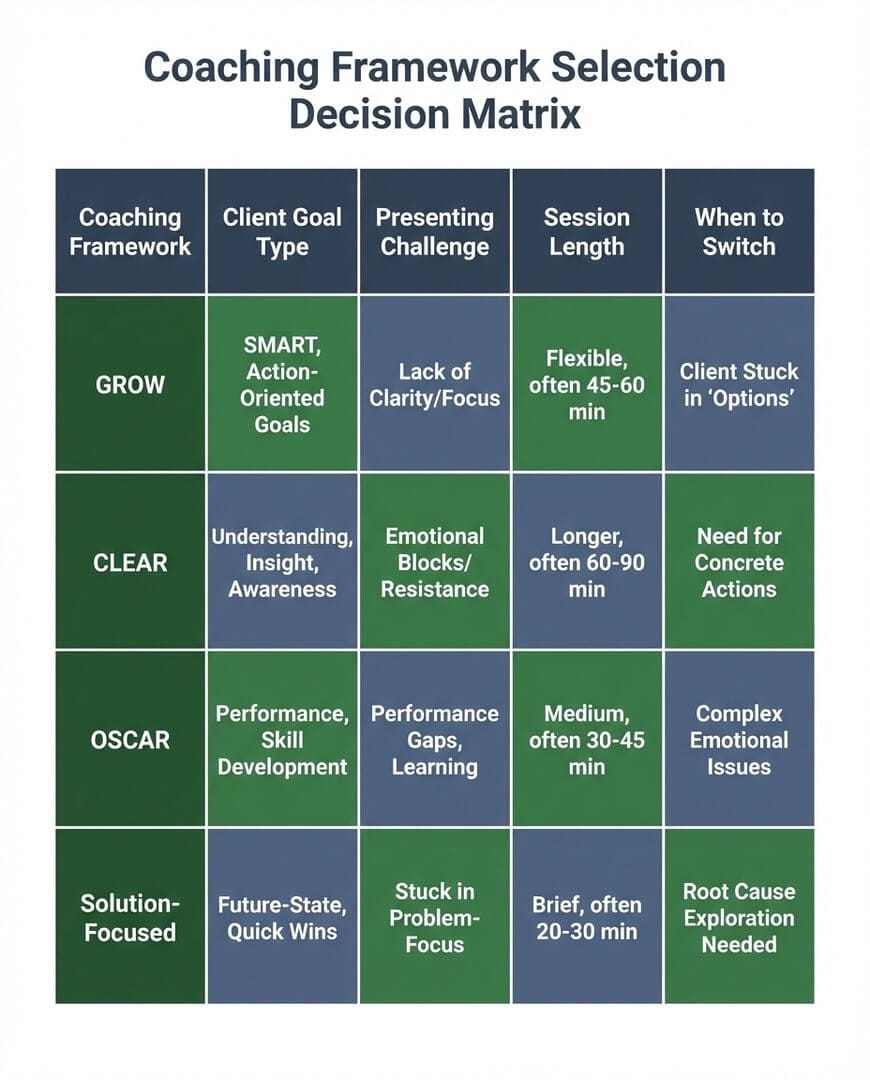
Four common coaching frameworks mapped to the selection variables. This is not a prescription - it is a decision tool. Use it to make your framework choice explicit and to identify when conditions shift enough to warrant switching. GROW as the most common practitioner starting point anchors the matrix, but every row has a specific use case where it outperforms the others.
| Goal Type | Challenge | Session Length | Framework | When to Switch |
|---|---|---|---|---|
| Task / performance | Skill gap, metric target, concrete deliverable | 30-90 min | GROW | Client keeps cycling in Reality without reaching Options - the issue is relational, not task-level |
| Relational / trust | Interpersonal conflict, leadership dynamic, stakeholder tension | 60-90 min | CLEAR | Client has processed the relationship and is ready for concrete action - shift to GROW or OSCAR for the action phase |
| Outcome-driven / exec | Performance accountability, measurable results, organizational goals | 45-90 min | OSCAR | Client’s stated outcome keeps shifting because the presenting goal masks a deeper issue - shift to CLEAR for exploration |
| Pattern-breaking | Stuck behavior, repeated failure, low motivation despite clarity | 30-60 min | Solution-Focused | Exceptions reveal a pattern the client needs to examine rather than replicate - shift to CLEAR or a narrative approach |
The "When to Switch" column is the column most coaches skip. It is also the one that matters most. Every framework has a structural assumption about what the client needs. When the session contradicts that assumption, the framework becomes a constraint rather than a container.
Notice the switching signals are all client behaviors, not coach preferences. The client cycles. The client's goal shifts. The client's exceptions reveal something unexpected. Framework switching is a response to what the session is telling you, not a decision you make in advance.
Framework Selection in Practice
Novice coaches see a client and apply a template. Expert coaches read the situation - goal type, relational dynamics, emotional state - then select the structure most likely to serve what is present. The difference is deliberate framework awareness.
Two scenarios that show how framework selection works when it goes right - meaning the coach notices the mismatch and responds to it rather than pushing through.
Scenario A: The Tactical Goal That Is Not Tactical
A mid-level leader books coaching to "improve my presentation skills for board meetings." Task goal, clear metric, obvious GROW fit. The coach sets up Goal (better board presentations), moves to Reality (what current presentations look like, what feedback the client has received), and starts toward Options.
Fifteen minutes in, the client says: "I prepare thoroughly. The content is solid. But when the CFO starts asking questions, I freeze." The coach pauses. This is no longer about presentation technique. This is about a specific interpersonal dynamic - the client's relationship with a particular stakeholder is affecting their performance.
GROW cannot hold this. Options for "how to not freeze when the CFO questions you" will produce tactical answers the client already knows. What they need is space to explore that specific dynamic, which means shifting to CLEAR's Listening and Exploring phases. The contract changes from "improve presentations" to "understand what the CFO dynamic triggers."
The action that comes from this session differs from anything GROW would have produced - because the framework shift let the session reach the actual issue.
Scenario B: The Pattern That Looks Like a Task
An executive wants to "stop micromanaging." They have tried delegating, read the books, and know they should let go. They keep pulling work back. This pattern has survived three previous coaching engagements.
A solution-focused approach starts with exceptions: when has the client successfully delegated? They identify two projects where they let go entirely. Both involved team members they had worked with for years.
The exceptions reveal the selection variable: this is not a delegation skills problem. It is a trust problem. The client delegates when trust exists and micromanages when it does not. Solution-focused coaching identified the pattern, but resolving it requires a relational framework that can help the client examine how they build (or fail to build) trust with newer team members.
The switch is from solution-focused to CLEAR. The session pivots from "replicate the exceptions" to "understand what trust means in your leadership and how you build it." The micromanaging resolves as a byproduct of the trust work, not as a direct target.
Framework Choice and ICF Competencies
ICF PCC markers assess whether coaches adapt their approach based on what emerges in the session. The distinction between applying a model and partnering to design an approach (Competency 8) is precisely where framework selection becomes a credentialing issue. Coaches who cannot articulate their structural choices struggle to demonstrate PCC-level adaptability in mentor coaching reviews.
ACC Certification — $3,999
60+ training hours, mentor coaching, and supervision included. Everything ICF requires for your Associate Certified Coach credential.
Framework selection is a coaching skill, not a pre-session administrative decision. Choosing between coaching frameworks deliberately connects to ICF Core Competency 8 - Facilitates Client Growth - which includes partnering with the client to design the approach. The word "partner" is deliberate. The coach who arrives with a predetermined framework and runs it regardless of what the coaching session reveals is not partnering. They are applying.
PCC markers specifically assess whether a coach adapts their approach based on what emerges in the session. A coach demonstrating PCC-level skill does not just use a coaching model. They can articulate why they chose it, when they noticed it needed to shift, and what they did with that awareness. This is exactly what framework selection as a deliberate coaching methodology produces.
For coaches building toward credentialing, framework selection becomes a development edge. The ICF ACC program introduces coaching models and frameworks. The PCC journey requires the coach to demonstrate that they can move between approaches based on the client's needs. Treating framework selection as a skill to practice - not just a preference to have - accelerates that development.
The coaches who struggle at PCC assessment are rarely the ones who used the wrong framework. They are the ones who cannot explain why they chose any framework at all.
Discussing Frameworks With Your Mentor
Supervision research identifies meta-level reflection - thinking about how you coached, not just what you did - as the primary accelerator of coach development. Framework choice operates at exactly that meta level. Bringing structural decisions into mentor sessions converts supervision from a feedback loop into a deliberate development methodology.
Framework selection becomes a coaching development tool when you bring it into supervision. Most mentor coaching conversations focus on what the coach did in the coaching session - what questions they asked, how they managed silence, whether they maintained the coaching agreement. Framework choice operates one level above those decisions. It is the structural choice that shaped which questions were available in the first place.
Three questions to bring to your next mentor session:
Most coaches can tell you what happened in a session. Fewer can tell you why they chose the structure they used to run it. That gap is where development lives.
1. "Which framework did I choose for this client, and what drove that choice?" This question separates deliberate selection from default behavior. If the honest answer is "I used GROW because I always use GROW," that is useful data. It means framework selection is not yet a conscious skill.
2. "At what point did I realize my framework choice was or was not working, and what did I do with that realization?" This is the question that produces the most honest self-assessment. Most coaches can identify the moment retrospectively - they felt the session stall, or they noticed the client disengaging. The revealing part is what they did next. A coach developing well says "I noticed and shifted." A coach stuck in a single framework says "I noticed but kept going because I did not know what else to do."
3. "Across my last five sessions with this client, has my framework choice evolved as the engagement progressed?" Coaching engagements are not static. A client who needed CLEAR in sessions one through four for relational exploration may need GROW by session eight when they are ready for action. Tracking framework choice across an engagement reveals whether the coach is adapting to the client's development or running the same structure on repeat.
Frequently Asked Questions
The most common framework questions from coaches in training center on transparency, switching, and default selection. These questions reflect healthy uncertainty - they indicate a coach moving from unconscious default behavior toward deliberate structural awareness. The answers below reflect practitioner consensus and ICF assessment standards, not a single theoretical position.
Should I tell my client which framework I am using?
Not in most cases. The framework is the coach's tool, not the client's concern. Telling a client "we are going to use the GROW model today" makes the structure visible in a way that can constrain the conversation - the client starts performing the model rather than engaging in the coaching. The exception is when a client directly asks about your approach, or when you are working with a client who is also a coach and transparency about methodology serves the partnership.
Is GROW always the best starting point for new coaches?
GROW is the most common starting point because its four phases are intuitive and its structure compresses well. But "best starting point" depends on the coach's client population. A coach working primarily with executives on relational leadership challenges will get more mileage starting with CLEAR. A coach in an organizational context focused on performance metrics may find OSCAR more natural. Learn GROW first if your training program uses it, then add a second framework within your first year of practice based on where GROW does not fit your clients.
Can I switch frameworks mid-session?
Yes, and the ability to do so is a skill marker. The switch should be a response to what the session reveals, not a decision you announce. When a task-focused session surfaces a relational issue, shifting from GROW's Options phase to CLEAR's Listening phase is not abandoning the model. It is adapting the structure to serve the client. The client does not need to know a switch happened. They need to experience a session that follows where they actually are rather than where the framework assumed they would be.
ACC Certification — $3,999
60+ training hours, mentor coaching, and supervision included. Everything ICF requires for your Associate Certified Coach credential.
See the ACC Program →