
Why Your CFO and CMO Can’t Agree (And Why That’s Actually Useful)
The quarterly business review is running long. The CMO presents the brand investment case. Market positioning, share of voice, competitive narrative. The CFO’s first question: “What’s the expected return and over what period?” The CMO hears: you do not trust my judgment. The CFO hears their own question as entirely reasonable — how do you invest without a return model? The CMO cannot produce a return model because brand impact does not work that way. The CFO cannot approve investment without one because fiduciary responsibility does not work any other way.
Neither leader is being unreasonable. Both are doing exactly what their careers trained them to do. The collision is not between two people. It is between two professional formations trying to process the same decision with different operating systems. And if this scene sounds like a meeting you have attended more than once, the problem is not the people in the room. It is what their careers installed long before they sat down at the same table.
Key Takeaways
- The CFO-CMO tension is the most visible formation collision on most leadership teams — and the most frequently misdiagnosed as a personality conflict.
- Finance processes decisions through evidence, quantified returns, and risk mitigation. Marketing processes decisions through narrative, market timing, and creative conviction. Both are legitimate. Neither is complete.
- The friction is productive. Finance without marketing produces correct decisions nobody follows. Marketing without finance produces compelling strategies nobody can fund.
- Resolving the tension is the wrong goal. Naming it — and understanding the formation logic on each side — is what turns a recurring argument into a strategic advantage.
- A team coach who understands both formations does not pick a side. They help each leader see what the other’s formation provides that theirs does not.
Two Operating Systems, One Decision
A career in finance installs a specific relationship with evidence. Data before commitment. Returns quantified before resources allocated. Risk assessed before action taken. After fifteen or twenty years, this is not a policy. It is an instinct. When someone proposes investment without a model, the finance-trained mind does not hear confidence. It hears an unaudited claim. The CFO who asks “What’s the ROI?” is not being difficult. They are doing what their career built them to do.
A career in marketing installs a different relationship with evidence. Market windows that close. Brand value that compounds over years but cannot be isolated in a quarterly model. Competitive positioning that depends on timing and narrative, not on provable returns. The CMO who says “We can model this to death or we can move while the window is open” is not being reckless. They are doing what their career built them to do.
Both formations have legitimate relationships with risk. Finance metabolizes risk through quantification: measure it, model it, mitigate it. Marketing metabolizes risk through conviction: read the market, trust the narrative, move before the data is complete. Put them in the same room on the same decision, and the CFO experiences the CMO as someone who wants to spend money without evidence. The CMO experiences the CFO as someone who wants to analyze until the opportunity is gone.
| Finance Formation | Marketing Formation | |
|---|---|---|
| What counts as evidence | Quantified returns, documented assumptions, sensitivity analysis | Market signals, competitive narrative, audience resonance |
| How risk is processed | Measured, modeled, mitigated before action | Assessed intuitively, accepted as inherent to timing |
| What “strategic” means | A five-year scenario model with probability-weighted outcomes | A market narrative about where the category is headed |
| Time horizon | Three-to-five-year capital allocation windows | Six-month campaign arcs, quarterly brand cycles |
| What “responsible” looks like | No investment without a defensible return model | No delay when the market window is closing |
Tell a CFO to “think more strategically” and they build a scenario model. Tell a CMO to “think more strategically” and they paint a market narrative. Both are strategic thinking. Neither would recognize the other’s version as strategy.
What Each Side Hears
The misread is symmetrical. The CFO interprets the CMO’s narrative confidence as a lack of analytical rigor. “If they had real evidence, they would present it as data. The fact that they are telling a story means they do not have the numbers.” The CMO interprets the CFO’s analytical questions as a lack of strategic vision. “If they understood the market, they would not need me to reduce it to a spreadsheet. The fact that they keep asking for ROI means they do not understand what brand does.”
Recognize This Meeting?
If this argument keeps happening on your leadership team, the problem is not the people. It is the formations in the room. That distinction changes what coaching can do.
Both readings are accurate projections of one formation onto the other. The CFO is right that the CMO is not providing quantified evidence. The CMO is right that the CFO is not grasping the market dynamic. The collision is not a misunderstanding that better communication can fix. It is a structural tension between two legitimate professional operating systems that define evidence, risk, and strategy differently.
The meeting ends without resolution. Both leaders leave frustrated. Both believe the other does not understand. And in three months, the same meeting happens again. Same argument. Same positions. Same frustration. Not because neither leader has grown. Because the formation underneath the argument has not been named.
This collision is not unique to the CFO and CMO. It is the most visible version of a dynamic that occurs whenever two formations with different evidence standards, risk orientations, and time horizons sit around the same decision. The CTO and GC have their own version. So do the COO and the CHRO. The specifics differ. The structure is the same.
Why the Tension Is Productive
The instinct is to resolve the tension. Get the CFO and CMO aligned. Find common ground. Build a shared framework for evaluating marketing investment. These are not bad ideas. They are incomplete ideas — because they assume the tension is a problem to be solved rather than a dynamic to be understood.
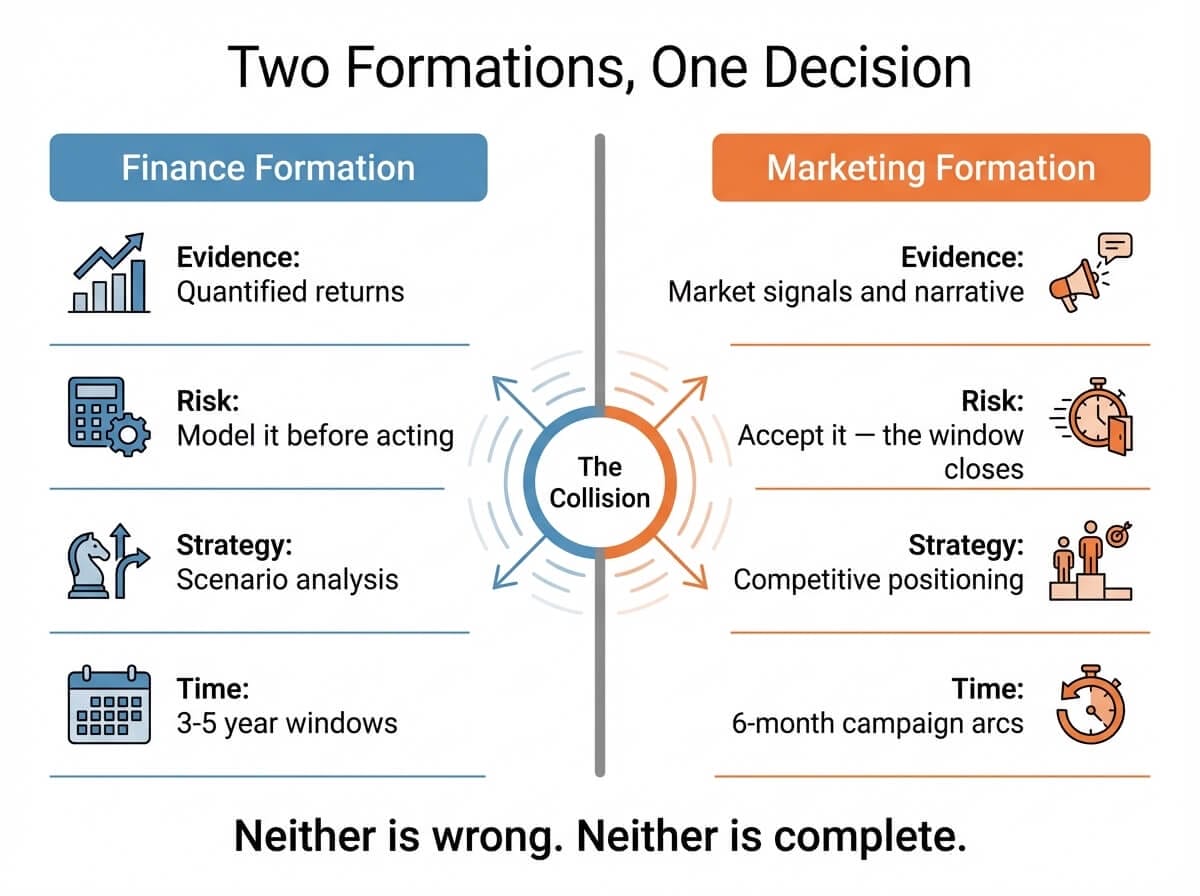
Finance without marketing produces correct decisions nobody follows. The analysis is sound. The strategy is defensible. The market moved while the organization was still modeling. Marketing without finance produces compelling strategies nobody can fund. The narrative is powerful. The positioning is sharp. The balance sheet cannot support it.
The collision between these two formations is not dysfunction. It is the organization’s decision-making immune system. The CFO’s rigor prevents reckless investment. The CMO’s conviction prevents analysis paralysis. Neither formation alone produces a good decision. The tension between them does — when both leaders can see the tension for what it is rather than experiencing it as the other person being wrong.
The productive question is not “who is right?” It is “what does this room need that neither formation is providing on its own?”
What Changes With a Coach Who Gets This
Generic team coaching hears this tension and offers communication frameworks. How to present to a finance audience. How to ask questions that feel collaborative rather than adversarial. Active listening exercises. Personality assessments that label one leader as “analytical” and the other as “creative.”
A team coach who understands both formations does not resolve the tension. They name the structure underneath it. In the room with both leaders, the question to the CFO is not “How can you be more supportive of marketing?” The question is: “What would it take for you to approve investment in something you cannot model?” That question surfaces the formation logic — the deep assumption that unmodeled investment is irresponsible — without attacking the person who holds it.
The question to the CMO is not “How can you present your case more analytically?” The question is: “What would it take for you to present a business case that a finance mind could evaluate without feeling like you reduced your work to a spreadsheet?” That question surfaces the CMO’s formation logic — the belief that reducing narrative to numbers strips it of the thing that makes it powerful — without dismissing it.
Neither question asks either leader to become the other. Both questions invite each leader to see the formation logic driving their position. And that recognition — “I keep asking for the model because my career taught me that decisions without models are irresponsible” — is where the recurring argument starts becoming a productive structural tension instead of a personal frustration.
The patterns in this article connect to several related dynamics across careers and levels: why the CMO keeps arguing in a language the CFO won’t accept, when this tension is just one voice the team isn’t hearing, and why each side has a different definition of acceptable risk.
The Room Needs Both
The next time your leadership team hits the same argument for the third consecutive meeting, consider the possibility that nobody in the room is wrong. The CFO who insists on more data before committing and the CMO who insists on moving before the window closes are not having a disagreement about strategy. They are having a collision between two professional formations, each doing exactly what it was trained to do.
The resolution is not common ground. It is mutual recognition — each formation seeing what the other provides that it cannot. The rigor that prevents recklessness. The conviction that prevents paralysis. Both are the room working.
If your leadership team has a version of this collision — and most do — the question is not how to stop the argument. It is whether a coach who understands the formations in the room can help the team see the structure underneath the friction, so the tension becomes an asset instead of a recurring frustration.
A Conversation About the Tension in Your Room
A 30-minute call about the recurring friction on your leadership team. Not personality conflicts. The structural tension between formations that process decisions differently.
Book a Free Consultation →