AI Career Disruption by Industry: Executive Impact Guide | 2026
54% of banking jobs have high automation potential - that's from Citigroup's own analysis, the highest of any sector. But if you're a CFO reading that number, you're asking the wrong question.
The question isn't whether banking jobs are at risk. It's which parts of YOUR role are task execution versus strategic judgment. Because that 54% includes everything from tellers to treasury analysts to chief financial officers - and the transformation pattern is completely different at each level.
I've spent 20+ years in technology leadership across investment banking, commodities trading, and enterprise software. What I've seen consistently is this: executive disruption doesn't follow the same rules as workforce automation. The stats that make headlines - the layoff numbers, the automation percentages, the productivity projections - tell you almost nothing about what's actually happening to specific leadership roles.
What does tell you something: understanding how AI disruption unfolds differently across industries, and more importantly, across executive functions within those industries. That's what we're going to break down here — and for executives who want to stress-test their own position first, the productivity audit assessment tool surfaces the gaps before disruption does.
The Industry Disruption Hierarchy: Why Timing Matters
Not all industries are experiencing AI disruption simultaneously, and that timing creates different strategic windows for executives. Understanding where your industry sits isn't about predicting the future - it's about knowing how much runway you have to prepare.
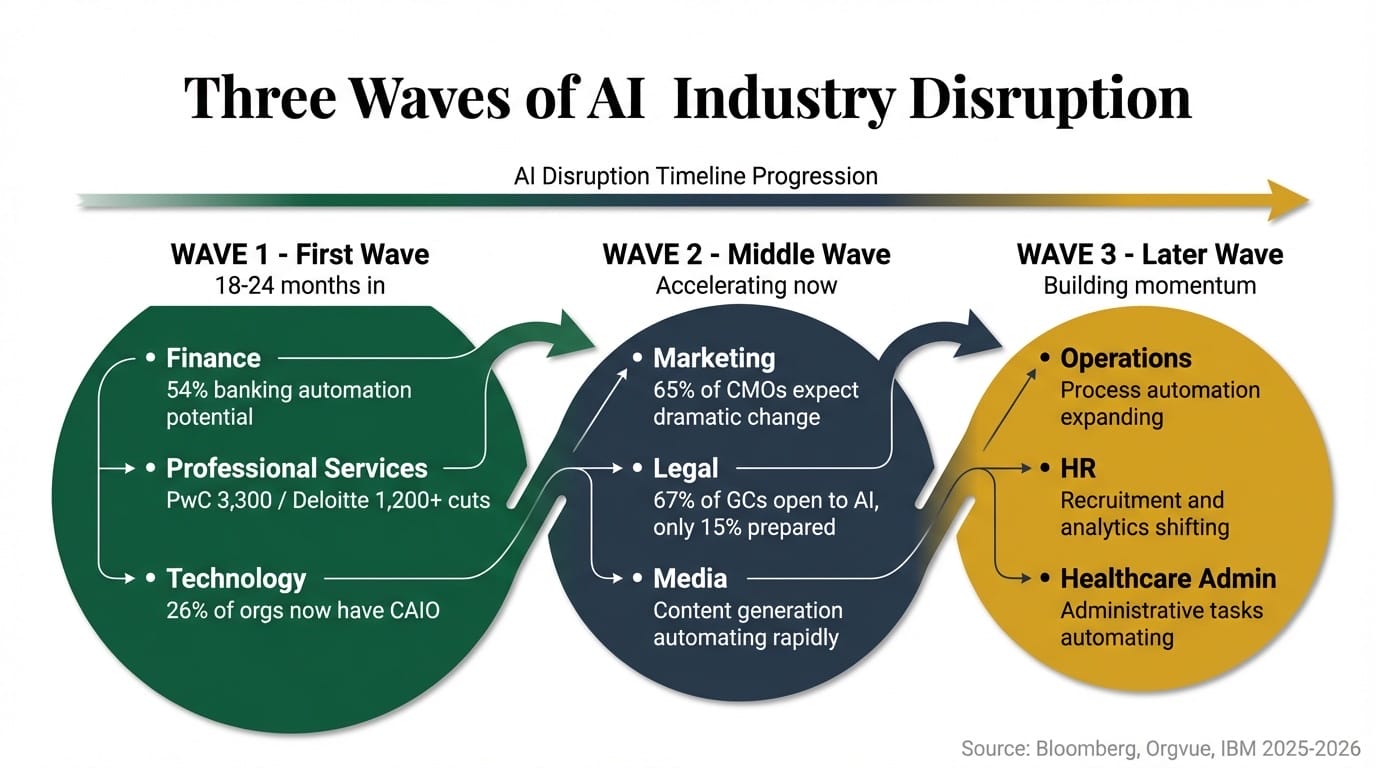
First Wave (Already Transforming): Finance, Professional Services, Technology. These sectors are 18-24 months into significant executive role evolution. If you're here, your transformation window is narrowing. The disruption patterns are established, the case studies exist, and the executives who adapted early are already differentiated from those who didn't. This isn't prediction anymore - it's observation.
Middle Wave (Accelerating Now): Marketing, Legal, Media. These sectors are seeing rapid adoption with executive impact becoming visible. Your window is open but closing. The pattern here is acceleration: what seemed theoretical 18 months ago is now operational, what was operational is now urgent. CMOs are watching content teams shrink. General Counsels are seeing contract review timelines compress from weeks to hours. The disruption curve is steeper than it was for the First Wave because the technology matured between waves.
Later Wave (Building Momentum): Operations, HR, Healthcare Administration. Disruption is real but executive-level impact is still emerging. You have more time - which is both opportunity and risk. The opportunity: you can watch what happened in First Wave industries and learn from their mistakes. The risk: the false comfort of distance leads to preparation that never happens.
Here's the insight most people miss: being in the "first wave" isn't necessarily worse. Executives in finance and professional services who started adapting two years ago are now ahead of the curve. They've figured out their AI executive career reality while others are still reading headlines. The early adapters in First Wave industries have a structural advantage - they've done the hard work of role redefinition when the pressure was building, not when it had already crested.
The danger is the Later Wave trap - assuming you have time when that time is already being consumed by executives who recognized their exposure earlier than you did. Every month of delay means adapting under greater pressure with fewer options.
What matters isn't which wave you're in. It's whether you're using your available window or letting it slip.
The Industry Disruption Scorecard rates your industry's AI exposure across five dimensions: task automation potential, adoption timeline, competitive pressure, talent pipeline impact, and new role emergence. Takes 8-10 minutes. Results route you to industry-specific guidance.
Finance and CFO Leadership: From Scorekeeper to Transformation Architect
Finance executives face the most quantified disruption data of any function. That Citigroup analysis identifies an additional 12% of roles that will be augmented - meaning the work doesn't disappear, but the work changes fundamentally. The total exposure: 66% of banking roles facing either automation or significant augmentation.
From Scorekeeper to Transformation Architect
If reporting automation is eating 60% of the work, your mandate is changing. Talk it through with a coach and design your next operating model.
The CFO role is shifting from scorekeeper to transformation architect. Reporting automation waiting to happen? That's 60% of what many finance leaders currently do. Monthly closes, variance analysis, budget-to-actual reconciliation, regulatory compliance reporting - these are task execution, and the technology to do them faster and more accurately than human-led teams already exists.
The capital allocation decisions, the strategic judgment calls, the board-level translation of numbers into narrative - that's often 15-20% of the actual week.
Notice the gap. If 60% of your work is task execution and 20% is strategic judgment, what fills the remaining 20%? For most CFOs, it's coordination overhead - meetings about the reporting, reviews of the analysis, alignment conversations that exist because the underlying work is slow enough to require checkpoints.
When automation compresses the task execution layer, that coordination overhead evaporates with it. The 20% of strategic judgment doesn't suddenly become 40% or 60% of the job. What expands is the expectation that CFOs will drive transformation - not just report on it.
The CFOs who are navigating this well aren't the ones taking AI courses. They're the ones who've run their own version of the PURPOSE AUDIT™ - examining exactly which parts of their work are task execution (automatable) versus strategic judgment (irreplaceable). They've mapped their weeks honestly, categorized their contributions accurately, and made decisions based on that data rather than their self-image.
Major banks including JPMorgan, Bank of America, and Goldman Sachs have maintained stable or growing headcounts despite automation investments. The roles aren't disappearing. They're transforming. The question is whether the people in them are transforming at the same pace.
27% of CFO job listings now mention AI competency requirements - a figure that was near zero three years ago. That's not because CFOs need to understand machine learning architectures. It's because boards and CEOs expect finance leaders to drive AI-enabled transformation across the organization, and they're starting to filter for that capability at the hiring stage.
The trap to watch for: assuming "I'm senior enough to be safe." Seniority without role evolution is just expensive overhead waiting to be noticed. The most vulnerable CFOs aren't the ones in highly automated functions - they're the ones who've defined their value by tasks that are becoming algorithmic, regardless of their title or tenure.
For CFO-specific guidance: See our deep dive on CFO career AI disruption.
Marketing and CMO Leadership: The Most Acute Executive Pressure
CMOs face a different kind of disruption - one that hits faster and harder than most other executive functions.
Gartner's 2025 survey found that 65% of CMOs believe AI will dramatically transform their role within the next two years. That's not "might change" or "could affect" - that's marketing leaders themselves saying dramatic transformation is coming fast.
The same survey revealed something more telling: 82% of leaders say their company's identity needs significant change to keep pace with AI's impact on markets. Marketing isn't just being automated - it's being reconstituted.
I worked with a CMO last year who'd already been through two rounds of layoffs at her company and was starting to wonder if the third would include her. What she discovered wasn't what she expected: her vulnerability wasn't the AI tools that could generate content or optimize campaigns. It was that she'd stopped doing the one thing AI couldn't replicate - reading the room on brand meaning, translating cultural shifts into strategic positioning, making the judgment calls that algorithms can't make because they require understanding humans, not just human behavior data.
Content production is commoditizing. Campaign optimization is increasingly algorithmic. But knowing what your brand actually means, why it matters, and how that translates to people who don't think about your brand at all - that's human work. The CMOs who recognize this are repositioning around it. The ones who don't are becoming sophisticated AI operators, which is valuable, but not at CMO compensation levels.
CMO tenure at Fortune 500 companies continues to fall. The job isn't disappearing - it's becoming something different faster than most people in it are adapting.
For CMO-specific guidance: See our deep dive on CMO career AI disruption.
Technology Leadership: Disrupted by Your Own Domain
Here's the irony that doesn't get discussed enough: technology leaders face disruption from the very domain that built their careers.
The CTO who built their reputation on technical architecture expertise, infrastructure leadership, or platform strategy is watching that work commoditize in real-time. The tools getting better at these functions were built by people like them - and are now being deployed against roles like theirs.
I've spent 20+ years in technology leadership - from hands-on development to Global Senior VP at Citi, from enterprise software at S&P Global to platform leadership at Solera. And every CTO I've talked to in the past six months has asked some version of the same question: "What's my value when AI can do increasing amounts of what used to be my team's work?"
Most of them are asking it wrong.
The question isn't "what can I still do that AI can't?" That's a defensive framing that leads to shrinking territory. You find yourself defining your role by what's left over after automation takes its share - and that share keeps growing.
The real question is: "What am I actually for in an AI-augmented organization?"
For most technology leaders, the answer involves something they've always done but never centered: translating between engineering reality and executive expectation. Making judgment calls about technical investment that require understanding business context no AI has access to. Building and leading teams through ambiguity that can't be prompted away. Knowing when to say "this won't work" to a CEO who's read a article about what AI can do, and being credible when you say it.
The best developers I've worked with were often the laziest people around - they'd automate a task after doing it once because they couldn't stand the thought of doing it twice. CTOs facing AI disruption need that same instinct applied to their own roles: what am I doing manually that I should be automating? And what am I doing that requires specifically me - my judgment, my relationships, my understanding of this particular organization's technical reality?
The path many CTOs are exploring: the Chief AI Officer role. IBM's research found that 26% of organizations now have a CAIO, up from 11% in 2023. And 57% of those CAIOs were appointed from internal talent pools - often from CTO or CIO backgrounds. Organizations with CAIOs report approximately 10% higher ROI on AI spend, which means this isn't a vanity title. It's a results-driven role expansion.
Two-thirds of the CAIOs surveyed expect most organizations will have someone in this role within two years. The emergence is happening fast because the need is acute: someone has to bridge business strategy and technology strategy specifically for AI, own the portfolio-level decisions, and navigate the complexity that comes from organizations using an average of 11 generative AI models today with plans to use 16 or more by end of 2026.
The CTO-to-CAIO pathway isn't the only option. But it illustrates the broader pattern: technology leaders have to stop defining themselves by what they technically know and start defining themselves by the judgment they provide. Technical knowledge is still necessary - but it's no longer sufficient.
For CTO/CIO-specific guidance: See our deep dive on CTO career AI disruption.
Legal Leadership: The General Counsel's Expanding Mandate
General Counsels occupy an interesting position in the AI disruption landscape. The FTI Consulting General Counsel Report 2025 revealed a striking gap: 67% of GCs are open to using generative AI, but only 15% feel prepared to manage its risks.
That preparation gap is both a vulnerability and an opportunity.
Legal work has significant automation potential - contract review, due diligence, regulatory research, document production. These tasks are being automated now, and legal departments are adapting accordingly. AI is already providing what one GC described as "at a minimal fraction of law firm cost the ability to form high-level answers and approaches to legal questions globally."
But here's what the automation conversation misses: AI is creating entirely new categories of legal work that didn't exist three years ago.
AI governance. Algorithmic liability. Data rights in machine learning contexts. Intellectual property questions that existing frameworks weren't built to answer. Employment law implications of AI-driven workforce decisions. Regulatory compliance for AI systems that evolves faster than most GCs can track.
The EU AI Act entered into force in August 2024 with staged application. Prohibitions and AI literacy duties began in February 2025. Obligations for general-purpose AI models became applicable in August 2025 for new models, with existing models due for compliance by August 2027. US public agencies now require designated AI officers. The regulatory environment isn't stabilizing - it's expanding, and it's expanding faster than most legal functions can absorb.
The General Counsel role is expanding, not contracting - but it's expanding into unfamiliar territory. Bloomberg Law described the emerging mandate clearly: legal leaders are becoming "architects of AI-enabled legal functions, stewards of an innovative culture, and strategic partners who help shape the entire enterprise beyond the legal department."
The FTI research shows progress: 44% of GCs are now actively using AI, up from 28% in 2024 and 20% in 2023. But only 15% feel prepared for the governance implications - which means 85% are using tools they don't feel ready to oversee.
That gap between adoption and readiness is where the opportunity sits. GCs who position themselves as the organization's AI governance leaders - not just users of AI tools - are claiming strategic influence that expands well beyond traditional legal function boundaries. They're becoming the executive who says "here's what we can do, here's what we can't do, and here's how we navigate the ambiguity responsibly."
The risk: waiting for the governance mandate to arrive rather than claiming it proactively. The GCs who wait will find the role already defined by others - by CTOs who see governance as technical compliance, by CEOs who want someone else to own the risk, by board members who just want assurance that someone is paying attention.
For General Counsel-specific guidance: See our deep dive on General Counsel AI career.
Professional Services: The Consulting Warning Signal
If you want to know what AI-driven executive disruption looks like 18-24 months before it hits your industry, watch professional services.
The cuts are significant and accelerating. PwC eliminated approximately 3,300 roles between September 2024 and May 2025 - the firm's first major reduction since 2009. Deloitte UK cut approximately 1,230 advisory roles. KPMG reduced its US audit workforce by about 330 positions. McKinsey is considering workforce reductions of up to 10% - potentially several thousand roles - over 18-24 months.
McKinsey itself acknowledged what's driving this: tasks like "benchmarking, research synthesis, and even PowerPoint creation" are "increasingly automated." That's not junior analyst work. That's the foundation of what consultants at all levels do.
Fast Company characterized these cuts as "a warning signal for consulting in the AI age." I'd put it more directly: professional services cuts aren't a warning about consulting. They're a preview of what happens when knowledge work gets automated faster than the people doing it adapt.
The pattern is clear. Research and synthesis work - the kind that used to require experienced analysts and associates - is being automated or dramatically accelerated. Client-facing relationship work, strategic judgment, and the ability to navigate organizational complexity remain valuable. The question is whether your personal contribution leans toward the first category or the second.
The trap for professional services leaders: assuming "that's Big 4, that's not us." Mid-market firms are 18-24 months behind on the disruption timeline. The same patterns are coming.
For professional services-specific guidance: See our deep dive on consulting career AI disruption.
The Industry Disruption Scorecard rates your industry's AI exposure across five dimensions: task automation potential, adoption timeline, competitive pressure, talent pipeline impact, and new role emergence. Takes 8-10 minutes. Results route you to industry-specific guidance.
From Industry Trends to Personal Assessment
Industry data tells you the landscape. It doesn't tell you your position on it. For CEOs navigating that disruption at the identity and strategy level, CEO coaching addresses the adaptive leadership work the industry context demands.
Two executives in the same industry, same title, same company size can have completely different exposure profiles based on how their specific role is structured. A CFO who spends most of their time on strategic capital allocation has a different transformation path than a CFO who's primarily managing a reporting function.
This is where the frameworks matter.
The PURPOSE AUDIT™ helps you distinguish which parts of your role are task execution (increasingly automatable) versus strategic judgment (irreplaceable). The same framework looks different for a CMO than a CTO - but the question it answers is the same: what percentage of what you do is actually your purpose versus accumulated tasks?
The TRANSITION BRIDGE™ provides the decision methodology once you understand your exposure. Are you looking at Transform (evolve current role), Pivot (adjacent move leveraging experience), Reinvent (significant career change), or Portfolio (multiple income streams)? Each industry's disruption pattern affects which path makes the most sense.
The AI FLUENCY MAP™ identifies the five competencies executives need - not coding skills, not prompt engineering, but the fluency that lets you lead AI-related decisions effectively. What counts as "fluent enough" varies by function: a CTO needs different depth than a CMO.
The RUNWAY READY™ assessment addresses the practical question: how much transition time do you actually have? Financial runway, psychological readiness, and network strength all factor into how aggressively you can - or must - move.
The industry context from this article helps you interpret your personal assessment. If you're a CFO in financial services, you know you're in First Wave territory with a narrowing window. If you're a CMO at a consumer brand, you know you're facing the most acute pressure of any executive function. If you're in professional services, you know the cuts aren't theoretical - they're happening now at firms you've worked with.
But knowing your industry's pattern isn't the same as knowing your specific situation.
Using This Guide: What Comes Next
This article gives you the landscape. The industry-specific deep dives give you the detail. But neither substitutes for personal assessment.
Here's what I'd recommend:
For C-suite leaders navigating disruption at the identity and organizational level, C-suite coaching addresses the amplification mechanism that turns individual development into organizational change. If you recognized your industry above: Read the corresponding deep dive (linked at the end of each section). Get the specific transformation patterns, role evolution data, and path options for your function.
If your industry isn't covered in depth here: The frameworks still apply. Operations, HR, healthcare administration, and other "Later Wave" industries will face executive disruption. The timing is different, not the fundamental pattern.
Regardless of industry: Run your own PURPOSE AUDIT™. Understand your actual task-to-purpose ratio before making any career decisions. The executives who navigate this well share one thing: they took time to understand their specific situation before reacting to general trends.
The Industry Disruption Scorecard can help you assess your sector's exposure level and your position within it. But the scorecard is a starting point, not an answer.
What matters isn't which industry you're in. It's what you do with the window you have.
Your Industry Path Forward
The transformation is already underway. Whether you're a CFO watching automation absorb 60% of your traditional work, a CMO facing the industry's most acute pressure, a CTO being disrupted by your own domain, a General Counsel navigating an expanding mandate, or a professional services leader watching the warning signals materialize - the question is the same.
What are you actually for?
Your industry context shapes how you answer that question, but it doesn't answer it for you. The executives who thrive through this transition aren't the ones with the best industry position. They're the ones who understood their specific role clearly enough to evolve it deliberately.
Understanding your industry's disruption timeline gives you context. Running a PURPOSE AUDIT™ gives you clarity. Choosing your path through the TRANSITION BRIDGE™ gives you direction. Building AI fluency appropriate to your function gives you capability.
Industry knowledge alone changes nothing. Industry knowledge combined with personal clarity and deliberate action - that changes everything.
Start with the deep dive for your function. Then run the assessment. Then decide what you're actually building toward.
Your window is open. The question is how you use it.
Next Steps:
- CFOs: AI and Finance Leadership - What CFOs Need to Know
- CMOs: AI and Marketing Leadership - Why CMOs Face Unique Pressure
- CTOs/CIOs: AI and Technology Leadership - Navigating Disruption in Your Own Backyard
- General Counsel: AI and Legal Leadership - The General Counsel's New Reality
- Professional Services: AI and Professional Services - The Consulting and Advisory Transformation
- All Executives: Begin with the Executive AI Vulnerability Assessment to understand your personal position
For executive career guidance or career transition support navigating these changes, Tandem Coaching Partners works with senior leaders facing exactly these questions. The structured engagement model for that work is covered in executive coaching for career transitions, including the three-phase assessment, positioning, and integration process.
The Industry Disruption Scorecard rates your industry's AI exposure across five dimensions: task automation potential, adoption timeline, competitive pressure, talent pipeline impact, and new role emergence. Takes 8-10 minutes. Results route you to industry-specific guidance.
This article is part of the AI Career Navigator series from Tandem Coaching Partners, providing executive-level guidance for career transformation in the AI era.
Redefine Your Executive Role Before It’s Redefined
Let’s map what in your week is task execution vs. strategic judgment—and build a plan for the next 12–24 months.
Book a Free Consultation →