
AI Skills for Executives: The 5 Competencies That Actually Matter
Last month, a CFO at a Fortune 500 industrial company showed me the certificate she'd earned from a prestigious six-week "AI for Business Leaders" program. She'd invested forty hours and a significant fee. When I asked what she'd learned, she described machine learning architectures, neural network types, and model training methodologies. When I asked how any of that helped her evaluate the AI vendor proposal sitting on her desk, she paused.
"That wasn't really covered."
She'd learned the wrong things. Not because she chose badly - because the options were designed for a different audience. The AI education market has exploded, but it's built almost entirely around two poles: technical practitioners who need to build AI systems, and general workforce populations who need basic digital literacy. The executive in the middle - who needs neither coding skills nor beginner tutorials, but rather the judgment to make AI-related decisions that affect careers, investments, and organizational direction - remains underserved.
This matters because the advice most executives receive is either too technical to be useful or too generic to differentiate. "Learn to code" fails executives for the same reason "learn to weld" would fail them: it's the wrong skill for the role. "Understand AI basics" fails because basics don't help when you're evaluating a $3 million implementation proposal or deciding whether your CMO position is sustainable.
Executive AI fluency isn't about understanding algorithms. It's about making better decisions when algorithms are involved.
The gap between what's being taught and what executives actually need has real career consequences. AI fluency - the right kind - is becoming a career differentiator. The wrong kind is an expensive distraction.
The "Learn to Code" Myth: Why Generic AI Advice Fails Executives
The directive to "learn to code" or "master prompt engineering" assumes that executive value comes from doing technical work. It doesn't. Executive value comes from evaluating, deciding, governing, and communicating - activities that require understanding AI, not operating it.
Consider the practical absurdity: A CFO doesn't code the ERP system. A CMO doesn't design the database architecture. A General Counsel doesn't write the document management software. They evaluate, select, implement, and govern. The same principle applies to AI. You don't need to build AI systems. You need to know which ones to buy, how to assess whether they're working, and when they're creating risk you haven't priced.
Yet the market keeps pushing technical education because that's what the market knows how to sell. McKinsey research reveals that only 17 percent of senior leaders' skill sets are technical by nature, and only 5 percent of their careers included holding a technical role. This isn't a gap to be closed through crash courses in Python. It's a feature of how executive roles create value.
The "learn everything" pressure also ignores a fundamental resource constraint: executives can't spend months on technical courses. Every hour of learning competes with executive responsibilities. The return on learning time must be calibrated to executive realities, not academic ideals.
Three failure patterns emerge from this mismatch between what's offered and what's needed:
The Certificate Collector accumulates AI courses and credentials without strategic selection. The activity feels like progress. The LinkedIn profile grows. The actual decision-making capability remains unchanged because the certificates address organizational AI transformation, not personal career fluency.
The Technical Overreacher attempts to master technical depth inappropriate for the role - studying transformer architectures when they need vendor evaluation frameworks, learning Python when they need governance literacy. The time investment is substantial; the career protection is minimal.
The "I'm Too Senior" Delegator pushes all AI learning to subordinates while remaining strategically illiterate. This worked when AI was a departmental concern. It doesn't work when boards are asking AI governance questions and investors are evaluating AI strategy.
Most executives who've "learned AI" in the past two years learned the wrong things. Not because they chose badly - because the options were designed for a different audience.
The PURPOSE AUDIT™ Worksheet helps you distinguish the tasks AI can absorb from the judgment that remains irreducibly human. Takes 45-60 minutes to reveal your task-to-purpose ratio.
What AI Fluency Actually Means at Executive Level
AI fluency for executives requires a different definition than AI fluency for engineers or general workers. The executive standard is "sufficient for strategic judgment" - enough understanding to make informed decisions about AI in your domain without becoming a practitioner.
Need an AI Vendor Evaluation Game Plan?
Bring a real proposal or use case. We’ll map the questions to ask, the risks to price, and what “credible ROI” should look like.
Three tests determine whether your AI fluency is sufficient:
Can you evaluate? When a vendor presents an AI solution, can you assess whether the claims are credible, the ROI projections realistic, the risks appropriately disclosed? Can you distinguish genuine capability from marketing hype?
Can you govern? Do you understand the regulatory landscape affecting AI in your domain? Can you identify the ethical and reputational risks of AI deployment? Could you hold an informed conversation with your General Counsel about AI liability?
Can you communicate? Can you translate AI concepts for boards, investors, peers, and teams? Can you explain why an AI initiative matters without either oversimplifying or drowning in technical jargon?
If you can do these three things in your domain, you have executive AI fluency. If you can't, you have a specific capability gap - not a general need to "learn AI."
The threat framing matters here. The real competitive pressure isn't "AI will replace you." It's "you'll be replaced by an executive who uses AI effectively." Jensen Huang's distinction between tasks and purpose is useful here, though it requires critical application. His observation that AI automates tasks while humans retain purpose has validity, but his vested interest as Nvidia's CEO means his optimism about seamless transition deserves scrutiny. The executives I work with experience the transition as genuinely difficult, not the friction-free evolution his framework sometimes implies.
You don't need to build AI systems. You need to know which ones to buy.
The Five Competencies That Actually Matter: AI FLUENCY MAP™
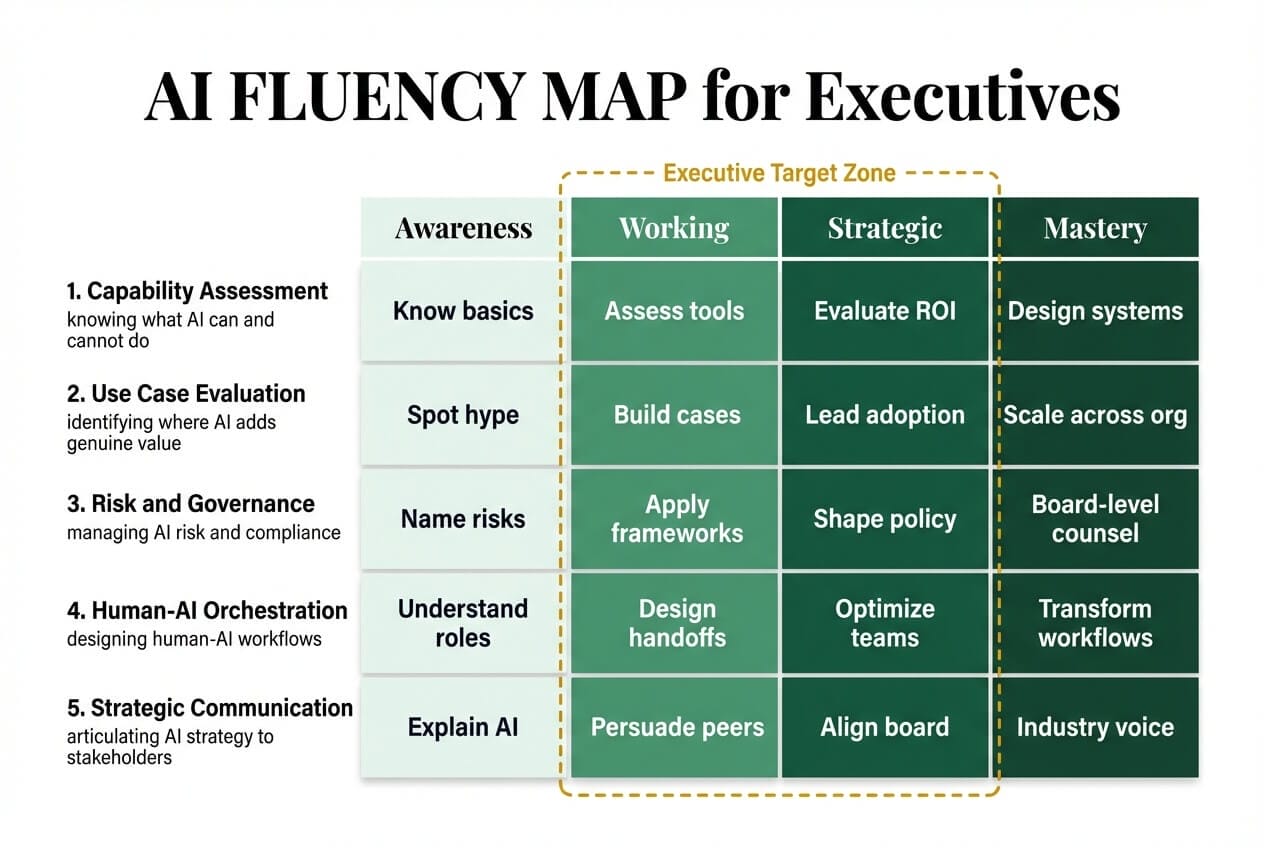
Rather than an undefined mandate to "understand AI," executives need clarity on specific competencies with defined proficiency levels. The AI FLUENCY MAP™ framework identifies five competencies that actually matter for executive career relevance, each with four proficiency levels: Awareness, Working, Strategic, and Mastery.
The critical insight: Executives need Working-to-Strategic proficiency on most competencies. You don't need Mastery on any. Mastery is for practitioners. Strategic proficiency is for decision-makers.
Competency 1: Capability Assessment
What it means: Understanding what AI can actually do today in your domain - and what it fundamentally cannot do. This isn't about knowing model architectures; it's about knowing which business problems AI can credibly solve and which claims are premature.
Why it protects your career: Without capability assessment, you can't distinguish genuine AI opportunities from vendor hype. You'll either miss legitimate advantages or pursue expensive failures.
Executive application: A CFO at a mid-size manufacturing company doesn't need to build predictive models - but absolutely needs to evaluate whether the AI vendor's ROI projections are credible. That requires understanding current AI capabilities and limitations in financial forecasting.
Proficiency target: Working to Strategic. You need enough depth to ask good questions and evaluate answers, not enough to build systems.
Competency 2: Use Case Evaluation
What it means: Assessing ROI, risk, and organizational fit for AI applications. This includes total cost of ownership beyond licensing, integration complexity, change management requirements, and the questions vendors hope you won't ask.
Why it protects your career: The World Economic Forum's Future of Jobs Report 2025 identifies AI and big data skills as the fastest-growing in demand, but most AI projects fail to deliver value - not because the technology doesn't work, but because the use cases were poorly selected. Executives who can evaluate opportunities accurately become invaluable.
Executive application: When evaluating AI opportunities, the critical skill isn't understanding how the AI works - it's understanding whether this particular application, in this particular context, for this particular organization, makes strategic sense.
Proficiency target: Working to Strategic. This is where executives should develop their deepest fluency.
Competency 3: Risk and Governance
What it means: Understanding the regulatory, ethical, and organizational guardrails affecting AI deployment. This includes EU AI Act basics, liability implications, reputational risk, and board-level governance expectations.
Why it protects your career: AI governance and ethics have become career differentiators. The executive who can engage substantively on AI risk, rather than deferring everything to Legal, demonstrates strategic capability that boards increasingly value.
Executive application: A CMO deploying AI-generated content faces brand risk that legal review alone won't catch. Understanding where AI outputs require human review - and why - protects both the organization and the executive's reputation.
Proficiency target: Working, with Strategic depth in your functional domain. You don't need to draft governance policies, but you need to engage credibly when they're discussed.
Competency 4: Human-AI Orchestration
What it means: Designing how humans and AI work together — not using tools yourself, but architecting systems where human judgment and AI capability complement each other effectively. (Understanding the interpretation cascade that underlies AI-assisted work is essential context for anyone designing these systems.)
Why it protects your career: This competency is hardest to outsource. Technical teams can build AI systems; consultants can recommend AI strategies; but designing the ongoing human-AI workflow that creates sustainable value requires executive judgment about organizational capability, talent deployment, and change management.
Executive application: When AI handles initial customer service triage, where does human judgment need to intervene? At what point does efficiency optimization start damaging customer relationships? These are executive decisions, not technical ones.
Proficiency target: Working to Strategic. The "conductor" role - orchestrating human and machine capabilities - is emerging as a distinctly executive competency.
Competency 5: Strategic Communication
What it means: Translating AI concepts for different audiences - upward to boards and investors, laterally to peers, and downward to teams. This remains irreducibly human and increasingly valuable.
Why it protects your career: The executive who can explain AI risk to a board and AI opportunity to a team has a competency no certificate provides. Strategic communication bridges the gap between technical reality and organizational action.
Executive application: When your board asks about AI strategy, can you provide an answer that's neither dismissively brief nor drowning in technical detail? Can you translate the CFO's risk concerns into terms the CTO will find credible, and vice versa?
Proficiency target: Strategic. This is where executive experience creates unique value - and where AI fluency becomes career protection.
The executive who can explain AI risk to a board and AI opportunity to a team has a competency no certificate provides.
The AI FLUENCY MAP™ Self-Assessment scores you across five competencies that actually matter for executive decision-making – not coding, not prompting. Takes 10 minutes. Get your proficiency level per competency plus a prioritized development plan.
What You Don't Need to Know (And Can Confidently Skip)
The counter-narrative to "learn everything" is equally important: defining what you can safely skip without career damage.
You don't need to know: How large language models are trained. Transformer architecture details. Neural network mathematics. Python programming. Advanced prompt engineering techniques. Model fine-tuning methodologies. Data science workflows.
This isn't anti-intellectualism - it's role clarity. A CFO doesn't need to understand database query optimization to effectively govern data analytics. A CMO doesn't need to understand compression algorithms to evaluate content delivery networks. The same principle applies to AI.
The WEF's research confirms that skills requiring "nuanced understanding, complex problem-solving or sensory processing show limited current risk of replacement by GenAI, affirming that human oversight remains crucial." What executives need is the fluency to provide that oversight effectively - not the technical depth to do the work themselves.
You can skip: Technical certifications not specifically designed for executive decision-makers. Deep-dive courses on AI implementation. Hands-on coding bootcamps. Most content marketed as "AI for Business Leaders" that's actually "organizational AI transformation" in disguise.
You cannot skip: Understanding current AI capabilities and limitations in your domain. Developing evaluation criteria for AI investments. Building governance awareness proportional to AI deployment. Learning to communicate AI concepts across organizational boundaries.
The distinction protects your learning time for competencies that actually matter.
Calibrating AI Fluency to Your Career Path
AI fluency requirements vary significantly based on which of the career paths requiring AI fluency you're pursuing. The TRANSITION BRIDGE™ framework identifies four paths - Transform, Pivot, Reinvent, and Portfolio - and each requires different fluency calibration.
Transform Path (evolving your current role): Focus on Competencies 1-3 at Strategic level within your current domain. A CFO transforming their role needs deep fluency in AI capability assessment for finance, use case evaluation for financial applications, and governance specific to financial AI deployment.
Pivot Path (adjacent career move): Focus on Competency 4 (Human-AI Orchestration) at Strategic level. Adjacent moves leverage your existing domain expertise while repositioning for AI-integrated roles. Orchestration skills transfer across domains.
Reinvent Path (career change): Focus on Competency 5 (Strategic Communication) while building Working proficiency across all competencies. Career reinvention requires translation capability - explaining AI from one context into another.
Portfolio Path (multiple income streams): Focus on Competency 2 (Use Case Evaluation) at Strategic level. Portfolio executives evaluate AI opportunities across multiple contexts; strong evaluation frameworks become force multipliers.
A worked example: Consider a CTO at a mid-sized technology company contemplating whether to stay in their current role, pivot to a Chief AI Officer position, or build a portfolio of advisory relationships.
The Transform path would require deepening Competencies 1-4 within their current technical domain - becoming the CTO who leads AI integration rather than delegates it. The Pivot to CAIO requires Strategic-to-Mastery on Competencies 1-4 and Strategic on Competency 5 - a substantial intensification. The Portfolio path requires Strategic use case evaluation across multiple industries - breadth over depth.
Each path has legitimate claim on executive attention. The right path depends on factors we explore in Pillar 3 - what you're actually for, your financial runway, and your psychological readiness for different types of transition.
Most AI courses teach executives to be worse data scientists instead of better decision-makers.
The AI Learning Roadmap Generator combines your role (CFO, CMO, CTO, or others), your career path (from TRANSITION BRIDGE™), and your current fluency gaps into a personalized 90-day development plan. No generic "learn AI" courses – specific competencies for your situation.
The Chief AI Officer Question
As AI becomes central to organizational strategy, a new executive role is emerging: the Chief AI Officer. IBM's 2025 research indicates that 26 percent of organizations now have a CAIO, with average compensation around $354,000 - and significantly higher at Fortune 500 companies.
Should you pursue this path? The honest answer requires more self-assessment than ambition.
The CAIO role demands both technical credibility AND business fluency. It's not a refuge for executives seeking to escape AI disruption by becoming "the AI person." It requires genuine capability across all five AI FLUENCY MAP™ competencies at Strategic-to-Mastery levels - a substantial professional development commitment.
The path makes sense for executives who:
- Already have technical depth (current CTOs, CIOs, technical executives)
- Are genuinely energized by AI specifically, not just seeking safety
- Have organizational credibility to navigate both technical and business conversations
- Are willing to invest significantly in developing governance and communication fluency
The path doesn't make sense for executives who:
- View CAIO as an escape from disruption rather than a calling
- Lack technical credibility that would take years to build
- Don't find AI inherently interesting
- Would be pursuing the role from fear rather than capability
For those seriously considering this pivot, the Chief AI Officer career path article explores requirements, realities, and assessment criteria in depth.
Your AI Fluency Assessment and Next Steps
The distinction between executives who navigate AI effectively and those who don't isn't technical knowledge - it's calibrated fluency. Knowing what you need to know, developing that competency to the appropriate level, and confidently skipping what doesn't matter.
The AI FLUENCY MAP™ Self-Assessment provides a structured way to evaluate your current proficiency across all five competencies, identify specific gaps, and prioritize your development investment. The assessment takes approximately 15 minutes and outputs a personalized fluency profile with targeted recommendations.
This matters because the competitive dynamic has shifted. The threat isn't AI replacing executives - it's executives with appropriate AI fluency replacing those without it. The time investment in calibrated learning pays career dividends; the time invested in wrong learning doesn't.
For specialized executive coaching for AI fluency development, the key is finding guidance that addresses your specific competency gaps rather than generic AI education. The coaching trends increasingly emphasize specialized expertise over jack-of-all-trades approaches - and AI fluency for executives requires precisely that specialization.
Your next step is assessment. Not another course. Not another certificate. Assessment of where you actually stand on the five competencies that matter, followed by targeted development on the specific gaps your career path requires.
The real competition isn't AI. It's executives who have figured this out while others are still taking the wrong courses.
Frequently Asked Questions
What's the difference between AI fluency and AI expertise?
AI expertise implies practitioner-level depth – the ability to build, train, and optimize AI systems. AI fluency means sufficient understanding to make informed decisions about AI in your domain. Executives need fluency, not expertise. The confusion between these terms has driven much of the misdirected AI education for business leaders.
What AI competencies matter for executive-level roles?
The AI FLUENCY MAP™ framework identifies five: Capability Assessment (understanding what AI can/cannot do), Use Case Evaluation (assessing ROI and fit), Risk and Governance (regulatory and ethical awareness), Human-AI Orchestration (designing human-AI workflows), and Strategic Communication (translating AI for stakeholders). Executives need Working-to-Strategic proficiency on these – not Mastery.
How do I know if I'm spending learning time on the right things?
Apply the three-test filter: Does this help me evaluate AI opportunities? Does it improve my governance capability? Does it enhance my strategic communication? If an AI learning investment doesn’t advance at least one of these, it’s probably designed for a different audience.
What AI knowledge do I need for board conversations?
Board AI conversations typically focus on three areas: strategic opportunity (what AI could do for competitive advantage), risk management (regulatory, ethical, reputational exposure), and governance (who’s accountable, what controls exist). You need enough fluency to engage substantively in all three, not to provide technical implementation details.
Is the Chief AI Officer role right for me?
CAIO roles require both technical credibility and business fluency at high levels. The path makes sense if you have existing technical depth, genuine interest in AI specifically, and willingness to develop governance and communication competencies to Mastery level. It doesn’t make sense as an escape from AI disruption or if your technical credibility would take years to build.
Do I need to learn to code or prompt?
No. Basic prompting is useful as a general productivity skill, but it’s not a differentiating executive competency. Coding is for practitioners, not executives. The time invested in these skills would be better spent on evaluation, governance, and communication competencies.
How much time should I invest in AI learning?
This depends on your gap analysis. Executives with significant gaps in multiple competencies might need 40-60 hours of targeted learning over six months. Those with specific gaps might need 10-20 hours on focused competency development. Generic AI education without assessment often wastes time on content that doesn’t address actual gaps.
What makes executive AI fluency different from general AI literacy?
General AI literacy focuses on understanding what AI is and how to use basic AI tools. Executive AI fluency focuses on decision-making: evaluating opportunities, governing deployments, communicating strategy, and architecting human-AI systems. The competencies are different, and the educational content serving each should be different too.
The AI FLUENCY MAP™ framework identifies five: Capability Assessment (understanding what AI can/cannot do), Use Case Evaluation (assessing ROI and fit), Risk and Governance (regulatory and ethical awareness), Human-AI Orchestration (designing human-AI workflows), and Strategic Communication (translating AI for stakeholders). Executives need Working-to-Strategic proficiency on these - not Mastery.
The AI FLUENCY MAP™ Self-Assessment scores you across five competencies that actually matter for executive decision-making – not coding, not prompting. Takes 10 minutes. Get your proficiency level per competency plus a prioritized development plan.
Get Clear on Your AI Decision Gaps
In a free consult, we’ll pinpoint where you need Working-to-Strategic fluency (evaluate, govern, communicate) for your next AI bet.
Book a Free Consultation →